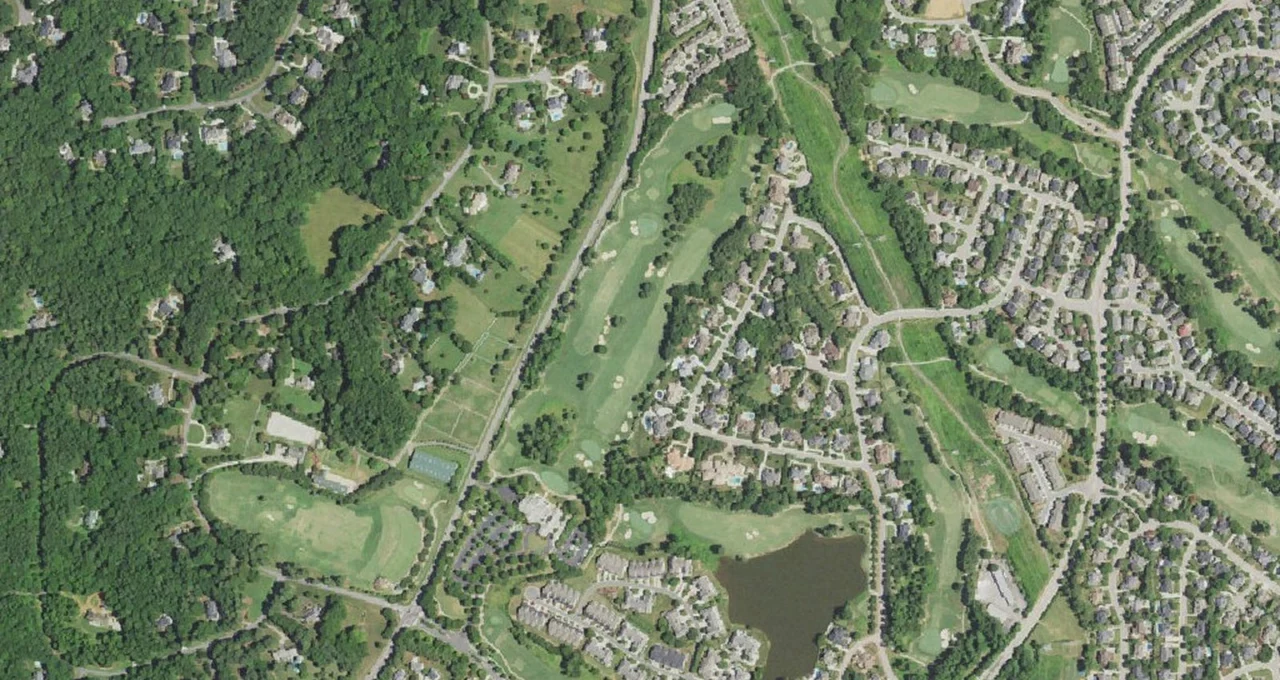
The Country Club at Wakefield Plantation from the air. Aerial imagery USGS, domaine public.
The Country Club at Wakefield Plantation
Holes
27 (18-hole championship course and a 9-hole par 33 course)
By
71
Length
7,305 yards from the Gold tees (rating 75.3, slope 136)
Green fee
—
Best season
—
The Country Club at Wakefield Plantation is a private club in North Raleigh, North Carolina, built into the Wakefield Plantation community next to Falls Lake. Until 2011 it was TPC Wakefield Plantation, a member of the Tournament Players Club network run by the PGA TOUR; that year McConnell Golf, a company founded in 2003 that owns a portfolio of private clubs, bought it and gave it its current name. The club’s address is 2201 Wakefield Plantation Drive, Raleigh.
The championship course was designed by Hale Irwin, the three-time U.S. Open champion, and opened in 2000. The club describes it as laid out over 217 acres adjacent to Falls Lake, with Bermuda fairways framed by tall stands of pine and a series of creeks that shape the strategy of many holes. A second, shorter course of nine holes sits beside the club’s sports complex, and the property also has a practice facility, a learning center, tennis and pickleball courts, pools and a fitness center.
The main course is a par 71, with a par 35 on the front nine and a par 36 on the back. On the club’s scorecard dated September 2022, it measures 7,305 yards from the Gold tees, with a course rating of 75.3 and a slope of 136. The Blue tees play 6,866 yards (73.3 and 133), the White tees 6,357 yards (70.5 and 130), the Green tees 5,938 yards (68.5 and 126 for men, 74.4 and 138 for women) and the Red tees 5,090 yards (64.5 and 115 for men, 69.4 and 123 for women). Two hybrid sets fill the gaps: Blue/White at 6,580 yards (71.6 and 131) and White/Green at 6,100 yards (69.4 and 127). The club’s own course page, like encyclopedic entries, still gives an overall length of 7,257 yards, and booking listings carry older figures of 7,236 yards with a rating of 75.0; this page follows the most recent scorecard.
What it asks of you
The numbers say most of it. A slope of 136 from the back and of 130 or more from every men’s set down to the White tees marks a course that is hard on a bad day, and the reason is not only length. The terrain rolls, the fairways are framed by pines and homes, and creeks cross or follow a good share of the holes. The club’s own hole notes come back again and again to the same words: precise, narrow, accurate, distance control.
The first demand is the tee shot. On several holes the landing area is squeezed between fairway bunkers and woods, or runs beside a creek. The 2nd is a dogleg left with three bunkers on the right and trees on the left; the 5th has a creek along its whole length; the 10th has three bunkers on the right and out of bounds on the left; the 15th, in the club’s words, leaves little room for error off the tee. A player who drives it straight will find the course much kinder than one who fights a slice.
The second demand is the approach, because the ground is used to hide targets. Reviewers of the course point out that the hills create blind approaches, notably at the 3rd and the 17th, and that false fronts send short shots back down the slope. Several greens are large and undulating, which makes a long first putt a real test, and the club itself recommends a pin sheet on the 12th. The third demand is water: creeks guard the 7th, cross the 6th, sit in front of the 9th and the 18th, and a pond on the 9th must be carried from the tee.
The balance of the card is unusual. There are only three par 5s, and two of them measure more than 575 yards from the Gold tees. There are four par 3s, from 158 to 215 yards, and eleven par 4s, several of them longer than 450 yards. Short holes are few and each one is guarded, so scoring chances have to be taken when they come.
The front nine
The 1st, a par 4 of 433 yards from the Gold tees, plays downhill with a slight right-to-left shape, and the club says it plays much shorter than its yardage; a large green is guarded by a bunker front left. The 2nd, 416 yards, is the narrow dogleg left, with a shallow green set downhill behind a deep bunker. The 3rd is a par 3 of 215 yards, slightly uphill to a blind green almost 40 yards deep, with woods to the right.
The 4th, a par 4 of 375 yards, gives the first real choice: a driver toward the green or a lay-up to a wide landing area beside a fairway bunker. The 5th, 452 yards, is straight but tight, with a creek along its full length and a long, narrow, raised green. The 6th, a par 5 of 590 yards, starts with an uphill drive into a narrow fairway, asks for a precise lay-up over a creek that splits the fairway, and finishes on a large, contoured green.
The 7th, at 158 yards, is the shortest hole on the course, but a creek frames the front and right of a big, rolling green. The 8th, a par 4 of 482 yards, is rated the hardest hole on the card for men from every set: the fairway is flat until it turns right about 200 yards from the green, then drops sharply downhill between trouble on both sides to a green guarded by deep bunkers on the left. The 9th, 432 yards, crosses a pond and a deep fairway bunker from the tee, then a creek in front of the green, for a front nine of 3,553 yards.
The back nine
The 10th, a par 4 of 471 yards, opens the back nine with bunkers on the right, out of bounds on the left and more sand around the landing area. The 11th is a downhill par 3 of 207 yards that the club says plays a club shorter; the green sits on a diagonal and its front tilts away from the player. The 12th, a short par 4 of 370 yards, is a matter of placement between bunkers off the tee and five more around one of the largest greens on the property.
The 13th is the longest hole on the course, a par 5 of 620 yards that plays slightly downhill, with bunkers left off the tee, one on the right at the lay-up and sand on both sides of the green. The 14th, a par 3 of 195 yards, plays downhill to a long, narrow green with a swale on the right that collects anything hugging that side. The 15th, a par 4 of 459 yards, rewards a long drive with extra roll on a downslope, but its green is protected by ridges and knolls.
The finish is where the terrain matters most. The 16th, 456 yards, is an uphill dogleg right with water up the left and woods up the right. The 17th, 395 yards, climbs severely from right to left to a blind green with a false front, and the club warns that the second shot plays longer than the distance. The 18th, a par 5 of 579 yards, asks for accuracy on the first two shots among bunkers and trees, then a downhill approach over a creek to the right-hand tier of the green. The back nine measures 3,752 yards.
The nine-hole course
The second course is a par 33 of about 2,700 yards, according to the club, with four par 3s, four par 4s and a par 5. The club presents it as a walking course for children, beginners and families, and it hosts the club’s parent-and-child event and its junior championships for players aged 12 and under.
What tournaments have shown
For most of its first two decades, the course was the Raleigh stop of the PGA TOUR’s developmental circuit, under its successive names: Nationwide Tour, Web.com Tour and Korn Ferry Tour. The event was known as the SAS Carolina Classic before becoming the Rex Hospital Open in 2006, a charity tournament for the patients of the local hospital system. Its organizers count 18 years at Wakefield Plantation before the tournament moved in 2023 to Raleigh Country Club, another McConnell Golf property, where it was renamed the UNC Health Championship; the company said the move was meant to bring the event closer to downtown. The 2020 edition was canceled because of the pandemic.
The winners’ list at Wakefield reads like a register of future tour players. Eric Axley won in 2005, Kyle Thompson in 2007 and 2011, James Hahn in 2012 and Chesson Hadley in 2013; later champions include Trey Mullinax in 2016, Conrad Shindler in 2017, Joey Garber in 2018, Sebastian Cappelen in 2019 and Mito Pereira in 2021. Cappelen and Pereira both finished at 21 under par, which the tournament record book lists among its best scores to par.
What golfers are saying
This is a private club, and the public record is thin: a handful of course-guide entries, rating sites and comments from guests who played with members or in an outing, plus coverage of the tour event. The points below summarize what recurs in that material. They are other people’s opinions, not ours; nobody from Panxis has played the course, and we name and quote no one.
What comes up in its favor
- Conditioning is the most frequent compliment: fairways and greens are described as well kept, and the greens as fast and true.
- Reviewers like the way the routing uses the rolling ground, and describe the creek carries on the finishing holes of each nine as a strong close.
- The tree-lined, understated character of the course is seen as a quality rather than a weakness, with most of the trouble visible from the tee.
- The nine-hole course earns warm comments of its own, as a genuine short course rather than a practice area.
What comes up against
Critical comments are rare in the public record, which is itself a sign of how little of it exists. The reservations that do appear are these.
- Rating sites classify the course as hard, and some players find the combination of fast greens, blind approaches and false fronts punishing for the average member or guest.
- Access is the main limit: without a member or an organized outing, there is no way to play.
How to play it
The Country Club at Wakefield Plantation is a private membership club and does not sell public tee times. Guests play with a member, under the club’s rules. The club also hosts corporate events, golf outings and weddings, arranged in advance, and an outing is one of the few ways onto the course without a member. Membership categories and conditions are set by the club and McConnell Golf; the club’s website is the reference for current rules.
The facilities
Beyond the two courses, the club lists a practice facility with video and radar technology, a learning center where PGA professionals teach, and a junior golf program. The sports side includes eight tennis courts, four of them lighted hydro-clay courts and four hard courts, pickleball, pools with a water slide and a children’s pool, a kids’ club, a fitness center, dining rooms and banquet spaces. The club calendar also includes member events and competitions through the season.
Getting there and when to go
The club sits in North Raleigh, inside the Wakefield Plantation community, at 2201 Wakefield Plantation Drive, near the southern shore of Falls Lake. Golf is played in the Raleigh area through most of the year; the club’s calendar of member events runs through the season, and course schedules and closures are the club’s call.
Green fees
The Country Club at Wakefield Plantation is a private club and publishes no public green fees. Guest conditions are set by the club. See the club’s own site.
How this page was made
The factual frame comes from public sources: OpenStreetMap for the location; the club’s website for the architect, the acreage, the grass, the hole-by-hole descriptions, the nine-hole course and the facilities; the club’s scorecard dated September 2022 for the yardages, pars, stroke indexes, ratings and slopes; encyclopedic entries for the opening year, the former TPC status and the 2011 sale; the club’s tournament page, the tournament’s record book and the 2022 announcement of the move to Raleigh Country Club for the tour event. Where sources disagree, as they do on the length, we say so and follow the scorecard.
The opinion section summarizes course guides, rating sites and guest reviews read in September 2026. We report recurring themes rather than individual voices, and we reproduce no quotations. Nobody from Panxis has played or visited this course, and this page is no substitute for a round.
The club has not paid for this page, has not seen it before publication and has no say over its content. This page contains no commercial link and earns us no commission. If you know the course and something here is wrong or out of date, write to us and we will correct it.
Other courses nearby
Closest to this one in our United States directory:
- NorthStone Country Club — 132 mi
- Quail Hollow Club — 141 mi
- Farmington Country Club — 145 mi
- East Potomac Blue Course — 218 mi
The hole to know
A par 4 of 482 yards from the Gold tees, rated the hardest hole on the card. The fairway is flat until it turns right about 200 yards from the green, then drops sharply downhill between trouble on both sides to a green guarded by deep bunkers on the left.