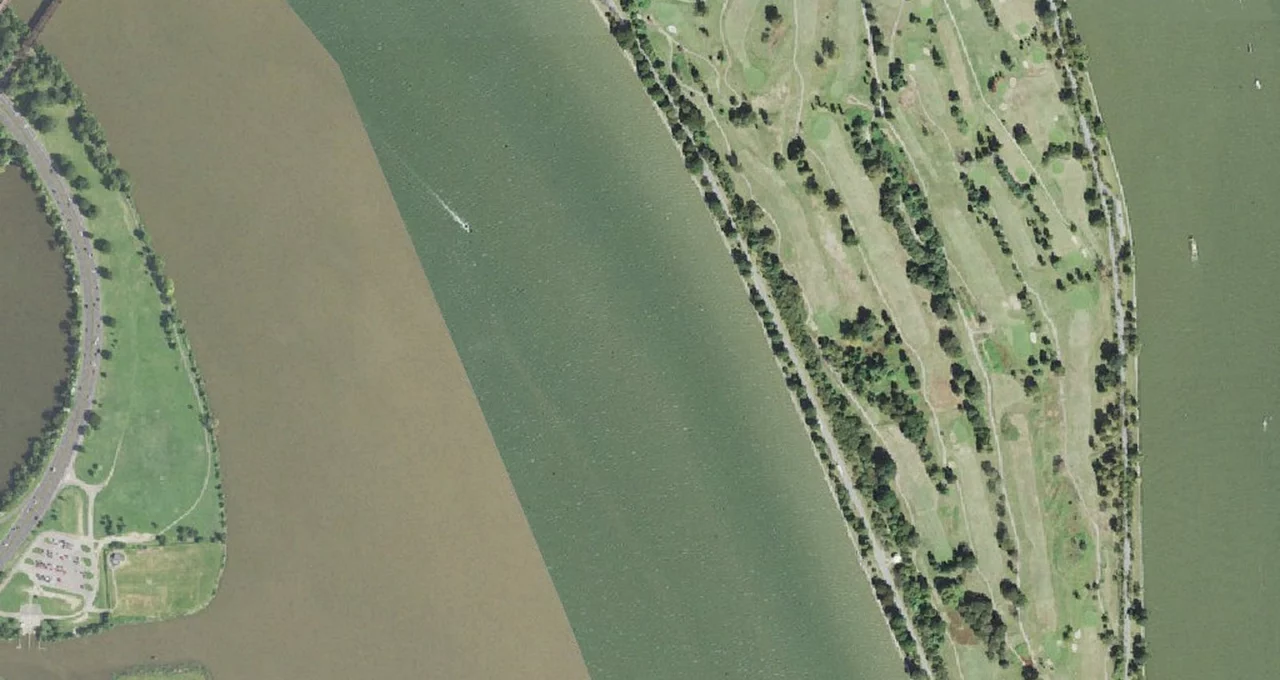
East Potomac Blue Course from the air. Aerial imagery USGS, domaine public.
East Potomac Blue Course
Holes
18
By
72
Length
6,599 yards from the Blue tees (rating 70.5, slope 115 per golfingrecord.com and OpenGolfAPI; 18Birdies gives 70.0 and 112); White 6,226, Gold 5,706, Red 5,203, Green 4,638
Green fee
—
Best season
Open year-round according to the National Park Service and WTOP, with hours that vary with the weather per the operator; OpenGolfAPI lists March to November
The Blue Course is the 18-hole layout of East Potomac Golf Links, the public golf complex on the man-made peninsula of East Potomac Park in Washington, D.C., between the Washington Channel and the Potomac River, about two miles south of the White House. The operator, the National Links Trust, gives the address as 972 Ohio Drive SW, Washington, DC 20024. The land belongs to the federal government and is managed by the National Park Service. On the operator’s website, the Blue is a par 72 of 6,599 yards and a Walter Travis design from the early 1920s; the site calls it “your most difficult round at East Potomac.”
The Blue shares the property with two nine-hole courses, the Red and the White, a two-level driving range, practice holes and a miniature golf course, so the complex totals 36 holes. It is one of the most played public golf facilities in the city, and in 2026 it also became one of the most argued about: the federal government ended the operator’s long-term lease at the end of 2025, published a plan for a new championship course in May 2026, and in October 2026 a federal judge stopped the Park Service from cutting more trees on the property. This page describes the course as it exists today, from public sources, and explains what is at stake. Nobody from Panxis has played it.
A municipal course on reclaimed land
East Potomac Park did not exist as dry land in the nineteenth century. The Cultural Landscape Foundation writes that the U.S. Army Corps of Engineers built the island from the Potomac River flats, and that in 1897 Congress declared it a public park, to be “forever held and used as a park for the recreation and pleasure of the people.” A May 2026 review on the GolfDC website adds that the dredging started in 1882 and that the ground sits about 10 feet above the water on three sides. The Cultural Landscape Foundation says East Potomac Park was listed in the National Register of Historic Places in 1973, and WTOP, the Washington news radio station, described the golf course itself as being on the Register in May 2026.
The idea of a public course here is old. Wikipedia’s article on the course says a municipal course was first proposed in 1911, that the Army Corps of Engineers approved one in 1913, and that the First World War delayed the work, the land being used for barracks and victory gardens. The opening date is the first point on which sources disagree. Wikipedia gives March 15, 1921 for the first nine holes, with more holes in 1921 and 1922 bringing the total to 18 in the fall of 1922, and a further nine on May 30, 1925. The Cultural Landscape Foundation says the course opened in 1919. The Fried Egg, a golf architecture website, wrote in 2019 that Travis designed the first nine in 1919 and that two more nines followed in 1921 and 1925; in 2025 the same site wrote that the Blue Course opened in 1920 as an 18-hole reversible course and drew more than 65,000 rounds in its first year. GOLF.com, the GolfPass directory and OpenGolfAPI date the Travis design to 1916, and GolfDC says golf started on the site in 1917. We could not settle the question, so we give the range.
The design is less disputed. Every source we read credits Walter J. Travis, the Australian-born amateur champion turned architect, with the 18 holes now called the Blue. Travis built them to be played in both directions, like the Old Course at St Andrews: GolfDC says each nine had two directions of play, and that the Blue as it exists today follows the routings known as B and D. The course was quickly considered one of the best public layouts in the country, according to the Fried Egg. In 1923 it hosted the second U.S. Amateur Public Links Championship, a USGA event, which GolfDC says was played on the A and C routings. GOLF.com wrote in 2019 that the course was the home track of Presidents Harding and Coolidge, and Wikipedia names Harding among its first players.
The two other courses have their own credits, and the sources do not agree on them either. Wikipedia attributes both the Red and the White to Robert White. Golf Course Architecture, the trade magazine, says in a June 2026 article that nine holes were built by Robert White, 18 by Travis and nine by William Flynn, and GolfDC calls the White a William Flynn design from 1925. The Fried Egg described a Flynn role in 1925 as possible but unconfirmed.
Segregation and 1941
East Potomac was built as a whites-only public course. The National Park Service’s page on the site describes it as a “whites-only, segregated public golf course” and says that in 1941 three Black golfers, Asa Williams, George Williams and Cecil R. Shamwell, insisted on playing a round and did so under police guard, after which Interior Secretary Harold Ickes desegregated the course. The same page links that episode to the full integration of national park facilities in 1945. Wikipedia tells a harsher version: Black golfers who tried to play in 1941 were attacked with thrown stones and threats, three of them later played with an escort of six U.S. Marshals, and because that protection could not be provided every day, Black golfers rarely played there until the city’s courses were desegregated in 1955. GolfDC adds that the three men belonged to the Royal Golf Club. A GOLF.com column from 2019 describes the course as well integrated at a time when much of American golf was segregated; that reading does not match the National Park Service account, which we follow here.
Decline, the National Links Trust, and the 2026 dispute
For decades the course was run under short concession agreements. The Fried Egg wrote in 2019 that the Park Service had done so for more than 30 years, and that the Blue had lost its reversibility and its clusters of small bunkers. GOLF.com, the same year, found the holes ordinary, the bunkers shallow, the greens slow and the conditioning adequate. In July 2019 the Park Service asked for proposals for a long-term lease covering East Potomac, Rock Creek and Langston, the three public courses it owns in the city. The National Links Trust, a nonprofit backed by Troon, won, and the Park Service announced a 50-year lease in October 2020. The trust’s plan, as described by the Fried Egg and GOLF.com, was to have Tom Doak, who offered to work without a fee, restore Travis’s Blue Course, including its reversible routing, and to rebuild the Red and White courses.
That plan stopped at the end of 2025. According to the Associated Press, the Interior Department warned the trust in the fall of 2025 that it would be found in default if it did not accept a large pile of rubble and dirt from the demolition of the White House East Wing at East Potomac. A notice of default followed in early December, and on December 31, 2025 the trust announced that its lease had been terminated. The Interior Department said the trust had not carried out required capital improvements or met the terms of the lease; the trust disputed this, said it had invested in capital improvements, that rent offsets had been approved by the Park Service, and that rounds and revenue had more than doubled during its tenure, and agreed to keep managing the courses on a temporary basis. The DC Preservation League says about 30,000 cubic yards of soil and debris were dumped on the course from October 2025, and an interim report by Jacobs Engineering Group, requested by the Park Service and reported by the AP in May 2026, found lead, chromium and other contaminants above laboratory reporting limits; the Interior Department replied that the soil had passed all legal standards.
In May 2026, according to WTOP and Golf Course Architecture, the Interior Secretary, Doug Burgum, published a plan by the architect Tom Fazio: a single 18-hole championship course of more than 7,600 yards from the back tees (7,660 according to Golf Course Architecture), a nine-hole short course and a double-sided driving range, in place of today’s 36 holes. Burgum said residents would pay discounted rates, on the model of Bethpage Black and Torrey Pines. Under a deal reached the same week, WTOP reports, the National Links Trust received a new long-term lease for Rock Creek and Langston and continues to manage East Potomac until renovation begins. After touring the course in late June 2026, President Trump said work would begin in September and that the course could host major championships; Golf Course Architecture quotes him describing the greens as “virtually unplayable” and the course as in very poor condition.
The dispute is now in federal court. The DC Preservation League and two local golfers sued the Interior Department on February 13, 2026. On October 10, 2026, Park Service crews cut down several hundred trees on the course; the Park Service described the work as part of a 2019 cultural landscape report, separate from the redesign. The count differs by source: a Justice Department lawyer told the court 430 trees were felled, the plaintiffs said 529, and Wikipedia cites a Park Service filing that puts the total planned at 729. According to CBS News and ABC News, U.S. District Judge Ana Reyes barred further tree removal through at least October 26 and required three business days’ notice before any irreversible change to a permanent feature of the course. On October 16 the Justice Department asked her to step aside from the case. As we prepared this page, no court had ruled on the redesign itself, the Park Service had posted a projected construction contract with a solicitation expected in January 2027, according to WTOP, and the course remained open, with individual holes liable to close during work.
What the course asks of you
The Blue is a flat, open course on low ground surrounded by water, and the sources agree that its main defense is the wind. The scorecard published by golfingrecord.com, which matches the hole yardages given by OpenGolfAPI, lists six sets of tees, all par 72: Blue at 6,599 yards, White at 6,226, Gold at 5,706, Red at 5,203 and Green at 4,638. Each nine is a par 36, with two par 3s, two par 5s and five par 4s. The ratings differ by source. Golfingrecord.com and OpenGolfAPI give the Blue tees a course rating of 70.5 and a slope of 115, as does Wikipedia for the rating; 18Birdies gives 70.0 and 112. Golfingrecord.com lists the White tees at 68.7 and 111.
From the Blue tees, the card reads as follows:
- Front nine: 1st, par 4, 360 yards; 2nd, par 4, 418; 3rd, par 5, 596; 4th, par 3, 169; 5th, par 4, 291; 6th, par 5, 547; 7th, par 4, 308; 8th, par 3, 210; 9th, par 4, 356. Out: 3,255 yards, par 36.
- Back nine: 10th, par 4, 311; 11th, par 3, 191; 12th, par 5, 499; 13th, par 4, 371; 14th, par 4, 410; 15th, par 3, 174; 16th, par 4, 432; 17th, par 5, 563; 18th, par 4, 393. In: 3,344 yards, par 36.
The character of the course comes from the site rather than from earthworks. The Lying Four golf blog, writing in 2019, found most holes straightaways and the bunkering reduced over the decades, but praised the routing: the first four holes head toward the tip of the peninsula, the front nine comes back with the Washington Monument growing larger, and the back nine has more movement and more interesting greens. GolfDC says there are no water hazards crossing the course, that north and south winds lengthen or shorten holes, and that east and west winds can push balls out of play; its author recalls 40 mile an hour winds on the 6th, which has trees and out of bounds on the right. A 2017 WTOP article described thick, deep rough and saucer-shaped greens. OpenGolfAPI counts 14 bunkers.
A few holes come up repeatedly:
- The 3rd, a par 5 of 596 yards, is the longest hole and the number one stroke-index hole on the card. GolfDC says the ground-level tees create a chute through trees, that a new elevated tee built under the National Links Trust opens the view, and that bunkers guard the green on both sides.
- The 5th, 7th and 10th, par 4s of 291, 308 and 311 yards, are the birdie holes; GolfDC notes that a strong following wind can bring the green into range from the tee.
- The 8th, the par 3 described below.
- The 12th, a par 5 of 499 yards, is the hole the Lying Four blog held up as a model: a short dogleg right to a green tilted toward the fairway. GolfDC describes a mound left of the green that feeds approach shots back onto the putting surface.
- The 16th, a par 4 of 432 yards and stroke index 2, is the longest par 4, with long grass left, trees right and a tight, slightly raised green with sand left and a run-off right, according to GolfDC.
- The 18th, a par 4 of 393 yards, plays from an elevated tee with a view of the Washington Monument and the city skyline, GolfDC says.
The 8th is the hole most often singled out. It measures 210 yards from the Blue tees and 196 from the White. GolfDC’s reviewer, who says he has played the course more than 300 times since 2009, calls it the toughest hole on the course: bunkers on both sides, a firm green sloping from back to front, and the advice that “short is much better than long.” The Foretee directory lists it as the signature hole, at 211 yards, with the Washington Monument behind the green.
What golfers say
East Potomac is heavily played, but most public reviews are star ratings without text. The themes below come from what we could read in October 2026: the 18Birdies listing (3.8 out of 5 from 1,919 ratings, with value at 4.2 and course condition at 3.2, and short written reviews from August 2026), the Hole19 app (4.0 out of 5 from 109 reviews, without visible text), the GolfDC review of May 2026, the Lying Four blog in 2019, GOLF.com in 2019 and WTOP in 2017. GolfPass shows that about 89 percent of its reviewers recommend the course, but its review pages could not be opened when we prepared this page. Several of these accounts predate the National Links Trust’s work, which changed the maintenance. These are other people’s opinions, not ours. Nobody from Panxis has played the course, and we name no reviewer.
What comes up in its favor
- The setting: views of the Washington Monument, the Potomac, the Tidal Basin and Reagan National Airport, and the cherry blossoms in season, mentioned in almost every account.
- Value: the highest sub-score on 18Birdies, and a recurring point in reviews of every period.
- The walk: a flat site where holes flow into one another, which GolfDC and the Lying Four blog both recommend walking.
- Playability: forgiving, wide and fairly short, with real birdie chances on the short par 4s, according to GolfDC.
- Improvement since 2020: GolfDC describes fairways mowed regularly, greens rolled and cut more often and better drainage, and says the course “has a soul again.”
- History and character: a Travis routing that the Lying Four blog found consistent with the original, and a public course with a long story.
What comes up against
- Conditioning: the lowest sub-score on 18Birdies; an August 2026 review there said the facility is “showing its age.”
- Wet ground: GolfDC says the course is still prone to standing water in summer, that the 4th fairway was once underwater for nearly a week, and that the 12th to 14th fairways are often soft.
- Bunkers: GolfDC reports many bunkers short of sand or with rocks; GOLF.com and the Lying Four blog found them shallow and few in 2019.
- Slow greens, a frequent complaint before the National Links Trust era, including from GOLF.com and the Lying Four blog in 2019.
- Pace of play on busy days: WTOP reported weekend rounds of four and a half to five hours in 2017, and GolfDC advises teeing off before 8 a.m.
- Basic facilities: GolfDC says drinking water is often only available at the turn, and the Lying Four blog mentioned portable toilets in 2019.
Getting there and playing
The Blue is a public course. The operator’s website takes tee times online, and lists the course on GolfNow as well; its FAQ says bookings open seven days ahead, each tee time is for four players, and smaller groups are not paired. The same page offers 9 and 18 holes on the Blue, with separate rates for weekdays, weekends, seniors, military and juniors; we do not report prices, which change, and the operator’s site is the place to check them. Riding carts and push carts are sold in the pro shop. A course status notice dated October 1, 2026 on the operator’s site listed all three courses as open, walking only, with carts available in the pro shop “if permitted,” so it is worth checking the status before you go.
The National Park Service and WTOP describe the course as open year-round, and the operator says hours depend on the weather; OpenGolfAPI gives a season of March to November, which does not match. The practice facilities include a range of 100 stalls on two levels, 50 of them covered and heated according to the operator (26 heated according to Wikipedia and WTOP), with Toptracer technology, three practice holes rented by the hour, and more than 18,000 square feet of putting greens free to the public. The Potomac Grille serves breakfast and lunch, and the operator does not allow outside food or drink.
The course sits inside East Potomac Park, reached by Ohio Drive SW; WTOP pointed drivers to the Ohio Drive SW exit from Interstate 395 in 2017. GolfDC warns of heavy crowds and parking congestion during the cherry blossom season. Measured on the map from the point OpenStreetMap gives for the Blue Course, the Washington Monument is about 1.6 miles away in a straight line, the White House about 2.1 miles and Reagan National Airport about 1.4 miles, across the Potomac. These are straight-line distances, not road distances.
How we built this page
The factual frame comes from public sources: OpenStreetMap and Wikidata for the location and identifiers; the operator’s website, playdcgolf.com, for the courses, booking rules, carts, hours and facilities; Wikipedia’s article on the course; the National Park Service page on the 1941 desegregation; the Cultural Landscape Foundation and the DC Preservation League for the park and the lawsuit; the Fried Egg (2019 and 2025), GOLF.com (2019), Golf Course Architecture (June 2026) and the Associated Press for the course’s history, the National Links Trust lease and its termination; WTOP, CBS News and ABC News for the Fazio plan and the October 2026 court orders; golfingrecord.com, OpenGolfAPI and 18Birdies for the scorecard and ratings; and GolfDC’s May 2026 review, the Lying Four blog, Foretee, Hole19 and WTOP (2017) for the description of the holes and the opinions. The Washington Post, CNN, Golf Digest and GolfPass could not be read in full when we prepared this page.
Where sources disagree, we say so. The opening of the Blue is dated 1916 (GOLF.com, GolfPass, OpenGolfAPI), 1917 (GolfDC, for the start of golf on the site), 1919 (the Cultural Landscape Foundation), 1920 (the Fried Egg in 2025, GolfDC, Lying Four) and 1921 (Wikipedia); Wikipedia’s infobox gives 1923, and Wikidata gives an official opening of May 9, 1931, which seems to concern the miniature course. The Blue tees are rated 70.5 and 115 by golfingrecord.com and OpenGolfAPI, 70.0 and 112 by 18Birdies. The White Course is credited to Robert White by Wikipedia and to William Flynn by GolfDC and Golf Course Architecture; its par is 33 on the operator’s card, 34 in the operator’s own description and on GolfDC, and 31 on Wikipedia. The Red Course measures 1,148 yards for the operator and 1,142 for Wikipedia. The range has 50 heated stalls for the operator and 26 for Wikipedia. Annual rounds were about 40,000 for GOLF.com in 2019 and about 130,000 in 2025 for Golf Course Architecture, which may cover different parts of the facility. The number of trees cut in October 2026 is 430, 529 or, for the total planned, 729, depending on the source. The 1941 episode is told differently by the National Park Service, Wikipedia and GOLF.com.
A great deal here will age, and quickly: the court case, the tree order that runs to at least October 26, 2026, the Fazio plan and its timetable, the identity of the operator, the course conditions, the opening hours, the cart rules and the reviews read in October 2026. If the redesign goes ahead, the Blue as described on this page may not survive in its present form. The opinion section reports recurring themes rather than individual voices. Nobody from Panxis has played or visited this course, and this page is no substitute for a round.
The course, its operator and the National Park Service have not paid for this page, have not seen it before publication and have no say over its content. This page contains no commercial link and earns us no commission. If you know the course and something here is wrong or out of date, write to us and we will correct it.
Other courses nearby
Closest to this one in our United States directory:
- Langston Golf Course — 4 mi
- Chevy Chase Club — 8 mi
- Columbia Country Club — 9 mi
- Congressional Country Club — 12 mi
The hole to know
A par 3 of 210 yards from the Blue tees (196 from the White), with bunkers on both sides and a firm green sloping from back to front. GolfDC's reviewer calls it the toughest hole on the course; Foretee lists it as the signature hole, with the Washington Monument behind the green.