Family golf with mixed abilities: scramble, alternate shot and a capped score that keep everyone in
Stroke play, one ball each, every shot counted, is the wrong format for a group where the levels are far apart. Change the format and the same family, on the same course, has a very different afternoon.

In brief
- In a scramble, everyone plays from the best shot; a house rule that uses every player's drive a few times keeps the youngest involved.
- Alternate shot (Rule 22, foursomes) puts a parent and child on one ball, each teeing off on alternate holes.
- A maximum score per hole, such as double par, is an official form of stroke play under Rule 21.2 and ends the snowmen.
- Scramble and alternate shot scores cannot be posted for a Handicap Index; own-ball rounds can.
A family round usually goes wrong in one of two ways. Either the strongest player sets the pace and the youngest spends three hours chasing a ball through the rough, or everyone plays their own ball by the book and the group is two holes behind by the fourth tee. Neither is anyone’s fault. Stroke play, one ball each, every shot counted, is simply the wrong format for a group where one player drives 250 yards and another drives 60. Change the format and the same people, on the same course, have a very different afternoon. Here are three that hold up when the levels are far apart, and how to choose between them.
If you are bringing a child to golf for the first time, our guide to getting kids started in golf covers clubs, lessons and the first month. This article is about what happens after that: the day the whole family actually goes out and plays together.
Why ordinary stroke play falls apart
Stroke play punishes the weakest player twice. The first time on the scorecard, where an 11 on a par 4 is there for everyone to see. The second time on the clock, because the slowest player also hits the most shots, walks the furthest and spends the most time looking for balls. A child who feels they are holding the group up stops enjoying it quickly, and so does the parent who keeps looking back at the group behind.
The fix is not to ask the better players to go easy. It is to pick a format where each player’s good shots matter and their bad shots do not sink the group. All three formats below do that in a different way, and none of them needs anything more than a pencil and an agreement on the first tee.
Format one: the scramble, for the first rounds
In a scramble, everyone tees off, the group picks the best drive, and everyone plays their next shot from that spot. You repeat until the ball is in the hole. One score per team, per hole.
For a family, the scramble has two big strengths. Nobody is ever stuck in a bunker for five swings, because the group simply moves on from the best ball. And the pace takes care of itself, since only one ball is in play after each shot. It is the format used at the PGA of America’s own family event: the 2025 PGA Family Golf Championship at Whistling Straits and Blackwolf Run, in Wisconsin, was two days of team scramble for families of two to four related players, with a minimum age of 10.
Its weakness is that the best player can end up doing all the work while the others watch their shots get picked up. Two simple house rules fix that:
- Everyone’s drive gets used. Agree that each player’s tee shot must be chosen at least three or four times over nine holes. Suddenly the child’s 70-yard drive down the middle of the fairway is worth something, and everybody cheers for it.
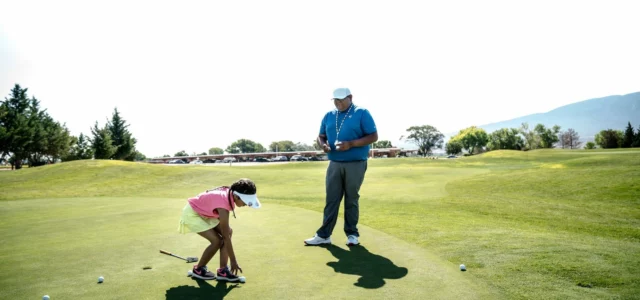
- The youngest putts first. On the green, the least experienced player takes the first putt. If it drops, the hole is done. Children remember the putt that went in far longer than the drives.
One limit to know: a scramble score does not count for a Handicap Index. Under the World Handicap System, you post a score only when every player has played their own ball on every shot. For a family day that hardly matters, but a teenager who is starting to keep a handicap should know that this round is for fun.
Format two: alternate shot, for two players
Alternate shot, which the Rules of Golf call foursomes (Rule 22), puts two players on one ball. One tees off on the odd-numbered holes, the other on the even ones, and after that they take turns until the ball is holed. It is the format the Ryder Cup uses on its foursomes sessions, and it works remarkably well for a parent and child, or a grandparent and grandchild.
The appeal is that nobody gets a free ride. Every shot matters, and each player has to hit the next shot from wherever the other one left it. A parent learns to leave the ball somewhere their partner can actually play from. A child learns that a short, straight shot is often more useful than a long, crooked one. Pairs end up talking about strategy on every hole, which is the whole point of the afternoon.
Two adjustments help when the gap is big:
- Different tees. Let each partner tee off from the tee that suits their length. In a club competition, a side normally plays from one set of tees. In a casual family round, you can agree otherwise, and a child hitting from the forward tees keeps the ball in play.
- Choose who starts. Give the first tee shot to whichever partner is more nervous. Getting the first swing out of the way early is easier than waiting.
Two pairs can play against each other in alternate shot: mother and son against father and daughter, for example. It is quick, since only two balls are in play for four people.
Format three: your own ball, with a cap on every hole
Sooner or later, a young golfer wants to play their own ball and keep their own score. The format that makes this possible with mixed levels is a maximum score per hole. The Rules of Golf include it as an official form of stroke play (Rule 21.2): the committee sets a cap, and when a player reaches it, they pick up and write down the cap. In a family round, the family is the committee. Double par is a common choice: 6 on a par 3, 8 on a par 4, 10 on a par 5.
The cap does three things at once. It stops the snowman, so no child walks off a hole with a 14. It protects the pace, because nobody plays more than a fixed number of shots. And it keeps the scorecard meaningful, so a young player can see their progress round after round.
Adjust the cap to the player. A beginner might pick up at double par; a stronger junior at triple bogey. You can also let beginners start each hole from a spot closer to the green, such as the 150-yard marker or the edge of the fairway. Many junior programs use shorter tees for exactly this reason, and the idea is the same one behind choosing the right tees for adults.
If the group wants to compare scores, Stableford points are an easy next step: points instead of strokes, and zero points when you pick up. Our guide to Stableford scoring explains how it works.
How to pick the right format for the day
- First time out, or a child under about ten: scramble, nine holes, with the “everyone’s drive gets used” rule.
- Two players with a big gap: alternate shot, each from their own tee.
- Four players who want to play against each other: alternate shot in two teams.
- A junior who wants their own score: own ball with a cap per hole, and Stableford if you want a winner.
- Mixed feelings in the group: start with a scramble on the front nine, switch to capped own ball on the back.
The course, the time and the length of the round
The format does most of the work, but the setting matters too. Nine holes is plenty for a family round, especially with children under twelve. A short or executive course, or a par-3 layout, gives everyone more chances to reach the green, and our guide to nine-hole and short courses explains what to look for.
Book the quiet times: late afternoon, when many courses offer twilight rates and the tee sheet thins out, or early on a weekday in the school holidays. Tell the pro shop when you book that you are a family group with a young player. Many will put you where nobody is right behind you.
Keep the pace honest anyway. Play ready golf, keep the youngest player’s bag light, and let faster groups through without waiting to be asked. Our advice on pace of play for higher handicappers applies to a family foursome just as well.
Keeping it fun, and keeping them coming back
- Give each player a job. One keeps score, one rakes bunkers, one tends the flagstick. Children like having a role that is not about hitting the ball.
- Set side games. Longest putt holed, closest to the pin on a par 3, fewest balls lost. Small contests give weaker players a chance to win something.
- Keep the coaching short. One tip per nine holes at most. A family round is not a lesson, and a child who is corrected on every shot will soon want to stay home.
- Bring food and water. A hungry nine-year-old on the seventh hole ends rounds faster than any bad shot.
- Stop while it is still good. If the youngest is tired after six holes, walk in. Finishing the round matters less than wanting to come back next week.
Where American families can play together
The PGA of America has promoted July as Family Golf Month for years. In past editions, participating facilities offered family clinics, junior rates and “Kids Play Free” rounds, where a junior plays at no charge with a paying adult. Offers vary by course and by year, so ask at your local course, or look for the programs on PGA.com in early summer.
Municipal courses are often the best place to start. Many city and county systems offer junior rates, and their nine-hole and par-3 layouts suit a family scramble perfectly. Ask about the junior rate when you book, and whether the course allows juniors on the course with a paying adult at off-peak times.
For families who enjoy competing, the PGA Family Golf Championship shows that the family scramble has become a real event in its own right. For most families, though, the right competition is the one around the kitchen table afterward: who holed the long putt, whose drive got used on the 9th, and when you go back.
If a child or teenager starts playing seriously, the next step is a handicap. A Handicap Index lets them play against their parents on equal terms, own ball, every shot, and that is a family round of a different kind altogether.
Your first family round, step by step
- Book nine holes at a quiet time, on a short or municipal course if you can.
- Agree on the format on the first tee: scramble for the first outing, with every player’s drive used at least three times.
- Let each player tee off from the tee that suits their length.
- Give the youngest the first putt on every green.
- Keep one scorecard, with one team score per hole, and a side game for the par 3s.
- Next time, try alternate shot in pairs, or own ball with a double-par cap.
The best format is the one where everyone walks off the 9th green wanting to play again. Try one of the three this weekend, and change the rules as you go.