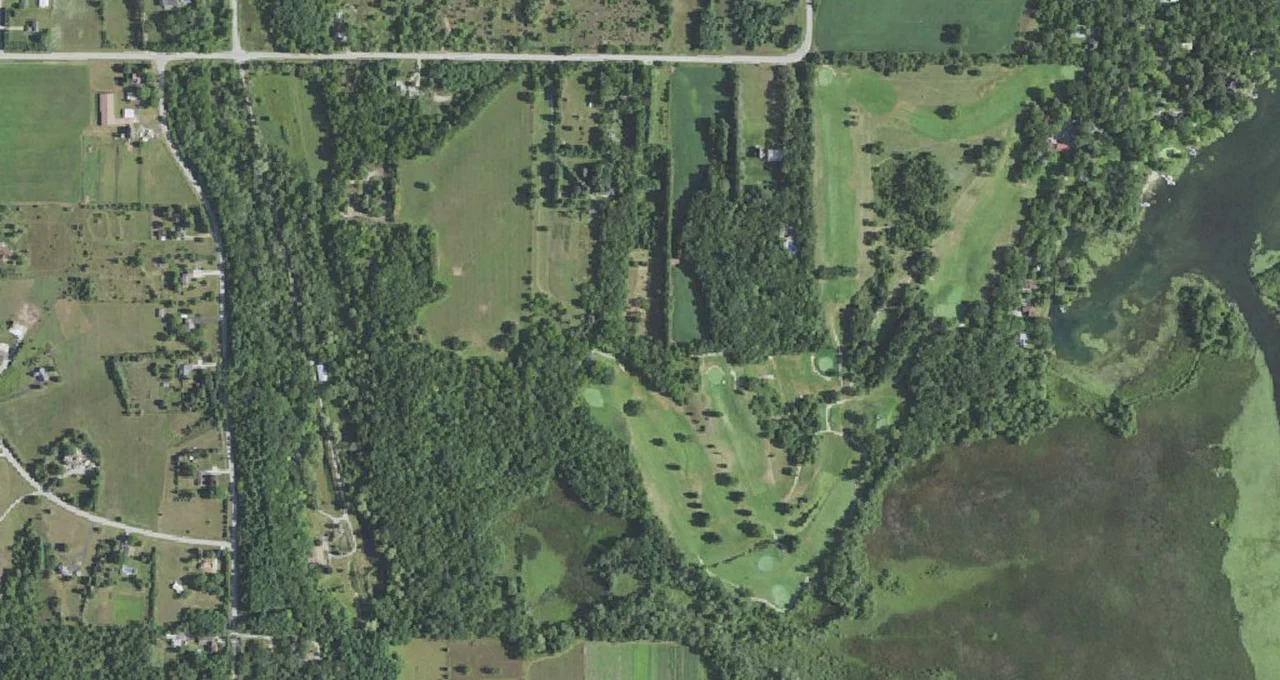
Eagle Springs Golf Resort from the air. Aerial imagery USGS, domaine public.
Eagle Springs Golf Resort
Holes
9
By
35
Length
2,814 yards from the White tees on the course's own scorecard (rating 66.6, slope 113 printed on the card); a golf app and a state golf directory list a back set of 2,860 yards
Green fee
—
Best season
—
Eagle Springs Golf Resort is a nine-hole public course in the Town of Eagle, in the southwest corner of Waukesha County, Wisconsin, on the western shore of Eagle Spring Lake. Its address is W352 S10355 Tuohy Road, Eagle, WI 53119, off County Highway LO. The course dates its founding to 1893 and has stayed in the hands of one family ever since: the Tuohys, who settled the land as farmers, and their descendants. Since 2021 it has been run by the sixth generation, Anne and Matt Krug, according to the course’s own history page.
The course’s scorecard gives a par of 35 over 2,814 yards from the White tees, the longest set it prints, and a par of 36 over the Red tees for women. Played twice, as most people who want a full round do, that makes 5,628 yards and a par of 70 from the White tees. It is not long, and it is not meant to be. What has drawn attention to Eagle Springs, from golf magazines and architecture writers alike, is its ground: blind tee shots over ridges, punchbowl greens, a par 3 on top of a steep mound, and a layout that has been shaped more by the land and by the family than by any known architect.
In 2020 Golf Magazine, on golf.com, ranked Eagle Springs 23rd in its list of the 50 best nine-hole courses in the world, describing it as the oldest course in Wisconsin and possibly the quirkiest. The course also says it was named Nine-Hole Course of the Year in 2006 and 2007 by the Golf Course Owners of Wisconsin.
A lakeside resort from the 1890s
The course’s history page tells the story as the family has passed it down, combining oral history and documents, and says research is continuing. In 1866 John and Mary Tuohy, Irish immigrants who had come from Boston, settled on the western shore of the lake and started a farm. The barnyard fence from that farm still stands around the course’s maintenance barn. In 1893 John sold his part of the land to his son William, who saw it as a vacation spot and built a resort with a grand hotel, twelve cottages and an 18-hole golf course. Guests came from Chicago, Milwaukee and Waukesha, met by horse-drawn buggies at the train stations in Eagle and Mukwonago. According to the course, a hotel room cost $2.00 a day and 18 holes of golf cost 25 cents. Wikipedia adds that the original farm covered 601 acres and that William let golfers who could not pay play for free.
William’s daughter Agnes Ellen died in 1920 at the age of 21. The following year, according to the course, he closed the hotel, sold it, and had it razed, and from then on he concentrated on the golf course. Wikipedia says the hotel was sold and moved rather than razed. After the Great Depression the course was cut from 18 holes to nine, which the family attributes to money, the difficulty of maintaining the course through a drought and a shortage of workers. The Fried Egg, a golf architecture publication, writes that aerial photography from 1937 shows the course already reduced.
Several buildings from the resort era survive. The clubhouse is the hotel’s old laundry building, and the cottage beside the 9th green was the hotel’s icehouse. Inside the clubhouse are the resort’s original cherry wood tables and chairs and the hotel’s cherry wood bar. A spring house that supplied the property with water still stands, and the wrought iron sign bearing the Tuohy name has been swallowed by a tree along the entrance drive. Nine of the original twelve cottages remain; the course says they have been rented each season by the same families, in some cases for up to 50 years.
Ownership passed down the family line. Wikipedia records that William died in 1939 and that his widow ran the resort with their children and a granddaughter until her own death in the 1950s. The fifth-generation owner, Mike Bolan, ran the course during the period when it collected most of its recognition, and in 2021 it passed to his niece by marriage, Anne Krug, and her husband Matt. Some sources have not caught up with that change: Wikipedia and the 2020 golf.com ranking still name Mike Bolan as the owner.
Who designed it: an open question
The design history is uncertain, and the sources do not agree. The course’s history page says William Tuohy hired A.G. Spalding, the baseball pitcher and manager turned sporting goods maker, to design the first two holes, and let nature dictate the rest. It places this in the context of the original 1893 resort but gives no date. The golf.com ranking credits the course to William Tuohy in 1893 and to Spalding in 1921, and Wikipedia also places Spalding’s work after 1920. The Fried Egg points out the difficulty: Albert Goodwill Spalding died in 1915, so a redesign in 1921 cannot have been his, and the publication considers the architect of the course unknown. A Wisconsin golf blog adds Tom Bendelow, a prolific designer of the period, as another possible name, without evidence either way.
The course spells the name “Spaulding” throughout its site; the sporting goods company and its founder spell it Spalding. A state golf directory lists Spalding as the architect and 1893 as the opening year. We leave the question open: the family tradition, the 1915 death and the 1921 date cannot all be right, and no primary document we found settles it.
The claim that this is Wisconsin’s oldest course also comes in different forms. The course calls itself the oldest family-owned nine-hole golf resort in Wisconsin, golf.com calls it the oldest course in the state, and other writers call it one of the oldest. The course’s home page says it is listed by the USGA among the first 100 clubs established in the United States, while its history page attributes the “First 100 Clubs in America” recognition to Golf Magazine. We could not trace the original list.
What it asks of you
Eagle Springs is short, but the scorecard understates it. The course rating printed on the card is 66.6 with a slope of 113, and 66.0 with a slope of 109. The card does not say which tees or which players these apply to; a golf app attributes the first pair to men from the White tees and the second to women from the Red tees. A rating of 66.6 is an 18-hole figure, so it appears to rate two loops of the nine. A slope of 113 is the standard value for a course of average difficulty, which is more than its length alone would suggest. The app also lists ratings for women from the White tees (71.4, slope 121) and men from the Red tees (62.4, slope 104).
The challenge is in the ground rather than the yardage. Reviews and architecture writing about the course describe blind shots on several holes, greens with steep falloffs and closely mown surrounds that let a missed ball run well away, punchbowl greens that gather shots, a hole played along a fairway shaped like a half-pipe, and bunkers of unusual shapes. A golf app rates the course as hard, with fast greens. Ponds and wet ground come into play on several holes on the way toward the lake. The terrain is rolling former farmland, and anyone walking should expect climbs.
The nine holes
From the course’s scorecard: White tees, then Red tees in brackets, with men’s par, then women’s par where it differs, and the stroke index for the first and second loops. The back nine on the card replays the same holes with the second set of stroke indexes.
- 1st: par 4, 298 yards (248), stroke index 13 and 14.
- 2nd: par 3, 134 yards (134), stroke index 7 and 8.
- 3rd: par 4, 306 yards (227), stroke index 11 and 12.
- 4th: par 4, 401 yards (296), stroke index 1 and 2.
- 5th: par 4, 413 yards (398, par 5 for women), stroke index 3 and 4.
- 6th: par 4, 291 yards (263), stroke index 15 and 16.
- 7th: par 3, 133 yards (133), stroke index 17 and 18.
- 8th: par 5, 447 yards (348), stroke index 9 and 10.
- 9th: par 4, 391 yards (270), stroke index 5 and 6.
The card totals the Red tees at 2,309 yards, but the hole-by-hole figures add up to 2,317. Other sources give other totals: a golf app lists Blue tees of 2,860 yards, White tees of 2,757 yards and Red tees of 2,315 yards, and a state golf directory gives 2,860 yards from the back tees, with a nine-hole rating of 34 and a slope of 118. One blog describes the longest tees as Blue rather than White and gives a different order of stroke indexes. This page follows the course’s own card.
The opening hole sets the tone. Writers describe a blind, uphill tee shot over a large ridge, with a ridge running up the middle of the fairway toward a green that has a raised plateau on one side and a punchbowl on the other. The Fried Egg says Mike Bolan enlarged the green to take in the plateau. It is a short par 4 on the card, but not a simple one.
The 2nd is the hole people come for. Known as the Volcano, it is a par 3 of 134 yards from both sets of tees, to a small green on top of a steep, isolated mound. According to The Fried Egg, the slopes fall away more than 20 feet on every side, so a shot that misses the green can end up well below it. Wikipedia reports that it was named the ninth best par 3 in Wisconsin in 2011, without saying by whom. Because the climb is hard work, the family built an alternate downhill par 3, sometimes called 2B, for golfers who cannot make it up the hill; a state directory accordingly lists the course as having nine or ten holes.
The 3rd is a short par 4 bending around wet ground and a pond, described by reviewers as a risk-and-reward hole. One blog gives it as 302 yards rather than the 306 on the card. The 4th is the hardest hole on the stroke index, a par 4 of 401 yards over rolling ground, with a creek to carry, woods on the left and a punchbowl behind the green according to course reviews. The 5th, the longest par 4 at 413 yards, plays downhill toward the lake with water on the left and in front of the green; it is a par 5 for women from the Red tees.
The 6th is the shortest par 4, 291 yards, with the half-pipe fairway and bunkers around the green. The 7th is a downhill par 3 of 133 yards, the easiest on the stroke index; reviewers describe a long trench bunker in front of a green set into a hillside, and a slope behind it that can be used to feed the ball back. The 8th, the only par 5 for men at 447 yards, starts with a blind tee shot to a wide fairway and finishes at a small green ringed by a horseshoe-shaped bunker. The 9th, a par 4 of 391 yards, is a dogleg, although two blogs disagree on whether it turns left or right. One of them reports that the green, previously hard to hold, was enlarged after the 2024 season.
What golfers say
Eagle Springs has been written about by golf architecture writers, Wisconsin golf journalists and bloggers, and reviewed on golf apps and booking platforms. The points below summarize what recurs in that material. They are other people’s opinions, not ours; nobody from Panxis has played the course, and we name no reviewer.
What comes up in its favor
- The character of the course is the main draw: reviewers describe it as quirky, unlike any modern design and fun for every level of player, while still challenging good golfers.
- The 2nd hole, the Volcano, is singled out again and again, and the opening pair of holes is often described as one of the best starts in the state. Some prefer the 7th as the best par 3.
- Value is frequently mentioned: reviewers describe the prices as very low compared with destination courses in the region.
- The setting and the history are part of the appeal, from the narrow drive between the cottages to the old clubhouse, which reviewers describe as one of the most unusual in Wisconsin golf.
- Several reviews praise the condition of the greens and the course in general, and the family atmosphere and friendly staff.
What comes up against
- Not every hole draws the same enthusiasm: some reviewers find the 3rd and the 8th dull next to the rest.
- The severe greens and blind shots can feel like luck as much as skill; some reviewers describe putts and chips that roll a long way off the green.
- The 9th green was considered too small for the hazards around it before its recent enlargement.
- Pace of play is rated fast in a golf app but average by some reviewers on booking platforms.
- For golfers who want a full round, it means playing the same nine holes twice.
How to play it
The course is open to the public. Tee times are booked online through the course’s booking page or by phone at (262) 594-2462. The course says the best prices are always online and that booking at least 14 days ahead gets the best available rate. Carts are available, and the rate card includes walking rates.
A large share of play is organized around the season’s leagues. In 2026 the course ran a women’s league on Thursday mornings from late May to late August, a senior men’s league on Wednesday mornings for golfers aged 60 and over, couples leagues on Friday evenings and Sundays, and three weeknight leagues listed as sold out. Each league charges a $35 fee for the season, and the women’s and senior leagues charged $24 a week for green fee and cart. Seasonal memberships for 2026 ranged from $575 walking for seniors to $2,035 riding for a couple, plus 5 percent tax, with a junior membership at $270.
For children, the course ran a junior camp in June 2026 for ages 6 to 13, at $80, or $130 including six rounds for the season, with no clubs required. A junior league on Tuesdays, for children from 5th grade up, cost $260 plus tax and included a junior membership with unlimited play; players had to walk nine holes, carry their own bag and bring their own clubs. The course also runs autumn events, including couples scrambles, a member-guest tournament with a hayride and music evenings in its pavilion, and hosts private outings on request.
Staying on site
The resort is offering overnight stays again. Its lodging page lists two rentals: a restored two-story house from before 1900, with three bedrooms and two bathrooms, a few steps from the clubhouse and the 1st tee, rented by the weekend or the week; and the Ivy Cottage, a rustic cottage about 100 years old with two bedrooms and one bathroom, next to the 9th green. Both come with access to a private beach on Eagle Spring Lake, which the course puts at 300 acres. The site does not publish prices for either.
Getting there and when to go
The entrance is on County Highway LO, between the villages of Eagle and Mukwonago. The course gives directions from three directions. From Milwaukee, take I-43 south to the Highway 83 exit at Mukwonago, go north to Highway LO, then west for about six and a half miles; the entrance is on the left, a mile past County E. From Madison, take I-94 east to Highway 67 at Oconomowoc, go south through the Village of Eagle following the signs for Old World Wisconsin, then turn left on LO; the entrance is on the right after two miles. From Waukesha, take Highway 59 west to County E in North Prairie, then E south to LO and turn right; the entrance is a mile on, on the left. The course says it is about 10 minutes from Lake Beulah, 15 from Lauderdale Lakes and 20 from Lake Geneva, and one blog puts it 40 to 45 minutes from Milwaukee. The access road is narrow and runs between the cottages.
The course does not publish a season or opening hours. A state golf directory lists it as open year round, weather permitting, which is unlikely to mean golf in a Wisconsin January. The leagues and junior programs run from May to August, and events continue through the autumn, so late spring to October is the safe window. Call ahead in early spring or late autumn.
Green fees
The course’s rates page, headed “2026 Summer Season Rates” and dated “as of 5/19/2025”, lists Monday to Thursday prices: $23.50 to walk nine holes and $32.00 to ride, $32 to walk 18 holes and $46.50 to ride. A Monday twilight rate after 4 p.m. costs $19.00 walking and $27.50 riding. Juniors always pay $15.00 for nine holes. Seniors pay $16.50 walking and $24.00 riding from Monday to Friday, with no senior rate on Saturday or Sunday before 3 p.m. From Friday to Sunday, prices are set dynamically according to demand, time, day and weather, and are shown only when booking. Older reviews quote lower weekend walking rates, which no longer apply. See the course’s own rates page.
How this page was made
The factual frame comes from public sources: OpenStreetMap for the location and outline of the course; the course’s website for the address, the ownership, the family history from 1866 to 2021, the Spalding tradition, the surviving buildings and cottages, the awards it cites, the scorecard and ratings, the 2026 rates, memberships, leagues and junior programs, the lodging, the events and the directions; Wikipedia and Wikidata for the 601-acre farm, the family succession, the 1939 death, the fate of the hotel, the 2011 par-3 distinction and the identifiers; golf.com for the 2020 ranking and its design attribution; The Fried Egg for the 1915 death of Spalding, the 1937 aerial photography, the enlarged 1st green and the description of the holes; the 18Birdies app for the tee sets, ratings and slopes by gender, and its ratings of difficulty and pace; the GolfWisconsin directory for its yardage, rating, architect and season; and course reviews on Top 100 Golf Courses, GolfPass and the Wisco Golf Addict and Always Time For 9 blogs for the description of the holes and the opinions summarized above.
Where sources disagree, we say so. The course credits A.G. Spalding with the first two holes; golf.com dates his work to 1921, six years after his death, and The Fried Egg considers the architect unknown. The “First 100 clubs” recognition is attributed to the USGA on the course’s home page and to Golf Magazine on its history page. The course says the hotel was razed, Wikipedia that it was moved. The Red tees total 2,309 yards on the card and 2,317 when the holes are added up, and other sources give other yardages and tee names. Two blogs disagree on the direction of the 9th hole. Wikipedia and golf.com still name the previous owner.
The opinion section summarizes reviews and articles on golf apps, booking and rating platforms, golf publications and blogs, read in October 2026. We report recurring themes rather than individual voices, and we reproduce no quotations from reviewers. Nobody from Panxis has played or visited this course, and this page is no substitute for a round.
The course has not paid for this page, has not seen it before publication and has no say over its content. This page contains no commercial link and earns us no commission. If you know the course and something here is wrong or out of date, write to us and we will correct it.
Other courses nearby
Closest to this one in our United States directory:
- Erin Hills — 27 mi
- Brown Deer Park Golf Course — 33 mi
- Kemper Lakes Golf Club — 49 mi
- Onwentsia Club — 52 mi
The hole to know
The Volcano: a par 3 of 134 yards from both sets of tees, with a small green on top of a steep mound that falls away on every side; an alternate downhill par 3 exists for golfers who cannot make the climb.