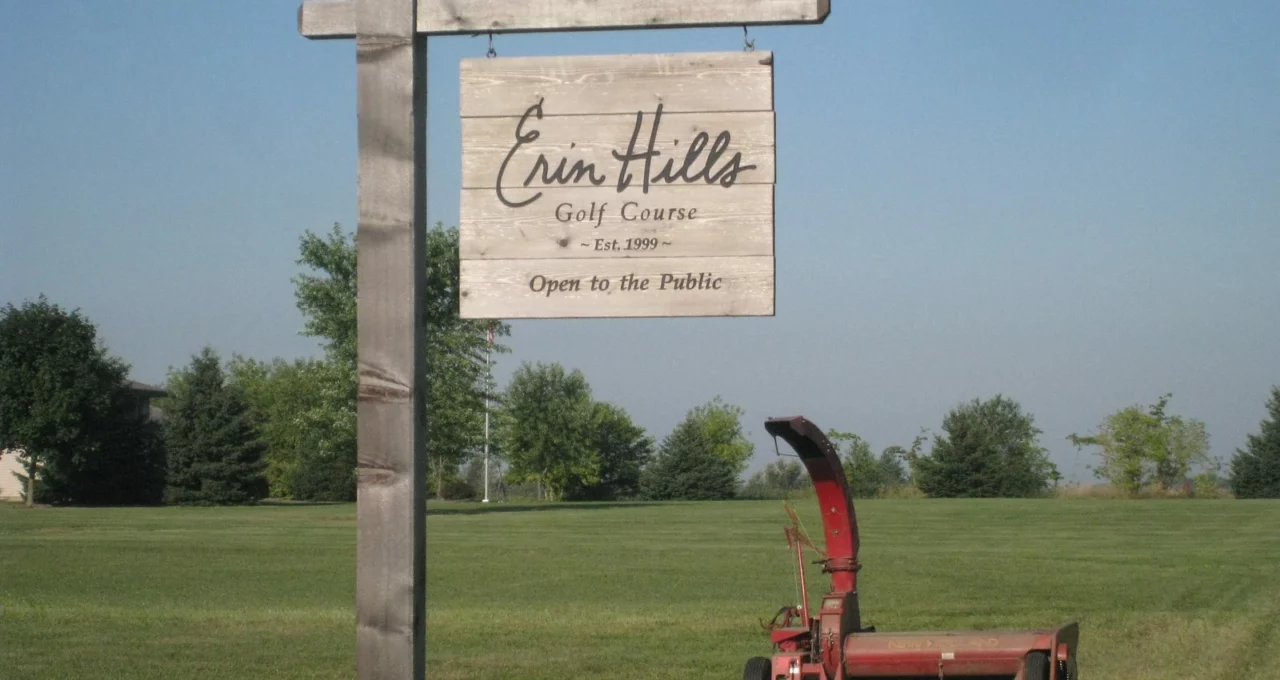
Erin Hills — Photo Dan Perry / Wikimedia Commons, CC BY 2.0
Erin Hills
Holes
18
By
72
Length
—
Green fee
—
Best season
Roughly April to October
Erin Hills opened in 2006 on rolling glacial ground in the kettle moraine country north-west of Milwaukee. It was designed by Michael Hurdzan and Dana Fry, long-time partners, together with Ron Whitten, the architecture editor of Golf Digest, which is an unusual credit and one Whitten had waited a career to earn. The course staged the U.S. Amateur in 2011 and then the 2017 U.S. Open, the first ever played in Wisconsin.
It is a par 72 that stretches beyond 7,800 yards at its full championship length, though almost nobody plays it there. What the numbers do not convey is the ground itself: ridges, kettles and hollows left by the ice sheets, with very little earth moved to create the holes. The architects have said their main work was deciding what to leave alone.
What it asks of you
There are no trees in play. The fairways are enormous by championship standards, wider than anything most visitors will have seen, and that width is not generosity. It is the setup of the question. The defense is fescue rough, the wind across an exposed plateau, and green complexes that reject an approach played from the wrong half of a very wide fairway. Finding the fairway is easy. Finding the correct third of it is the round.
Most greens sit above the approach and have to be attacked through the air with real distance control. The ground game that works on a links is available in places but not everywhere, and a player who cannot flight the ball down in wind will struggle from the middle of the course outward. Reviews from mid-handicappers are consistent on one point: past an index of about fifteen, the back tees turn the day into an exercise rather than a round.
The walk is the other half of the story. Carts are not available on the course and push carts are not permitted; everyone walks, most with a caddie. It is a genuine hike of around eight and a half miles across hilly ground, and the caddie is not a luxury add-on but part of how the course is meant to be played.
What players say about it
The notes below summarize recurring themes in public reviews of the course, read across specialist golf sites, traveler review pages and player discussion threads. They are other people’s opinions, not ours: we have not played the course. We report what comes back repeatedly rather than isolated remarks, and we do not name or quote individual reviewers.
What comes up in its favor
- Conditioning tee to green is praised almost without exception, and the fescue is described as genuinely healthy rather than merely present.
- The caddie programme is one of the most consistently positive points. Reviewers credit caddies with keeping pace honest and with reading greens that are difficult to read alone.
- The walking-only policy divides opinion but the majority verdict is that it makes the experience, and that the course would be diminished with carts on it.
- The sense of scale and the absence of housing or trees give the place a character several accounts describe as unlike anything else in the Midwest.
What comes up against
- Difficulty is the most common reservation. Players with a mid to high index frequently report that the course wore them down rather than tested them.
- The tee policy comes up repeatedly: visitors are steered toward a tee based on index and stated handicap, and some resent not being allowed to choose.
- The walk itself is a real objection for anyone not used to it, and reviewers note that some paths are steep and can be awkward in wet conditions.
- Cost is the other recurring theme. Between the green fee, the caddie fee and the customary gratuity, several accounts conclude that it is a once-in-a-while course rather than a repeat one, and food on site is described as expensive.
Getting there and when to go
Erin Hills sits in Washington County, roughly forty minutes north-west of Milwaukee and around two hours from Chicago, which makes it an easy add-on to a Wisconsin trip that includes Whistling Straits and Blackwolf Run. Milwaukee Mitchell is the nearest airport of any size.
The season runs from roughly April to October, and shoulder months are a gamble on an exposed site where wind is the main defense. Midsummer gives the best conditions and the highest demand. Lodging is available on the property, which matters more here than at most courses because of how early the first tee times go and how long the round takes. Book well ahead: the tee sheet for peak weekends fills months out.
Green fees
Rates, caddie fees, stay-and-play packages and tee times are handled by the course, and they change by season. See the course’s own site.
How this page was made
The factual frame comes from public sources: OpenStreetMap for the location, Wikipedia and published architecture coverage for the history and the design credits, and the club’s own site for access, season and booking. The opinion section summarizes public reviews and player discussions read in September 2026; we report recurring themes rather than individual voices, and we do not reproduce or attribute quotes.
We have not played this course, and nothing here is a substitute for that. The club has not paid for this page, has not seen it before publication and has no say in what it says. If you know the course and something here is wrong or out of date, write to us and we will correct it.