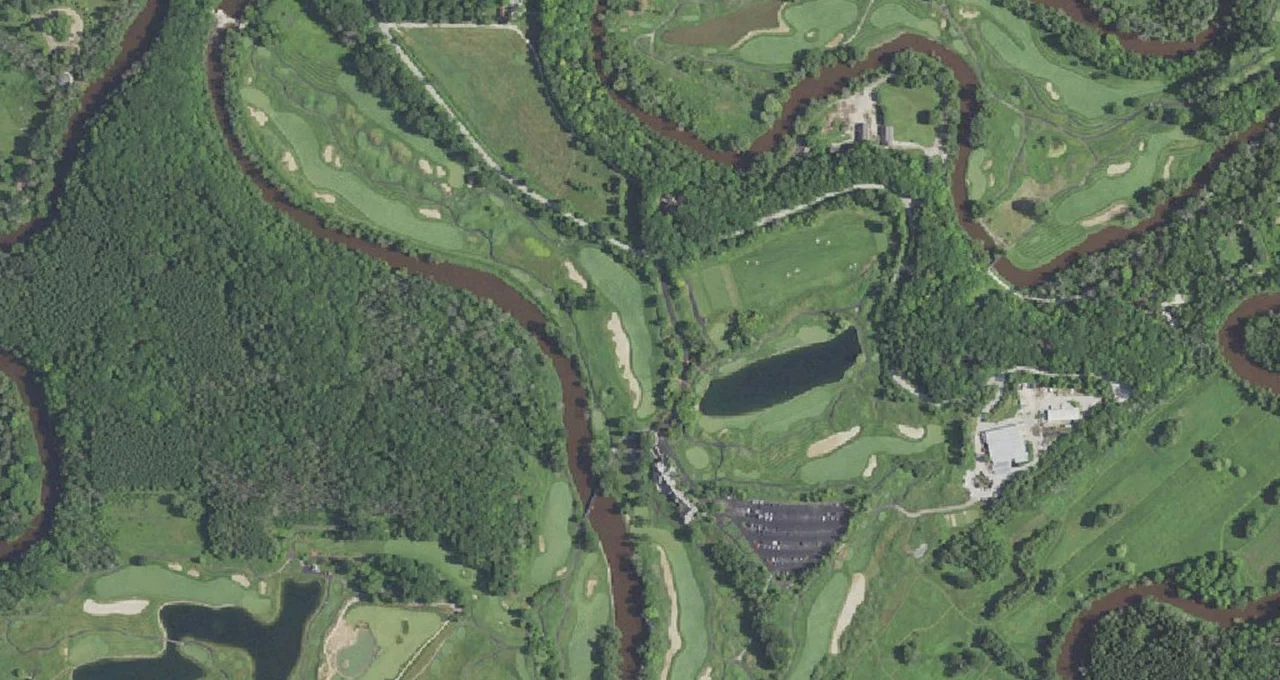
Blackwolf Run from the air. Aerial imagery USGS, domaine public.
Blackwolf Run
Holes
18
By
72
Length
River course: 7,404 yards from the Black tees on the club's scorecard (rating 76.2, slope 151). The second course, Meadow Valleys, measures 7,314 yards, par 72, from its Black tees
Green fee
—
Best season
—
Blackwolf Run is a golf complex on the Sheboygan River in the village of Kohler, Wisconsin, a few miles west of Sheboygan and of the Lake Michigan shore. It is owned by the Kohler Company and run as part of its resort, alongside The American Club hotel and the two courses at Whistling Straits, about nine miles to the north in a straight line. The address is 1111 W. Riverside Drive, Kohler, WI 53044. Despite the resort setting, it is a public facility: the resort says all its courses are open to golfers who are not staying there.
The site holds two 18-hole courses by Pete Dye, the River and the Meadow Valleys, both par 72, plus a 10-hole par-3 course called The Baths and a two-acre putting course. This page covers the whole site, but when it gives a single set of figures, they belong to the River, the better known of the two. On the club’s scorecard, the River measures 7,404 yards from the Black tees, with a course rating of 76.2 and a slope of 151. The Meadow Valleys card gives 7,314 yards, 75.3 and 145. Blackwolf Run has hosted the U.S. Women’s Open twice, in 1998 and 2012, on a composite of nine holes from each course.
One course that became two
The resort’s own account says the land was once the hunting ground of Chief Black Wolf and his Winnebago people, and that the courses were designed by Pete Dye and Herb Kohler, the company’s former executive chairman. In a 2001 profile in Cigar Aficionado, Kohler explained that the company’s customers kept asking why it had no high-class golf course of its own. He interviewed several leading architects, including Jack Nicklaus and Tom Fazio, before choosing Dye, who he said had a reputation for championship courses and would spend real time on site.
The same article tells how the partnership nearly ended before it began. Dye wanted a decision on some 70-year-old elms near the planned 17th green; Kohler, delayed at the office, arrived in the evening to find the trees burning in six piles and the architect gone. He called Dye in Indianapolis and threatened to take his name off the course unless they agreed on how decisions would be made. Dye flew back, they reached an agreement, and Kohler described the two men as best friends by the time of the interview.
The first 18 holes opened in June 1988, according to the USGA. Wikipedia records that Golf Digest named Blackwolf Run its best new public course of that year. A third nine followed in 1989 and a fourth in 1990, and the 36 holes were then reorganized into the two courses played today. The original 18 survive inside them: the River uses holes 1 to 4 and 14 to 18 of the first course, and the Meadow Valleys uses the other nine as its holes 10 to 18. One consequence, explained by the USGA’s championship director in 2012, is that the first green of 1988 is now approached from the opposite direction as the 10th of the Meadow Valleys. The original fairway still exists and is kept for championship use.
The two courses finish side by side. The 18th holes of the River and the Meadow Valleys share a very large double green below the clubhouse, a lodge-style building of stone and pine logs; Cigar Aficionado put the green at 23,000 square feet. The resort says the Meadow Valleys 18th has a separate green for the red tees.
The site keeps growing. The Baths, a 10-hole par-3 course on 27 acres designed by Herb Kohler and Chris Lutzke, a former associate of Dye, opened in June 2021 according to Wikipedia. In October 2025 the company broke ground on Purebred Farm, a 14-hole, walking-only course by the firm King Collins Dormer on 47 acres directly west of the Meadow Valleys, with check-in at the Blackwolf Run clubhouse. Wikipedia gives summer 2027 as the planned opening; the resort’s page gives no date.
Championships
The 1998 U.S. Women’s Open, the 53rd, was played from July 2 to 6 on the original 18-hole routing at par 71 and 6,412 yards. Se Ri Pak of South Korea and Jenny Chuasiriporn, a 20-year-old amateur from Duke University, tied at 290, six over par, after Chuasiriporn holed a long birdie putt on the 72nd hole. Their 18-hole Monday playoff also ended level at 73. Pak won on the second extra hole with a birdie, on the 92nd hole of the championship, and became, at 20, the youngest woman to win two majors in the same year, per Wikipedia.
The image that stayed from that week came at the end of the playoff. Pak’s drive on the 18th, the River’s closing hole on today’s cards, finished at the edge of the water hazard along the left side. She took off her shoes and socks, stepped into the water and played the ball out. That hazard is normally a long sand bunker. Golf Channel reported in 2012 that Dye had built it so it could be flooded, and that it had been drained for resort play because water slowed rounds down. Before the 2012 Women’s Open, the USGA wanted to keep it as sand; Kohler argued for water, citing how widely Pak’s shot had been watched in South Korea, and it was flooded again within days.
The championship returned from July 5 to 8, 2012, on the same routing, now par 72 and 6,954 yards. Wikipedia describes the layout: the front nine is the back nine of the Meadow Valleys, and the back nine is holes 1 to 4 and 14 to 18 of the River. Na Yeon Choi of South Korea won her first major with 281, seven under par, four shots ahead of Amy Yang, after a third-round 65.
The River scorecard also lists three “World Championships of Golf” winners: Mark McCumber in 1995, Greg Norman in 1996 and Ernie Els in 1997. Several directories say Blackwolf Run hosted Andersen Consulting match play in those years. That event’s finals were played at Grayhawk in Arizona, after regional rounds held at various courses, so the names on the card most likely refer to rounds played here rather than to the overall titles. We could not find a source that settles it.
What it asks of you
The River is the course most visitors come for. The resort describes terrain shaped by glacial runoff, following about five miles of valley and bluff, and quotes Dye’s line that the course was not built but found. Elevation changes are frequent: the official hole notes mention a bluff on the 6th that falls 80 feet to the river and a tee on the 8th some 50 feet above the fairway. A reviewer at Plugged In Golf counted water on 14 of the 18 holes.
The par is unusual: 37 on the front nine, with par 5s at the 1st and 8th, and 35 on the back, which has three par 3s. The scorecard gives the following pars and Black tee yardages, with the stroke index in brackets. The names are the club’s own.
- 1st, Snake: par 5, 610 yards (5). The river runs along the whole left side, and the club warns that the deep green complicates club choice.
- 2nd, Burial Mounds: par 4, 377 yards (13). Severe mounds to the right, dense trees to the left, a green ringed by bunkers.
- 3rd, Gotcha: par 4, 468 yards (1). The hardest hole on the card, with native grasses and a large bunker along the dogleg and an undulating green.
- 4th, Swan Lake: par 3, 219 yards (15). Played over a lake that runs the length of the hole; Golf Course Gurus notes a wall of rocks between the water and the green.
- 5th, Made in Heaven: par 4, 427 yards (3). An elevated tee with a wide view over the fairway below.
- 6th, Jackknife: par 4, 388 yards (17). A short dogleg where the bluff on the right drops to the river.
- 7th, Glencary: par 4, 426 yards (7). A tee shot over a ravine to one of the smallest greens on the course.
- 8th, Hell’s Gate: par 5, 532 yards (9). A forced carry over the valley, then a sharp turn right to a split-level fairway and a shallow green.
- 9th, Cathedral Spires: par 4, 361 yards (11). A short par 4 with two routes: safe to the left, or a risky line to a lower fairway beside the river.
- 10th, River and Marsh: par 3, 227 yards (14). Water and sand on almost every side of the green.
- 11th, Rise and Fall: par 5, 621 yards (6). The river along the whole right side and tight landing areas. The longest hole on the course.
- 12th, Long Lagoon: par 4, 486 yards (2). A forced carry over a lagoon, then an approach between bunkers on the left and the river on the right.
- 13th, Tall Timber: par 3, 231 yards (10). A long, deep green behind heavy bunkering, with the river to the right.
- 14th, Blind Alley: par 4, 346 yards (16). Back along Swan Lake, with water right and a large bunker left of the green.
- 15th, The Sand Pit: par 4, 374 yards (18). Three large bunkers, a generous landing area and a downhill approach.
- 16th, Unter der Linden: par 5, 620 yards (8). A winding downhill hole with a large linden tree in play for the approach and a green falling toward the river.
- 17th, Snapping Turtle: par 3, 181 yards (12). A boomerang-shaped tee wrapped around water that also fronts the green.
- 18th, Dyehard: par 4, 510 yards (4). The longest par 4, with the bunker of 1998 running the full left side and a green sloping toward the river.
The front nine measures 3,808 yards and the back nine 3,596. The card offers five sets of tees and a combination: Blue at 6,865 yards (73.7 and 144 for men), Green at 6,465 (72.1 and 139), White at 6,095 (70.3 and 132), White/Red at 5,602 (68.0 and 127) and Red at 5,120 (65.7 and 123). For women, the card gives 77.6 and 143 from the Green tees, 75.7 and 138 from the White, 73.0 and 131 from White/Red and 70.3 and 125 from the Red. It also prints a handicap recommendation for each tee: the Black tees for players at 0 to 2, the Blue for 3 to 8, the Green for 9 to 14, the White for 15 to 20 and the forward tees above that.
The reviews that describe the River in detail agree on its method. Plugged In Golf calls its theme visual deception: shots that look harmless hide trouble, and frightening ones often have a safe option just out of view. Most tee shots face a large hazard, but most fairways are generous for the player who takes the conservative line, and the same reviewer recommends a forecaddie for anyone trying to score. He found the greens slightly small, and smaller in play than their dimensions suggest because of their shapes, with few closely mown areas around them. Breaking Eighty describes the greens as the fastest its author had played. The 9th draws the most comment. Plugged In Golf reports that its caddie said Dye had named it his favorite hole; Golf Course Gurus, by contrast, thinks the risk of driving at the green far outweighs the reward and recommends a long iron to the left.
The Meadow Valleys
The second course is shorter on reputation but close in length. The resort describes it as both subtle and devilish: rolling prairie, oak savanna and heathland on the front nine, then a back nine through steeper ground cut by Weeden’s Creek. That back nine is the half that comes from the 1988 course, and it is the half the U.S. Women’s Open played. The par is 36 on each side.
From the Black tees it measures 7,314 yards (3,708 out and 3,606 in), with a men’s rating of 75.3 and a slope of 145. The other tees are Blue at 6,884 yards (73.3 and 139), Green at 6,450 (71.5 and 136), White at 6,140 (70.3 and 132), White/Red at 5,702 (67.8 and 128) and Red at 5,065 (65.2 and 123). The women’s figures run from 78.0 and 134 on the Green tees to 70.4 and 118 on the Red.
The holes the club singles out are mostly on the back nine. The 10th, Quiver, the original opening hole of 1988, plays from a tee shot through trees to the smallest green on the course; in 2012 the USGA noted that the approach is so steeply uphill that most of the flagstick cannot be seen from the fairway. The 12th, Ledge Walk, the second-hardest hole, has a sharp drop to Weeden’s Creek on the left. The 14th, Nature’s Course, has a green 40 feet below the fairway and guarded by water on three sides. The 15th, Mercy, is a forced carry from every tee to the largest green at Blackwolf Run, with a swale four feet deep in it. The 18th, Salmon Trap, crosses the Sheboygan River to the shared double green.
Plugged In Golf calls the Meadow Valleys a slightly gentler version of the River: more open, with less water (a real hazard on six holes, by its count), fewer hidden options and more chances to hit driver, but with elevated greens and big bunkers that still punish loose approaches.
What golfers are saying
This section summarizes recurring themes in public reviews read in October 2026: GolfPass user reviews, travel and equipment sites (Plugged In Golf, Breaking Eighty, Golf Course Gurus, Top 100 Golf Courses), and review snippets from Tripadvisor and Golf Digest that we saw only in search results. Nobody from Panxis has played the course; these are other people’s opinions, and we quote no individual reviewer.
What comes up in its favor
- Conditioning. On GolfPass, the River scores 4.9 out of 5 for conditions, its best category, across about twenty reviews, every one of which recommends the course. Reviewers describe immaculate turf and very fast, smooth greens.
- Setting. The river valley, the elevation changes, the absence of houses around the course and wildlife come up again and again. Some reviewers say they would rather replay the River than the Straits course at Whistling Straits, even if the Straits has more spectacle.
- Strategy. Reviewers like that the safe line exists on most holes, and that the River offers enough tee options for mid and high handicaps.
- Service and facilities. The staff, the clubhouse, the locker room, the range with grass tees and the restaurant view over the double green get consistent praise.
- The Meadow Valleys is often called overlooked: worth playing, a little easier, and quieter on the tee sheet.
What comes up against
- Value is the River’s weakest score on GolfPass, 3.8 out of 5, well below every other category.
- Pace of play is among the lowest GolfPass scores for both courses, and one reviewer reported a round of more than four hours along with staff pressing the group to keep up.
- Difficulty. Several reviewers warn that the River can frustrate the average golfer: thick rough and foliage off the fairways, forced carries, lost balls and greens that are hard to read.
- Some reviewers find the first holes of the Meadow Valleys good rather than memorable, and its front nine flatter than the rest of the site.
- Distances between greens and tees on the River lead some reviewers to advise taking a cart.
Who can play
Blackwolf Run is a resort facility open to the public. The resort’s FAQ says all Kohler golf courses are open to golfers who are not staying at the resort; only the Straits course at Whistling Straits may have booking restrictions for non-guests. Tee times are booked online or by phone through the resort, and the courses are also sold in golf and lodging packages.
Unlike the Straits course, the River and the Meadow Valleys allow carts. The resort’s policy page says the carts carry GPS and, weather permitting, may drive on the fairways. Forecaddies are optional on both courses, one per group, and should be reserved in advance; they find balls, give yardages and tend the flagstick. Directories and Top 100 Golf Courses say golfers may also walk and carry; the resort’s policy page does not address walking on these two courses, so it is worth asking when booking. The Baths is walking only, with free pull carts and free rental clubs.
The resort publishes discounted rate categories (twilight, replay after a first 18-hole round, juniors aged 17 and under with a paying adult, and military rates on certain holiday weekends), with junior and military rates bookable by phone only. Rental sets from three major brands are available. Rain checks are prorated for the holes not played and do not expire. The resort’s FAQ adds that photography and video are not allowed on the courses, practice areas or clubhouse terraces without prior approval.
Practice facilities include a double-sided range with grass tees, a short-game area with a bunker and a large putting green near the clubhouse, according to reviewers. The clubhouse holds the golf shop, the locker rooms and the Blackwolf Run Restaurant, and a food truck near The Baths serves in season; the resort listed it as open through October 18 in 2026.
The resort publishes no official season dates. Wisconsin courses close for the winter; past news reports, which we saw only in search excerpts, mention April openings for the Kohler courses.
Getting there
Blackwolf Run is at 1111 W. Riverside Drive, Kohler, WI 53044, on the edge of the village of Kohler, which the resort places two-thirds of a mile west of Interstate 43 (exit 126, then Highway 23 west and County Road Y). Measured in a straight line from the middle of the site, downtown Sheboygan is about three and a half miles to the east-northeast, Whistling Straits about nine miles to the north, downtown Milwaukee about 48 miles to the south, Milwaukee’s General Mitchell International Airport about 54 miles and downtown Chicago about 128 miles. The resort gives driving distances of 64 miles from Milwaukee’s airport, 67 miles from Green Bay’s Austin Straubel International Airport and 134 miles from Chicago O’Hare on its golf pages, and rounder figures (60, 60 and 140 miles) on its travel page. Sheboygan County Memorial Airport, about five miles away, takes private aircraft. The resort runs an on-demand shuttle between its locations in the village for hotel guests.
Green fees
Green fees depend on the course, the season, the time of day and whether the round is part of a package, and they are not given here. For current rates and tee times, see the Blackwolf Run page on the resort’s website and its golf rates and policies page.
How this page was made
The factual frame comes from public sources: OpenStreetMap and Wikidata for the location and identifiers (Wikidata records a par of 72 and a slope of 151); the resort’s website, read in October 2026, for the River and Meadow Valleys scorecards (2023 PDFs with yardages, pars, stroke index, ratings, slopes and handicap recommendations), the hole-by-hole notes and names, the pages on The Baths and Purebred Farm, the golf policies, the FAQ, the travel page and the restaurant page; Wikipedia for the opening dates, the 1988 award, The Baths and the two U.S. Women’s Opens; the USGA’s July 2012 article on the original routing and the opening hole, read in an Internet Archive copy; Golf Channel’s July 2012 report on the 18th-hole hazard; Cigar Aficionado’s 2001 profile of Herb Kohler; GOLF Magazine’s November 2024 ranking story; and reviews on GolfPass, Plugged In Golf (2020), Breaking Eighty (2023), Golf Course Gurus and Top 100 Golf Courses. The resort’s old address, americanclubresort.com, now redirects to kohlerwisconsin.com. We could not open the GolfPass pages, Golf Digest, Tripadvisor, BizTimes or the Wisconsin State Golf Association’s news site, which refused our requests; what we say about them comes from search-result excerpts and is limited to scores and themes.
Where sources disagree, we say so. The opening year of the River is given as 1988 by some sources and 1990 by GolfPass and others; both are right in a sense, since half its holes date from 1988 and the course took its present form in 1990. One review site gives the River’s design date as 1998, which is the year of the first Women’s Open, not of the course. Wikipedia gives the Meadow Valleys a rating of 75.1 and, in its text, 7,250 yards, against 75.3 and 7,314 yards on the club’s card; GolfNow lists 7,142 yards. Several directories show 6,507 yards for the River’s Green tees against 6,465 on the current card, and a rating of 70.3 for the Red tees that the card gives as the women’s rating. Top 100 Golf Courses gives the 9th as 337 yards from the back tees, which is the Blue figure on the card. The River follows the Sheboygan River for five miles according to the resort and seven according to Cigar Aficionado. GOLF Magazine ranked the River 29th on its 2024 list of Top 100 Courses You Can Play, and third on the 1999 list; we could not read Golf Digest’s current rankings directly, and secondary sources give figures from different years, so we give none. The resort’s two pages on The Baths give different terms for hickory club rental.
Some details will age: the course ratings, the rate categories and policies (published for the 2026 season), the restaurant and food truck hours, the Purebred Farm timetable and the review scores, all read in October 2026. Nobody from Panxis has played or visited Blackwolf Run, and this page is no substitute for a round.
The resort has not paid for this page, has not seen it before publication and has no say over its content. This page contains no commercial link and earns us no commission. If you know the course and something here is wrong or out of date, write to us and we will correct it.
Other courses nearby
Closest to this one in our United States directory:
- Brown Deer Park Golf Course — 41 mi
- Erin Hills — 46 mi
- Blue Mound Golf & Country Club — 47 mi
- Eagle Springs Golf Resort — 69 mi
The hole to know
On the River course, Cathedral Spires is a par 4 of 361 yards from the Black tees: a safe line to a fairway on the left, or a risky one toward a lower fairway beside the Sheboygan River, with trees blocking the direct route to a green that tempts long hitters.