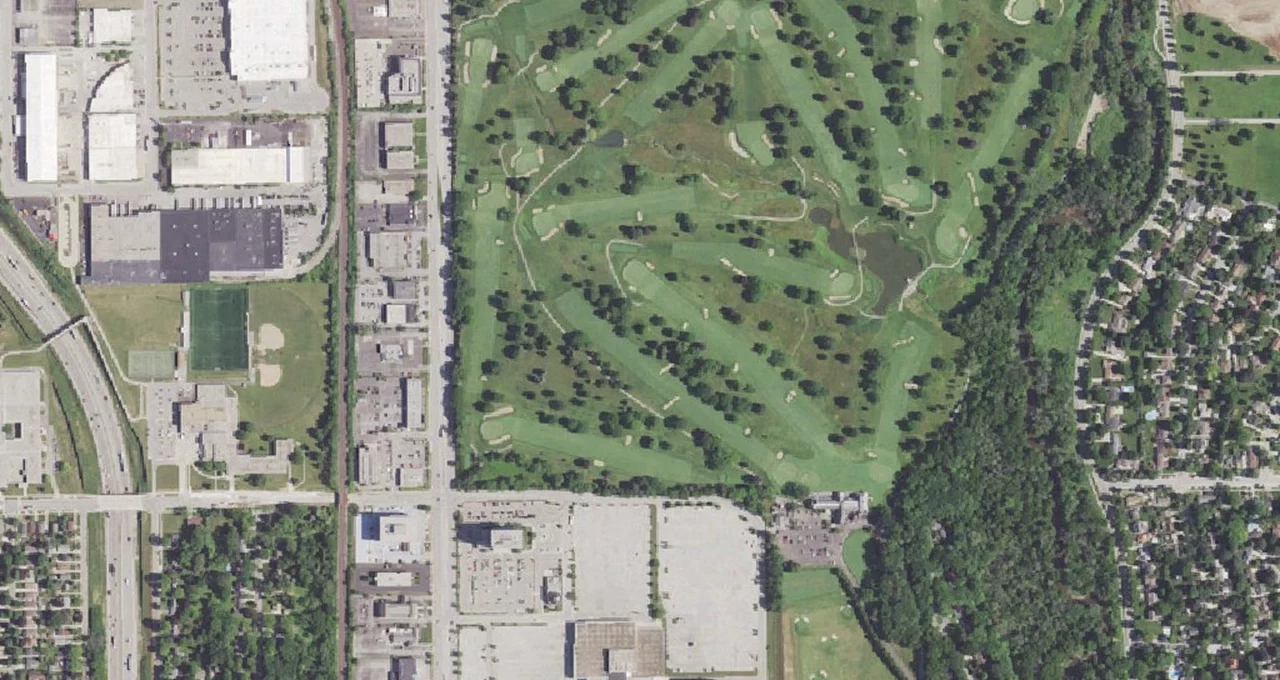
Blue Mound Golf & Country Club from the air. Aerial imagery USGS, domaine public.
Blue Mound Golf & Country Club
Holes
18
By
70 (two par 5s, four par 3s)
Length
6,743 yards from the Black tees on a current scorecard site (rating 72.4, slope 132); older cards give 6,666 to 6,672 yards (72.0 or 72.1, slope 131)
Green fee
—
Best season
—
Blue Mound Golf & Country Club is a private 18-hole club in Wauwatosa, Wisconsin, the suburb that borders Milwaukee to the west. Its entrance is on West North Avenue, between 101st and 102nd Streets, and the club gives its address as 10122 West North Avenue. The course was designed by Seth Raynor, one of the leading architects of the 1910s and 1920s, and opened in the summer of 1926 on a property the club now puts at 200 acres. Seven years later it staged the 1933 PGA Championship, won by Gene Sarazen, which the club and the Wisconsin golf press describe as the first major championship ever played in the state.
The course is a par 70, with two par 5s and four par 3s. Its length depends on which card you read, a point taken up in detail below: the longest current scorecard we found gives 6,743 yards from the Black tees, with a course rating of 72.4 and a slope of 132, while Wikipedia and several older cards give between 6,666 and 6,672 yards, rated 72.0 or 72.1 with a slope of 131. The club itself publishes no scorecard on its public pages.
Blue Mound is a members’ club. There are no public tee times, and the only way onto the course for an outsider is as the guest of a member. This page is meant for golfers curious about one of the Midwest’s best-documented Raynor courses, for those lucky enough to be invited, and for anyone following the championship history of Wisconsin golf.
A club older than its course
The club is older than the course it plays today. According to the Wisconsin Historical Society’s architectural inventory, which draws on the club’s centennial history of 2002, Blue Mound was founded in 1903 by 93 members who wanted a golf club west of the city of Milwaukee. They leased a 70-acre farm belonging to Jacob Wellauer and built a small frame clubhouse there in 1905. A September 2011 article in The Grass Roots, the magazine of the Wisconsin golf course superintendents, gives the same 1903 founding and dates the move to the present site to 1926. Wikipedia and Wikidata, by contrast, give 1926 as the year the club was established, which is the year of the current course rather than of the club.
The earlier grounds already had a championship record. Walter Hagen won the 1916 Western Open at Blue Mound by one stroke over Jock Hutchison and George Sargent, the first of his five Western Open titles, according to the club. The Western Open was then one of the most important events in American professional golf. The club also says it hosted the first Wisconsin State Open in 1919, won by Arthur Clarkson according to a Wisconsin golf blog, which adds that the State Open returned in 1921. Since the present course opened only in 1926, those three events were necessarily played on the club’s previous layout, whose exact site we could not establish.
The move came in stages. In 1923, according to the state inventory, the club bought two adjoining farms, the Swan farm and the Gilbert farm. A new clubhouse was designed by the Milwaukee architects Kirchhoff & Rose and built by the Oeflein Construction Company, and the clubhouse and the course opened together in the summer of 1926. The club describes the building as Cotswold in style, built of Lannon stone and preserved in its original state; the state inventory lists its walls as limestone. The two descriptions are compatible, since Lannon stone is a dolomitic limestone quarried northwest of Milwaukee.
The new club did not have an easy start. The state inventory says the golf course went bankrupt in 1933, the very year of the PGA Championship, operated on a lease for a few years and was incorporated again in 1936 under a new name. The club is known today as Blue Mound Golf & Country Club.
Seth Raynor’s last years
Seth Raynor was a surveyor from Long Island who learned golf architecture as the engineer of Charles Blair Macdonald, the designer of the National Golf Links of America. The club’s history page, quoting a 2010 article by Anthony Pioppi in Golf Course Architecture, says Raynor made his first solo design in 1914, at the age of 38, and designed, expanded or renovated more than 100 courses, with large greens, short par 4s and bold bunkering as his signatures. He died of pneumonia in West Palm Beach, Florida, in January 1926, at the age of 51, months before Blue Mound opened.
That timing explains a second name in the club’s archives. According to The Fried Egg, a golf architecture site that published a profile of the course in April 2025, the club still holds Raynor’s plan of 1924, with a description of each hole. An aerial photograph from 1927 shows that not all of his bunkers had been built by then, and Charles Banks, Raynor’s associate, was hired in the fall of 1927 to finish the bunkering. Banks’s hand-drawn plans, dated 1927, are also in the archives. A bronze statue of Raynor stands to the left of the first tee; some writers call it a bust.
Raynor and Macdonald built their courses around “template” holes, adaptations of celebrated holes in Scotland and England: the Redan from North Berwick, the Biarritz from the French course of that name, the Alps from Prestwick, the Road from St Andrews, and others of their own invention such as the Punchbowl, the Short and the Double Plateau. Blue Mound has a full set of them, which is why it attracts architecture enthusiasts from well beyond Wisconsin.
The championships
The 1933 PGA Championship was played from August 8 to 13 at what was then Blue Mound Country Club, according to Wikipedia. It was a match-play event. After a 36-hole stroke-play qualifier, the defending champion, Olin Dutra, and the top 31 professionals advanced to 36-hole matches spread over six days. Dutra lost in the second round to Johnny Farrell. Gene Sarazen beat Ed Dudley and then Farrell, and in the final defeated Willie Goggin 5 and 4. It was Sarazen’s third PGA Championship and the sixth of his seven major titles. The course played to a par of 70 and 6,270 yards. A plaque on the 5th hole marks the spot where the final ended, according to The Grass Roots. Top 100 Golf Courses notes that the nines were played in the opposite order to the one used since the 1960s. No other major came to Wisconsin until the 2004 PGA Championship at Whistling Straits.
Other events followed. In 1940, Babe Didrikson Zaharias won the Women’s Western Open at Blue Mound, then a major in women’s golf, beating a member of the club in the 36-hole final, 5 and 4. In 1955 the club hosted the first Miller High Life Open, a PGA Tour event, won by Cary Middlecoff with a total of 265, fifteen under par; the tournament then moved to other courses in the Milwaukee area. In 2010 Blue Mound held the Western Junior, won by Patrick Rodgers. In 2011 it was the second stroke-play course of the U.S. Amateur, alongside Erin Hills, before match play moved to Erin Hills alone; the club lists Kelly Kraft as the winner, over Patrick Cantlay in the final, and a field that included Jordan Spieth, Justin Thomas and Brooks Koepka.
The club staged the 100th Wisconsin State Open in 2020, which it says Harrison Ott won at ten under par, and co-hosted the stroke-play rounds of the 2022 U.S. Mid-Amateur with Erin Hills. The Grass Roots adds that the club had hosted the Wisconsin State Amateur ten times by 2011.
A restoration over a quarter of a century
Like many courses of its era, Blue Mound drifted away from its design after the Second World War. Top 100 Golf Courses describes a Raynor course that had been allowed to decay, narrowed by encroaching trees, with greens that had shrunk to about two thirds of their original size. Tom Doak, the architect who heads Renaissance Golf Design, is quoted there saying the course was a mess the first time he saw it.
The club turned to Bruce Hepner, then of Renaissance Golf Design. The Fried Egg describes the work as a long, gradual and comparatively inexpensive restoration running from 1999 to 2024, more than twenty years of continuous work. It began with tree removal and new mowing lines; thousands of trees were cut from the playing corridors, which improved the turf and opened long views across the property. The greens were pushed back out to the edges of their pads, the fairways widened to reach the bunkers again, and in a final phase every bunker was rebuilt in Raynor’s style, with flat floors and steep grass faces. According to The Fried Egg, all eighteen greens are the originals of 1926. A Wisconsin golf blog adds that the work also meant removing some updates made in the 1990s and keeping others, and fighting the effects of the emerald ash borer.
The superintendents carried out much of this work. Tim Venes, who joined the staff in the late 1980s according to The Grass Roots, led the maintenance team for years; Alex Beson-Crone succeeded him and, according to a Wisconsin golf publication, left after seven seasons to run course maintenance at Erin Hills.
What it asks of the player
Blue Mound is laid out on unusually flat ground for a Raynor course. The Fried Egg notes that only two holes have significant changes in elevation: the 7th, a short par 3 that drops down a hill in the northeast corner of the property, and the 8th, a par 4 that climbs back up the same hill on a diagonal. The first five holes run around the flat perimeter. The 7th, 8th and 9th move down into a central valley, and the back nine opens through that valley before returning to the clubhouse. A reviewer for Top 100 Golf Courses describes the routing as running clockwise.
The defense of the course lies in its greens. Several are very large, some over 10,000 square feet, with tiers, ridges and shelves that allow pin positions close to the edges. A Wisconsin golf blog reporting on the 2020 State Open, played on very firm and fast greens, noted that scores were high over the first two days, and quoted a PGA Tour veteran in the field calling them among the fastest he had played. On a calm day at member speeds, the main challenge for a club golfer is to finish on the right level of the green rather than simply to hit it. Off the tee, the reviewers agree that the corridors are generous since the tree clearing, though a number of trees still come into play.
The card below comes from the scorecard site Stymie, the most complete card we found, with par, yardage from the Black tees and the stroke index of each hole. Names of the template holes come from The Fried Egg, Top 100 Golf Courses, a Wisconsin golf blog and the course guide Golf Course Gurus.
- 1st: par 4, 398 yards (index 5). A par-4 Redan, the first of two right-to-left Redan greens on the course.
- 2nd: par 4, 415 yards (3). The Double Plateau, the largest green on the course at more than 10,300 square feet according to one blogger, with raised tiers at back right and front left.
- 3rd: par 3, 220 yards (15). The Biarritz, with a swale about four feet deep across the green; the front section is left unmown, which some writers would like to see changed.
- 4th: par 4, 388 yards (9). The Alps, with rippling contours in the green. A blogger reported in 2019 that the club was considering raising the fairway short of the green to make the approach blind, as on the original at Prestwick.
- 5th: par 5, 497 yards (7). A version of the Road hole with a raised green. One reviewer notes that many golfers play it as a long par 4.
- 6th: par 4, 335 yards (13). A short par 4 that Top 100 calls “Strategy,” with a geometric green guarded by bunkers at the back and on both sides.
- 7th: par 3, 167 yards (17). The Short, played downhill to a large green almost ringed by bunkers, with Mount Mary University in the background.
- 8th: par 4, 475 yards (1). The Punchbowl, uphill to a green set in a bowl at the crest of the hill.
- 9th: par 4, 375 yards (11). A tee shot over a ravine, then an approach toward the clubhouse.
- 10th: par 4, 445 yards (4). Called the Prize, with a large, modified Double Plateau green.
- 11th: par 4, 382 yards (12).
- 12th: par 4, 480 yards (2). From a tee beside a pond at the low point of the valley, up to a Hog’s Back fairway that crests and cants from right to left.
- 13th: par 3, 185 yards (16). The second Redan, a long and narrow green tilted from right to left behind a deep bunker.
- 14th: par 4, 416 yards (10). Called the Valley, with a blind tee shot out of the valley.
- 15th: par 4, 459 yards (6). A green with a bowl, a back tier and a front trough, which The Fried Egg counts among the most unusual on any Raynor course.
- 16th: par 4, 355 yards (14).
- 17th: par 3, 191 yards (18).
- 18th: par 5, 560 yards (8). The Long, the longest hole on the course, with cross bunkers in the landing area and the clubhouse behind the green.
That gives 3,270 yards out and 3,473 in. The same card lists seven other tee sets: Blue at 6,335 yards (70.6 and 127 for men), Founders at 5,920 yards (68.6 and 123), White at 5,529 yards (67.3 and 120 for men, 72.3 and 124 for women) and Forward at 5,427 yards (71.8 and 123). For a high handicapper, the sensible approach drawn from the reviews is to play from the Founders or White tees, aim for the middle of the large greens and accept a long putt rather than attack the corner pins.
What players say
As a private club, Blue Mound has few public reviews. We read detailed accounts on Top 100 Golf Courses, which shows an average of 4.5 out of 5, the course guide Golf Course Gurus, which gives it an A-minus, a Wisconsin golf blog and The Fried Egg, which awards it two eggs on its own scale. A golf app showed ten reviews without text that we could read. The points below summarize what recurs. They are other people’s opinions, not ours; nobody from Panxis has played the course, and we name no one.
What comes up in its favor
- The greens are the main compliment: large, full of spines, tiers and shelves, and in several accounts among the best in the region.
- Conditioning is described as excellent, with firm fairways and fast, true greens.
- The template holes, especially the Double Plateau 2nd, the Punchbowl 8th, the 10th and the Redan 13th, are singled out by almost every writer.
- The course is easy to walk, and the caddies get warm mentions.
- Reviewers like a course that avoids modern trends, such as stretched tees and heavy bunkering, and is fun to play repeatedly.
- The 1926 clubhouse and its view from the 9th and 18th fairways are praised, and the membership is described by one writer as younger and more welcoming than its reputation.
What comes up against
- The land is flat for a Raynor course, which limits its drama in the eyes of several reviewers.
- The course is short by modern standards, and some feel it lacks the length to rank higher.
- A handful of holes, often the 4th to the 7th and the 15th and 16th, are called average; several short par 4s look alike from the tee.
- Some reviewers find the bunker at the Road hole less fierce than in other versions.
- Outside critics, reported by a blogger who disagrees with them, say the tree clearing made the course too easy and the membership old-fashioned.
Who can play
Blue Mound is private, and play is limited to members and their guests. The club describes itself as a walk-on course for members, where tee times are seldom needed, with a matchmaking service to set up games and caddies readily available in summer. The club’s guest page sets out its rules: no phone calls on the course or in the clubhouse, rounds of three and a half hours for a four-ball and never more than four, carts kept off tees and away from greens and bunkers, and a dress code with tucked-in golf shirts, no T-shirts or athletic wear, and caps worn forward outdoors and removed indoors. Membership details, including any fees, are not published on the club’s public pages.
The practice facilities are, according to the club, centrally placed: a range it calls one of the largest in the region, a separate short-game area with a bunker and chipping green, a putting green and a lesson tee for the professional staff. The clubhouse has a formal dining room for 250 guests, four private rooms, a members’ grill and outdoor dining beside the course.
Getting there
The club is on West North Avenue in Wauwatosa, near the Menomonee River and the Mount Mary University campus. The entrance, between two stone pillars, is reached only from the westbound lanes of North Avenue, as The Fried Egg and the club both point out. The course sits behind a residential neighborhood and a shopping center.
In a straight line, the course is about 7 miles from Milwaukee City Hall, about 11 miles from Milwaukee Mitchell International Airport, about 68 miles from the State Capitol in Madison and about 85 miles from downtown Chicago. These distances are measured on the map and not by road.
Green fees
There are no green fees in the public sense. Guests play at the invitation of a member, under terms set by the club, which publishes no rates. For questions about guest play, see the club’s own website or call the club at (414) 258-4656.
How this page was made
The factual frame comes from public sources: OpenStreetMap for the location; the club’s website, bluemoundgcc.com, for the address, its tournament history, the 200-acre site, the clubhouse, the practice facilities and the guest rules; Wikipedia and Wikidata for the 1933 PGA Championship, the 1955 Miller High Life Open, the 1940 Women’s Western Open and the identifiers; the Wisconsin Historical Society’s architectural inventory, as reported in search summaries, for the founding, the farms, the clubhouse architects and the bankruptcy; The Grass Roots (September and October 2011) for the founding, the move, the State Amateur and the plaque on the 5th; The Fried Egg’s 2025 profile for Raynor’s plan, Charles Banks, the terrain and the restoration; Top 100 Golf Courses and Golf Course Gurus for the template names, the reviews and the condition of the course before restoration; a Wisconsin golf blog for the 2020 State Open and hole descriptions; Stymie and other scorecard sites for the card. We could not open the USGA’s rating database, the Wisconsin Historical Society’s pages or Golf Club Atlas directly.
Where sources disagree, we say so. The club dates from 1903 in the state inventory and The Grass Roots, but from 1926 in Wikipedia and Wikidata, which date the current site. One scorecard site says Raynor opened the course in 1924, the year of his plan; every other source gives 1926. The restoration began in the late 1980s according to Top 100 Golf Courses, in the late 1990s according to Wikipedia and the state inventory, and in 1999 according to The Fried Egg. The length is 6,672 yards in Wikipedia, 6,666 or 6,667 yards in Golf Course Gurus, a Top 100 review and a blog, and 6,743 yards on Stymie, whose card reflects new back tees on the 8th and 12th that a 2021 review said added about 100 yards; the ratings range from 72.0 to 72.4, the slope from 131 to 132, and an open golf database lists hole yardages that add up to 6,858 yards against its own total of 6,667. The 8th is 475 yards on the current card and 445 on an older one. The opponent Didrikson beat in 1940 is Mrs. Russell Mann for the club and Wikipedia, Lucille Mann for The Grass Roots, probably the same person. The 2010 Western Junior winner’s name is spelled Rogers in Wikipedia and Rodgers by the club. A blog names Peter Uihlein as the 2011 U.S. Amateur champion; he won in 2010, and we follow the club, which names Kelly Kraft. The club calls its stone Lannon stone, the inventory limestone. One scorecard site describes Blue Mound as a public daily-fee course, which it is not, and gives a different phone number from the club’s. The coordinates in Wikidata and OpenStreetMap differ by about 0.1 mile; this page uses OpenStreetMap.
Some details will age: the scorecard and its ratings, the guest rules, the review averages read in October 2026, the staff mentioned and any later restoration work. We found no published season dates and no membership rates, and give none. The opinion section reports recurring themes rather than individual voices. Nobody from Panxis has played or visited this course, and this page is no substitute for a round.
The club has not paid for this page, has not seen it before publication and has no say over its content. This page contains no commercial link and earns us no commission. If you know the course and something here is wrong or out of date, write to us and we will correct it.
Other courses nearby
Closest to this one in our United States directory:
- Brown Deer Park Golf Course — 7 mi
- Erin Hills — 22 mi
- Eagle Springs Golf Resort — 26 mi
- Blackwolf Run — 47 mi
The hole to know
The Punchbowl, a par 4 of 475 yards from the Black tees on the current card (445 on older cards) and the No. 1 stroke index: it climbs the only real hill on the property to a green set in a bowl at the crest, modeled on Raynor's punchbowl holes and often called the signature of the course.