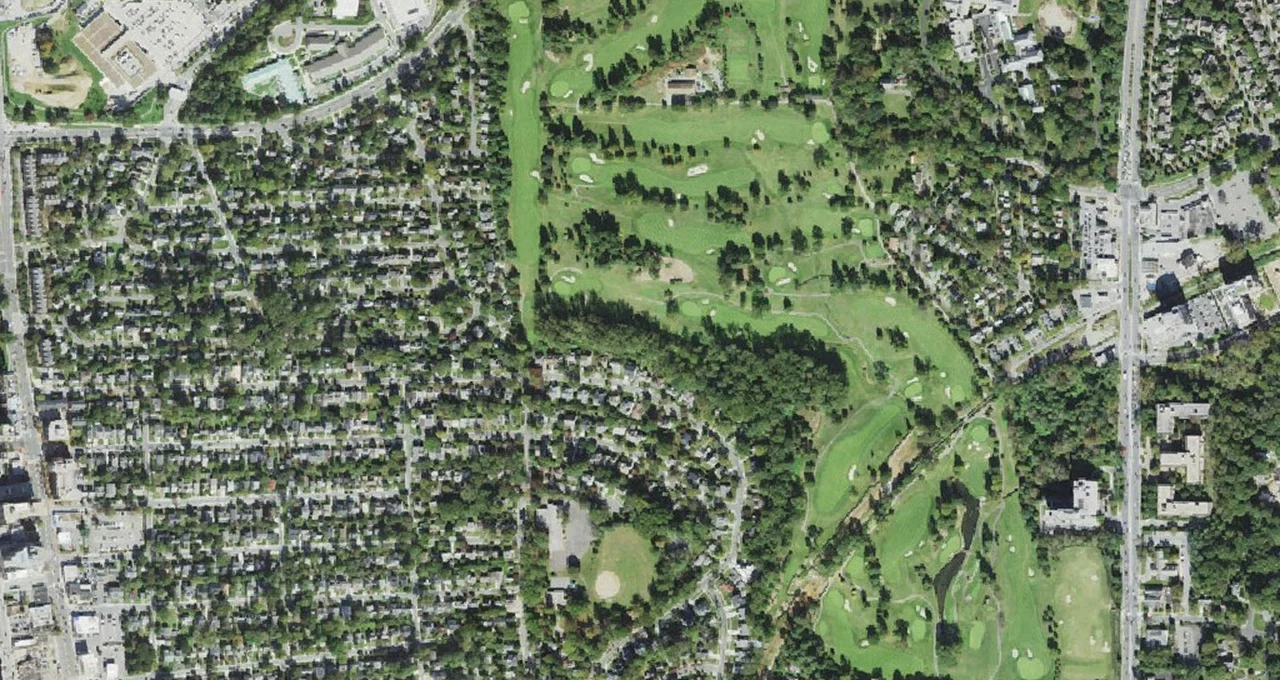
Columbia Country Club from the air. Aerial imagery USGS, domaine public.
Columbia Country Club
Holes
18
By
70 (35 out, 35 in)
Length
Back tees listed between 6,508 yards (Golf Digest) and 6,900 yards (Wikipedia); 6,660 yards from the Black tees (rating 72.2, slope 139) on Golf Course Gurus. Set at 6,116 yards (75.7/142) for the 2021 U.S. Girls' Junior
Green fee
—
Best season
—
Columbia Country Club is a private, member-owned club in Chevy Chase, Maryland, the suburb that sits just across the line from northwest Washington, D.C. The club gives its address as 7900 Connecticut Avenue, and Connecticut Avenue runs along the front of the property. Its golf course has 18 holes and plays to a par of 70, with two par 5s and four par 3s. The course was laid out by Herbert H. Barker and opened in 1911; Walter J. Travis reworked it a few years later to prepare it for national championships. Sources disagree on how much credit each man deserves, and on the year of Travis’s work, as explained below.
Columbia is best known for one week in July 1921, when it hosted the 25th U.S. Open and President Warren G. Harding handed the trophy to Jim Barnes. It has since staged two more USGA championships, the 2003 U.S. Junior Amateur and the 2021 U.S. Girls’ Junior, and the USGA has chosen it for two more: the 2027 U.S. Senior Women’s Amateur and the 2035 U.S. Senior Amateur. Golf Digest ranks it eighth among Maryland’s courses in its 2025-26 list. Because the club is private and membership is by invitation only, this page is a portrait of a course that most readers will only see as a member’s guest or as spectators at a championship.
The length depends on the source and on the tees. The USGA set the course up at 6,116 yards for the 2021 Girls’ Junior; the club’s back tees are listed at anywhere between 6,508 and 6,900 yards in the directories and publications we read. Those figures are set out in detail in the section on how this page was made. Besides golf, the club lists indoor and outdoor tennis courts, four platform tennis courts, indoor and outdoor pools, a fitness center, a six-lane duckpin bowling center, a child-minding facility and several restaurants.
From the Columbia Golf Club to Chevy Chase
The club’s own history begins on September 29, 1898, when nine men organized the Columbia Golf Club in Washington. Its first home was on Brightwood Avenue, the road later renamed Georgia Avenue, in the Schuetzen Park neighborhood; it then moved farther north to what the club calls a crude nine-hole course. In 1909 a group of members bought land on Connecticut Avenue from the Chevy Chase Land Company, the developer of the new suburb. The certificate of incorporation of Columbia Country Club is dated August 25, 1909, the founding date that Wikidata also records. According to the club, the old Columbia Golf Club played its last round on December 31, 1910, and 200 of its 600 members followed the new Columbia Country Club, which opened on the evening of January 1, 1911.
Wikipedia puts the original purchase at 126 acres, enlarged to about 146 acres in the 1930s, and notes that a railroad right-of-way of the Baltimore and Ohio split the property, so that members had to cross the tracks to play. The clubhouse, which still dominates the view from the 18th fairway, was designed by a club member, Frederick B. Pyle; Wikipedia says his design was chosen from four proposals and that the building opened on January 6, 1911. Wikidata gives the elevation as about 292 feet, so altitude plays no part in how the ball flies here, unlike at some championship venues in the West.
The course was laid out by Herbert H. Barker, with help from a founding member, Dr. Walter S. Harban, whom LINKS Magazine describes as chairman of the greens committee. The USGA’s announcements describe Barker’s 1911 layout as updated by Travis eight years later, which places Travis’s work in 1919, and the USGA’s 2021 fact sheet speaks of extensive renovations by Travis in 1919. Wikipedia dates his extensive changes to 1915, and the Travis Society, which studies the architect’s work, says he was commissioned in 1919, together with Robert White, to bring the course up to U.S. Open standard. The club itself goes further than the USGA, writing that the course is widely recognized as a Travis design even though Barker and Harban are often named as the official designers; Golf Digest and the OpenGolfAPI directory credit Travis alone. Harban and Travis also worked together on the course at East Potomac Park in Washington, according to the club.
The club adds that dams on its stream created two ponds that fed one of the earliest automated irrigation systems on an American golf course. The American Society of Golf Course Architects makes a similar, more cautious claim, saying Columbia may have been one of the first clubs in the country to install irrigation.
The 1921 U.S. Open and a president on the course
The 1921 U.S. Open was played on July 21 and 22 over 72 holes, with a field of 84 and no cut, according to Wikipedia. Par was 70, as it is today. Jim Barnes, an Englishman, led from start to finish: he opened with a 69 and finished at 289, nine strokes ahead of two former champions, Walter Hagen and Fred McLeod, who tied for second at 298. It was Barnes’s only U.S. Open and the third of his four major titles. President Harding attended the final round on the Friday afternoon and presented the cup and the medal, a scene the club, the USGA and LINKS Magazine all recall.
The amateurs had a good week too. Chick Evans, the 1916 champion, was low amateur in fourth place at 302, and a 19-year-old Bobby Jones tied for fifth at 303. Billy Satterfield, who reviews courses on the Golf Course Gurus site, writes that Jones took a nine on the 5th hole that week after hooking two balls out of bounds. Fred McLeod, one of the two runners-up, is the first of only four head professionals that Wikipedia lists in the club’s history, followed by William Strausbaugh, Robert Dolan and Steven Delmar.
The championship almost turned on the greens. LINKS Magazine tells how Harban spent four years bringing the putting surfaces up to standard, only to see a drought burn them out two weeks before the Open; the members were said to have spread coal dust over them. Barnes, LINKS writes, simply made sure of his two-putts while his rivals three-putted. The same article says that Harry Vardon and Ted Ray, who toured Columbia the year before, had called Columbia one of the very best courses in America.
Later championships: Harman, Zhang and the senior events to come
The USGA came back 82 years later. The 2003 U.S. Junior Amateur was won by Brian Harman, who beat Jordan Cox 5 and 4 in the final, according to Wikipedia’s list of champions. The USGA notes that Harman was the first left-hander to win the title; the USGA’s 2018 announcement already called him a future PGA Tour winner.
In July 2021, a hundred years after Barnes, the club hosted the U.S. Girls’ Junior. The championship was the 72nd edition in the USGA’s 2021 material, while the USGA’s 2018 announcement had called it the 73rd; the difference comes from the cancellation of the 2020 edition because of the pandemic. Rose Zhang, already the 2020 U.S. Women’s Amateur champion, shot an 8-under-par 62 in the second round of stroke play, which the USGA described as a Columbia record and a tie for the lowest round in the championship’s history. She was medalist at 131 and went on to beat Bailey Davis 6 and 4 in the final, according to GOLF.com. The USGA noted that she was the eighth player to win both the Girls’ Junior and the Women’s Amateur, and the first to win the Women’s Amateur first. The club’s history page still lists her 62 as the competitive course record.
In December 2023 the USGA announced that Columbia would host the 2027 U.S. Senior Women’s Amateur and the 2035 U.S. Senior Amateur, its fourth and fifth USGA championships. The USGA counts three national championships so far: the 1921 Open, the 2003 Junior Amateur and the 2021 Girls’ Junior.
The club’s membership has included prominent figures from Washington. Wikipedia names Presidents Richard Nixon and Barack Obama, the FBI director J. Edgar Hoover and the five-star generals Omar Bradley and Hap Arnold; the USGA’s fact sheet also mentions Obama, Bradley and Arnold. Wikipedia records a less flattering chapter too: in 1989 the club agreed to stop discriminating after the State of Maryland threatened a tax break, and by 1994 women were admitted as members. The USGA’s fact sheet adds that Martin West, a two-time Walker Cup player, has won the club championship several times.
A railway, a green moved to the half-centimeter, and new grass
The old railroad that once split the property has shaped the course’s recent history. According to the American Society of Golf Course Architects, the long-dormant rail easement has been reactivated for the Purple Line, a light-rail line between Bethesda and New Carrollton. In 2013, according to Club & Resort Business, the club signed a 25-page agreement with the Maryland Transit Administration and Montgomery County and dropped its opposition to the project. Under that deal the line was shifted about 12 feet north over a stretch of 1,700 feet to spare four holes and protect views from the clubhouse, two golf-cart underpasses were to be built for the club’s exclusive use, and sound walls were guaranteed. The trade magazine reported that two-car trains would pass through the course about 70 times a day, and that the club’s president had told members the 14th green would have to be moved and the 2nd fairway might need reorienting.
That is what happened, according to the American Society of Golf Course Architects. In its magazine, By Design, in 2022, it reported that Joel Weiman of McDonald Design Group began a renovation master plan in 2017 with the club’s committee and superintendent, that the 2nd hole was reconfigured, and that the 14th green was surveyed, shifted and replicated, in Weiman’s words, to within a half-centimeter tolerance. The same article says that, apart from minor changes to hazards and the addition of a driving range, the layout has never been altered, and that the club is converting from cool-season to warm-season grasses.
Wikipedia describes the most recent work as a September 2022 overhaul with new irrigation and drainage, renovated bunkers and fairways re-sodded with a hybrid of Bermuda and rye grass, after new tees and irrigation in 2012. A Golf Digest panelist writing in 2023 also notes that the club changed its fairway grass in 2022. Earlier work is recorded by LINKS Magazine: William Flynn tinkered with the course in the 1930s, George and Tom Fazio touched it up later, and Brian Ault and Thomas Clark restored the bunkering in 2000. The most visible loss is the 5th hole’s cross bunker, about 100 yards long according to LINKS, which has been grassed over.
Not everyone agrees that the course has stayed true to its origins. The USGA calls it remarkably similar to the original design, and Satterfield writes that the routing is very close to the one used in 1921. The unsigned course profile on Planet Golf, an architecture site, argues instead that the course has changed considerably since 1921: the Travis slopes have been softened, trees have grown into many tee shots, the layout has been stretched for modern equipment, and the work was done, in its view, moderately at best.
What the course asks of you
Columbia is short by modern championship standards and makes up for it with ground. Every source we read stresses the terrain: the USGA calls the setup hilly and narrow, with challenging greens; Wikipedia speaks of tight fairways and small, undulating greens; Golf Digest panelists describe uneven lies, steep slopes and greens that one of them measured at 13 to 14 on the Stimpmeter in windy autumn conditions. A stream, Coquelin Run, crosses the property; Wikipedia says it runs past or through the 1st, 15th, 16th, 17th and 18th holes and is dammed at the 17th to form a pond.
The hole-by-hole card the USGA published for the 2021 Girls’ Junior, played from forward tees suited to that field, gives the shape of the round:
- 1st: par 4, 369 yards.
- 2nd: par 4, 396 yards.
- 3rd: par 4, 344 yards.
- 4th: par 3, 190 yards.
- 5th: par 5, 536 yards.
- 6th: par 4, 376 yards.
- 7th: par 4, 317 yards.
- 8th: par 3, 177 yards.
- 9th: par 4, 388 yards.
- 10th: par 4, 409 yards.
- 11th: par 4, 407 yards.
- 12th: par 5, 520 yards.
- 13th: par 3, 164 yards.
- 14th: par 4, 377 yards.
- 15th: par 4, 348 yards.
- 16th: par 3, 151 yards.
- 17th: par 4, 287 yards.
- 18th: par 4, 360 yards.
That makes 3,093 yards out and 3,023 yards in, both par 35, for 6,116 yards, with a USGA rating of 75.7 and a slope of 142 for that event. From the men’s back tees the holes are longer: the OpenGolfAPI directory lists the 6th at 460 yards (stroke index 1), the 9th at 443, the 10th at 433, the 11th at 440 (index 2), the 14th at 440 and the 18th at 433. LINKS Magazine makes the same point: a run of par 4s from the 9th, each between 430 and 442 yards, plus a 455-yard 6th and a 433-yard 18th, gives the course the challenge of a much longer one.
The holes that come up most often in the sources are these:
- The 5th, the longer of the two par 5s (536 yards for the 2021 Girls’ Junior, 545 in OpenGolfAPI), once crossed by the long bunker that Bobby Jones is said to have found in 1921. Its removal is one of the changes Planet Golf regrets.
- The 7th, a short par 4 of 317 to 326 yards depending on the source, which Satterfield picks as the best birdie chance, with a forgiving fairway and a large bunker in front of the green.
- The 12th, a par 5 of 520 yards, with a layup area guarded by a pot bunker and a drop to a second fairway, according to Satterfield.
- The 15th, a par 4 of about 350 to 378 yards that turns left to a raised fairway and then drops to a green flanked by deep bunkers; Satterfield warns that a driver can find trouble in the long grass.
- The 16th, a par 3 over water, is the hole that the USGA’s 2021 fact sheet says served as Bobby Jones’s inspiration for the 12th at Augusta National. Wikipedia is more careful (it may have inspired it), and a Golf Digest panelist calls the story a rumor while seeing the likeness. We found no primary source from Jones, so we treat it as a club legend rather than a fact.
- The 17th, a short par 4 of 287 to 323 yards, which Wikipedia describes as a tee shot of about 200 yards over the pond followed by an uphill pitch of about 70 yards. Satterfield calls the blind approach to a domed green one of the hardest short par 4s he knows.
- The 18th, a par 4 that climbs toward the clubhouse, which the USGA calls the signature hole. Planet Golf describes its plateau green as split by a ridge and humps into four areas; Satterfield writes that the green once had six sections and now has four.
The figures will vary with the tees in use. The club does not publish a scorecard on its website, and the card that a guest receives on the day is the only reliable one.
What golfers say
Columbia is private, so public opinion is thin. Booking platforms and golf apps, which supply most reviews of public courses, carry little for a club that sells no tee times. The views summarized here come from three places: the ten panelist comments shown on Golf Digest’s course page when we read it in October 2026 (the page reports 12 reviews and an average panel score of 4.3 out of 5, and some comments appear twice), Satterfield’s review on Golf Course Gurus, which gives the course a B+, and the unsigned profile on Planet Golf. Most of these writers played as guests or as ranking panelists. Their opinions are theirs, not ours; nobody from Panxis has played the course.
What comes up in its favor
- The greens. Panelists and Satterfield single out the Poa annua greens as among the best putting surfaces they have played, very fast and well kept; LINKS Magazine says the same.
- The use of a small, hilly property. Several panelists marvel at how much variety and elevation change fits into a tight site, and Satterfield praises the movement of the ground and the shot options it creates.
- The finish. Satterfield compares the last four holes to the closing stretch at Merion’s East Course; panelists name the 16th and 18th as a crescendo, and the 11th and 13th among the strongest holes.
- Its character as a classic course that does not rely on length but still asks for many clubs; one panelist was surprised by how many drivers he hit.
- Conditioning, with firm, fast Bermuda fairways since the change of grass, and the setting, with autumn colors and the view of the clubhouse from the 18th.
What comes up against
- The tight site can feel cramped. Panelists mention some tees and greens, and especially the 16th and 17th, as squeezed into the geography; one finds the 17th awkward, and Satterfield calls it frustrating.
- Repetition. One panelist finds that several par 4s leave the same approach distance and shot.
- Extreme green speeds can make some hole locations border on the unplayable, in one panelist’s view.
- Before the change of fairway grass, summer heat and rain had taken a toll on the turf away from the greens, according to a 2023 panelist.
- Planet Golf judges that the course has lost architectural quality and visual interest as trees grew and Travis’s contours were softened, even if it is greener and prettier as a parkland course.
Getting there and playing
Columbia is a private, member-owned club, and the club states that membership is by invitation only. There is no public tee-time booking: golfers play as guests of a member. The club publishes a guest guide for 2026 that hosts are asked to share. It asks guests to drop their bags at the bag room behind the clubhouse, past the paddle tennis courts at the west end of the property, to play from appropriate tees and to follow the golf shop’s instructions. Caddies are required for tournament participants and their guests; Satterfield writes that caddies accompany groups and that players may walk or ride, but the club does not publish a general cart or caddie policy.
The guide also sets out a dress code and device rules. Men wear collared shirts in the clubhouse; denim is banned on the main floor at all times and, from April 1 through September 30, throughout the grounds for anyone aged 13 or older, with an exception for white denim in some family areas. Jackets are required in the main-floor dining room after 5 p.m., with a tie on Saturday evenings. Phones must stay on silent, speakerphone use is forbidden and calls are allowed only in cars, in designated telephone rooms, in locker rooms or outside the entrances to arrange transport. Photography is allowed in public areas but never in locker rooms.
The club does not publish a golf season. Winter play depends on conditions and on the club’s decisions; Wikipedia notes that the club runs an ice rink in winter only.
The club sits on Connecticut Avenue in Chevy Chase, in Montgomery County. Measured in a straight line on the map, it is about 7 miles north-northwest of the White House and about 10 miles north of Reagan Washington National Airport; these are map distances, not road distances. The club’s phone number is (301) 951-5000. As a private club, Columbia publishes no green fees for visitors, and we do not report any rates; guests should ask their host.
How we built this page
The factual frame comes from public sources: OpenStreetMap and Wikidata for the location, the founding date, the elevation and the identifiers; the club’s website, columbiacc.org, for its history, its address, its facilities and its 2026 guest guide; the USGA’s 2018 and 2023 announcements and its fact sheet and medalist report for the 2021 U.S. Girls’ Junior (read through the Internet Archive, as the USGA site refused our requests); Wikipedia for the club, the 1921 U.S. Open and the list of U.S. Junior Amateur champions; GOLF.com for the 2021 final; LINKS Magazine for the 1921 greens and later architects; the American Society of Golf Course Architects’ magazine By Design for the Purple Line work; Club & Resort Business for the 2013 agreement; the Travis Society for Travis’s commission; the OpenGolfAPI directory for back-tee hole lengths; and, for opinions, Golf Digest’s course page, Golf Course Gurus and Planet Golf.
Where sources disagree, we say so. The founding date is 1898 for the original golf club and for Golf Digest, August 25, 1909 for the incorporation of Columbia Country Club (the club and Wikidata), and 1911 for the opening of the course (the USGA). Travis’s work is dated 1919 by the USGA, the Travis Society and Golf Course Gurus, and 1915 by Wikipedia; the club and Golf Digest present the course as a Travis design, while the USGA credits Barker with Harban’s help. The clubhouse opening is January 1, 1911 for the club and January 6 for Wikipedia. The length and ratings from the back tees vary widely: 6,900 yards with a rating of 72.3 and a slope of 139 in Wikipedia; 6,660 yards, 72.2 and 139 from the Black tees on Golf Course Gurus; 6,603 yards, 72.2 and 139 in OpenGolfAPI, whose own hole lengths add up to 6,808; 6,586 yards in LINKS Magazine; and 6,508 yards with a slope of 138 on Golf Digest. Golf Course Gurus gives the other tees as 6,360 yards (70.7/135), 6,104 (69.7/132) and 5,310 (65.8/125). The hole lengths quoted for the 7th, 15th, 16th and 17th also differ from one source to the next. Golf Course Gurus calls the course sixth in Maryland, an earlier ranking; Golf Digest’s current list places it eighth. The 2021 Girls’ Junior was the 72nd edition for the USGA’s 2021 pages and the 73rd in its 2018 announcement. On the story of the 16th and Augusta, see above.
Some details will age: the rankings, the review counts read in October 2026, the tee ratings, which are revised periodically, the guest guide, the Purple Line, whose trail and rail works were still under way in county documents we found, and the future championships. The opinion section reports recurring themes rather than individual voices. Nobody from Panxis has played or visited this course, and this page is no substitute for a round.
The club has not paid for this page, has not seen it before publication and has no say over its content. This page contains no commercial link and earns us no commission. If you know the club and something here is wrong or out of date, write to us and we will correct it. The club’s own history page tells the story of the Columbia Golf Club and the 1921 Open in its own words.
Other courses nearby
Closest to this one in our United States directory:
- Chevy Chase Club — 1 mi
- Congressional Country Club — 5 mi
- Langston Golf Course — 9 mi
- East Potomac Blue Course — 9 mi
The hole to know
A short par 3 over water (151 yards at the 2021 U.S. Girls' Junior, 163 to 167 in other sources). The USGA says it inspired Bobby Jones's 12th at Augusta National; Wikipedia says it may have, and we found no primary source.