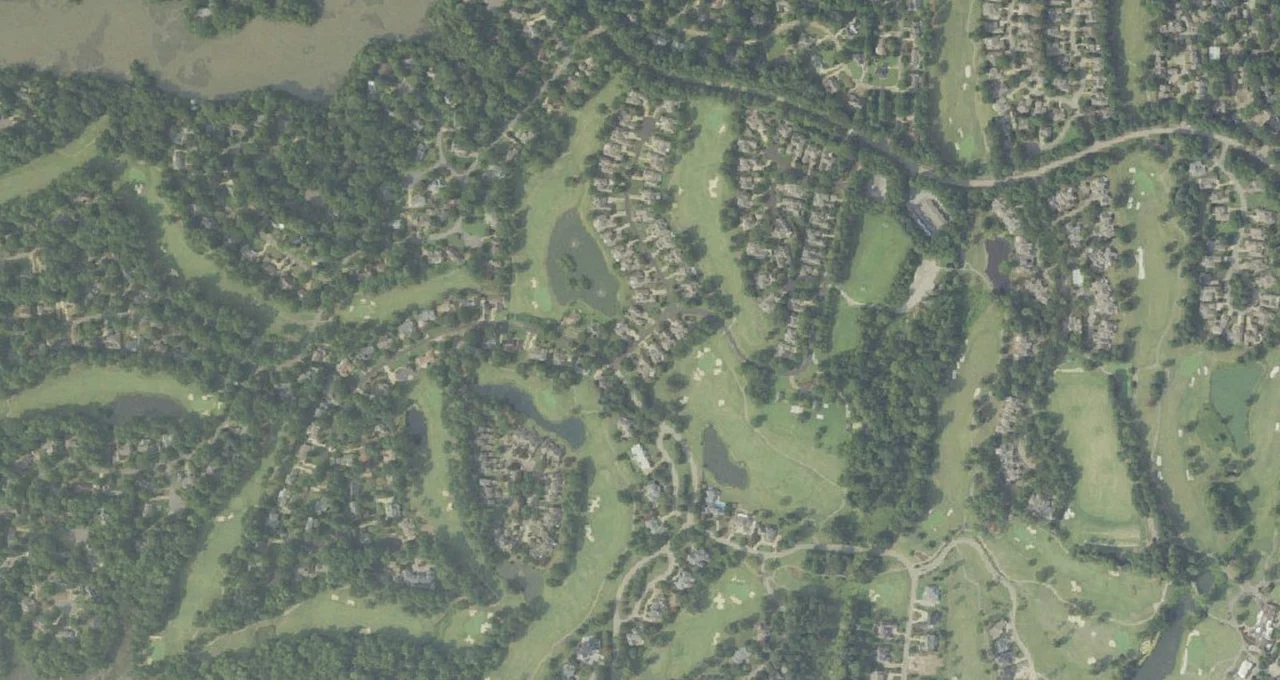
Kingsmill Resort: The River Course from the air. Aerial imagery USGS, domaine public.
Kingsmill Resort: The River Course
Holes
18
By
71
Length
6,831 yards from the Gold tees (rating 73.2, slope 136) per GolfPass and a 2018 travel blog; GolfPass and GolfLink summaries also show 74.7 and 139, 1Golf 73.1 and 137; six tee sets down to about 3,400 yards
Green fee
—
Best season
—
The River Course is the oldest of the golf courses at Kingsmill Resort, a resort community on the north bank of the James River in James City County, Virginia, a few miles southeast of the historic center of Williamsburg. The resort gives its address as 1010 Kingsmill Road, Williamsburg. The course was designed by Pete Dye and opened in 1975, according to Wikipedia and the course profile on Top 100 Golf Courses; one independent travel blog dates the layout to 1974, which may reflect the year of construction rather than of opening. It is a par 71 of 6,831 yards from the back tees, and it is the course that brought professional golf to Williamsburg: the PGA Tour played here every year from 1981 to 2002, and the LPGA Tour for most of the years between 2003 and 2021.
Kingsmill was developed in the early 1970s by Anheuser-Busch, the brewer, whose Busch Gardens theme park sits nearby. Wikipedia traces the later changes of ownership: the resort was sold in 2010 to Xanterra, the hospitality company owned by Philip Anschutz, and in 2017 to Escalante Golf of Fort Worth, Texas. Today the resort has a hotel, a marina, a spa and a tennis center alongside three 18-hole courses: the River, the Plantation Course by Arnold Palmer and Ed Seay, and the Woods Course. Wikipedia credits the Woods Course to Tom Clark and Curtis Strange, while Top 100 Golf Courses names Tom Clark alone. The Woods is reserved for members; the River and the Plantation are the two courses a resort guest can play.
A tour stop for four decades
The PGA Tour event that came to Kingsmill in 1981 was not new. It had been played since 1968 at Silverado Country Club in Napa, California, first as the Kaiser International Open Invitational and then as the Anheuser-Busch Golf Classic, before Anheuser-Busch moved it to its own resort in Virginia. It kept the Anheuser-Busch Golf Classic name until 1995 and was played as the Michelob Championship at Kingsmill from 1996 to 2002, the last year of the PGA Tour in Williamsburg.
The list of winners at Kingsmill on Wikipedia starts with John Mahaffey in 1981 and ends with Charles Howell III in 2002. Calvin Peete (1982, 1983) and Mark McCumber (1987, 1994) won it twice, and two players who each won a major championship in 2001 defended their titles here back to back: David Duval in 1997 and 1998, and David Toms in 2000 and 2001. Scott Hoch set the 72-hole tournament record of 265, 19 under par, in 1996. A 2022 article in Sports Illustrated lists Jack Nicklaus, Johnny Miller and Tom Watson among the winners of the Anheuser-Busch Classic; none of them appears in the list of Kingsmill champions, and their victories in this event date from its years in California, not from the River Course.
The LPGA took over in 2003 with the Michelob Light Open at Kingsmill, renamed the Michelob ULTRA Open at Kingsmill from 2004 to 2009. Its winners, as listed on Wikipedia, include Grace Park (2003), Se Ri Pak (2004), Karrie Webb (2006), Suzann Pettersen (2007) and Annika Sorenstam (2008), with Cristie Kerr winning in 2005 and 2009. Anheuser-Busch, by then taken over by InBev, ended its sponsorship after the 2009 edition, and there was no tournament in 2010 or 2011. The event returned in 2012 as the Kingsmill Championship (Jiyai Shin won it in a playoff over Paula Creamer that had to be finished on Monday morning), and Cristie Kerr won it a third time in 2013. Later champions include Lizette Salas, Minjee Lee, Ariya Jutanugarn (2016 and 2018) and Lexi Thompson (2017).
From 2019 the event was called the Pure Silk Championship presented by Visit Williamsburg. Bronte Law won the first edition in 2019. The 2020 edition, set for May, was canceled because of the coronavirus pandemic, as reported at the time by local television stations in Hampton Roads. Wei-ling Hsu won the 2021 edition, which turned out to be the last: Kingsmill was absent from the 2022 LPGA schedule, and a local report attributed this to the end of a three-year sponsorship contract with no new title sponsor. We found no formal statement from the LPGA on the reasons.
The resort’s golf page says the course is “home to 38 PGA and LPGA tour events”. That figure matches the dates above: 22 PGA Tour editions from 1981 to 2002 and 16 LPGA editions (2003 to 2009, 2012 to 2019 and 2021). Wikipedia’s article on the resort speaks of 29 professional tournaments between 1981 and 2009, which is the count before the LPGA’s second period, not a contradiction.
Pete Dye’s return
Dye came back to his own course almost thirty years after it opened. Golf Channel, in a 2008 course review, dates his return to 2004 and describes a “multi-million dollar facelift” of greens, fairways and bunker complexes; Wikipedia also gives 2004. Some resort and booking descriptions date the same work to 2005, which may be the year it was completed. Excerpts of trade press coverage from Golf Course Industry, which we could not open in full, describe the scope: all 18 greens reshaped and resurfaced with A4 bentgrass, most landing areas widened, fairway bunkers added and existing bunkers pushed back to account for modern equipment, and several tees moved to give better angles into the greens. The superintendent of the time summed up the aim as making the course a little harder for the better player and more playable for the average one. The resort’s own course page says only that Dye adjusted the layout to bring out its finer details.
The card
The resort does not publish a scorecard on its course page, so the figures come from golf directories, which agree on the par and on the total yardage from the back tees but not on everything else. A travel blog that played the course in 2018 and the directory GolfPass list six sets of tees, all par 71: Gold 6,831 yards (rating 73.2, slope 136), Blue 6,326 (70.9 and 131), White 5,704 (67.9 and 126), a combined White/Red set of 5,191 (65.8 and 119), Red 4,814 (68.4 and 122 for women) and a short Green set of about 3,400 yards. The GolfPass and GolfLink summaries also show a rating of 74.7 and a slope of 139 from 6,831 yards, the European directory 1Golf gives 73.1 and 137 for the Gold tees and 5,640 yards for the White, and GolfingRecord shows a single White card of 5,640 yards. Ratings are revised from time to time and directories update them at different moments, which probably explains the gaps; the resort’s pro shop is the place to ask for the current card.
For the tournaments the course played shorter than the Gold tees: Wikipedia’s article on the LPGA event gives 6,379 yards in its summary box and a 2013 scorecard totaling 6,340 yards.
The hole-by-hole cards describe a front nine of 36 with par 5s at the 3rd and 7th and par 3s at the 2nd and 5th, and a back nine of 35 with one par 5, the 15th, and par 3s at the 13th and 17th. Wikipedia lists bentgrass greens and Bermuda and ryegrass fairways.
What it asks of the golfer
A Pete Dye course rarely lets a player relax, and the descriptions of the River Course follow the pattern. The site is rolling, wooded ground on the bluffs above the James, cut by small ravines and streams, and the reviews return again and again to the elevation changes: greens perched above the fairway that call for an extra club, approaches that play uphill, tee shots over ground that falls away. Where the land is flat, Dye added his own defenses. Reviewers on Top 100 Golf Courses and on the Traveling Golfer site both mention the signature pot bunkers, deep and steep-lipped, in the fairways and around many greens.
The fairways themselves are described as generous on several holes and tree-lined on others, so the course is less about hitting the fairway than about being on the right side of it. The Traveling Golfer review put it plainly: the fairways leave room, but the position of the approach is what counts. That is because of the greens. They are described as undulating and quick, with false fronts and sections that shed the ball toward the edges, and the same review warned that there is no easy up and down around them. The 2004 renovation flattened some of the greens slightly, according to the trade press excerpts, but they remain the main test.
A few holes come up in almost every description. The 3rd is a par 5 that doglegs left, given as 518 yards from the back tees by Sports Illustrated, with a fairway that slopes hard from right to left and a second shot that climbs to an elevated green. The 5th is a par 3 where, in the same article, a stream curls around the front and right of the green with a bunker following the same curve. The 6th has a green only 32 yards deep with several levels, according to the Golf Channel review. The 4th is rated the hardest hole on that card, and the 9th is a long par 4 of 467 yards from the back that finishes the front nine with another change of elevation.
The finish is what television made famous. The 16th is a long par 4, 458 yards from the back tees in the 2008 Golf Channel review, that bends right and falls toward the James, usually into a wind off the river, to a large green framed by mounds where tournament crowds gathered. Sports Illustrated noted in 2022 that new large homes on both sides have largely closed the river view that once made the hole scenic. The 18th turns back inland: a dogleg left of about 450 yards from the back tees in the same article, with water down the whole left side of the tee shot, fairway bunkers, and a large two-tiered green below the clubhouse guarded by long, trench-like bunkers.
The 17th, by the river
Between them sits the hole everyone remembers. The 17th is a par 3 of 177 yards from the back tees, a figure given both by the resort’s blog and by Sports Illustrated; the directory cards give it about 156 yards from the Blue tees and 133 from the White. It plays from an elevated tee along the bank of the James River, which runs on the right, across a hollow to a long, narrow green. The Golf Channel review measured the green at about 50 yards from front to back, the longest on the course, and described a pot bunker and a long bunker of some 30 yards guarding the right; Dye enlarged the putting surface during the renovation but, according to the trade press excerpts, added bunkers around it. The wind usually comes off the river, and the same review said three putts are common on a green of that length.
The hole also carries history. The resort’s blog calls it “the most historic 177 yards of golf in America” and says the English colonists who would found Jamestown came ashore near this spot in 1607 before moving on to Jamestown Island, that the bank served as a defensive position in the Revolutionary War and again in the Civil War, and that old pilings in the river mark a colonial landing and the start of a road to Williamsburg. A Civil War cannon and an American flag stand by the hole. The blog gives 1765 as the date of the Revolutionary use, which cannot be right since the war began in 1775; Sports Illustrated describes the site more cautiously as a Revolutionary War battery reused in the Civil War. We report the tradition as the resort tells it, and we did not find an independent historical source on the exact landing site.
What golfers say
Public reviews of the River Course are spread across GolfPass, Top 100 Golf Courses and independent travel blogs. We read those we could open and the excerpts shown by search engines for the others. What follows sums up the recurring themes; nobody is named and nothing is counted.
On the plus side. The closing stretch draws the most praise, with the 17th named again and again as the favorite hole and the view of the James as the reason. Reviewers like the variety of the layout, the elevation changes, and the mix of wooded holes that demand accuracy and more open holes that let a player swing freely. The greens are usually described as in very good condition and rolling true, and several reviewers call the course in excellent shape overall. The history along the way, marked by signs and plaques, and the sense of playing where the tours played are part of the appeal. Reviewers also mention friendly staff, several sets of tees that let average players enjoy the course, and a setting one reviewer found uncrowded and not touristy.
On the minus side. The difficulty around the greens is the most common caution: fast, contoured surfaces, false fronts and deep pot bunkers punish an approach that is slightly off, and short-game recovery is hard. Some tee shots require a forced carry over water or a ravine, which reviewers say is manageable from the right tees but costly from the wrong ones. Several reviews regret that houses line much of the course, some of them described as dated, and that recent construction has hidden part of the river view on the 16th. One reviewer noted changes to the cart paths near the closing holes. Condition can also depend on the weather: one blog that played in an unusually wet Virginia summer found the course below its usual standard, while stressing that it had hosted a tour event earlier that year. Finally, a few reviewers who praise the golf say other parts of the resort feel in need of updating.
How to play it
The River Course is not open to the public. The resort’s golf FAQ states that the River and Plantation courses are “open to overnight resort guests and members only”, and that the Woods Course is reserved for full golf members. A round therefore goes with a stay at the resort, either through one of its golf packages or by booking a room and then requesting a tee time. Tee times are requested through a form on the resort’s website or by calling the golf shop at 757-253-3906; the resort does not publish a booking window.
Carts are included with the round. The superintendent decides each morning whether carts may go on the fairways, so the resort suggests calling that morning; on cart-path-only days it estimates the round takes about 30 minutes longer. Range balls are included with a round, and resort guests have free access to the driving range and putting green. The pro shop rents Callaway sets for men and women. The resort also runs a Golf Channel Academy on site, which it describes as the only one in Williamsburg. The dress code asks for collared shirts, allows Bermuda-length shorts and bans denim.
The advice that emerges from the reviews is consistent. Choose the tees for the carries, not for the yardage. Take an extra club into greens that sit above you and play to the fat part of the green rather than at flags near the pot bunkers. Spend time on the putting green before the round. And on the 17th, check the wind off the river before choosing a club: the green is long, so the right distance matters more than the line.
Getting there and when to go
Kingsmill sits southeast of Williamsburg, next to the Busch Gardens park, on the Virginia Peninsula between Richmond and Norfolk. The nearest airport is Newport News/Williamsburg International; Richmond and Norfolk have larger airports. Colonial Williamsburg, Jamestown and Yorktown, the three corners of Virginia’s Historic Triangle, are all a short drive away, which is part of the case the resort makes for a golf trip.
The resort does not publish a golf season or closing dates. For reference, the LPGA played here in September until 2012 and in May from 2013. The resort publishes a yearly golf operations schedule with pro shop hours.
How this page was made
This page is based on the Kingsmill Resort website (golf overview, River Course page, golf FAQ and a blog article on the 17th hole, read on November 1, 2026), Wikipedia articles on the resort, on the Michelob Championship at Kingsmill and on the LPGA event, Wikidata for the location, Sports Illustrated (January 2022), a Golf Channel course review (May 2008), the Top 100 Golf Courses course profile and reviews, the Tiger Golf Traveler and Traveling Golfer blogs, local news reports on the 2020 cancellation and the 2022 schedule, and the directories GolfPass, GolfLink, 1Golf, GolfingRecord and Open Golf API for the card. The OpenStreetMap outline of the course gives the map position.
GolfPass, Golf Digest and the Golf Course Industry articles on the renovation could not be read directly; for them we relied on the excerpts shown by search engines and say so above. Where sources disagree, as they do on the opening year (1975 or 1974), the year of the Dye renovation (2004 or 2005), the ratings and slopes, the tournament yardage, the architects of the Woods Course and the dates in the resort’s account of the 17th, we say so. We found no official scorecard from the resort and no published golf season, and we have not filled those gaps. The resort says the course is ranked by Golf Digest; we could not confirm the current ranking and do not repeat it. The opinion section summarizes public reviews; we report recurring themes, not individual voices. Nobody from Panxis has played or visited this course, and this page is no substitute for a round.
Kingsmill Resort has not paid for this page, has not seen it before publication and has no say over its content. This page contains no commercial link and earns us no commission. If you know the course and something here is wrong or out of date, write to us and we will correct it.
Other courses nearby
Closest to this one in our United States directory:
- East Potomac Blue Course — 115 mi
- Langston Golf Course — 117 mi
- Farmington Country Club — 117 mi
- Chevy Chase Club — 123 mi
The hole to know
A par 3 of 177 yards from the back tees along the James River, played from an elevated tee to a green some 50 yards long guarded by bunkers on the right, by the spot where, the resort says, colonists landed in 1607.