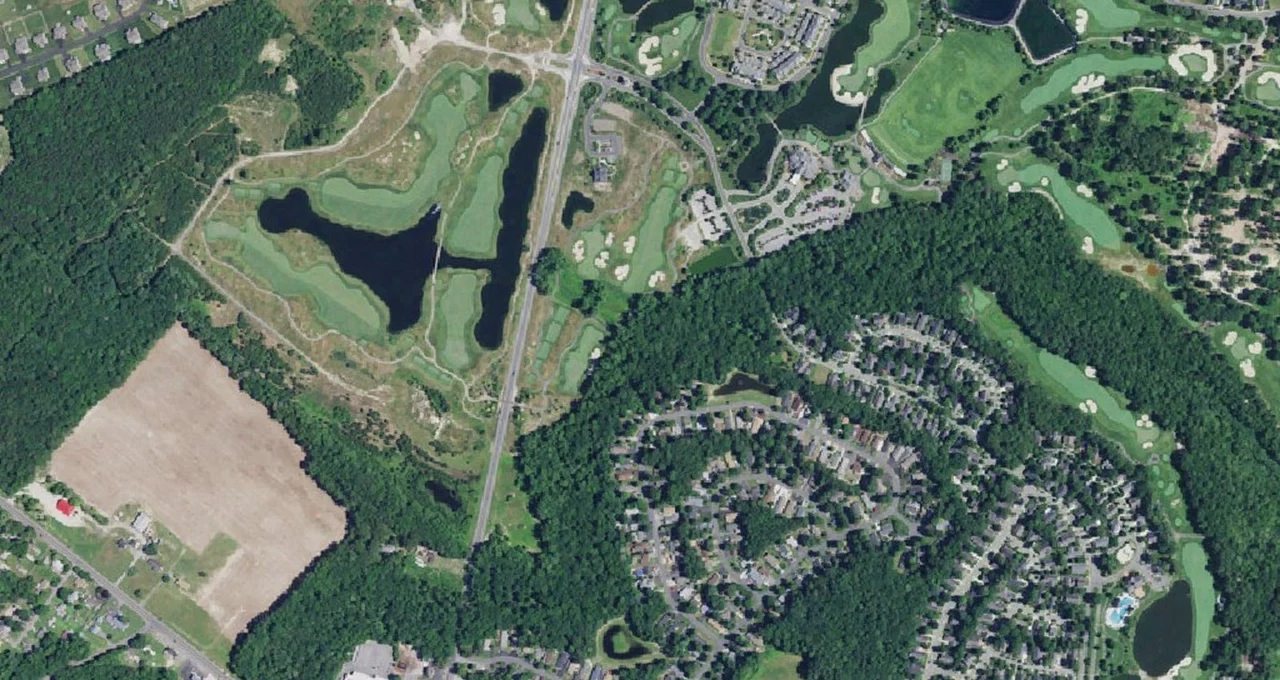
Baywood Greens from the air. Aerial imagery USGS, domaine public.
Baywood Greens
Holes
18
By
72
Length
6,983 yards from the Blue tees on the club's 2025 scorecard (rating 74.0, slope 144); 4,214 yards from the Green family tee. GolfPass's hole-by-hole card adds up to 6,963 yards
Green fee
—
Best season
—
Baywood Greens is a public 18-hole golf course in Long Neck, a community in Sussex County, Delaware, on the peninsula between Rehoboth Bay and Indian River Bay. The club gives its address as 32267 Clubhouse Way, Long Neck, DE 19966; some directories use the postal town of Millsboro instead. It is the centerpiece of a residential community of the same name, developed by Tunnell Companies, the family firm behind the nearby Pot-Nets communities, and its fairways wind between the homes, the clubhouse and a series of man-made ponds.
The course is a par 72 made of two nines with their own names and personalities: the Woodside nine, holes 1 to 9, cut through hardwood forest, and the Waterside nine, holes 10 to 18, built around ponds, timber bridges and two tunnels. On the club’s 2025 scorecard it measures 6,983 yards from the Blue tees, with a course rating of 74.0 and a slope of 144, and 4,214 yards from the forward Green family tee. The club markets it under the nickname “Augusta of the North,” a reference to its flowers and landscaping rather than to its routing, and it has been a fixture of Golf Digest’s list of the best courses in Delaware for more than two decades.
A course built by a developer, nine holes at a time
The early history comes mostly from the club’s own website, in versions kept by the Internet Archive between 2001 and 2015. According to a page from 2001, the Woodside nine opened in May 1998 and the Waterside nine in May 2000, as the first 18 holes of what was meant to become a 27-hole complex. The practice facilities, a driving range with target greens protected by bunkers, a landscaped putting green of 25,000 square feet and a chipping and bunker green, were completed in May 1999. The same page says that fairways and greens were bent grass, with sodded roughs of tall fescue; we found no more recent statement on the grasses.
The opening of the second nine was covered at the time by Fritz Schranck in his Hole by Hole golf column, dated May 26, 2000. He described Tunnell Companies, L.P. as the owner of the public course, counted 23 acres of ponds, and reported a promotion with a local radio station and a car dealership for the first hole-in-one on the 6th hole over the opening weekend. The club’s PGA professional at the time, Brian Barrows, told him he expected Baywood Greens to become the top course in southern Delaware.
The club’s pages from 2004 and 2008 credit Robert W. Tunnell Jr., principal of Tunnell Companies, as the man behind the course, the clubhouse and the surrounding communities. A 2026 article in Coastal Style magazine adds that his father, Robert W. Tunnell Sr., founded Tunnell Companies in 1962 and wanted strong color in the landscape from the start. The same pages list the scale of the construction: more than 70 bunkers and some 400 mounds and depressions built with about 1,000 truckloads of sand, more than 70 acres of sod for the primary roughs, tons of pine needles brought in from Georgia, and over 200,000 plants, shrubs and trees. Later versions of the site raise the plant count to more than 300,000 and the ponds to 27 acres, with eight timber bridges and two tunnels.
The third nine has never opened, as far as the sources we read show. The club’s site described a “Duneside” nine in 2014 and 2015, designed by the architect Cary Bickler with Rob Tunnell and his son, on flat farmland to be shaped into man-made sand dunes in a style the club compared to Scottish links. The page said it was under construction, with an opening date to be named later. Wikipedia places this planned “Sand Nine” on the north side of Delaware Route 24. The club’s current pages and its 2025 scorecard still describe 18 holes on two nines, and no later source we found reports an opening.
Who designed it? Three versions
Design credits for Baywood Greens differ from one source to the next. The club’s own history, in its 2004 and 2008 versions, says the initial layout and design were by Bill Love, a member of the American Society of Golf Course Architects, then formerly of the firm Ault, Clark and Associates, and that the final design was completed by Larry Dewitt, whom the club calls a land sculptor, and by the owner and developer Rob Tunnell, who “turned original sketches” into the finished course.
Golf Digest’s course page names a single designer, Brian T. Ault, of the same firm. Several directories credit the firm, Ault, Clark and Associates, without a first name. The Golf Association of Philadelphia lists “Bill Love/Brian Ault and Staff,” GolfPass lists both men for 1998, and a European golf travel site describes an original design by Bill Love with Rob Tunnell, with later modifications by Brian Ault. We follow the club’s account, which is the most detailed and the closest to the construction, and note that the course is widely attributed to the Ault, Clark firm as a whole.
What it asks of you
On paper, the course is long from the back: 6,983 yards from the Blue tees, with a slope of 144 for men. Most visitors will play shorter. The 2025 scorecard lists seven sets of tees: Blue, Black at 6,491 yards (72.1 and 140), White at 6,088 yards (70.2 and 134 for men, 76.0 and 142 for women), a White and Yellow combination at 5,533 yards, Yellow at 5,171 yards, a Yellow and Green combination at 4,520 yards, and the Green family tee at 4,214 yards. Each nine is a par 36, with two par 3s and two par 5s on each side.
The two nines play differently. The club describes Woodside as the more traditional half, with tree-lined fairways, wildflowers in four environmentally sensitive areas and a waterway that it connects to the Delaware Bay. Waterside, it says, has man-made ponds in play on eight of its nine holes. Two professional reviewers we read reached the same conclusion from opposite sides: a 2026 reviewer on the Top 100 Golf Courses site found the back nine far more memorable than the front, and a Golf Digest panelist praised the range of options the course gives a player off the tee. Another panelist noted that most greens slope from back to front, which rewards staying below the hole.
The scorecard’s local rules say a good deal about the place. Areas marked with green and white signs are environmentally sensitive and closed to play; they are treated as penalty areas. Special drop areas are marked on holes 6, 11 and 14. Players take free relief from the landscaped flower beds. Carts must stay on the path on all par 3s, and both the GPS yardages and the course markers are measured to the middle of the green.
The hole notes below combine the yardages, pars and stroke index of the 2025 scorecard (Blue tees, men’s stroke index in brackets) with the descriptions the club published on its course map pages in 2008, which describe the same routing:
- 1st: par 4, 375 yards (13). Fairway sand and grass bunkers off the tee, then a short iron to a two-tiered green guarded front left and back right.
- 2nd: par 4, 365 yards (11). Water down the right; the club suggests a long iron or fairway wood from the tee to a large green.
- 3rd: par 4, 435 yards (3). A slight dogleg left with a second shot over a depression to a long, narrow green. The club calls par “a welcome score.”
- 4th: par 4, 462 yards (1). The longest par 4 on the Woodside nine and the hardest hole on the current card. Fairway bunkers catch short drives and a pond on the left catches long ones; the green, the smallest on the course according to the club, is guarded by water and sand on the left.
- 5th: par 5, 603 yards (5). The longest hole on the course, called a “monster hole” by the club: a tee shot over a large fairway bunker, a second shot downhill to a lay-up area and a short iron to a two-tiered green.
- 6th: par 3, 223 yards (15). A long carry over tidal wetlands from bulkheaded tees to a green the club says is larger than it looks, with a huge bunker front right.
- 7th: par 5, 538 yards (7). A lateral sand bunker about 500 feet long and wetlands run down the left; played conservatively, it leaves a wedge and a birdie chance.
- 8th: par 3, 161 yards (17). The shortest hole from the back, with a large green ringed by sand and rough, where the wind decides the club.
- 9th: par 4, 392 yards (9). A drive over a dry pond, then an approach across the corner of a freshwater wetland and a pot bunker.
- 10th: par 4, 410 yards (4). A dogleg right with a deep bunker on the right of the fairway and a downhill green almost surrounded by sand.
- 11th: par 3, 190 yards (16). A large green with water on three sides.
- 12th: par 4, 320 yards (18). The shortest par 4 on Waterside: a tee shot over water, then a short iron to a severely sloped green.
- 13th: par 5, 534 yards (14). A dogleg right, reachable in two according to the club, with water left of the green and two large bunkers.
- 14th: par 4, 425 yards (2). The island fairway, described below.
- 15th: par 3, 195 yards (12). The green sits 16 feet above the tee, according to the club, which advises an extra club; it is terraced, with a pond in front and sand around it.
- 16th: par 5, 515 yards (10). A pond runs the whole left side of the fairway and the green; the choice is between going for the green in two or laying up.
- 17th: par 4, 415 yards (8). A slight dogleg left; a drive down the right avoids an approach over trees.
- 18th: par 4, 425 yards (6). Island tees, a long drive, and a second shot to a green guarded by bunkers and water, finished by an arched bridge below the clubhouse.
The 14th is the hole most often singled out, by the club, by Golf Digest panelists, by the Top 100 reviewer and by the director of golf, Anthony Hollerback, who described its tee shot to Coastal Style as a tough little drive that demands accuracy. From the tee, a player can aim left at a fairway surrounded by water, which leaves a much shorter approach, or play right, around the pond, which turns the hole into a long dogleg left. The 16th, which Hollerback called a risk-reward hole, offers the same kind of decision with a par 5.
For a club golfer, the numbers point to a course that gives with one hand and takes with the other. The front nine holds the longest par 5, the 603-yard 5th, and the longest par 3, the 223-yard 6th, and the hardest holes on the card, the 4th, 14th, 3rd and 10th, are all par 4s of more than 400 yards from the Blue tees. The 12th and the 8th are the clearest scoring chances. Ponds are in play on most of the back nine, and reviewers advise bringing extra balls.
Rankings
Golf Digest’s ranking history for the course, as shown on its course page in December 2025, puts Baywood Greens inside the top five in Delaware from 2001 to 2010, first in 2011-12, fourth in 2013-14, third in 2015-16, fifth in 2017-18, second from 2019 to 2022, fourth in 2023-24 and third in 2025-26. The club still cites the 2011-12 first place. On the same page, the course’s highest score from Golf Digest’s panelists is for aesthetics and its lowest for shot options. GOLF Magazine placed it fifth in Delaware in its 2024-25 list, and the Top 100 Golf Courses site ranks it sixth in the state. The club also says Golf Magazine named it one of the 50 best courses for women; we could not find the original list.
What golfers are saying
Baywood Greens has a large body of public reviews for a course of its size. The largest is on GolfPass, where search-engine excerpts showed an average of about 4.6 to 4.7 out of 5 from more than 570 reviews; we could not open those pages directly and read them through excerpts. We also read the five panelist reviews summarized on Golf Digest’s page and a detailed 2026 review on the Top 100 Golf Courses site. The points below are recurring themes from other people, not our own judgment, and we quote no individual reviewer.
What they like
- The landscaping comes first by a wide margin. Reviewers describe flowers in bloom across the course, colorful beds, bridges and wooden pond walls, and natural preserve areas. A Golf Digest panelist compared the visual effect to a theme park combined with an arboretum, a remark that reads as much as a reservation as a compliment.
- Conditioning is the second constant: well-kept fairways, bunkers in good shape and a course that looks carefully kept.
- The staff, from the starter and the rangers to the bag drop, get frequent praise for being friendly and organized.
- The practice facilities are often mentioned as a plus.
- Reviewers often find the back nine the most memorable part of the round; the 2026 Top 100 reviewer singled out the 14th, 15th, 16th and 18th.
What they like less
- Pace of play is the most common complaint. Several reviewers describe late starts, rounds of five hours or more and very busy days on holiday weekends; others report four-hour rounds on quieter days.
- The greens draw mixed comments. Some players found them large and fast; others found them slow or bumpy, often after aeration, and one reviewer complained that winter aeration leaves them in poor shape for weeks.
- Price comes up in both directions: some reviewers find it good value, others too expensive to play often.
- Some reviewers, including the Top 100 reviewer in 2026, find the front nine less interesting than the back, with plantings that add more to the scenery than to the golf. That reviewer gave the course its lowest mark for strategy and its highest for facilities.
Nobody from Panxis has played the course. This section is a summary of what others have written.
Who can play
Baywood Greens is open to the public; the club has long described itself as “exclusively public,” with the line “We just look private.” Tee times are booked online through the club’s website or by phone with the pro shop. In its booking terms, the club has said that a credit card is required at booking for authorization and that golfers pay at the golf shop on the day of play. Residents of the surrounding community use the same course.
The club’s hours and information page for 2026 says that golf carts and practice facilities are included in the green fee; an earlier version added GPS and range balls. Carts carry a GPS system, and the club also offers a mobile app with a GPS yardage guide and 3D flyovers. One directory says walking is permitted; the club’s own pages do not address walking. Soft spikes are mandatory, conventional golf attire is required, and T-shirts and jeans are not allowed. TaylorMade and Mizuno rental clubs are available. The club accepts major credit cards but not Apple Pay, and has an ATM in the pro shop. Groups that want to hold a tournament are asked to book about a year ahead.
The club publishes no official season. Its pages give separate in-season and off-season hours for the pro shop without dates, and reviews describe rounds in December. The 2026 hours page lists three aeration periods: March 9 to 11, August 24 to 26 and November 17 to 20. It also says the course opens at 6:30 a.m., with the pro shop open from 6:30 a.m. to 5 p.m.; the footer of the same site gives in-season hours of 6 a.m. to 7 p.m. and off-season hours of 8 a.m. to 5 p.m. Check with the pro shop before planning an early or late round.
Practice, lessons and the clubhouse
The practice area includes a driving range, a large putting green and a chipping green with a bunker. The club’s PGA staff offer private and group lessons, clinics, junior programs and club fitting; the 2026 instruction page lists Corey Phillips as a lesson professional, and earlier versions of the site referred to the Tritapoe Academy of Golf. The 2025 scorecard names Anthony Hollerback as director of golf and Jamie Palokas as director of agronomy. Coastal Style reported in 2026 that Hollerback had been at the property for 26 years and that Joya Parsons directs the horticulture program, which aims to have something in bloom or in fall color from late February through November.
The clubhouse stands behind the 18th green, with a veranda overlooking the finishing hole. Its restaurant serves lunch and dinner, a snack shop and beverage carts serve the course, and men’s and women’s locker rooms are on the ground floor, with restrooms on several holes. The building also hosts weddings and events; Coastal Style reports that the dining and event program is run by Highwater Management. The wider community includes a pool, tennis courts, marinas and beaches on the inland bays, which are for residents.
Getting there
The course is on the Long Neck peninsula, off Delaware Route 24, between the town of Millsboro and the resort town of Rehoboth Beach. The address is 32267 Clubhouse Way, Long Neck, DE 19966. The scorecard lists the pro shop at (302) 947-9800 and a toll-free number, (888) 844-2254; the clubhouse has its own number, (302) 947-9225.
Measured in a straight line from the middle of the course, Millsboro is about seven miles to the west, Rehoboth Beach about eight miles to the northeast, Lewes and the Cape May-Lewes Ferry terminal about ten miles to the north, and Ocean City, Maryland, about 22 miles to the south. Salisbury Regional Airport in Maryland is about 27 miles away, Dover about 40 miles, Wilmington about 78 miles, and Baltimore, Philadelphia and Washington are all between about 89 and 101 miles. These distances are measured on the map, not by road; a golf travel site estimates the drive from Baltimore, Philadelphia or Washington at about two and a half hours, a figure that depends heavily on beach traffic in summer.
Green fees
Green fees at Baywood Greens vary by season, day of the week and time of day, and change often. We do not reproduce them here. Current rates and tee times are available from the club: see the Baywood Greens website, or call the pro shop.
How this page was made
The factual frame comes from public sources: OpenStreetMap for the location, the address and the identifiers; Wikidata and Wikipedia for the entity record, the planned third nine and the reference to the 2025 scorecard; the club’s 2025 scorecard, published as a PDF on the server of Pot-Nets, for the tees, yardages, pars, stroke index, ratings, local rules and staff names; the club’s website for the golf, course, hours and information, instruction, packages and clubhouse pages, read in copies kept by the Internet Archive between 2001 and 2026 because the live site refused our requests, including the 2001 page on the opening dates and construction, the 2004 and 2008 history pages, the 2008 hole-by-hole course map and the 2014 and 2015 Duneside page; Fritz Schranck’s Hole by Hole column of May 26, 2000; Coastal Style magazine, July/August 2026, for the Tunnell family, the horticulture program and the director of golf’s comments; Golf Digest’s course page, in a December 2025 archived copy, for the designer credit, the ranking history, panelist scores and panelist reviews; GOLF Magazine’s 2024-25 Delaware list; the Top 100 Golf Courses site and its June 2026 review; the Golf Association of Philadelphia club directory; and the GolfPass, Where2Golf, ForeTee, GolfingRecord and Blue Tees directory listings. We could not open the GolfPass pages, the Golf Digest page live or the club’s website directly.
Where sources disagree, we say so. The design credit is Bill Love with Larry Dewitt and Rob Tunnell for the club, Brian T. Ault for Golf Digest, the Ault, Clark firm for several directories, and Bill Love with later changes by Brian Ault for one travel site. The stroke index has changed: on the 2025 card the 4th is the hardest hole, while older cards, still used by several directories and the Top 100 site, rank the 5th first. Tee names have changed too: the 6,983-yard tees are Blue on the 2025 card and Gold on older cards and on the club’s 2008 pages. Ratings and slopes differ with the date of the source: 74.0 and 144 from the Blue tees on the 2025 card and in the Golf Association of Philadelphia’s directory, 73.4 and 135 on older cards, with Golf Digest also showing a slope of 135, and 70.8 and 126 from the Black tees in the 2000 column. The association’s directory also lists a Gold tee rated 73.3 and 142 that does not appear on the 2025 card. GolfPass’s hole-by-hole card adds up to 6,963 yards, because it gives the 16th as 495 yards instead of 515, and one directory carries an 18-hole card of 6,639 yards with different hole lengths that we could not match to any tee. The club’s older pages speak of five sets of tees from 3,539 to 6,983 yards; the 2025 card has seven, from 4,214 yards. The 2000 column counted 23 acres of ponds and the club now says 27; the plant count grew from 200,000 to 300,000 between versions of the club’s site. Golf Digest gives the address as 32279 Clubhouse Way and the Golf Association of Philadelphia as 32267 Long Neck Road, Millsboro; we use the address on OpenStreetMap and the club’s site. The pro shop hours differ between two pages of the club’s own site.
Some details will age: the staff names, the tee ratings, the aeration dates, the hours, the rankings and the review counts and scores were read in October 2026. The opinion section summarizes reviews read in October 2026; we report recurring themes rather than individual voices. Nobody from Panxis has played or visited this course, and this page is no substitute for a round.
The club has not paid for this page, has not seen it before publication and has no say over its content. This page contains no commercial link and earns us no commission. If you know the course and something here is wrong or out of date, write to us and we will correct it.
Other courses nearby
Closest to this one in our United States directory:
- Langston Golf Course — 98 mi
- East Potomac Blue Course — 100 mi
- Chevy Chase Club — 105 mi
- Columbia Country Club — 105 mi
The hole to know
A par 4 of 425 yards from the Blue tees, stroke index 2: the tee shot can carry to an island fairway on the left for a much shorter approach, or play safe to the right around the pond, which turns the hole into a long dogleg left.