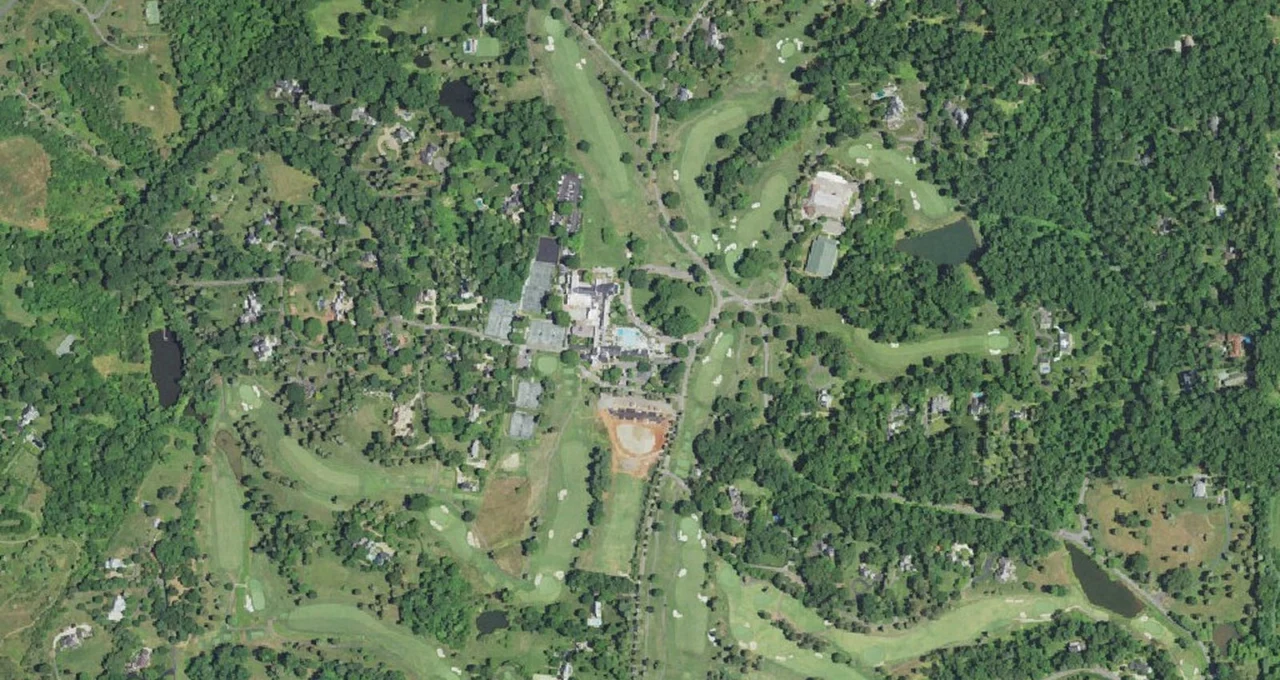
Farmington Country Club from the air. Aerial imagery USGS, domaine public.
Farmington Country Club
Holes
36
By
—
Length
—
Green fee
—
Best season
All year, with occasional winter closures
On 1 June 1927 the Warner Wood estate granted an option on the property known as Farmington, and on 27 August the club was incorporated. The main course, the original south and north nines, was laid out by Fred Findlay in 1927.
The clubhouse is older and more remarkable than the golf. Its octagonal east wing was designed by Thomas Jefferson and built in 1802, as an addition to a house that already stood before 1780. Jefferson’s Monticello is ten minutes away, and the University of Virginia he founded is closer still. There are few golf clubs anywhere whose front door was drawn by a head of state, and none in the United States where that head of state was also the architect of the university down the road.
What it asks of you
Rolling Piedmont ground at the foot of the Blue Ridge, with the mountains visible from the higher holes. Findlay’s routing works with the fall of the land rather than against it, and the greens are small and well defended in the style of the 1920s.
The Main Course plays to a par of 70 at a little under 6,800 yards from the back tees, with a rating of 71.6 and a slope of 128, which tells you it is a proper test without being a modern brute. Length is not the defense. Small targets, elevation change on the approach, and greens that punish the shot played from the wrong side are.
The property carries twenty-eight holes today, added over the decades, but the original nines remain the heart of it. Virginia’s climate keeps the course open most of the year.
What players say about it
Membership is by invitation and there is no visitor tee sheet, so the public record consists of guest accounts, listings and occasional member commentary rather than a body of reviews. The notes below summarize themes that recur across those public sources. They are other people’s opinions, not ours: we have not played the course, and we do not name or quote individual reviewers.
What comes up in its favor
- Conditioning is consistently well rated, with fairways and greens described as well groomed year round.
- The course is repeatedly placed among the strongest traditional layouts in Virginia, and the word that recurs is difficult but friendly.
- The setting draws comment from everyone who writes about it: Blue Ridge views from the high ground and a property that has been in continuous use since the eighteenth century.
- The Jefferson clubhouse is treated as a genuine attraction rather than a curiosity, and guests write about the building as much as the golf.
What comes up against
- Access is closed. Invitation-only membership means most golfers will never see it, and the review record is thin as a result.
- The course is short by modern standards and better players sometimes find it more charming than testing.
- Not all internal opinion is warm. Member commentary posted publicly has questioned whether the club is keeping the quiet dignity it was known for, which is unusual to see said out loud about a club of this kind.
- Twenty-eight holes assembled over a century do not read as one design, and the additions are not held in the same regard as the Findlay nines.
Getting there and when to go
Farmington is on the western edge of Charlottesville, minutes from the university and around two hours from Washington by road. Charlottesville has a small commercial airport; Richmond and Washington Dulles are the practical alternatives.
The course plays most of the year, with occasional winter closures. Spring and autumn are the best of it, and autumn in the Blue Ridge foothills is the reason to plan a visit for October. Guest play is arranged through a member.
Green fees
Guest conditions and rates are set by the club and are not published. See the club’s own site.
How this page was made
The factual frame comes from public sources: OpenStreetMap for the location, Wikipedia and published architecture and local history coverage for the club, the course and the clubhouse, and the club’s own site for access. The opinion section summarizes public commentary and guest accounts read in September 2026; we report recurring themes rather than individual voices, and we do not reproduce or attribute quotes.
We have not played this course, and nothing here is a substitute for that. The club has not paid for this page, has not seen it before publication and has no say in what it says. If you know the course and something here is wrong or out of date, write to us and we will correct it.