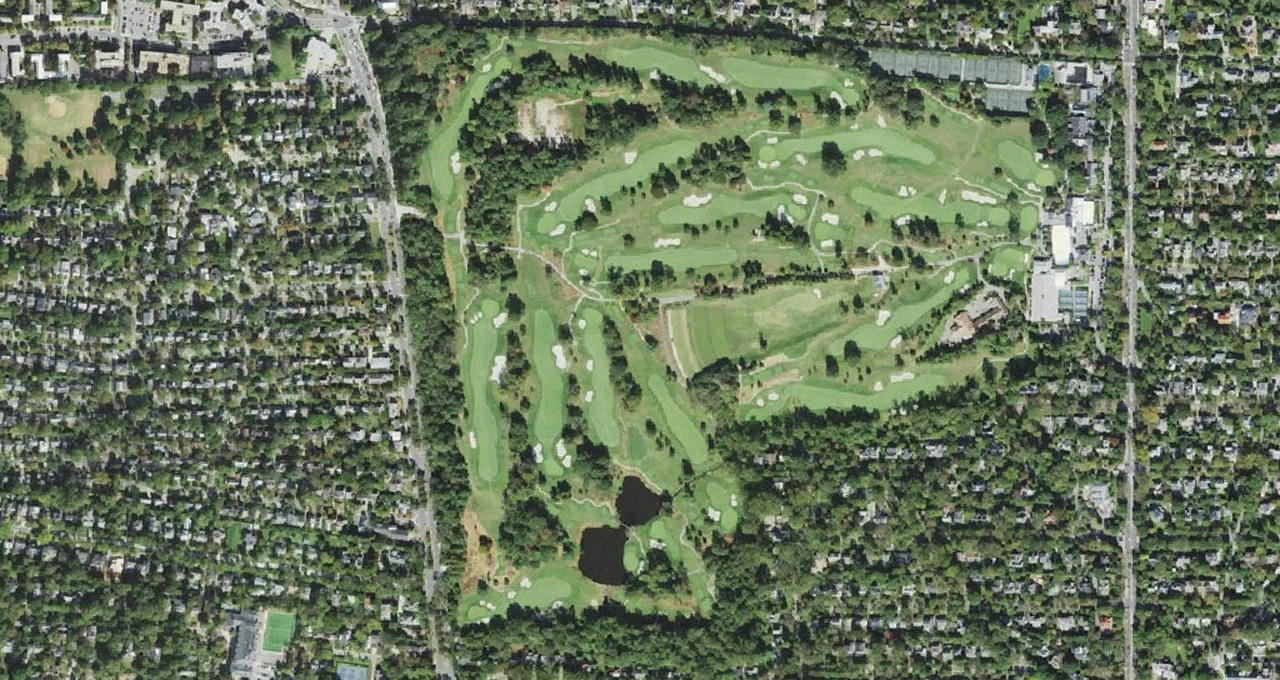
Chevy Chase Club from the air. Aerial imagery USGS, domaine public.
Chevy Chase Club
Holes
18
By
71 according to Golf Digest (2026) and one course directory; older directory scorecards show 70, and a 1984 superintendents' newsletter gave 69
Length
7,205 yards according to Golf Digest (2026); 7,140 yards on one directory's par-71 card; 6,803 to 6,911 yards on older par-70 cards (rating 73.6 to 73.8, slope 131 from the Black tees)
Green fee
—
Best season
—
Chevy Chase Club is a private club on Connecticut Avenue in Chevy Chase, Maryland, in the southern part of Montgomery County, just north of the District of Columbia line. The club gives its address as 6100 Connecticut Avenue, Chevy Chase, MD 20815. It was organized in the fall of 1892 by a group of men from the Metropolitan Club of Washington, D.C., and it began as a hunt club: golf arrived in 1895 with a course of six holes, the same year the United States Golf Association was founded, as the club likes to point out. Today it is a full country club, with a single 18-hole golf course alongside tennis, paddle tennis, swimming pools, duckpin bowling, an outdoor ice rink and a guest house, according to the club’s own description of its facilities.
The course has an unusually layered history. Donald Ross worked on it around 1910; Charles Hugh Alison, the partner of Harry Colt, reshaped it in the early 1920s, with William Flynn overseeing construction according to Golf Digest; Robert Trent Jones, Tom Clark and Arthur Hills followed. Most recently, Andrew Green carried out a renovation that began in 2024 and that Golf Digest named its Best Renovation of 2025. Golf Digest’s listing for that award gives the course as 7,205 yards and a par of 71. Older scorecards in course directories show a par-70 course of about 6,800 to 6,900 yards, and the figures differ from one source to the next, as explained below.
The club also has a place in championship history, though not a recent one. The USGA’s records list the 1908 U.S. Women’s Amateur at the Chevy Chase Club, and Wikipedia records that the 1934 Curtis Cup, the match between the women amateurs of the United States and of Great Britain and Ireland, was played there. Because the club is private, this page describes a course that most readers will only see from Connecticut Avenue or as a member’s guest.
From a fox hunt to a golf club
The best account we found of the club’s early years is “Early Days at the Chevy Chase Club,” an article by Joan F. Marsh published in November 2001 by the Montgomery County Historical Society in its quarterly, The Montgomery County Story. Marsh traces the club’s roots to a fox hunt organized in the 1880s in what was then farmland on the edge of Washington. It was fox hunting, she writes, not golf, that inspired the founding of the club. In the fall of 1892, a group of men, most of them members of the Metropolitan Club, met to formalize their plans; Francis G. Newlands, the developer of the new streetcar suburb of Chevy Chase and later a senator, promised that his Chevy Chase Land Company would help them acquire a permanent home. Wikipedia’s article on Chevy Chase names the original hunt club Chevy Chase Hunt.
In 1894 the club settled on a tract that included a pre-revolutionary frame house known as the Bradley Farmhouse, and in 1897 it bought that 9.36-acre tract, according to the club and Wikipedia. Golf came the following year after the move. Marsh tells the story: G. Thomas Dunlop, a Chevy Chase landowner, was introduced to the game by a friend in the summer of 1895, and Henry May, the president of the Washington Golf Club across the Potomac in Virginia, offered to help start it at Chevy Chase. The six-hole course opened on September 25, 1895. Quoting John Lynham’s history of the club, Marsh describes a first tee in front of the old clubhouse, a drive across Connecticut Avenue with its trolley tracks and overhead wires, four holes over the open fields of the Chevy Chase Land Company and a sixth hole played back across the avenue. Marsh notes that Chevy Chase cannot claim the first course in the Washington area: the Washington Golf Club had laid out nine holes in Arlington in 1894.
The six holes soon proved too few. Marsh writes that a nine-hole course was laid out over the Land Company’s property west of the club and that by 1898 an 18-hole course was already being contemplated. A short history published in September 1984 in the newsletter of the Mid-Atlantic Association of Golf Course Superintendents dates the nine-hole course to 1896 and the second nine to 1898, and says the club joined the USGA in December 1898. Golf Digest, in its 2026 renovation feature, credits Willie Davis with the original nine holes in 1896 and says they were expanded to 18 about two years later, probably by Willie Tucker, the club professional.
Ross, Alison and the course of the 1920s
The present course dates from the years around 1910, and here the sources start to diverge. According to Marsh, the club had acquired the land it was leasing by 1909, and its grounds then ran from Connecticut Avenue west to Wisconsin Avenue, with Bradley Lane as the northern boundary. Donald Ross was engaged to design what she calls a truly professional course, which opened in October 1910. The 1984 newsletter says the same in substance: the club bought the land of the present course in 1909, hired Ross to lay out a new course on a 195-acre site, and abandoned the old one when the new course was finished in 1910. The club’s own timeline speaks of the dedication of the new golf course in 1911, the year its new stone clubhouse was completed. Golf Digest, for its part, writes that Ross remodeled the existing holes rather than building a new course, and the architect J. Drew Rogers, who worked on the course in the 1990s, writes on his firm’s site that some accounts have Ross spending only a day on the property and making recommendations. Andrew Green told the GolfDC site in 2026 that the course has a Ross foundation and that Walter Travis also consulted, played the course and left notes.
The second chapter is better documented. The club commissioned a remodel in 1921 from the British firm that grouped Harry Colt, Charles Alison and Alister MacKenzie, and Alison, who handled most of the firm’s North American clients, is generally credited with the bulk of the design, according to the 1984 newsletter, which dates completion to 1923. The club’s timeline also says that Colt, MacKenzie and Alison completed a thorough reconstruction of the course in 1923. Top100GolfCourses.com dates Alison’s redesign to 1922, and Rogers writes that Alison visited in 1921 and did significant work in 1924. Golf Digest and Rogers both say that William Flynn did much of the site work, with Golf Digest adding the name of Flynn’s partner Howard Toomey.
The clubhouse belongs to the same period. Marsh writes that Jules Henri de Sibour designed the large stone clubhouse, finished in June 1911, and that Waddy B. Wood designed the new Bradley House, the guest building, after 1926. She also records President William Howard Taft’s verdict on the new clubhouse, which he called “the finest example of early penitentiary colonial architecture I have ever seen.” Taft, she writes, was the first of many presidents to enjoy the honorary membership the club offered to the President and Vice-President. In 1998 the club was included in the Chevy Chase Village historic district, with three of its buildings considered sufficiently unchanged to be listed: the main clubhouse, the old carriage house and the green and white gazebo on Connecticut Avenue, built in 1915 at the old trolley stop.
Championships and later changes
The 1908 U.S. Women’s Amateur, held October 19 to 24 according to the USGA’s records as quoted in search results, was won by Katherine Harley, who beat Mrs. T. H. Polhemus 6 and 5. It was played before the opening of the Ross course of 1910, so on the club’s earlier layout. In September 1934 the second Curtis Cup match came to Chevy Chase: the United States, captained by Glenna Collett-Vare, beat Great Britain and Ireland 6 and a half points to 2 and a half, according to Wikipedia. One club directory, privateIQ, says the club hosted the 1936 U.S. Women’s Amateur; Wikipedia gives Canoe Brook Country Club in New Jersey as the venue that year, and we follow Wikipedia. The club’s timeline also recalls that it hosted its first Davis Cup tie, between the United States and Japan, in 1929: tennis has long been the other great sport at Chevy Chase.
After the Second World War the course changed several times. The 1984 newsletter says Robert Trent Jones was brought in as a consultant in 1947 and that his ideas mostly concerned rearranging or eliminating Ross’s bunkers and redesigning several holes, including making the 11th a par 5; not all his suggestions were carried out. Rogers dates Jones’s influence to 1948 and mentions changes by Tom Clark around 1990. In 1984, the newsletter described the course as 6,500 yards and a par of 69, “still considered one of the best tests of golf in the Washington metropolitan area,” with greens of bent grass and Poa annua.
The club says Arthur Hills began a total renovation of the course in 1997. Rogers, who worked on it as a young associate of Hills, writes that Hills was hired in the early 1990s to re-examine the course and to solve a problem of irrigation water storage, and lists the work as completed in 1996. The project squared the tees, refined the greens, rebuilt the bunkering and added a storage lake at the back of the property, fed by runoff and a well. That lake, according to Rogers, required several holes to be reconfigured, and the old par-3 10th was dropped. Golf Digest gives a different reason: the 10th was lost in the 1990s to make room for tennis facilities. Rogers himself considered the bunkering of that era “not quite right” and suggested that a return to Alison’s character would be worthwhile.
The Andrew Green renovation
That return is what Andrew Green, an architect known for restoring Ross courses such as Inverness, Oak Hill and Scioto, set out to do. Top100GolfCourses.com says his renovation began in 2024 and lasted twelve months. Golf Digest’s feature, written by Derek Duncan and republished by Australian Golf Digest in January 2026, explains the central question: with so many architects in the course’s past, which era should a restoration follow? Green and the club chose Alison’s version, using aerial photographs from the early 1930s as their main reference, and added features from the turn of the century, such as linear mounding and raised grassy berms, identified in other photographs. Green told Golf Digest that the aerial guided the team toward recreating Alison’s “really unique greens and bunker shapes,” adjusted for modern distances.
The work, as Golf Digest describes it, expanded the greens to allow more varied hole locations, recreated Alison’s bunkers, widened the playing corridors and removed some trees. Grass-faced bunkers and Alison-style shaping of the greens were meant to give contrast to a course that had become, in Golf Digest’s words, sterile and standardized. A new par-3 15th was built as a tribute to the lost par-3 10th. Speaking to GolfDC in 2026, Green described historic greens that were large and full of character, and a club that “just oozed its history.” The project won Golf Digest’s Best Renovation award for 2025, the second in a row for Green after Interlachen.
What the course asks of you
We could not find a scorecard published by the club after the renovation, and the directories disagree, so the following should be read with that in mind. Golf Digest gives 7,205 yards and a par of 71. OpenGolfAPI, a course database, shows a par-71 card of 7,140 yards from the longest tees, with three par 5s (the 6th, 8th and 11th) and four par 3s (the 4th, 9th, 12th and 15th), although the same page lists the Black tees at 6,911 yards with a rating of 73.6 and a slope of 131, which does not add up. Stymie, another directory, shows an older par-70 card of 6,803 yards from the Black tees, with a rating of 73.8 and a slope of 131, and eleven sets of tees down to 3,958 yards; on that card the par 5s are the 8th, at 595 yards, and the 10th, at 481 yards. Whatever the exact figures, the slopes in the low 130s describe a course that is clearly harder than average for a mid-handicapper, without being among the most punishing in the region.
A few features come up consistently in the sources:
- The ground. The course occupies gently rolling land between Connecticut and Wisconsin Avenues. Reviewers on Top100GolfCourses.com describe modest changes of elevation that make for a pleasant walk, and one finds the land less dramatic than that of Congressional Country Club, a few miles away.
- The greens. Alison’s greens were large and strongly shaped, and Green’s renovation expanded them again. A reviewer who played after the renovation describes them as large and heavily undulating, kept at a sensible speed so the slopes remain playable; a reviewer writing in 2023, before the work, already named the severe slope of the greens as the course’s main defense.
- Water. Reviewers mention creeks and ditches that shape the strategy on several holes, and Rogers describes the storage lake built in the 1990s at the back of the property.
- Width and firmness. The 2023 reviewer found wide fairways and a course kept fast and firm, and the 2026 reviewer writes that the firm turf rewards a ground game.
Individual holes are harder to describe from public sources. The hole most tied to the club’s history is the 15th, the par 3 that Green built as a nod to the original 10th. Among holes singled out by reviewers, a reviewer in June 2026 named the 8th, the 14th and the 10th as the best on the course; on the Stymie card the 8th is the longest hole, a par 5 rated the third-hardest. The 2023 reviewer enjoyed the short par 4 at the 5th or 6th; on the older card, the 5th is a par 4 of 350 yards from the back tees. We do not know how much these holes changed in the renovation.
What golfers say
Public opinion on Chevy Chase is thin. The club sells no tee times, so the booking platforms and apps that supply most reviews of public courses carry little about it, and the GolfPass pages we tried to read were not accessible to us. The views summarized here come from the three player reviews on Top100GolfCourses.com (dated August 2023, November 2025 and June 2026, when we read them in October 2026), from the site’s own description, which ranks the course third in Maryland, and from the comments of the architects who worked on it. They are other people’s opinions, not ours, and we name no reviewer.
What comes up in its favor
- The renovation. The reviewer who played the course before and after Green’s work writes that it transformed the course, that the greens and their surrounds now offer more options and that some holes have a links feel. He places it among the top three courses in Maryland.
- Presentation and conditioning, which the 2026 reviewer describes as excellent, with firm, fast turf.
- Strategy and playability: the same reviewer finds real architectural nuance and compares the course to a more member-friendly Oak Hill, and the 2023 reviewer calls it a good course with some fun holes.
- The history. Golf Digest’s feature and Green’s interview both dwell on the depth of the club’s past, and Rogers called the course “a true classic in every sense.”
What comes up against
- The land. One reviewer finds the terrain less dramatic and less exceptional than at nearby Congressional.
- Its pre-renovation state. The November 2025 reviewer writes that later work, which he attributes to Robert Trent Jones, had cost the course many of its Golden Age features, and Rogers judged the bunkering of the 1990s not quite right. These are criticisms of the course before 2024.
- Some reservations remain after the renovation: the 2026 reviewer rates strategy and variety at 3 out of 5, below the green complexes at 4, and finds Green’s hand more visible than Alison’s.
- Before the renovation, the 2023 reviewer saw the slope of the greens as the main defense, which suggests a course with less to say from tee to green.
With three reviews, this is a small sample, and any individual opinion carries a lot of weight. A course this recently renovated will also look different from one review to the next.
Getting there and playing
Chevy Chase Club is private. Course directories describe play as limited to members and their guests, with tee times arranged through a member, and the club’s public website addresses guests with a dress code, a device policy and other rules. We were unable to read those policies, so guests should ask their host. The club describes its grounds as offering year-round recreation but publishes no golf season on the pages we could read; in practice, play in the Washington area depends on winter weather and on the club’s decisions. Stymie says walking is permitted and carts are available, and privateIQ lists motor carts, pull carts and caddie service; we could not confirm these points with the club.
The club sits on the west side of Connecticut Avenue, just north of Chevy Chase Circle, which marks the boundary between Maryland and the District of Columbia; Marsh notes that the 1915 gazebo stands where the old trolley line stopped at the club. The 1984 newsletter gave directions from the Capital Beltway, I-495: take Connecticut Avenue toward Washington and turn right through the gate in the stone wall just after Bradley Lane. In a straight line, the club is about 6 miles northwest of the White House and about 9 miles north of Ronald Reagan Washington National Airport. These distances are measured on the map, not by road. There is nothing for the public to visit on the course.
How we built this page
The factual frame comes from public sources: OpenStreetMap for the location; Wikidata for the address, the postal code, the founding year and the clubhouse architects; the club’s website, chevychaseclub.org, as archived by the Internet Archive in 2025 and 2026, for its history, timeline, facilities and address (the live site refused our automated requests); Joan F. Marsh’s 2001 article for the Montgomery County Historical Society for the early years; the September 1984 newsletter of the Mid-Atlantic Association of Golf Course Superintendents for the Ross, Alison and Jones periods and the course as it was then; Wikipedia for the founding, the Curtis Cup and the 1936 Women’s Amateur; the USGA’s records, as quoted in search results, for the 1908 Women’s Amateur; Golf Digest’s 2026 feature on the best renovations of 2025, read through Australian Golf Digest and Golf Digest’s digital edition, for the lineage and the renovation; GolfDC’s interview with Andrew Green; J. Drew Rogers’s project page; Top100GolfCourses.com for the dates, the Maryland ranking and the reviews; and the Stymie, OpenGolfAPI and privateIQ directories for the scorecards and services.
Where sources disagree, we say so. The origins of the 18-hole course vary: a nine-hole course in 1896 and 18 holes in 1898 for the 1984 newsletter and Golf Digest, while Marsh says 18 holes were only being contemplated in 1898. The Ross course opened in October 1910 for Marsh and in 1910 for the newsletter and most directories, but the club dates its dedication to 1911. Ross designed a new course for Marsh and the newsletter, remodeled existing holes for Golf Digest, and may have spent only a day on site, according to accounts cited by Rogers. Alison’s work is dated 1921 (commission), 1922 (Top100GolfCourses.com), 1923 (the club and the newsletter) or 1924 (Rogers). Jones’s involvement is dated 1947 or 1948, and Hills’s renovation 1996 (Rogers) or 1997 (the club). The old 10th was lost to a storage lake according to Rogers and to tennis facilities according to Golf Digest. The par was 69 in 1984, is 70 on older directory cards and 71 for Golf Digest and OpenGolfAPI; the longest tees measure 6,500 yards in 1984, 6,803 or 6,911 yards on par-70 cards, and 7,140 or 7,205 yards on par-71 cards. One directory’s claim that the club hosted the 1936 U.S. Women’s Amateur is contradicted by Wikipedia. The club’s founding year is 1892 for the club, Wikipedia and Wikidata; one directory gives 1894, the year the club moved to its permanent site.
Some details will age: the scorecards, which will be updated after the renovation, the course ratings, the rankings, the review count read in October 2026 and the guest rules. The opinion section reports recurring themes rather than individual voices. Nobody from Panxis has played or visited this course, and this page is no substitute for a round.
The club has not paid for this page, has not seen it before publication and has no say over its content. This page contains no commercial link and earns us no commission. If you know the club and something here is wrong or out of date, write to us and we will correct it.
Other courses nearby
Closest to this one in our United States directory:
- Columbia Country Club — 1 mi
- Congressional Country Club — 5 mi
- East Potomac Blue Course — 8 mi
- Langston Golf Course — 8 mi
The hole to know
A par 3 built during Andrew Green's renovation, begun in 2024, as a tribute to the original par-3 10th, a hole lost in the 1990s (to tennis facilities according to Golf Digest, to an irrigation storage lake according to the architect J. Drew Rogers).