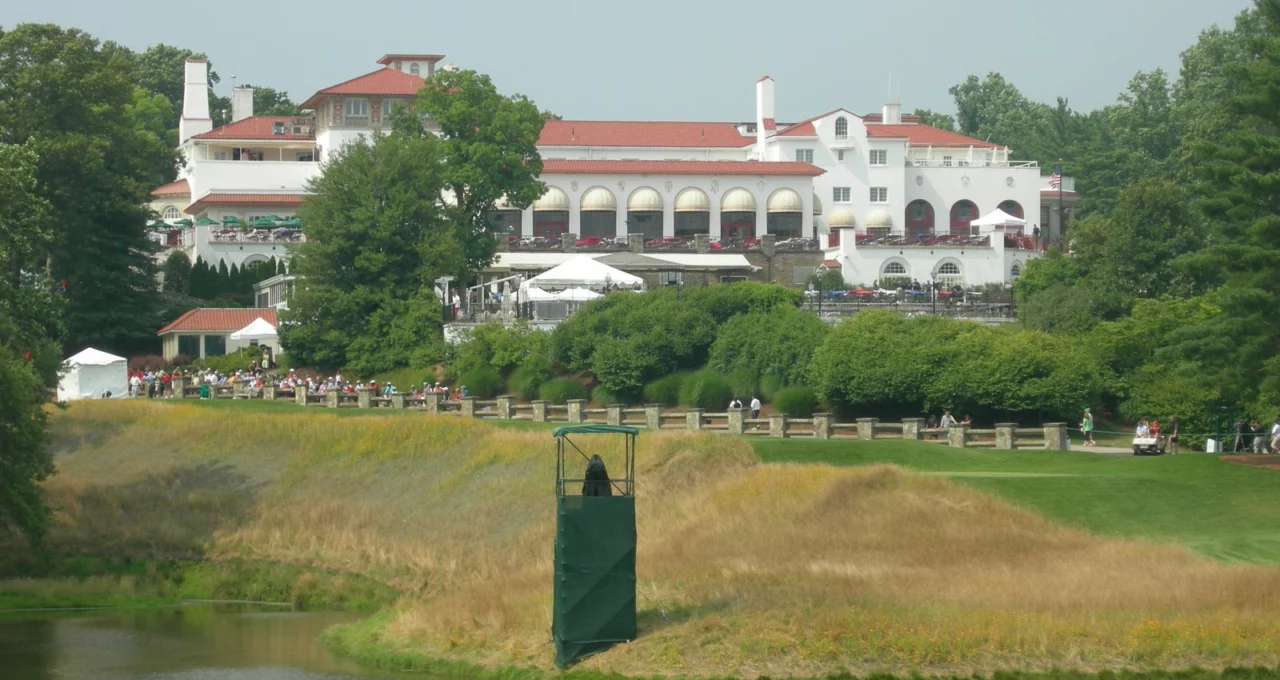
Congressional Country Club — Photo Carl Lindberg / Wikimedia Commons, CC BY 2.5
Congressional Country Club
Holes
36 (Blue and Gold courses)
By
72 (Blue)
Length
—
Green fee
—
Best season
Roughly March to November
Congressional was established in 1924 outside Washington, founded by members of Congress and businessmen who wanted a club within reach of the Capitol, which is where the name and much of the membership came from. The Blue Course was laid out by Devereux Emmet and substantially reworked by Robert Trent Jones ahead of the 1964 U.S. Open. It has staged five major championships: U.S. Opens in 1964, 1997 and 2011, and a PGA Championship, along with a long list of tour and USGA events.
The course that exists today is younger than any of that. In 2020 the club commissioned Andrew Green, prompted by drainage problems and declining conditions, and what he delivered was less a renovation than a reimagining: more than a thousand trees removed, green complexes rebuilt, and a course reshaped toward something closer to what Emmet might have drawn in the first place.
What it asks of you
A par 72 across Maryland parkland with genuine elevation change, which the Trent Jones work amplified and the Green work has now put back into view. The clubhouse is visible from all eighteen holes, which was not true before the trees came down, and much of the rest of the course is visible from each hole.
It is long, and the rough is thick, but it is not tricked up. There are few forced carries, few hazards in the ordinary sense, and a wide set of tees. The examination is in the green complexes, which reject an approach played from the wrong angle and which allow hole locations, the fourteenth in particular, that make a two-putt genuinely difficult.
The eighteenth, played to a green beside the lake, is the hole the Opens are remembered for. It has been played as both the closing hole and, in 1964, as the seventeenth.
What players say about it
Access is by membership or a member’s invitation, so the public record is made up of tournament coverage, architecture writing, rating panels and guest accounts. The notes below summarize themes that recur across those public sources. They are other people’s opinions, not ours: we have not played the course, and we do not name or quote individual reviewers.
What comes up in its favor
- The 2020 work is very well received. More than one architecture writer describes it as having turned one of the duller major venues into one of the more interesting ones.
- The tree removal is the single most praised decision. Sightlines, aesthetics and strategy all improved by common consent.
- Fairness is a recurring compliment: long and demanding, but with enough tees and few enough forced carries that a shorter hitter can still play it.
- The green complexes are credited as the real defense, and the variety of questions asked from hole to hole gets consistent praise.
What comes up against
- The aesthetic divides opinion. Some reviewers find the finished product somewhat artificial, a modern championship venue rather than a restored classic.
- The rough is thick, and the course is long enough that a mid-handicapper from the wrong tees will have a hard afternoon.
- Purists note that whatever Emmet drew is long gone, and that the current course is Green’s work referencing Emmet rather than Emmet’s course recovered.
- Access is closed. There is no visitor tee sheet, and the review record depends on invitations and tournament weeks.
Getting there and when to go
The club is in Bethesda, Maryland, around half an hour from downtown Washington outside rush hour and forty minutes from Dulles. There are two courses on the property, the Blue and the Gold; the Blue is the championship course and the reason to come.
The season runs from roughly March to November. Late spring and September give the firmest turf; Washington summers are humid and the course plays softer. Guest play is arranged through a member.
Green fees
Guest conditions and rates are set by the club and are not published. See the club’s own site.
How this page was made
The factual frame comes from public sources: OpenStreetMap for the location, Wikipedia and published architecture coverage for the history, the championships and the 2020 renovation, and the club’s own site for access. The opinion section summarizes public commentary and guest accounts read in September 2026; we report recurring themes rather than individual voices, and we do not reproduce or attribute quotes.
We have not played this course, and nothing here is a substitute for that. The club has not paid for this page, has not seen it before publication and has no say in what it says. If you know the course and something here is wrong or out of date, write to us and we will correct it.