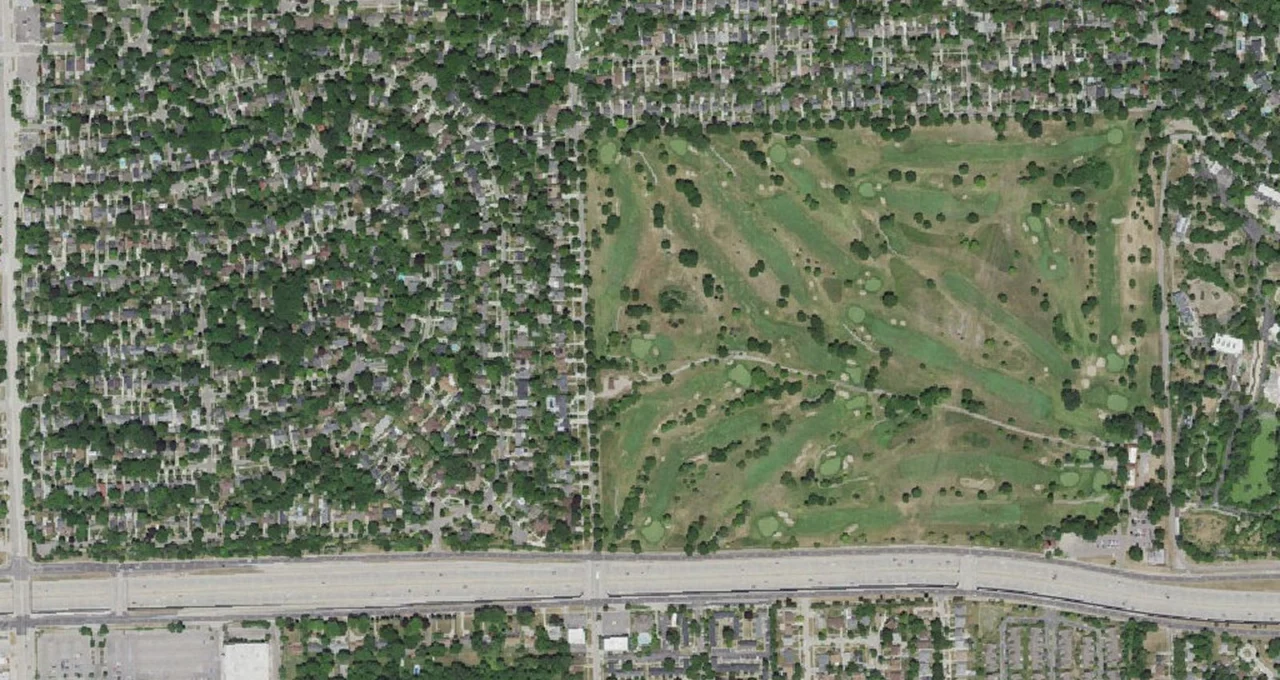
Rackham Golf Course from the air. Aerial imagery USGS, domaine public.
Rackham Golf Course
Holes
18
By
71
Length
6,555 yards from the Back tees on the course's scorecard (rating 71.6, slope 129); Wikipedia gives a rating of 70.8 from an older source
Green fee
—
Best season
The course gives daily hours of 8 a.m. to 8 p.m., closing at dusk, weather permitting; it publishes no season dates
Rackham Golf Course is a public 18-hole course at 10100 West Ten Mile Road in Huntington Woods, Michigan, a small city in Oakland County just north of Detroit. It sits beside the Detroit Zoo, with Interstate 696 running alongside it, and it belongs to the City of Detroit even though it lies outside the city limits. The course was laid out by Donald Ross, opened to the public on May 19, 1925, according to the state historical marker that stands by the clubhouse, and is today run for the city by Troon, the golf management company, under the Golf Detroit name.
On the scorecard the course publishes, it is a par 71 of 6,555 yards from the back tees, with a course rating of 71.6 and a slope of 129. It has hosted two national championships, the U.S. Amateur Public Links of 1940 and 1961, and it holds a particular place in the history of Black golfers in America through Ben Davis, its longtime professional, and the boxer Joe Louis, who played and hosted an amateur event there. The course itself says it has been named one of Donald Ross’s ten best public courses; it does not say by whom.
A gift with conditions attached
The land came from Horace Rackham, the Detroit lawyer who made his fortune as one of the first shareholders of the Ford Motor Company, and from his wife Mary. According to the historical marker, erected in 2022 by the Michigan Historical Commission, the couple acquired 150 acres from the Baker Land Company in 1923, while the company was laying out the subdivisions of what would become Huntington Woods. They gave 22 acres to the Detroit Zoo, which Wikipedia says became its parking lot, and had a golf course built on the rest. Wikipedia adds that Horace Rackham, then the first president of the Detroit Zoological Commission, had promised the land on condition that Detroit voters approve financing for the zoo.
In 1924 the Rackhams deeded the finished course and its clubhouse to the City of Detroit. The deed, quoted in full by the Michigan Court of Appeals in 2008, sets out several conditions: the premises must be “perpetually maintained” exclusively as a public golf course for the use of the public, the course and its turf must be kept at a standard at least equal to their condition at the time of the gift, alcoholic beverages were not to be brought onto, kept, used or sold on the premises, and if any condition is broken the property reverts to the Rackhams and their heirs. The court also notes that the earlier deed from the Baker Land Company already required the land to be used only as a public park, golf course or similar purpose.
Those clauses mattered eighty years later. In 2006, with the city in financial difficulty, Detroit considered an unsolicited $5 million offer from a private company, Premium Golf, and then issued a request for proposals with a minimum price of $6.25 million. The City of Huntington Woods, which had made its own offer, and several residents sued in June 2006. On July 15, 2008, the Court of Appeals ruled that the deed contains an express covenant limiting the land to use as a public golf course, that Detroit must obtain waivers from the holders of the reversionary rights before any sale, and that the property can only be sold to another public entity, not to a private buyer. The court describes the property as about 121 acres. Rackham has stayed a city course since.
The clubhouse, Ben Davis and Joe Louis
The clubhouse is an Arts and Crafts building by the Detroit architect Niels Chester Sorensen, decorated, according to the marker, with earth-tone and turquoise tiles from Detroit’s Pewabic Pottery and decorative brick panels inside and out. The marker also records Horace Rackham’s own description of his gift: “beautifully greened, smoothly fairwayed, cunningly roughed and expertly bunkered.”
The marker calls Rackham one of the first public 18-hole courses in Michigan and, for many years, one of the few integrated golf courses in the country. Its best-known figure is Erellon Ben Davis (1912-2013), who taught there for more than fifty years. Born in Pensacola, Florida, he moved to Detroit in 1925, according to the course’s own tribute, and became the first African American head professional at a municipal course in the United States. He counted Joe Louis among his pupils, and the marker says Louis began holding an invitational at Rackham in 1941. Davis was the first African American member of the Michigan Section of the PGA, in 1966 according to the course, won the Michigan PGA Seniors title in 1974 and entered the Michigan Golf Hall of Fame in 1992. The sources do not agree on when his Rackham career began, as explained in the method section below. The course’s amateur championship, the Ben Davis Detroit Open, carries his name; its 2026 edition was played on September 19 and 20.
Two national championships
USGA records list Rackham as the venue of two U.S. Amateur Public Links championships, the national title for players without a private club, which was last played in 2014.
- 1940, July 22 to 27: Robert C. Clark beat Michael Dietz 8 and 6 in the final. Edward J. Furgol and Worth Stimits Jr. shared the medal at 138, and the USGA counts 2,601 entries.
- 1961, July 10 to 15: Richard H. Sikes beat John A. Molenda 4 and 3, after also taking the medal with 135. He won the title again the following year elsewhere.
A front nine reshaped by a freeway
The course is not entirely the one Ross left. According to Wikipedia, the original front nine closed in October 1983 because of the extension of I-696 through the area, and the reworked holes reopened about two and a half years later; the historical marker says the freeway took ten acres from the property in the mid-1980s. Wikipedia states that the 7th and 9th are the only front-nine holes left untouched from the Ross plan, while a 2025 series on Detroit municipal golf by the Great Lakes Loops newsletter says the original front nine no longer exists. The bunkers were renovated in 2007, according to the course and the marker. A golf course directory also lists Bruce Hepner (1993), Jerry Matthews and Ray Hearn (2017) among the architects who worked on the course, without detailing what each did; we found no primary source to confirm those entries.
The course’s condition has followed the city’s finances. The Great Lakes Loops series, drawing on a National Golf Foundation study ordered by Detroit in 2018, describes years of deferred investment across the city courses, then a management contract with Signet Golf Associates from 2018, capital spending of $2.5 million, and the arrival of Troon in 2024. The same author calls Rackham the most successful of the three remaining city courses. A tee-time and review site placed it 13th on its 2019 list of the most improved courses in the United States.
What it asks of you
The layout is short by modern standards and has no water hazards, as Wikipedia notes. Its defense is in the greens. The course’s own hole-by-hole guide returns again and again to the same theme: greens that slope from back to front, which it calls a Ross signature, with run-offs at the sides and bunkers close around them. The recurring advice is to miss short and stay below the hole. Trees and long grass do the rest: the guide warns that a ball in the long grass left of the 9th is almost always lost.
The published card gives the following pars and back tee yardages. The front nine is a par 36 of 3,196 yards, the back nine a par 35 of 3,359 yards.
- 1st: par 5, 530 yards. Out of bounds along I-696 on the left; long hitters can reach in two.
- 2nd: par 4, 326 yards. Willows on the left, fairway bunkers on the right, a green sloped severely from back to front.
- 3rd: par 4, 376 yards. A dogleg left; the guide calls it and the 4th risk-and-reward holes.
- 4th: par 4, 364 yards. A dogleg right that can be cut over the trees with a carry the guide puts at 250 to 280 yards.
- 5th: par 3, 166 yards. One of the hardest greens on the course, with run-offs on both sides.
- 6th: par 4, 322 yards. A short slight dogleg left that long hitters can try to drive.
- 7th: par 5, 507 yards. Reachable in two, to a small, raised green.
- 8th: par 3, 185 yards. Bunkers all around; missing left leaves a chip from under the trees.
- 9th: par 4, 420 yards. The longest par 4 on the front nine.
- 10th: par 4, 451 yards. The longest par 4 on the course, with two pot bunkers on each side of the green, and the second hardest hole for men on the card.
- 11th: par 4, 424 yards.
- 12th: par 4, 348 yards. A raised green sloped steeply from back to front.
- 13th: par 3, 213 yards. A large, “turtle”-shaped green behind a big bunker on the right.
- 14th: par 5, 519 yards. Out of bounds along the whole left side.
- 15th: par 4, 387 yards. The zoo is on the left, out of bounds, and the guide mentions views of its train and giraffes; a large bunker in the middle of the fairway hides the landing area.
- 16th: par 3, 220 yards. The longest short hole, exposed to the wind.
- 17th: par 4, 349 yards. The easiest hole on the men’s card.
- 18th: par 4, 448 yards. The hardest hole for men on the card, and a par 5 for women; a bunker sits about 80 yards short of the green.
The card lists four sets of tees. For men, the Back tees are rated 71.6 with a slope of 129, the Middle tees (6,268 yards) 69.9 and 124, and the Silver tees (5,774 yards) 67.9 and 118. For women, the Silver tees are rated 74.5 with a slope of 132 and the Forward tees (5,316 yards) 71.4 and 126, on a par of 72. The card also suggests a set of tees by handicap: Back for men up to 14, Middle from 15 to 24, Silver from 25 to 32 and Forward beyond.
For a club golfer the course is less about length than about the approach. Three of the four par 3s measure 185 yards or more from the back, and the back nine opens with two long par 4s.
What golfers are saying
As a busy public course near a large city, Rackham has hundreds of public reviews, mostly on tee-time and review sites, plus pieces by golf writers and bloggers. One such site showed an average of 4 out of 5 from 356 reviews in October 2026. The points below summarize what recurs. They are other people’s opinions, not ours; nobody from Panxis has played the course, and we name no one.
What comes up in its favor
- The greens are the most praised feature: large, undulating and, in many recent reviews, quick and in good condition.
- Value for money for a Ross design so close to Detroit comes up often.
- Reviewers repeatedly mention friendly staff, from the shop to the starter.
- The history, the clubhouse and the setting count for a lot, including the giraffes visible from the back nine.
- One reviewer notes that the course held up well after heavy rain, thanks to the staff’s drainage work.
What comes up against
- Pace of play is the main complaint: five-hour rounds on weekends are described as normal, even with a ranger on the course.
- Conditions have varied over the years, and some reviews, especially older ones, describe the greens as rough.
- Outings can take over the course; one reviewer could only play six holes.
- For those who come for Ross, one golf writer points out that the original front nine no longer exists since the I-696 works.
Who can play
Rackham is open to everyone. Tee times are booked online through the course’s booking page or by phone with the golf shop at (248) 543-4040, and residents receive a discount on presentation of proof of residence, according to the rates page. The course says it is open daily from 8 a.m. to 8 p.m., closing at dusk, weather permitting. Walking is allowed. Carts are available, with rules set by the course: drivers must be at least 18 with a valid license, two people per cart, and non-playing riders are charged as golfers on weekdays and not allowed on weekends. Children under six are not permitted on the course. There is a chipping and putting green, but the course does not list a driving range. It also hosts leagues and outings, and its website has a page on First Tee Greater Detroit.
Getting there
The entrance is on West Ten Mile Road, about 0.9 miles west of Woodward Avenue, according to the historical marker, which stands between the parking lot and the clubhouse. The course says it is a few minutes from I-696 and I-75. In a straight line, downtown Royal Oak is about a mile and a half away, downtown Detroit about 12 miles and Detroit Metropolitan Airport about 21 miles. These distances are measured on the map and not by road.
Green fees
Rackham is a public, pay-and-play course, and it publishes its own rates for 18 and nine holes, walking or with a cart, with separate weekday and weekend rates, reduced rates for seniors and juniors, a small discount for Huntington Woods residents and access for Youth on Course members. Rates change from season to season, so check them on the course’s own rates page before you book.
How this page was made
The factual frame comes from public sources: OpenStreetMap for the location; the course’s website, rackham.golf, for the scorecard, the hole-by-hole guide, the address, the hours, the rates page, the cart rules, the 2007 bunker work, the clubhouse architect and the tribute to Ben Davis; the Michigan historical marker L2246, as transcribed by the Historical Marker Database, for the land purchase, the opening date, the clubhouse tiles, the integration of the course, the Public Links championships and the I-696 land loss; the 2008 opinion of the Michigan Court of Appeals in City of Huntington Woods v. City of Detroit for the deeds and the attempted sale; USGA records for the two Public Links finals; Wikipedia and Wikidata for the zoo agreement, the I-696 works and the identifiers; trade press for the Troon contract; the Great Lakes Loops newsletter for the recent management history; tee-time and review sites for the course directory data and the reviews.
Where sources disagree, we say so. The founding date varies: 1923 for the land purchase and in Golf Detroit’s description, 1924 for the gift to the city and in Wikipedia, May 19, 1925, for the opening. The course’s home page gives 6,253 yards for the middle tees and 5,413 for the forward tees, while its scorecard totals 6,268 and 5,316; this page follows the card. Wikipedia gives a rating of 70.8 from an old source, against 71.6 on the card on the course’s website, an image file uploaded in 2018 that the course still links as its scorecard. The dates of Ben Davis’s career conflict: the marker says the course hired him in 1936 to teach Black golfers and made him head professional in 1968; the course says he began giving lessons at a Ferndale driving range in 1936, joined Rackham in 1952 and became head professional two years later; the Great Lakes Loops newsletter dates his head pro appointment to 1952. Wikipedia and the newsletter differ on how much of the original front nine survives. The clubhouse architect’s name is spelled Sorensen by the course and Sorenson on the marker. Some directories point to rackhamgolfcourse.com, which is not the course’s own website; the official site is rackham.golf. Management and the Detroit Open dates are those published in October 2026 and will change.
The opinion section summarizes reviews on tee-time and review sites, read in October 2026. We report recurring themes rather than individual voices. Nobody from Panxis has played or visited this course, and this page is no substitute for a round.
The course has not paid for this page, has not seen it before publication and has no say over its content. This page contains no commercial link and earns us no commission. If you know the course and something here is wrong or out of date, write to us and we will correct it.
The hole to know
A par 4 of 448 yards from the Back tees and the hardest hole for men on the card (a par 5 for women): a solid drive is needed to reach in two, and a bunker about 80 yards short of the green catches the lay-up, according to the course's hole guide.