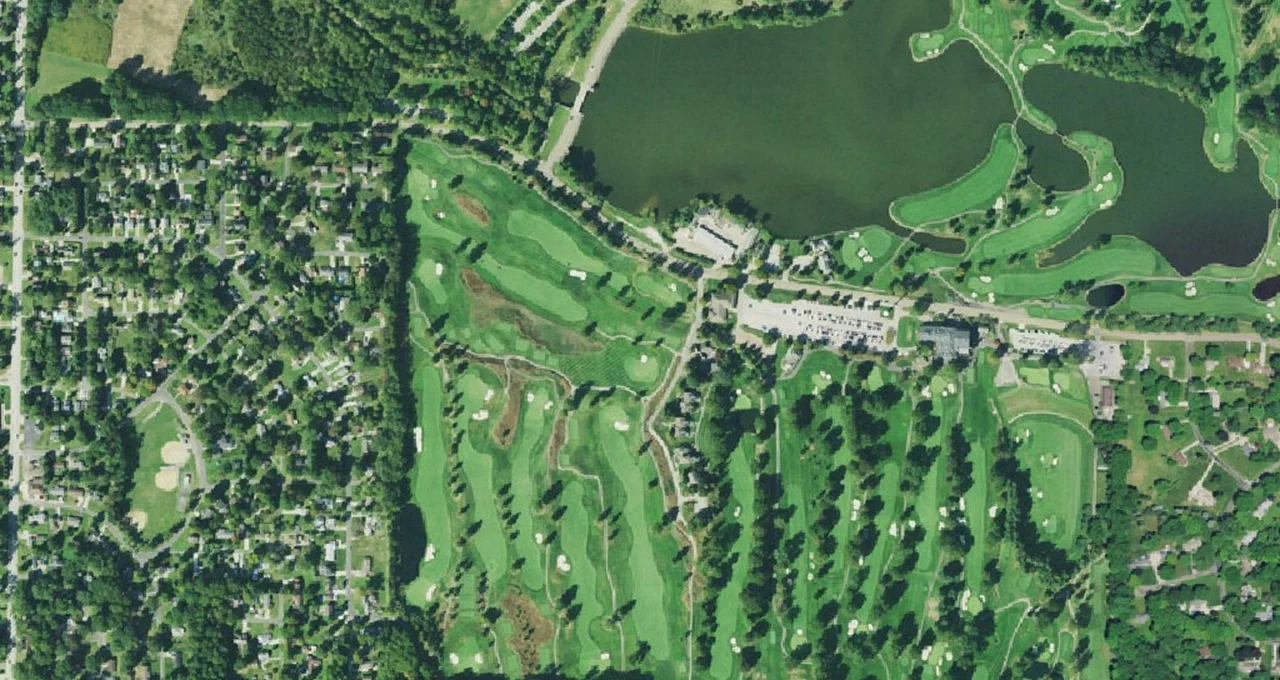
Firestone Country Club from the air. Aerial imagery USGS, domaine public.
Firestone Country Club
Holes
18
By
70
Length
7,400 yards from the Blue tees on the club's scorecard (rating 76.1, slope 132); encyclopedic entries give 77.0 and 148
Green fee
—
Best season
—
Firestone Country Club is a 54-hole private club in Akron, Ohio, at 452 East Warner Road, in the south of the city. Its three courses are the South, the North and the Fazio, which the club still notes was formerly called the West Course. The South Course is the one the golf world knows: for more than seventy years it was a fixture of professional golf, from the Rubber City Open of 1954 to the Kaulig Companies Championship of July 2026, the last tour event played there.
The club began as a company project. Harvey S. Firestone, founder of the Firestone Tire and Rubber Company, commissioned it in 1929 as a park for his employees, and the South Course opened on August 10, 1929, with Firestone hitting the first ball, according to encyclopedic entries. The original course was designed by Bert Way. The Firestone family sold the club to ClubCorp in 1981; its pages now sit on the website of Invited, the club group’s current name.
Three courses, one famous one
The South Course took its modern shape in 1960. To prepare it for that year’s PGA Championship, Robert Trent Jones Sr. added more than fifty bunkers and two ponds, lengthened the course and set it at par 70, as both the club and encyclopedic entries describe. Encyclopedic entries add that the 1960 rebuild brought it to 7,165 yards, and that it was renovated again in 2007 by Golforce.
The club’s scorecard gives the South Course as a par 70, with a par 35 on each nine, at 7,400 yards from the Blue tees, with a course rating of 76.1 and a slope of 132. The other sets are the Hybrid tees, rated 73.9 and 129, the White tees, 71.6 and 124, the Green tees, 69.0 and 118, and the Red tees, rated 70.4 and 123. Adding up the club’s hole-by-hole table gives 3,702 yards on the front nine and 3,698 on the back from the Blue tees. Sources differ on the rating: Wikidata records the same slope of 132 as the club, but the English-language encyclopedia entry lists a rating of 77.0 and a slope of 148, figures that match no tee on the current card. We follow the club. For the 2026 Kaulig Companies Championship, the PGA TOUR listed the course at 7,248 yards, a tournament setup rather than a set of member tees.
The North Course is also a Robert Trent Jones Sr. design, opened in 1969. The club describes a par 72 parkland course that bends around the Firestone Reservoir, with water in play on more than half the holes, doglegs both ways and large, quick greens. It measures 7,125 yards from the Gold tees (rating 74.8, slope 134), 6,741 from the Blue, 6,388 from the White and 5,589 from the Red. Encyclopedic entries give the same 7,125 yards but older ratings of 74.2 and 139. The North hosted the World Series of Golf in 1994, played that year at par 70 and 6,918 yards, and its signature is the island-green par 3 17th.
The third course is where sources disagree most. The club presents the Fazio Course as a Tom Fazio design built in 1989 and redesigned in 2021 by Tom Fazio Architects, a links-style par 70 of 6,904 yards from the Gold tees, rated 73.5 with a slope of 128. Encyclopedic entries say it was conceived by Geoffrey Cornish and Brian Silva, opened in 1989 and redesigned by Tom Fazio in 2002. We cannot settle the point from the sources we read, and we report both versions. The Fazio Course is the current home of the Ohio Senior Open.
Encyclopedic entries also mention a driving range opened in 1994 and a nine-hole course named after Raymond C. Firestone, opened for public play in 1995. The club’s current pages do not describe it, and we have not confirmed that it is still in operation.
What it asks of you
The South Course is long, straight and narrow. The club describes tree-lined fairways, elevation changes and firm, fast greens with severe false fronts, and the scorecard confirms the pattern: from the Blue tees, eight of the twelve par 4s measure more than 440 yards, and there are only two par 5s to offer relief. A rating of 76.1 from the back tees is high, and it says the course is hard for a scratch player; the slope of 132 says the extra difficulty for a higher handicap is real but not extreme. Most club golfers will be better served by the Hybrid tees, which add up to 6,907 yards in the club’s hole-by-hole table, or the White tees, at 6,454.
The demands are about the same from the first tee to the last: a drive that finds a fairway framed by trees and bunkers, then a long iron or hybrid to a raised green that rejects anything short. Reviewers of the course often mention perched greens, and the false fronts described by the club punish an approach that comes up a yard short. Recovery is difficult once out of position.
The front nine
The course opens with a par 4 of 399 yards from the Blue tees, followed by the 2nd, the only par 5 on the front nine, at 526 yards; the club describes it as uphill to a three-tier green. The 3rd is a par 4 of 442 yards that several reviewers count among the best holes on the course. The 4th is a par 4 of 471 yards and the 5th a par 3 of 200 yards on the scorecard table, though the club’s hole description gives 221.
The 6th, a par 4 of 469 yards from the Blue tees, is the No. 1 handicap hole on the card, and the club says it is the hardest hole at Firestone for the professionals. The 7th is a par 3 of 219 yards, the 8th a par 4 of 482 yards and the 9th, at 494 yards, the longest par 4 on the course.
The back nine
The back nine starts more gently, with par 4s of 410 and 418 yards at the 10th and 11th, and the 12th, a par 3 of 180 yards. It then stiffens: the 13th is a par 4 of 471 yards, the 14th a par 4 of 467 and the 15th a par 3 of 221 yards on the scorecard table, while the club’s hole tips speak of about 160 yards, the length of the Hybrid and White tees.
The 16th is the hole that gave the course its nickname. It is a par 5 of 667 yards from the Blue tees, with a pond in front of the green; the club advises that laying up is often the wise play. At the 1960 PGA Championship, Arnold Palmer made a triple bogey there and called the course a monster, and the name stayed. Encyclopedic entries give the hole as 625 yards when Jack Nicklaus played it in the 1975 PGA Championship, saving a par after a poor third shot and going on to win; the club says it was the 14th of his 18 major titles. The 17th is a par 4 of 400 yards, and the 18th, a par 4 of 464 yards, has a large fairway bunker on the right and a long, difficult green. A plaque on the 18th marks Tiger Woods’s approach at the 2000 WGC-NEC Invitational, an 8-iron from 168 yards to about two feet, hit in near darkness, before an 11-shot win.
What tournaments have shown
Firestone’s tournament record is one of the longest in American golf. The Rubber City Open was played at the club from 1954 to 1959. The South Course then hosted three PGA Championships: in 1960, won by Jay Hebert, in 1966, won by Al Geiberger, and in 1975, won by Jack Nicklaus. The American Golf Classic was played at Firestone from 1961 to 1976, and in 1974 the club hosted three televised events in a single year, according to encyclopedic entries.
The World Series of Golf, later the NEC World Series of Golf, was played at the club for 36 years, mostly on the South Course. From 1999 it was succeeded by a World Golf Championships event, later the WGC-Bridgestone Invitational, played at Firestone every year except 2002 until 2018. The club counts 18 editions of that event and eight wins on the South Course by Tiger Woods.
From 2019, the club hosted one of the PGA TOUR Champions’ five majors, first as the Bridgestone Senior Players Championship and then as the Kaulig Companies Championship. Winners at Firestone include Retief Goosen in 2019, Jerry Kelly in 2020, Steve Stricker in 2021, Ernie Els in 2024 and Miguel Angel Jimenez in 2025. The 2026 edition, the last at the club, was won on July 12 by Zach Johnson at 15 under par, six shots ahead of Boo Weekley, for his first senior major. From 2027, the event moves to Newport Beach, California, and for the first time since 1954 Firestone will not host a tour event. No new professional event at the club had been announced in the sources we read.
What golfers are saying
Public reviews of the South Course are not numerous. The main sources are a course ranking site with sixteen ratings, averaging 4 out of 5, a few independent review sites and the comments of magazine panelists. The points below summarize what recurs. These are other people’s opinions, not ours: nobody from Panxis has played the course, and we name and quote no one.
What comes up in its favor
- The history: few courses in the country have seen as many televised tournaments, and reviewers enjoy playing the holes where Palmer, Nicklaus and Woods made their names.
- Conditioning is consistently described as very good, at tour standard.
- The course is a real test, especially from the back tees and in the wind, and several reviewers find it walkable.
- The 3rd and the 16th are the holes most often singled out, with the 12th also mentioned.
- Rankings still recognize it: Golf Digest placed it 91st on its list of the 100 greatest public courses for 2025-26 and among the best courses in Ohio, and it appeared on the magazine’s overall list of America’s 100 greatest from 1966 to 1992.
What comes up against
- The design is often called repetitive: long par 4s, an out-and-back routing and similar shots on many holes.
- Narrow fairways and the run of long par 4s strike some reviewers as punishing rather than interesting.
- Several reviewers prefer the club’s other courses, or nearby Ohio courses such as Canterbury, and feel the South’s reputation exceeds its architecture by modern standards.
- The many raised greens frustrate some players.
How to play it
Firestone is a private membership club. The club offers individual memberships with full golf access, corporate memberships for client entertainment and team outings, and social memberships with club privileges but no golf.
The club also has a door for non-members. Its Stay and Play program, as the club describes it, lets groups play all three courses without a membership, combined with nights in the club’s rooms or on-course villas and tee times arranged by a concierge team. The packages the club lists run from two nights and three rounds, one on each course, to three nights and four rounds for groups of up to eight, with a larger format for groups of nine to twelve. A replay round in the longer packages does not include the South Course. Corporate outings, tournaments and private events are the other route onto the courses.
The rules on the course are those of a traditional club. Golf shirts must be tucked in, cargo shorts and cargo pants are not allowed, nor are T-shirts, jeans or athletic wear such as sweatpants, and caps must be worn forward. The club asks for a pace of play of four hours and asks slower groups to let faster ones through.
The facilities
Beyond the three courses, the club lists a golf academy, a practice area, fitness facilities and business services. For dining, it names the 1929 Grille, the 55th Hole bar overlooking the course and La Vetta, an Italian chophouse, with room service for overnight guests. The lodging is split between Club Rooms with course views and villas on the course. The club also hosts weddings, corporate meetings and private events. Encyclopedic entries note that the greens and fairways are Penncross bentgrass and Poa annua, and that the North and Fazio courses serve as home courses for the University of Akron golf teams.
Getting there and when to go
The club is at 452 East Warner Road, Akron, OH 44319, in the south of the city. For guests on a Stay and Play trip, the club says it can arrange van transfers from Akron-Canton Airport or Cleveland Hopkins International Airport. The club does not publish its season dates. Northeast Ohio winters are cold and snowy, so golf is a warm-season activity here; ask the club for its schedule.
Green fees
Firestone is a private club and does not publish public green fees. Rates for Stay and Play packages are given by the club’s reservations team, and membership terms by its membership office. See the club’s own site.
How this page was made
The factual frame comes from public sources: OpenStreetMap for the location; the club’s website for the address, the founding year, the course descriptions, the hole-by-hole yardages, pars, ratings and slopes, the redesign dates it gives, the tournament counts, the membership categories, the Stay and Play program, the dress code and the facilities; Wikidata for the par and slope; encyclopedic entries for the 1929 opening, the 1981 sale, the 1960 and 2007 work on the South Course, the earlier ratings, the course architects as they record them, the tournament history and the grasses; the PGA TOUR for the 2026 tournament yardage, the past senior champions and the 2027 move; regional press coverage for the 2026 result; and lists of PGA Championship winners for the 1960, 1966 and 1975 champions. Where sources disagree, as they do on the South Course rating, the architect and dates of the Fazio Course and some hole lengths, we say so and name the source we follow.
The opinion section summarizes public reviews, a course ranking site and magazine rankings read in October 2026. We report recurring themes rather than individual voices, and we reproduce no quotations. Some sources could not be consulted: the USGA course rating database, a golf travel site’s scorecard page and Golf Digest’s course page refused our requests, and we relied on summaries of them in search results only for the ranking figures. Nobody from Panxis has played or visited this course, and this page is no substitute for a round.
The club has not paid for this page, has not seen it before publication and has no say over its content. This page contains no commercial link and earns us no commission. If you know the club and something here is wrong or out of date, write to us and we will correct it.
Other courses nearby
Closest to this one in our United States directory:
- Bob O’Connor Golf Course — 91 mi
- Longue Vue Club — 94 mi
- Edgewood Country Club — 97 mi
- Linden Hall — 115 mi
The hole to know
The Monster: a par 5 of 667 yards from the Blue tees, with a pond in front of the green, where the club advises laying up. Arnold Palmer's triple bogey there in 1960 gave the course its nickname, and Jack Nicklaus saved a famous par on his way to the 1975 PGA Championship.