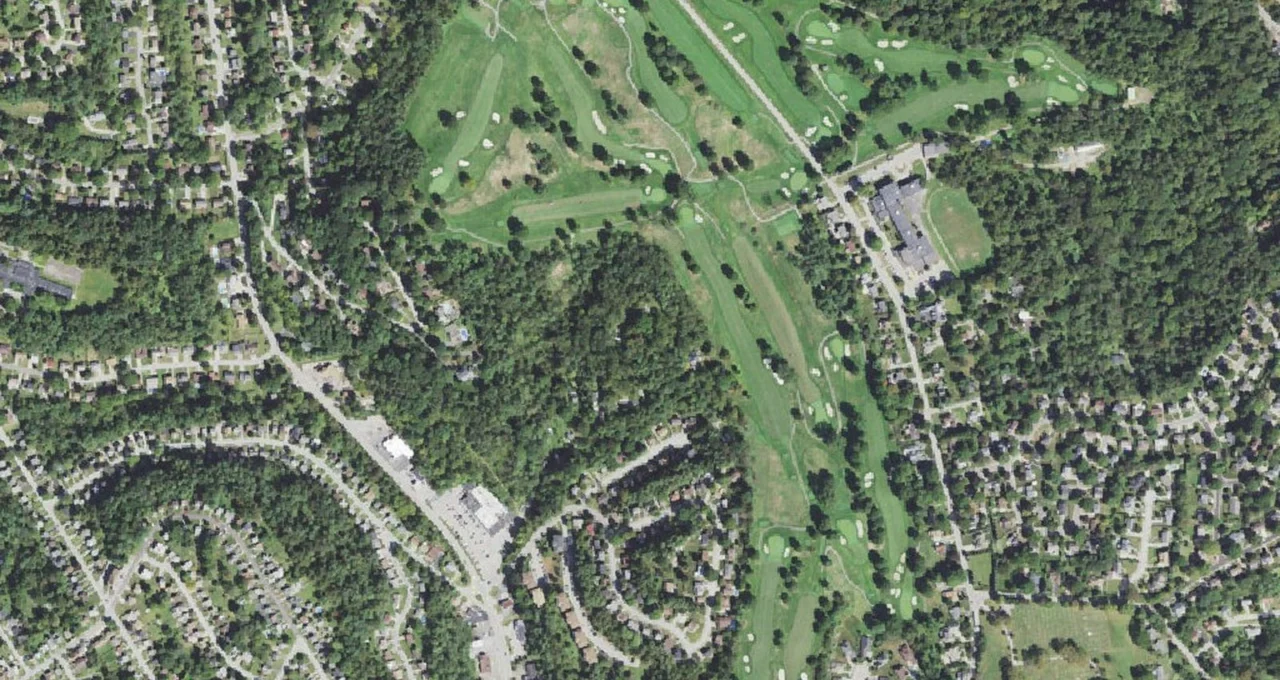
Edgewood Country Club from the air. Aerial imagery USGS, domaine public.
Edgewood Country Club
Holes
18
By
71 on the club's scorecard (front 35, back 36); 72 in Wikipedia, Stymie, TeeOff and ForeTee
Length
6,621 yards from the Blue tees on the club's card (White 6,252, Gold 5,456); 6,554 to 6,558 yards from the Blue tees on rated directory cards; 6,418 yards in Wikipedia
Green fee
—
Best season
March to November according to OpenGolfAPI; year-round according to TeeOff and GolfN
Edgewood Country Club is a private golf, tennis and social club on Churchill Road in Churchill, a small borough in Allegheny County, Pennsylvania, on the eastern side of the Pittsburgh area. The club gives its address as 100 Churchill Road, Pittsburgh, PA 15235, the mailing address used by OpenStreetMap, Wikidata and every directory we consulted. Its 18-hole course was laid out by Donald Ross and opened on July 4, 1922, according to the club’s own history. On the club’s current scorecard it is a par 71 of 6,621 yards from the Blue tees, the longest of four sets.
The club itself is older than the course. Edgewood dates its founding to 1898 and traces its first golf holes to 1896, in the North Homestead area, so the Churchill course is the club’s third or fourth home. Wikipedia places the founding in the borough of Edgewood; the present course lies about 2.7 miles east of that borough in a straight line. The club’s golf page calls it one of the oldest and best known clubs in Western Pennsylvania. Wikipedia lists a long run of regional championships played there, and in July 2025 the Pittsburgh television station KDKA featured its 8th hole in a series on the best holes in the region.
This page is a portrait built from public sources. It is not a review of a round, and nobody from Panxis has played the course.
From North Homestead to Churchill Road
The club’s timeline, titled “A Brief History of Edgewood Country Club,” starts in 1896, when Herman Westinghouse and a group of lawyers and engineers laid out a golf course in the North Homestead area, on what the club calls the Loomis Property. According to the same timeline, the first course had only seven or eight holes, and the founders soon looked for a larger site. In 1897 the course moved and a clubhouse was built near the Union Switch property; the club’s text attaches that property to “Westinghouse’s brother Herman,” a wording that repeats the founder’s name and that we cannot clarify. The club gives 1898 as the year Edgewood Country Club was formally established, and says it was elected to membership in the United States Golf Association in 1900. In 1907 Edgewood moved again, to the McKelvey farm.
The decisive step came in the early 1920s. The club’s history says that in 1921 a meeting led by a local businessman, E. C. Brown, authorized financing for a new clubhouse and an 18-hole course, and that in 1922 the club made its final move to its current location on Churchill Road, buying a tract of 167 acres. Donald Ross designed the new course. The club writes that it opened on July 4, 1922, that more than 3,000 men worked on it and that Ross still spent time overseeing the construction himself. At the time, the club counted 503 members, 400 of them active; by 1924 it had 552 members, including 98 women.
The club’s golf page credits him with more than 500 courses in the United States, among them Pinehurst No. 2, Oak Hill, Seminole and Scioto, and quotes his principle that “golf should be a pleasure, not a penance.” Wikipedia adds that he designed Edgewood while he was also working on Pinehurst No. 2. The dates do not line up perfectly across sources: Wikipedia puts the move to Churchill in 1921, the club puts it in 1922, the club’s course tour page speaks of a design from the mid-1920s, and directories give 1921 or 1922 as the opening year. We follow the club’s dated timeline, which gives the opening day.
The course did not stay as Ross left it. The club’s history says that in 1947 a project led by Emil Loeffer and John McGlynn removed many of the 128 bunkers of Ross’s design and reversed the direction of play. Later architects are credited only by directories. TeeOff and Golfer Collective list Ferdinand Garbin, Arthur Hills, Ron Forse and Jim Nagle alongside Ross; a GolfPass listing quoted in search results dates Garbin’s work to 1960 and Hills’s to 1997; PrivateIQ credits Hills with a renovation in 1960, and ForeTee with one in 1990. None of these listings says what each architect changed, and the club’s own pages name none of them, so we cannot describe their work.
What the club does document is a return toward Ross. Wikipedia says the course was restored during the club’s 100th anniversary and is now played as Ross originally designed it, while the club’s timeline, for the centennial year of 1998, mentions only a clubhouse renovation. The club’s history then records that construction of the 10th and 18th holes was completed in 2017 and that the work succeeded in redesigning the course “in the spirit of the original Donald Ross design.” The course tour page adds a new irrigation system, landscaping and renovated greenside bunkers over the decades. The two accounts can be read together, but we found no detailed description of either restoration.
The clubhouse has its own history. The club says a loan for a new building was approved in 1961, that its dining room opened on January 28, 1964, and that on the very next day, January 29, a fire destroyed the old clubhouse, damaging the new construction without serious harm. The building was renovated in 1988, redesigned to its current look in 1994 and renovated again for the centennial in 1998; the ballroom was remodeled in 2019. Today the club also has a swimming pool, which its membership page calls Olympic sized, Har-Tru tennis courts at the Violet H. Wright Center, and lighted platform tennis courts, and it rents its rooms for weddings and banquets, including to non-members.
On the competitive side, the club’s timeline dates its Men’s Invitational to 1954 and its Mixed Invitational to 1959. Wikipedia, citing the Western Pennsylvania Golf Association, lists WPGA champions crowned at Edgewood: the West Penn Amateur in 1939, 1946, 1965, 1969 and 1976, the West Penn Junior Amateur in 1937 and 1950, the William Penn Open in 1954, 1959, 2001 and 2006, the Tournament of Club Champions in 1995, the West Penn Senior Amateur in 1998, and the West Penn Women’s Amateur in 2005. The same list gives an impossible year, 2038, for a second Senior Amateur, so it should be read with care. The hole guide published by GolfTraxx adds that Arnold Palmer once made an 8 on the 18th during a West Penn Open at Edgewood; we found no second source for that story.
What the course asks of you
On paper, Edgewood is a course of moderate length. The club’s current scorecard lists four sets of tees for men: Blue, White, Gold and Red. Adding up the hole yardages on that card gives 6,621 yards from the Blue tees, 6,252 from the White and 5,456 from the Gold; KDKA, in its July 2025 article, published the same White and Gold totals and 6,620 yards for the Blue. The card shows a par of 35 on the front nine and 36 on the back, 71 in all, with four par 3s and three par 5s. Several directories show different, rated combinations of tees, such as 6,554 or 6,558 yards for the Blue, 6,282 for a Blue and White combination and 5,227 or 5,238 for the Red; these figures come from rating sheets that do not match today’s card exactly.
The Blue tees on the club’s card, also reproduced by OpenGolfAPI, read as follows:
- Front nine: 1st, par 4, 378 yards; 2nd, par 4, 463; 3rd, par 3, 204; 4th, par 4, 460; 5th, par 3, 176; 6th, par 4, 416; 7th, par 4, 420; 8th, par 5, 580; 9th, par 4, 307. Out: 3,404 yards, par 35.
- Back nine: 10th, par 4, 337; 11th, par 4, 398; 12th, par 3, 175; 13th, par 4, 399; 14th, par 3, 140; 15th, par 4, 343; 16th, par 5, 501; 17th, par 5, 504; 18th, par 4, 420. In: 3,217 yards, par 36.
The yardage alone does not explain the course. The ratings published by KDKA and Golf Course Gurus, 72.7 with a slope of 133 from the Blue tees and 71.1 with a slope of 131 from the White, put it above the difficulty of an average course. Every description stresses the same features: rolling ground, firm and fast greens, and bunkers rather than water. KDKA quotes the head professional, Pete Micklewright, saying “we don’t have any water hazards here,” and Wikipedia also says the course has no water hazards. Wikipedia says the greens regularly run about 12 feet on the stimpmeter and that Ross routed the holes to limit sidehill lies. ForeTee’s description counts thirteen holes with severe drop-offs behind or alongside the greens. OpenGolfAPI counts 69 bunkers, Stymie between 61 and 70; the club’s history speaks of 128 in Ross’s original design.
The club is candid about where the difficulty lies. Its golf page says the course plays best when dry, that pin positions and green speed largely decide how it plays, and that three-putts and four-putts are common when conditions are dry and the pins are well placed. Its own conclusion: “This is a fair test of golf.” The hole descriptions published on the club’s course information page, and repeated in GolfTraxx’s guide, point to a few holes in particular:
- The 4th, a par 4 of 460 yards from the Blue tees and 430 from the White, is described by the club as the longest par 4 for the membership and its number one handicap hole. A large hill crosses the fairway: the club says the tee shot must fly at least 230 yards to clear it and see the green, which is one of the largest and flattest on the course. From the Blue tees the 2nd, at 463 yards, is actually three yards longer.
- The 8th, a par 5 of 580 yards, is the longest hole and what the club calls its signature hole. The fairway slopes hard from right to left and the green is small, with a false front. KDKA’s 2025 feature describes the ideal drive just inside the bunkers on the right, letting the contours bring the ball back toward the middle, and a layup that leaves a short wedge; short approaches tend to roll back off the front of the green into the fairway.
- The 9th, a par 4 of 307 yards, is the risk-and-reward hole of the front nine: the green is within reach for long hitters, but a steep drop-off waits on the left, and the club recommends a hybrid or long iron from the tee.
- The 14th, at 140 yards, is the shortest hole on the course, but its two-tiered green has a drop of at least five feet between the tiers, so the pin position changes the hole completely.
- The 16th and 17th are back-to-back par 5s of 501 and 504 yards. The 16th plays uphill with out of bounds on the right and behind the green; the 17th, the shortest par 5, plays slightly downhill and is offered by the club as a birdie or eagle chance from the fairway.
- The 18th, a par 4 of 420 yards, has a narrow tee shot with out of bounds on the right and an elevated green with a severe false front. The club’s card gives it stroke index 2; GolfTraxx calls it one of the best and hardest finishing holes in Western Pennsylvania.
False fronts, two-tiered greens and out of bounds along the boundary come back again and again in the club’s descriptions: out of bounds on the left of the 6th and 7th and on the right of the 11th, 16th and 18th, false fronts on the 8th, 11th, 12th and 18th, and two-tiered greens on the 2nd, 5th, 10th and 14th. KDKA also featured Edgewood in the first edition of its series, in July 2023, with the 13th hole, which the club describes as a sharp dogleg to the right that long hitters can cut over the bunkers.
What golfers say
Because Edgewood is private, there are very few public reviews of the golf course, far fewer than for a public course of the same standing. What follows summarizes the themes we could find in October 2026: the one Golf Digest panelist review visible on its listing page, as reported in search results (the page itself refused our requests), the undated review summaries on Golfer Collective, the course description on ForeTee, the grade published by Golf Course Gurus, and the star averages shown on GolfN (4.5 out of 5 from two reviews) and Wander Golf (4.6, with no count). Most other review pages we tried were empty or inaccessible. These are other people’s opinions, not ours, and we name no reviewer.
What comes up in its favor
- The greens: the most consistent praise. The Golf Digest panelist calls them phenomenal, ForeTee describes them as fast, well contoured and difficult to lag, and both Wikipedia and KDKA stress their speed.
- Condition: Golfer Collective’s summary calls the course impeccable and meticulously maintained, and the Golf Digest panelist says it is kept in great shape.
- The Ross character: the false fronts, the bunkering and the use of the slopes are what reviewers and local media single out, and the Golf Digest panelist calls it a really good Donald Ross course.
- A challenge without excessive length: the panelist found it challenging without being overly long or difficult, and ForeTee calls it a short course that still has its difficulties.
- Friendly staff, mentioned in Golfer Collective’s summary.
What comes up against
- Few public reviewers criticize the course, and the sample is too small to draw firm conclusions. The most critical judgment we found is a grade of C+ from Golf Course Gurus, published without any explanation that we could read.
- Putting can be punishing: the club itself warns that three-putts and four-putts are common on dry days with tough pins, and the steep tiers and false fronts can send approach shots back down the slopes.
- The terrain is hilly, with blind shots such as the drive on the 4th and sloping fairways that often leave uneven stances, even if Ross tried to limit sidehill lies.
- Access: you cannot simply book a round, which is the main limit for any visiting golfer.
Getting there and playing
Edgewood is a private, member-owned club, as PrivateIQ describes it. The club’s membership pages offer full golf memberships, family memberships and social memberships with limited or no golf privileges, and invite applicants to contact the club. Golfer Collective states that guests must be accompanied by a member. Stymie lists the course as public and daily fee, which contradicts the club’s own pages and every other source, so we disregard it. The club also hosts golf outings, from small groups to corporate and charity events, with tee-time or shotgun starts, on request through its website. Outings and membership conditions are set by the club; we do not report fees.
TeeOff lists carts, club rental, a driving range, a chipping area, a putting green and a teaching professional, says walking is allowed and that metal spikes and fivesomes are not; PrivateIQ adds pull carts and caddie service, while TeeOff says no caddies, so check with the pro shop. Wikipedia lists a grass driving range, two putting greens and a short game area. The club’s dress code requires golf slacks or Bermuda-length shorts and golf shirts, tucked-in tops where designed to be tucked, soft spikes and hats worn bill forward, and bans jeans, cargo shorts and athletic wear on the course and practice areas. Sources disagree on the season: OpenGolfAPI gives March to November, while TeeOff and GolfN say year-round.
The club’s directions start from Interstate 376, the Parkway East: from downtown Pittsburgh, take the Churchill exit, 79B, turn left on Churchill Road and follow it for about a mile; from Monroeville, the club says the Churchill exit is on the left, followed by Beulah Road and then Churchill Road for about a mile and a half. Golfers are asked to pull up to the bag drop at the far end of the parking lot. The club describes itself as about 15 minutes from downtown. Measured on the map from the course’s OpenStreetMap position, the Point at the tip of downtown Pittsburgh is about 9.5 miles away in a straight line, Oakmont Country Club about 6.7 miles and Pittsburgh International Airport about 21.6 miles. These are straight-line distances, not road distances.
How we built this page
The factual frame comes from public sources: OpenStreetMap and Wikidata for the location and identifiers; the club’s website, its dated history, its scorecard and hole descriptions, its golf, course tour, about, membership, outings, directions, dress code and courtesy pages; Wikipedia’s article on the club and its article on Churchill, Pennsylvania; KDKA’s July 2025 feature on the 8th hole and its 2023 series page; and Golf Course Gurus, OpenGolfAPI, Stymie, TeeOff, PrivateIQ, ForeTee, GolfTraxx, GolfN, Wander Golf and Golfer Collective for ratings, architects, services and reviews. The pages of GolfPass, Golf Digest, TheClio and a golf architecture forum refused our requests; what we say about the Golf Digest panelist review and the GolfPass architect dates comes from search-engine excerpts.
Where sources disagree, we say so. The move to Churchill is dated 1921 by Wikipedia and 1922 by the club, whose course tour page also mentions a design from the mid-1920s. Par is 71 on the club’s card, at KDKA, at Golf Course Gurus and at OpenGolfAPI, but 72 in Wikipedia, Stymie, TeeOff and ForeTee, and 70 or 73 in some rating rows. The back-tee length is 6,621 yards on the club’s card (6,620 at KDKA and Golf Course Gurus), 6,554 or 6,558 in rated directory cards, 6,429 at TeeOff and ForeTee, and 6,418 in Wikipedia. Ratings and slopes vary: 72.7 and 133 from the Blue tees at KDKA, against 72.5 and 132 for men and 78.9 and 145 for women in directories. The Red tees measure 5,179 yards for KDKA and Golf Course Gurus, 5,227 or 5,238 elsewhere. GolfTraxx describes the 16th as a par 4 of 471 yards, while the club’s card makes it a par 5 (471 yards is its White tee length). Stroke indexes on OpenGolfAPI differ from the club’s card for several holes. Arthur Hills’s renovation is dated 1960, 1990 or 1997 depending on the directory. Stymie calls the course public, against every other source. Directories list two different telephone numbers for the club.
Some details will age: the ratings, which are revised periodically, the scorecard, the season and practice facilities, the membership categories and the few reviews we could read in October 2026. A secondary directory, GolfN, says the course ranked 57th on a Golfweek list of classic courses in 2024; we could not confirm this on Golfweek’s own site and do not rely on it. The opinion section reports recurring themes rather than individual voices. Nobody from Panxis has played or visited this course, and this page is no substitute for a round.
The club has not paid for this page, has not seen it before publication and has no say over its content. This page contains no commercial link and earns us no commission. If you know the club and something here is wrong or out of date, write to us and we will correct it. The club’s website carries its current scorecard, membership information and contact details.
Other courses nearby
Closest to this one in our United States directory:
- Longue Vue Club — 4 mi
- Bob O’Connor Golf Course — 6 mi
- Linden Hall — 26 mi
- Congressional Country Club — 172 mi
The hole to know
The club's signature hole: a par 5 of 580 yards from the Blue tees, the longest on the course, with a fairway sloping hard from right to left and a small green with a false front.