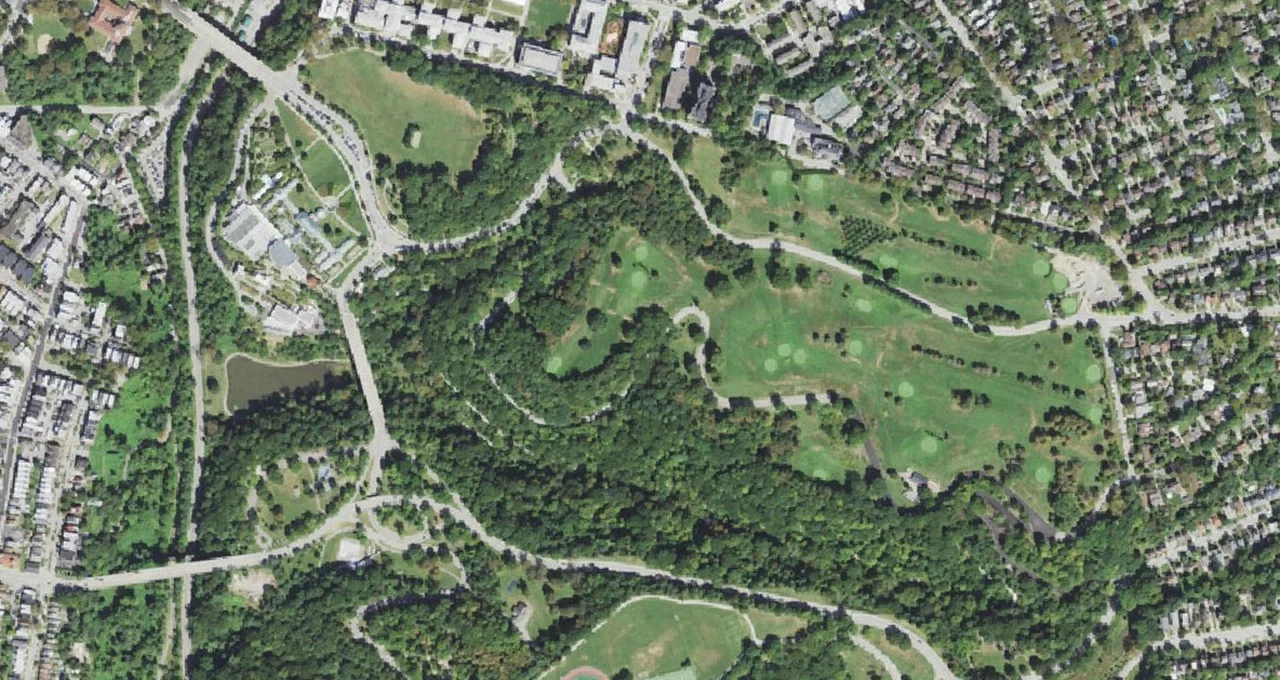
Bob O'Connor Golf Course from the air. Aerial imagery USGS, domaine public.
Bob O’Connor Golf Course
Holes
9
By
34
Length
2,400 yards according to the course; one golf app's card totals 2,195 yards. No rating or slope published for the nine
Green fee
—
Best season
Open all year, weather permitting; closed on Thanksgiving, Christmas and New Year's Day
The Bob O’Connor Golf Course at Schenley Park is a public course owned by the City of Pittsburgh and run on its behalf by First Tee-Pittsburgh, the local chapter of the youth golf nonprofit. It sits in the rolling ground of Schenley Park, between the Oakland and Squirrel Hill neighborhoods, and gives its address as 5370 Schenley Drive, Pittsburgh, PA 15217. Wikipedia describes it as the only golf course within the city limits. Locals call it “The Bob,” after Bob O’Connor, the Pittsburgh mayor and former city councilman who played there often and who died in office in 2006; the course took his name in 2007.
What golfers find today is not the course most directories still describe. Since 2022 the main layout has been a nine-hole course, “The Bob 9,” which the course presents as 2,400 yards and a par 34, walking only, open every day of the year except Thanksgiving, Christmas and New Year’s Day, weather permitting. Next to it is the “Palmer Loop,” a three-hole practice course, and the Arnold Palmer Learning Center, an indoor building with two Trackman simulators that opened in April 2021 in place of the old clubhouse.
Many public listings, including Wikipedia, Wikidata, a booking platform and a golf app, still carry the old 18-hole card: a par 67 of 4,620 yards, with a course rating of 63.3 and a slope of 104 on most of them (one app gives 62.8 and 103). Those figures describe the layout that existed before 2022. No rating or slope for the current nine appears in the sources we read, so this page gives none.
More than a century of golf in the park
The course’s own history puts it among the original centers of the game in western Pennsylvania. Its timeline starts in 1889, when Mary Schenley gave the City of Pittsburgh 300 acres of land that became Schenley Park. In 1897, according to the course, photographs confirm for the first time that part of the park was being used for golf. In 1898 the first nine-hole “Long Course” was designed by a Scottish immigrant, Mark Omiston, for the members of the private Pittsburgh Golf Club. In 1899 that club was among the founding members of the West Penn Golf Association, which held its first Amateur and Open championships on the Schenley Park course.
The course was expanded to eighteen holes in 1901, according to the course’s timeline. In 1906 the city asserted its control while letting the Pittsburgh Golf Club keep using and maintaining the course, and in 1912 Schenley Park Golf Course formally became, in the course’s words, one of the first municipally owned golf facilities in the United States, with a new clubhouse. That building served for more than a century.
Later milestones are more administrative. In 1978, Bob Koman set a competitive course record of 58 on the 18-hole, par 67 layout during the second round of the City Amateur. Carnegie Mellon University took over the operation of the course in 1993 under an agreement with the city. First Tee-Pittsburgh was formed in 2001, with Arnold Palmer as honorary chairman of its board, and began running programs at Schenley Park; it took over the operation of the course in 2008, a year after the renaming. In 2012 Audubon International certified the course as an Audubon Cooperative Sanctuary for its environmental efforts, as Wikipedia records, citing the Pittsburgh Post-Gazette.
The last two chapters changed the place more than any since the early years. In 2021 First Tee-Pittsburgh opened the Arnold Palmer Learning Center, which replaced the 1912 clubhouse and now serves as the chapter’s headquarters. In 2022 the course was reconfigured as nine holes, which the course says was done to make it more accessible to the public, and the three holes of the Palmer Loop were set aside for coaching and instruction. The course describes the nine as created from a reconfiguration of the original 18-hole routing. A golf trade magazine, in a passage we could read only in part, credits First Tee-Pittsburgh’s director of operations with routing it on the part of the property south of Schenley Drive, with the Palmer Loop on the part north of the road.
What it asks of you
The Bob 9 is a short course by modern standards, and the course pitches it as suitable for both beginners and accomplished golfers. The difficulty is not length. It is the ground: Wikipedia and a trade article both describe the rolling, hilly terrain of the park, and a course where every round is on foot makes that terrain part of the game. Uneven lies, uphill and downhill approaches, and the need to judge how a slope will move the ball matter more here than distance off the tee.
The one hole-by-hole card we found for the current nine comes from a golf app. It gives a par 34 made of seven par 4s and two par 3s, for 2,195 yards from the back tees, which is about 200 yards less than the 2,400 yards announced by the course. We follow the course’s figure for the total and give the app’s card for what it shows about the shape of the round:
- 1st: par 4, 373 yards, stroke index 1.
- 2nd: par 3, 117 yards, stroke index 5.
- 3rd: par 4, 217 yards, stroke index 8.
- 4th: par 4, 226 yards, stroke index 7.
- 5th: par 3, 160 yards, stroke index 4.
- 6th: par 4, 208 yards, stroke index 9.
- 7th: par 4, 237 yards, stroke index 6.
- 8th: par 4, 327 yards, stroke index 3.
- 9th: par 4, 330 yards, stroke index 2.
Read that way, the round opens with its longest and hardest hole, a par 4 of 373 yards, then runs through a middle stretch of very short par 4s, four of them between 208 and 237 yards. Those holes can tempt a longer hitter to go for the green from the tee, but on sloping ground the reward depends on where the ball finishes rather than how far it goes. The round then closes with two longer par 4s of more than 320 yards, ranked second and third on the app’s stroke index. The two par 3s, of 117 and 160 yards, are the most straightforward tests of iron play. Because the card comes from a single source and does not match the official total, treat the yardages as a guide rather than a measurement.
For a golfer who is building a game, the mix is useful: plenty of wedge and short-iron approaches, few holes that demand a driver, and constant practice at playing from a slope. For a strong player, the challenge is scoring, keeping the ball below the hole and making the short par 4s count.
The Palmer Loop is a separate proposition. The course describes it as two par 4s on either side of a par 3, each hole with three teeing areas, maintained to the same standard as the nine. It serves mainly as the outdoor classroom for First Tee-Pittsburgh’s youth classes and for the adult Operation 36 program, and the public can play it by the hour when no class is using it. The course recommends calling ahead to check.
What the old layout was like
Much of what is written about the course, and nearly all of its public reviews, concerns the 18-hole layout that was retired in 2022. That card, as preserved by a golf app, was a par 67 of 4,620 yards, 2,504 yards and a par 34 on the front nine, 2,116 yards and a par 33 on the back. A 2020 article in a club industry magazine quoted the course’s then director of golf as saying the layout had been in its current form since 1903 and played across public roads seven times, which he called dysfunctional for the twenty-first century. Reviews of that era describe tee shots hit from one hilltop over a busy road, protected by a chain-link fence, to a green on another hilltop.
What golfers are saying
The Bob draws a fair number of ratings but few detailed written reviews, and a large share of what exists predates the 2022 reconfiguration. The material behind this section is the ratings and comments on two golf apps, user reviews gathered by a golf travel platform and a local review site, as they appeared in September 2026. The points below are other people’s opinions, not ours; nobody from Panxis has played the course, and we name and quote no one.
What comes up in its favor
- The views are the most constant compliment: reviewers mention the downtown Pittsburgh skyline and the Oakland skyline from the fairways, which the course itself also highlights.
- Value scores well: on one app, value is the highest-rated category, well above condition, and reviewers find the round good for the price.
- The staff are described as friendly and welcoming, and the atmosphere as relaxed.
- Several reviewers see it as a place to learn or to work on the short game, with long par 3s and short par 4s that suit chipping and putting practice, and a quick nine after work.
- Pace of play is rated as fast on one app.
What comes up against
- Course condition is the weakest rating on the app that breaks scores down, well below value.
- Some reviewers complain about the absence of proper tee boxes on some holes.
- Older reviews criticize the layout itself: steeply sloped fairways, shots across public roads and holes where stray balls can reach other players. Some of this concerns holes that are no longer part of the nine.
- There is no driving range for warming up with full shots; the indoor simulators are the alternative.
How to play it
The Bob is open to everyone. Tee times can be booked up to seven days ahead on the course’s website, through its free app for iPhone and Android, which also offers GPS maps of each hole and a scorecard, or by calling the golf shop. Walk-ins are welcome every day the course is open. The course is walking only: players carry their bags, or rent a pull cart or a Club Car Tempo Walk, a motorized trolley. Rental clubs are available, and a booking platform adds that metal spikes are not allowed. Card payments carry a minimum purchase, per the course’s rates page.
The shop lists hours of 8 a.m. to 8 p.m. from Monday to Friday and 7:30 a.m. to 8 p.m. on weekends and holidays. The simulators can also be booked from 8 p.m. to 10 p.m. if reserved at least 24 hours in advance.
The course is also the home of competitions and programs: the Pittsburgh City Amateur Championship, whose 2026 edition the course scheduled for June 13 with every division played without handicaps, as well as PGA Junior League teams, Operation 36 for adults and simulator leagues in fall, winter and spring.
The facilities
The Arnold Palmer Learning Center is the building golfers see first. The course describes a balcony and floor-to-ceiling windows overlooking the course and the park, two Trackman simulators for hourly rental, a synthetic putting green, a workout area, conference and community space and a full golf shop. The simulators let players practice or play virtual rounds on more than 150 courses around the world, including Pebble Beach and the Old Course at St Andrews. The building is also rented out for meetings and events through First Tee-Pittsburgh.
There is no outdoor driving range. The practice options are the Palmer Loop, the simulators and the indoor putting green.
A course under discussion
The course’s future is being debated in public. In 2020 a club industry magazine reported plans by two architects, Jim Cervone and Ryan Farrow, to replace the 18 holes with a par 33 of just over 2,300 yards and a separate nine-hole par 3 course, with no tee shot crossing a road. The 2022 nine is not that plan, and a new one has since been drawn up.
In June 2026, PublicSource reported that First Tee-Pittsburgh holds the course under a lease of one dollar a year running to 2035, extendable to 2045, and that it has run the course at a loss of roughly 100,000 dollars a year. The chapter’s plan, called “Forging Our Future,” is credited in that article to the architect Jason Sloan. It first included electric carts and a full-swing practice center with high netting along Schenley Drive; after neighborhood opposition, First Tee-Pittsburgh dropped the full driving range, ruled out alcohol service and night lighting, and kept projects such as new irrigation, a large contoured putting green, a short-game area, a cart barn, parking and native plantings. CBS Pittsburgh reported in August 2026 that a smaller, contained practice area and electric carts were still under consideration, that neighbors wanted to keep the park as noncommercial as possible, and that the mayor had promised a public process. No decision had been announced when this page was written. Until one is, the Bob remains a walking course.
Getting there and when to go
The course is in Schenley Park, on Schenley Drive near its junction with Forbes Avenue, between Oakland, with what the course calls its university-medical district, and Squirrel Hill. The course gives its address as 5370 Schenley Drive, Pittsburgh, PA 15217. Schenley Drive runs through the property, and PublicSource notes that some residents consider it a hazardous road, so watch for traffic and golfers when driving or walking through.
The course is open all year, weather permitting, and closed only on Thanksgiving, Christmas and New Year’s Day. Its rates distinguish a peak season from April 1 to October 31 and an off-peak season from November 1 to March 31. The course suggests calling ahead in doubtful weather, and schedules and closures are its call.
Green fees
The course publishes its rates for nine holes. In peak season the regular walk-in rate is $18 and the weekend and holiday rate $20; students, faculty, military members and emergency responders pay $14, and a ten-round frequent golfer card costs $140 ($120 for students and military). From November to March, all golfers pay $14. First Tee-Pittsburgh participants play for $1. The Palmer Loop costs $6 an hour. Pull carts rent for $6, a Tempo Walk for $12 and clubs for $10. The simulators cost $40 an hour on weekday mornings, $50 on weekday afternoons and $60 on weekday evenings, weekends and holidays. The course’s rates page does not state the year these prices apply to, and the former pass holder program is closed to new members. See the course’s own rates page.
How this page was made
The factual frame comes from public sources: OpenStreetMap for the location; the course’s website for the address, the 2,400-yard par 34 nine, the Palmer Loop, the learning center, the history timeline, the hours, the booking terms, the programs and the rates; Wikipedia and Wikidata for the location between Oakland and Squirrel Hill, the identifiers, the renaming, the Audubon certification and the old 18-hole figures; the Hole19 app for the only hole-by-hole card of the current nine; the 18Birdies app for the old 18-hole card and user ratings; the TeeOff booking platform for the course policies; Club + Resort Business (2020) for the earlier redesign plan and the road crossings; PublicSource (June 2026) and CBS Pittsburgh (August 2026) for the lease, the finances and the current plan; and Golf Course Industry for the routing of the nine.
Where sources disagree, we say so. The length of the nine is 2,400 yards according to the course and 2,195 yards on the app’s card; we follow the course. The founding date is 1897 on the course’s home page and in Wikipedia’s infobox, while its own timeline dates the first designed nine to 1898, and Wikipedia’s text and a booking platform give 1902; we follow the course’s 1897 for the first golf in the park. The expansion to eighteen holes is dated 1901 by the course and 1903 by a 2020 trade article, and the municipal takeover 1912 by the course and 1913 by the same article. The first designer’s name is spelled Omiston by the course and Ormiston or Ormison by other sources; we follow the course. The architect of the redesign is given as Jim Cervone and Ryan Farrow in 2020 and as Jason Sloan in 2026, which reflects two different plans. Wikipedia’s mention of four simulators is out of date; the course lists two.
The opinion section summarizes reviews on golf apps, a golf travel platform and a local review site read in September 2026. We report recurring themes rather than individual voices, and we reproduce no quotations. Nobody from Panxis has played or visited this course, and this page is no substitute for a round.
The course has not paid for this page, has not seen it before publication and has no say over its content. This page contains no commercial link and earns us no commission. If you know the course and something here is wrong or out of date, write to us and we will correct it.
Other courses nearby
Closest to this one in our United States directory:
- Longue Vue Club — 5 mi
- Edgewood Country Club — 6 mi
- Linden Hall — 28 mi
- Congressional Country Club — 177 mi
The hole to know
On the only published hole-by-hole card of the current nine, from a golf app, the opener is the longest and hardest hole: a par 4 of 373 yards, stroke index 1.