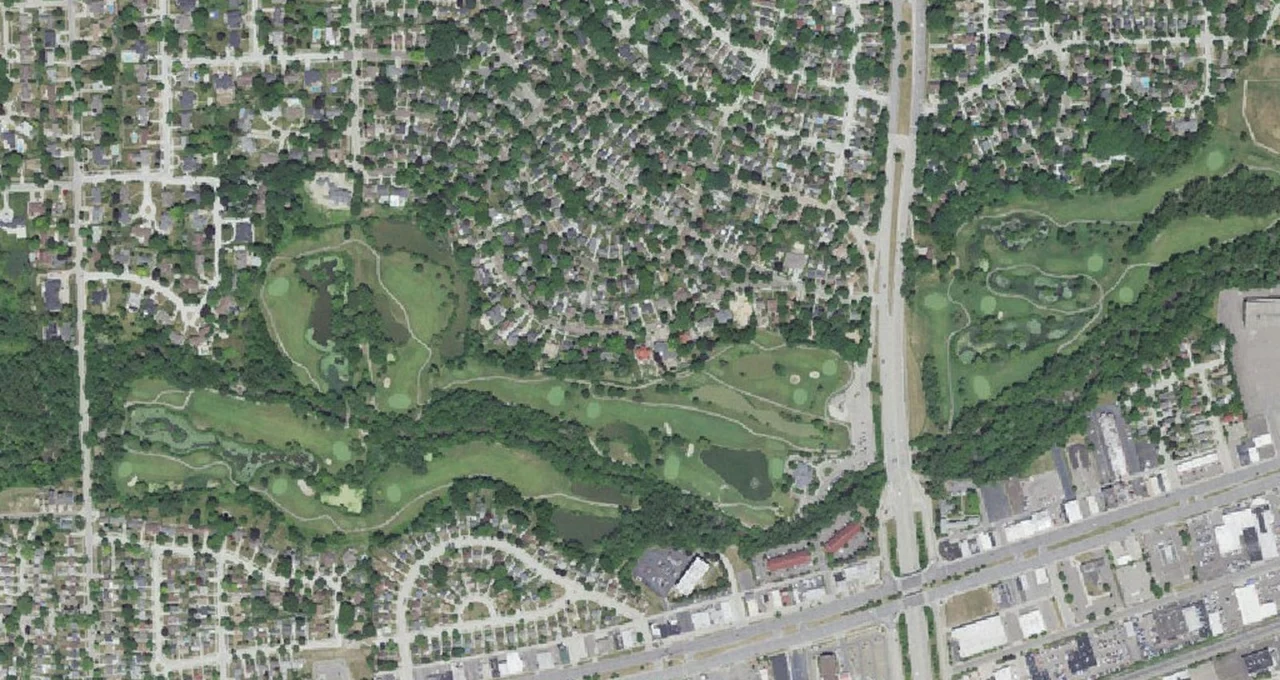
Dearborn Hills Golf Course from the air. Aerial imagery USGS, domaine public.
Dearborn Hills Golf Course
Holes
18
By
60
Length
4,495 yards from the Black tees on the course's scorecard (rating 61.2, slope 100)
Green fee
—
Best season
—
Dearborn Hills Golf Course is an 18-hole public course owned and operated by the City of Dearborn, Michigan, through its Parks and Recreation Department. It sits at 1300 South Telegraph Road, just north of Michigan Avenue, in the valley of the Rouge River. The course describes itself as “reputed to be Michigan’s oldest public golf course” and says it is listed in the State Register of Historic Sites. It was built in the early 1920s by Robert Herndon, a local developer, and passed to the city in the late 1980s.
It is a short course by design. The course’s own scorecard gives a par of 60, made up of twelve par 3s and six par 4s, over 4,495 yards from the Black tees, with a course rating of 61.2 and a slope of 100. The course calls itself an executive course, and nothing on the card is longer than 420 yards. For a golfer used to a regulation par 72, it is a round of irons, wedges and putts, with the driver needed on only a handful of holes.
The figures published by booking platforms and golf apps match the course’s own card: 4,495 yards, par 60, and the same four sets of tees. This page follows the scorecard published on the course’s website.
A public course when golf was for millionaires
The fullest account of the course’s origins is on the Michigan historical marker at the entrance gate, erected in 1989 by the Bureau of History of the Michigan Department of State. According to the marker, Robert Herndon developed more than fifty subdivisions and nine golf courses over his career, and opened the Dearborn Hills Golf Club in 1922. The marker cites the Dearborn Times Herald as calling it Michigan’s first public golf course. Bankers turned Herndon down, reminding him, in the marker’s words, that “golf was for millionaires,” and he financed the project with investors instead.
The marker also credits the design to three professional golfers, one of them Walter Hagen; it does not name the other two. Building the course and the Dearborn Hills subdivision next to it required extending Telegraph Road from Michigan Avenue to what is now Cherry Hill Road, and the marker notes that this extension helped Telegraph become a major thoroughfare. The road still runs through the property today.
Herndon died in 1986. According to the marker, his widow deeded the club to the City of Dearborn one year later. Wikipedia describes the same transfer without giving the year. In the summer of 1991 the course closed for a renovation and expansion, put at $5 million by the course and at nearly $5 million by Wikipedia. The course says the result was named Michigan’s best public golf course by readers of The Detroit News and was given three and a half stars in Golf Digest’s “Best Places to Play.” A traditionally styled brick clubhouse followed in 1995, with a restaurant, a pro shop and an outdoor patio.
The dates of the opening do not quite agree. The marker says 1922. The course’s website, booking platforms and a 2023 television report say 1923, and the city celebrated the course’s 100th anniversary in June 2023. Wikipedia splits the difference with “1922 to 1923,” which may simply reflect construction in one year and first play in the next. We give both.
Floods, a long closure and a full reopening
The river that gives the course its valley setting has also cost it several seasons. The city, as reported by CBS Detroit in March 2022, said the course had lost 42 days of the 2021 season to flooding after heavy rain in June 2021, and that log jams upstream on the Rouge were diverting water onto the fairways. The damage was serious enough that playing in 2022 would have meant roping off a large part of the course, so the city kept it closed for the whole 2022 season and refunded reservation deposits.
Half of the course reopened in 2023, in time for the 100th anniversary, according to the city. A CBS Detroit report from June 2023 dates the reopening to April of that year; it places the flood in 2022, while the city and the earlier report place it in June 2021, which is the date we follow. The full 18 holes did not return until 2025. In an announcement dated April 24, 2025, the city said all 18 holes were open for the first time since 2021, after work that included a comprehensive overhaul of the drainage, stabilization of the riverbank and improvements to the course infrastructure. The same announcement introduced a new restaurant in the clubhouse. The city did not give a cost for the repairs.
Anyone reading older reviews should keep this timeline in mind. Much of what has been written about the course’s condition dates from before or during those four years of flooding and repair.
What it asks of you
The course is laid out in two parts. The map on the course’s scorecard shows holes 1 to 11 on one parcel and holes 12 to 18 on the other, and OpenStreetMap shows South Telegraph Road crossing the property, with the river running through it. A Michigan golf blog notes that golfers pass under Telegraph through a tunnel to get from one side to the other. The ground is a river valley, and the scorecard map shows water on many holes, from ponds beside the greens to the river itself.
With twelve par 3s, the round is mostly about hitting greens from the tee. From the Black tees the short holes run from 144 to 222 yards, so this is not a pitch-and-putt: several of them call for a long iron or a hybrid. The six par 4s, between 357 and 420 yards from the back, are where a driver comes out, and they account for the six hardest holes on the stroke index. The same blog, reviewing the course in 2014 and updating the review in 2022, found the few par 4s the most interesting holes, with bends that reward thinking about where to put the tee shot.
The four sets of tees change the course a good deal. The scorecard gives:
- Black: 4,495 yards, rating 61.2, slope 100.
- Blue: 4,007 yards, rating 59.1, slope 90.
- Yellow: 3,428 yards, rating 59.0, slope 94.
- Red: 3,217 yards, rating 57.7, slope 92.
The card does not say which ratings apply to men and which to women; the higher rating on the Yellow tees than on the longer Blue tees suggests the two forward sets are rated for women, but we could not confirm it. A slope of 100 from the back is well below the standard figure of 113, which makes Dearborn Hills an easier test than an average regulation course, as its length would suggest. The course asks golfers to play a realistic set of tees for their ability.
The front nine
Par 30, 2,239 yards from the Black tees. Yardages are Black, then Blue, Yellow and Red in brackets, with the stroke index from the scorecard:
- 1st: par 3, 194 yards (180, 153, 133), stroke index 9.
- 2nd: par 4, 396 yards (366, 311, 288), stroke index 3.
- 3rd: par 3, 144 yards (124, 104, 98), stroke index 17.
- 4th: par 3, 173 yards (151, 122, 115), stroke index 11.
- 5th: par 4, 364 yards (334, 287, 271), stroke index 5.
- 6th: par 3, 212 yards (180, 167, 146), stroke index 7.
- 7th: par 4, 410 yards (380, 323, 306), stroke index 1.
- 8th: par 3, 182 yards (161, 139, 132), stroke index 13.
- 9th: par 3, 164 yards (140, 118, 111), stroke index 15.
The opening hole is a long par 3 of almost 200 yards, a demanding start without a warm-up swing. The 7th is the hardest hole on the card: a par 4 of 410 yards from the back, the longest hole on the front nine. The 3rd, at 144 yards, is the shortest hole on the course and the easiest on the stroke index.
The back nine
Par 30, 2,256 yards from the Black tees:
- 10th: par 4, 382 yards (352, 299, 288), stroke index 4.
- 11th: par 3, 188 yards (162, 141, 134), stroke index 14.
- 12th: par 3, 190 yards (178, 141, 136), stroke index 10.
- 13th: par 4, 420 yards (390, 332, 315), stroke index 2.
- 14th: par 3, 176 yards (147, 129, 119), stroke index 12.
- 15th: par 4, 357 yards (313, 275, 265), stroke index 6.
- 16th: par 3, 153 yards (125, 109, 99), stroke index 18.
- 17th: par 3, 168 yards (141, 123, 114), stroke index 16.
- 18th: par 3, 222 yards (183, 155, 147), stroke index 8.
The 13th, at 420 yards, is the longest hole on the course and the second hardest. The round closes with the longest par 3, 222 yards from the Black tees, an unusual finish that leaves a full shot to the last green rather than a short approach.
What golfers are saying
Dearborn Hills has drawn a fair number of public reviews over the years, on booking platforms, golf apps, travel sites and a Michigan golf blog. The points below summarize what recurs in that material. They are other people’s opinions, not ours; nobody from Panxis has played the course, and we name no reviewer. Keep the dates in mind: a good share of the criticism predates the drainage work completed in 2025.
What comes up in its favor
- It is seen as a good course for beginners and for working on irons and the short game, at a price that reviewers describe as affordable.
- The staff are often described as friendly, and the pace of play as smooth; one golf app rates the pace as fast.
- Several reviewers enjoy the layout of the holes, and some mention newer carts equipped with GPS.
- The clubhouse and its catering are praised by people who have held events there, and the course is also used for weddings and gatherings.
- In app ratings, value scores higher than course condition.
What comes up against
- Maintenance is the main complaint: reviewers mention hard or patchy greens, tee boxes in poor shape, fairways that are soggy or unevenly mown, and compacted bunkers.
- The Michigan golf blog found the par 3s too similar to one another and, given the length and the condition at the time, did not think the course good value.
- Some find the course short, with too many par 3s for their taste.
- A few reviews mention crowding at busy times, and a few describe unhelpful staff.
How to play it
Dearborn Hills is open to the public. The course takes reservations up to two weeks in advance, by phone with the pro shop at (313) 563-4653, which it also gives as 563-GOLF, or online through its tee-time booking page. It runs nine-hole and 18-hole outings with the clubhouse restaurant, hosts several leagues and says it considers new league bookings each spring.
The course publishes a set of local rules alongside its scorecard. Each player must have their own set of clubs. Shirts must be appropriate and golf shoes must not have metal spikes. Only drinks bought at Dearborn Hills may be taken onto the course. Drivers of power carts must be at least 18. Groups are paired into foursomes at busy times, and the instructions of rangers and starters must be followed. The rules also state that “caddies, walkers and riders are not allowed”; since the course sells walking rates, this reads as a ban on people accompanying a group without playing, but it is worth asking the shop if in doubt.
On pace, the course sets a target of two hours or less for each nine. It asks golfers to play ready golf rather than by honors, to use continuous putting, and to finish each par 3 without waving the next group onto the tee.
For seniors, the course ran two leagues in 2026 for golfers aged 55 and over, each over 14 weeks: a men’s league on Wednesdays and a women’s league on Mondays, both at 8 a.m., with a $60 registration fee and green fees paid weekly. Its Junior Golf Experience offers weekday clinics with professionals and a few holes of play for children aged 7 to 10 and 11 to 13, at $120 per session, with registration at the clubhouse. In the autumn it has also run evening “Glo-Golf” rounds: nine holes with a cart, glow-in-the-dark balls and a shotgun start after dark.
The facilities
The brick clubhouse built in 1995 houses the pro shop and Birdies Restaurant, the on-site restaurant chosen by the city through a competitive bidding process. According to the city, it had a soft opening in February 2025 and serves Tuesday to Sunday from 4 to 10 p.m. A booking platform describes an outdoor patio that overlooks the first and tenth tees. The course rents clubs and power carts.
Practice facilities are less clear. The course’s own website does not mention a driving range. A booking platform lists a driving range, a putting green and a teaching professional, and a golf app lists a mat driving range. We could not confirm the range from the course itself, so check before arriving expecting to warm up with a bucket of balls. The same platform lists bent grass greens and rye grass fairways.
Getting there and when to go
The course is at 1300 South Telegraph Road, Dearborn, MI 48124, according to its website. One page of the same site, for the junior program, gives the ZIP code 48126. The entrance is on Telegraph Road (US 24), a short distance north of Michigan Avenue (US 12), and the historical marker stands at the entrance gate. Dearborn lies just west of Detroit.
The course’s contact page gives hours of 7 a.m. to 9 p.m., Monday to Sunday. It does not publish a season. A booking platform lists the course as open year round, but the course itself announces no winter play, so check before planning a round in the cold months. The senior leagues start in early May, and evening events run into October. Given the history of flooding, a call to the pro shop after heavy rain is sensible.
Green fees
The course’s rates page, headed “Rates 2025,” was the one online at the end of September 2026. It lists $21 to walk nine holes and $27 to walk 18, and $26 to ride nine and $35 to ride 18. Seniors aged 55 and over and juniors aged 17 and under pay $18 and $23 walking, and $23 and $28 riding. After 6 p.m., weekdays and weekends, nine holes cost $17 walking and $22 riding. The course notes that rates are subject to change, and we found no 2026 schedule. See the course’s own rates page.
How this page was made
The factual frame comes from public sources: OpenStreetMap for the location, the course outline, Telegraph Road and the river; the course’s website for the address, ownership, history summary, the 1991 renovation and the awards it cites, the 1995 clubhouse, the scorecard, ratings and slopes, the local rules and pace-of-play guidelines, the hours, the leagues and junior program and the 2025 rates; the Michigan historical marker, as transcribed by the Historical Marker Database, for the 1922 opening, the investors, the design by three professionals including Walter Hagen, the Telegraph Road extension and the 1987 transfer to the city; Wikipedia and Wikidata for the construction dates and identifiers; the City of Dearborn for the 2023 partial reopening, the 2025 full reopening, the repairs and the restaurant; CBS Detroit reports from 2022 and 2023 for the flood, the 2022 closure and the anniversary; the TeeOff booking platform, which also lists Warner Bowen as architect, for the tee data, grasses, practice facilities and policies; the 18Birdies app for ratings and services; and the GolfBlogger review for the tunnel and the design assessment.
Where sources disagree, we say so. The opening year is 1922 on the historical marker and 1923 on the course’s website. The design is credited to three professional golfers including Walter Hagen on the marker, and to Warner Bowen on a booking platform and a course directory; we could not establish whether Bowen’s work belongs to the original course or to the 1991 rebuild, so we attribute neither. One report places the flood in 2022, while the city places it in June 2021. The driving range and the year-round season appear on platforms but not on the course’s site.
The opinion section summarizes reviews on booking platforms, golf apps, travel and local review sites and a golf blog, read in September 2026. We report recurring themes rather than individual voices, and we reproduce no quotations from reviewers. Nobody from Panxis has played or visited this course, and this page is no substitute for a round.
The course has not paid for this page, has not seen it before publication and has no say over its content. This page contains no commercial link and earns us no commission. If you know the course and something here is wrong or out of date, write to us and we will correct it.
Other courses nearby
Closest to this one in our United States directory:
- Plum Hollow Country Club — 10 mi
- Detroit Golf Club — 11 mi
- Rackham Golf Course — 13 mi
- The Country Club of Birmingham — 16 mi
The hole to know
The hardest hole on the stroke index: a par 4 of 410 yards from the Black tees, one of only six two-shot holes on a par-60 card otherwise made of par 3s.