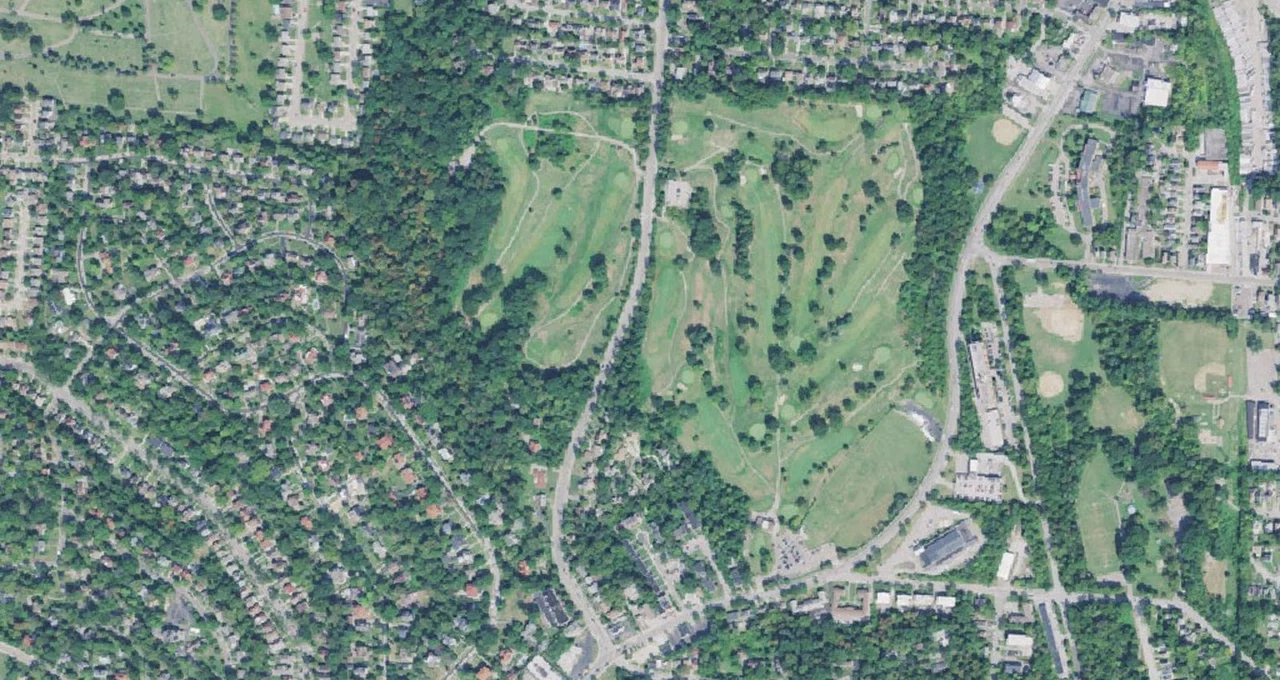
Avon Fields Golf Course from the air. Aerial imagery USGS, domaine public.
Avon Fields Golf Course
Holes
18
By
66
Length
4,963 yards from the Blue tees on the CRC scorecard (August 2024; rating 63.8, slope 111); GolfPass lists 5,081 yards and a par of 67
Green fee
—
Best season
—
Avon Fields Golf Course is a public, city-owned 18-hole course in Cincinnati, Ohio, at 4081 Reading Road, on the edge of the North Avondale and Paddock Hills neighborhoods, next to the city of Norwood. The course is one of six owned by the Cincinnati Recreation Commission (CRC) and, according to the CRC’s golf website and a 2026 trade release, is managed for the commission by Indigo Golf, a Troon company. OpenStreetMap and Wikidata list it under the shorter name Avon Field; the CRC, the scorecard and most directories call it Avon Fields.
It is a short course. The scorecard the CRC publishes, printed in August 2024, gives a par of 66 with no par 5: twelve par 4s and six par 3s, for 4,963 yards from the Blue tees, with a men’s course rating of 63.8 and a slope of 111. Local press and Wikipedia describe it as the oldest municipal golf course west of the Alleghenies. When it opened, and who laid it out, are two questions on which the sources do not agree, as set out below.
A city course since before the First World War
The most detailed account of the course’s origins we found is a 2014 article by the Cincinnati television station WCPO, written for the course’s 100th anniversary and still readable in web archives. According to that article, the city bought 114 acres of farmland in 1911, stretching from Reading Road west across Paddock Road. It opened nine holes in 1914 and the second nine a year later. WCPO also published the 1911 warranty deed for the land alongside the story. The centennial itself was marked in 2014 with a grill-out lunch, a scramble for about 100 players and a pig roast; the Cincinnati Reds Hall of Famer Dave Parker hit the first tee shot, and the former University of Cincinnati basketball player and coach Tony Yates, who told WCPO he used to stop for nine holes on his way home, was also there.
Not every source uses those dates. Wikidata gives 1914 as the year of inception, and Wikipedia’s categories place the course among venues completed in 1915. But Wikipedia’s infobox gives 1924 as the year it was established, and several golf directories and booking sites, including GolfNow and GolfN, repeat 1924. We found nothing that explains the 1924 date; the 2014 centennial, the deed and the dates given by the station point to 1914 and 1915 for the first eighteen holes.
A trade magazine of the time gives a glimpse of the course twenty years later. In August 1934, Golfdom reported on a free beginners’ golf school sponsored by the Cincinnati Post and taught by five local professionals, one of them Robert “Red” Straus “of the Avon Fields muni course.” The school brought out so many new players, the magazine wrote, that play at Avon Fields that year was 60 percent above the previous year’s figures.
The course has also changed shape. Wikipedia says the front and back nines were switched in the 1960s, when the construction of the Norwood Lateral, the expressway that now passes just north of the course, provided an opportunity to reduce some of the steepest hills and rework the layout. Ron Dumas, the assistant professional who served as the course’s unofficial historian, told WCPO in 2014 that the highway work took a lot of hills out of the course, along with 200 yards of length and two strokes of par. The road still shapes the round in another way: by WCPO’s account, golfers cross Paddock Road to play five of the holes.
Management has passed through several hands. The course was run directly by the city for most of its history. Wikipedia says Kemper Sports Management won the right to run the city courses in the late 1990s and that Billy Casper Golf took over the contract in 2003; WCPO’s centennial article says only that the CRC managed all city courses until it turned their operation over to Billy Casper Golf in 2003. Billy Casper Golf later became Indigo Golf Partners, which Troon acquired. In 2022, according to a release published by Club + Resort Business and First Call Golf, the CRC extended its contract with Indigo through 2026, with options to extend through 2030; the 2026 releases name Indigo Golf, a Troon company, as the manager, and the CRC’s own rules for cart rentals name the City of Cincinnati and Troon Golf. We did not find a public statement on whether the extension options have been taken up.
Who designed it? No firm answer
The original designer of Avon Fields is not documented. Wikipedia states that city records naming the original designer cannot be found. It then lists three possibilities: the archival website devoted to Donald Ross lists Avon Fields as one of his designs; others suggest it was laid out by a member of the Spalding family, of the sporting goods firm (Wikipedia spells the name Spaulding); and the architect William Langford is said to have revised the design in 1925, in a sentence that is incomplete in the article. Golf Digest’s course listing, which we could not open, credits Donald Ross in the extract shown by search engines.
Several golf directories and apps, including GolfN and a travel-guide site, credit William Diddel and date his work on the course to 1933; one of them says Diddel’s redesign produced the layout that exists today. We could not find a primary source for any of these attributions: no plan, no contemporary press report, no record from the CRC. The CRC’s own pages describe the course as “historic” and “classic” without naming any architect. Given the 1960s rework for the Norwood Lateral, the safest reading is that today’s course is the result of more than a century of changes on land the city bought in 1911, and that any single name attached to it should be treated with caution.
A course with its own place in Cincinnati golf
WCPO’s centennial story is mostly about people, and it explains why the course matters to many local players beyond its length or its rating. The station quoted a regular who called it “the black country club of Cincinnati,” and reported that, because of segregation in earlier decades, Avon Fields was the first place where many Black golfers’ parents or grandparents had been allowed to play. Dumas told the station that the course had “always been open to everybody.”
A plaque in the clubhouse, according to the same article, honors the founders of the Greater Cincinnati Golfers Club: six Black men who met on the first tee in 1934 and organized to open play for Black golfers at all of the city’s public courses. Another honors I.E. Hayes, a West End grocer who joined the club in 1938, was its president for 14 years and served on the city’s Golf Advisory Council until his death in 1991.
The best-known player associated with the course is Jimmy Woods, a Cincinnati amateur whom WCPO describes as a showman able to shoot par left-handed or right-handed. Barred by racism from becoming a club professional or joining the PGA, he stopped playing for a decade and worked as a dining car waiter, according to Dumas, who caddied for him from 1968. Woods held the Avon Fields record of 58, eight under par, until Dumas beat it by a stroke; Hank Wilms, a former professional at Avon and later at Neumann, then shot 55, which WCPO reported as still standing in 2014. Woods mentored young players at the course through a foundation that provided clubs, won the Avon Fields club championship at 70, and died in 2000 at 80. A golf booking site and a travel-guide site refer to a Jimmy Woods Learning Center on the property; the CRC’s current pages do not mention it, and we could not confirm that the name is still in use.
Dumas extended that work through Reaching Out For Kids, a summer program of golf and life lessons that he started in 1996 and that had been based at Avon Fields since 2005, with Saturday sessions in June and July, according to WCPO. The article also mentions a women’s league, “Les Birdies,” with about 60 members. We did not find more recent information on either, and the details date from 2014.
What it asks of you
Avon Fields is not built around length. From the Blue tees the longest hole measures 432 yards, and six holes are par 3s between 142 and 177 yards. The course is played over rolling ground, with tree-lined fairways and what the CRC calls elevated greens. WCPO’s centennial article summed it up as a short, rolling course with tight fairways and small, elevated, undulating greens, without sand bunkers but with plenty of trees. “It definitely favors players with a good short game,” Dumas told the station. Yates added that a ball landing too hard on the green can skip off it, and that the mix of uphill and downhill shots forces players to manage their game.
That makes the approach shot and the shot around the green the core of the round. A short hole on a small, raised green leaves little margin, and a miss that rolls down a slope can leave an awkward pitch back up. Because no hole is a par 5, the usual chances to recover a stroke with a long second shot are absent: a good score comes from hitting greens with short irons and avoiding the short-sided miss. Directory ratings point the same way. The men’s course rating of 63.8 from the Blue tees is nearly two strokes below par, but the slope of 111 shows that, for a higher-handicap player, the course plays harder than its length suggests.
The scorecard gives the following pars and Blue tee yardages, with the men’s and women’s stroke index in brackets. The front nine measures 2,618 yards and is a par 33; the back nine measures 2,345 yards and is also a par 33.
- 1st: par 4, 369 yards (men 5, women 1). An opening par 4 of medium length; the women’s stroke index makes it the hardest hole on the card for them.
- 2nd: par 3, 153 yards (men 17, women 15).
- 3rd: par 4, 271 yards (men 11, women 11). A short par 4 that rewards position more than power.
- 4th: par 4, 432 yards (men 1, women 7). The longest hole on the course and the hardest for men. One aggregator calls it a par 5; the current card says par 4.
- 5th: par 4, 354 yards (men 9, women 5).
- 6th: par 3, 142 yards (men 13, women 13). The shortest hole on the front nine.
- 7th: par 4, 358 yards (men 7, women 3).
- 8th: par 3, 177 yards (men 15, women 17). The longest of the six par 3s.
- 9th: par 4, 362 yards (men 3, women 9).
- 10th: par 4, 245 yards (men 12, women 10). A par 4 of 245 yards from the back tee, within reach of a long hitter. Its tee and fairway illustrated WCPO’s centennial story.
- 11th: par 4, 290 yards (men 10, women 12).
- 12th: par 3, 149 yards (men 14, women 18).
- 13th: par 4, 351 yards (men 4, women 6).
- 14th: par 4, 368 yards (men 2, women 2). The longest par 4 on the back nine, ranked second hardest for both men and women.
- 15th: par 4, 320 yards (men 8, women 8).
- 16th: par 3, 156 yards (men 16, women 14).
- 17th: par 3, 142 yards (men 18, women 16). The easiest hole on the men’s index.
- 18th: par 4, 324 yards (men 6, women 4).
The card lists three sets of tees. From the White tees the course measures 4,587 yards (men’s rating 62.4, slope 106; women’s rating 66.8, slope 114), and from the Gold tees 4,234 yards (men 61.5 and 101; women 64.6 and 110). From the Blue tees the women’s rating is 68.7 with a slope of 119. The front nine is where the length is: four of its par 4s measure more than 350 yards, and the hole ranked hardest for men, the 4th, is there. The back nine opens with two short par 4s of 245 and 290 yards and finishes with two par 3s in three holes, but its 13th and 14th are among the hardest holes on both indexes.
The local rules printed on the card and the CRC’s guidelines add some constraints. Carts must stay 30 feet from greens and tees, and on paths on every par 3. Groups are limited to four players. The card also has a course map, with on-course shelters and restrooms marked; the CRC states that the shelters are meant for light rain only, not lightning or high winds.
What golfers are saying
Avon Fields has a large number of public ratings, but few detailed written reviews. The material behind this section is the 18Birdies golf app, where the course had 566 reviews and an average of 3.9 out of 5 in October 2026; the GolfPass review platform, whose page refused our requests and whose figures (207 reviews, an average of 3.4, about 60 percent of reviewers recommending the course) we could see only in search results; a Golf Digest panel score of 2.1 visible in the same way; and the comments of regular players in WCPO’s 2014 article. The points below are other people’s opinions, not ours; nobody from Panxis has played the course.
What comes up in its favor
- Value is the most consistent strength. On 18Birdies it is the highest-rated category, at 4.1 out of 5, and short comments describe the course as a good, inexpensive option for a casual round or a quick nine in the evening.
- App users rate the pace of play as fast. One user noted that being first out on a weekend morning meant no waiting at all.
- Several reviewers see it as a good course for beginners and newer players, short enough to enjoy and practical for working on the short game.
- The greens get praise from some players: one recent app comment said they roll well for a public course, and the regulars WCPO interviewed in 2014 called them among the best in the city.
- Location comes up often: the course is a few minutes from downtown, and one regular told WCPO she lived close enough to walk.
- One recent comment credits a largely new grounds crew with improving conditions in recent seasons.
What comes up against
- Course condition rates lower than value on 18Birdies, at 3.7 out of 5, and conditions and amenities are the weakest scores on GolfPass as shown in search extracts.
- Some players find the course neither very attractive nor very challenging; the Golf Digest panel comments visible in search results describe little land, tiny greens, a design they found somewhat bland and a course that is fun but not a real test.
- Isolated comments complain about how the course is managed or about the attitude of staff at the first tee.
- The absence of par 5s and the short total length disappoint golfers who want a full-length course; app users rate the difficulty as medium.
Who can play
Avon Fields is open to the public. Tee times can be booked online through the CRC’s golf website up to 10 days ahead, or by phone up to 7 days ahead; holders of the CRC’s Eagle Pass can book up to 15 days ahead online. The CRC says its lowest rates are always online and that walk-up and phone reservations may cost more. Cancellations are requested at least 24 hours before the round, and late cancellations may be charged. On weekend and holiday mornings from March to November, only 18-hole reservations are taken unless the professional opens nine-hole times. Players are asked to arrive 20 minutes before their tee time, and single players may be paired or wait on standby.
The CRC sets a few other rules for all its courses. Each player must have their own bag and clubs; rental sets are available on a first come, first served basis. Shirts and golf or athletic shoes are required, and cleats and boots are not allowed. Children must be at least five to be on the course, and under eight must be accompanied by an adult. Junior rates apply to players aged 17 and under with a Youth Golf Association card, and senior rates start at 60. Under Ohio law, no alcohol may be brought onto the property, and personal coolers are not allowed except for medical supplies. The CRC says it welcomes golfers with disabilities and will make reasonable accommodations; contact the course’s general manager or head professional.
Carts are available, and the CRC says a new, larger fleet arrived across its six courses for the 2026 season. Renters must be at least 18; players of 16 and 17 may drive when accompanied by an adult player. Walking is allowed, according to GolfNow. In July 2026 the CRC and Troon announced that Avon Fields had joined the Youth on Course program, which gives members aged 18 and under reduced-price rounds on weekdays and after 3 p.m. on weekends and holidays.
The CRC does not publish an opening season for the course. Its practice range at Avon Fields is open from dawn to dusk, opens at about 11:30 a.m. on Wednesdays for maintenance, and closes when the ground is snow-covered or when the forecast high is below freezing.
Facilities
The CRC lists a pro shop, a snack bar with hot dogs, soft drinks and beer, and a covered driving range with artificial turf mats and a range of targets. GolfNow adds a putting green, a pitching and chipping area and a teaching professional, and the CRC offers lessons through its golf academy. WCPO described the clubhouse in 2014 as modest. The CRC’s improvement program, announced in April 2026 and funded, according to the commission, from course revenue rather than taxes, schedules a full irrigation renovation at Avon Fields for 2027; expect some visible work once it begins.
Getting there
The course’s address is 4081 Reading Road, Cincinnati, OH 45229, as printed on the scorecard and listed by OpenStreetMap and booking sites; the scorecard gives the course a direct phone line, and the CRC’s central booking number is 513.651.GOLF. The address in the footer of the CRC’s golf website, 10965 Springfield Pike, is the commission’s contact address for its six courses, not that of Avon Fields. The property lies between Reading Road and Paddock Road, with the Norwood Lateral expressway (State Route 562) passing just to the north.
Measured in a straight line from the middle of the course, Xavier University is less than a mile to the south, downtown Cincinnati about four and a half miles to the south-southwest and Cincinnati Municipal Lunken Airport about five miles to the southeast. Cincinnati/Northern Kentucky International Airport is about 13 miles to the southwest, downtown Dayton about 44 miles to the north, and Columbus and Louisville both a little over 90 miles away. These distances are measured on the map, not by road.
Green fees
Rates at Avon Fields vary by day, by walking or riding and by nine or eighteen holes, with separate rates for seniors, juniors and Eagle Pass holders, and the CRC says its online prices are its lowest. We do not reproduce them here; check the current rates on the course’s page on the CRC golf website, where tee times can also be booked.
How this page was made
The factual frame comes from public sources: OpenStreetMap for the location, the address and the operator tag; Wikidata for the entity record and the 1914 date; the CRC’s golf website for the course description, the August 2024 scorecard (yardages, pars, ratings, stroke index, local rules and map), booking rules, facility guidelines, practice range hours and the 2026 improvement program; WCPO’s 2014 centennial article, read in the Internet Archive, for the land purchase, the opening dates, the community history, the course records and the players’ comments; Golfdom’s August 1934 issue, in the Michigan State University turfgrass archive, for the 1934 golf school; Wikipedia for the designer attributions, the Kemper management period and the 1960s changes; Club + Resort Business and First Call Golf for the 2022 contract extension and the 2026 releases; GolfNow, GolfN and other directories for amenities and the dates they publish; and the 18Birdies app for ratings and comments. The GolfPass and Golf Digest pages refused our requests; the figures and comments we cite from them come from the extracts shown by search engines, and we give them less weight.
Where sources disagree, we say so. The opening date is 1914 for the first nine and 1915 for the second in WCPO’s article and Wikidata, consistent with the centennial in 2014, but 1924 in Wikipedia’s infobox and several directories. The designer is unknown according to Wikipedia, Donald Ross according to a Ross archive and Golf Digest, a member of the Spalding family according to unnamed others, with a 1925 revision by William Langford in Wikipedia and a 1933 redesign by William Diddel in several directories; we could confirm none of them. The par is 66 on the CRC’s scorecard and Wikipedia, 67 over 5,081 yards on GolfPass, and 65 on GolfN; one travel site calls the 4th a par 5, while the current card makes it a par 4, which may explain the older par of 67. GolfNow lists ratings of 63.3 and a slope of 103 from the Blue tees, against 63.8 and 111 on the scorecard; we follow the scorecard. Wikipedia places the end of direct city management in the late 1990s, with Kemper Sports Management, while WCPO says the CRC ran the courses until 2003. A booking site’s blog says the course is certified as an Audubon Cooperative Sanctuary; we could not confirm this with Audubon International and leave it aside.
Some details will age: the operator and its contract, the booking windows, the rules, the cart fleet, the range hours, the Youth on Course partnership, the 2027 irrigation work, and the review counts and scores, all read in October 2026. The community details from WCPO, including the programs and league, date from 2014. Nobody from Panxis has played or visited this course, and this page is no substitute for a round. The opinion section reports recurring themes and does not quote individual app users.
The course and the CRC have not paid for this page, have not seen it before publication and have no say over its content. This page contains no commercial link and earns us no commission. If you know the course and something here is wrong or out of date, write to us and we will correct it.
Other courses nearby
Closest to this one in our United States directory:
- Losantiville Country Club — 3 mi
- Crooked Stick Golf Club — 106 mi
- Inverness Club — 177 mi
- Eagle Crest Resort — 217 mi
The hole to know
The longest hole on the course and the hardest on the men's stroke index: a par 4 of 432 yards from the Blue tees on a course with no par 5, where a long second shot must hold one of the small, elevated greens.