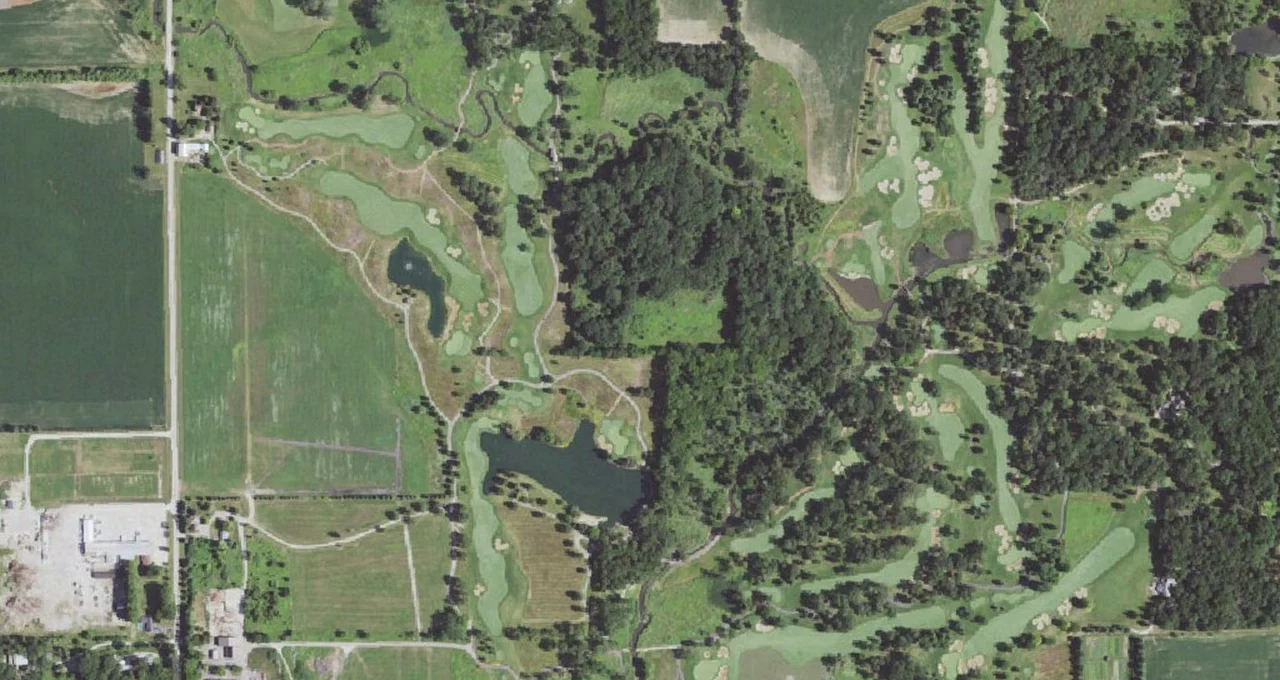
Rich Harvest Farms from the air. Aerial imagery USGS, domaine public.
Rich Harvest Farms
Holes
18
By
72
Length
7,735 yards from the Pro tees in course directories and on Wikipedia (rating 79.1, slope 155); other published cards give 7,671 and 7,699 yards
Green fee
—
Best season
—
Rich Harvest Farms is a private golf course on the rural western edge of the Chicago area, in Big Rock Township near the village of Sugar Grove, Kane County, Illinois. It is the work of one man, Jerry Rich, a businessman who made his fortune in stock exchange software and who designed the course himself on farmland he had been buying up since the 1980s. The club says the property now covers 1,820 acres across Sugar Grove and Big Rock. The 18-hole course opened officially in 1999, the year Golf Digest named it the fifth best new private course in the country.
The course is a par 72. Course directories and Wikipedia, which cites the USGA’s rating database, give 7,735 yards from the Pro tees, with a course rating of 79.1 and a slope of 155, among the highest figures you will find on any American course. It has hosted the 2009 Solheim Cup, the 2015 Western Amateur, two Palmer Cups, the 2017 NCAA Division I men’s and women’s championships and, in 2022 and 2023, the LIV Golf event in Chicago. Membership is by invitation only.
Rich Harvest Farms is also one of the more divisive courses in American golf. It has been ranked for two decades by Golf Digest, while at least one well-known architecture site calls it a textbook case of amateur design. Both views are set out below, along with the places where the sources disagree.
From a backyard course to a championship venue
According to the club’s own history, Jerry Rich began developing Rich Harvest Farms in 1988, out of a love of golf and of golf course design. What started as three holes grew, over about ten years, into an 18-hole course. Other accounts give a different starting point: Golf Digest describes a six-hole backyard course that was expanded into a layout of nine fairways and 11 greens that could be played in several ways, before it became a conventional 18-hole course. The Golf Course Gurus review site also speaks of six original holes, played from different tees that changed the par of each hole, and says the course later grew to nine holes before Rich built the full 18.
Wikipedia gives 1989 as the year the course was built and 1999 as the year it was expanded. A 2009 Daily Herald article says the 18 holes were finished in 1997. The club dates the official opening to 1999. The dates differ because the course was built in stages over a decade, and each source picks a different milestone.
The idea behind the project has become part of its legend. The Daily Herald wrote in 2009 that Rich modeled his ambition on Augusta National, both in the polish of the grounds and in the short, invitation-only member list. The Fried Egg repeats a more colorful story, presented as alleged, that Rich decided to build his own Augusta after asking how much a membership there would cost. Golf Digest notes that some people call the course “the Augusta of the Midwest.”
Golf Digest placed Rich Harvest Farms on its list of America’s 100 Greatest Golf Courses from 2003 to 2022. Its highest position was 45th, in the 2005-06 ranking. Since 2023 it has appeared in the magazine’s Second 100 Greatest list, where it stands 113th in the 2025-26 ranking, down from 108th. It is ranked seventh in Illinois in the magazine’s state ranking, a place it has held since 2017.
Championships and events
For a club with a small membership, Rich Harvest Farms has hosted an unusual number of significant events. The club’s tournament pages and Wikipedia list the following, among others.
- 2009 Solheim Cup, August 21 to 23: the United States beat Europe 16 to 12, its third consecutive win. The club reports a record of 120,000 spectators over the week.
- 2012: the Ryder Cup Captain’s Challenge, held during the week of the Ryder Cup at nearby Medinah, according to Wikipedia.
- 2015 Palmer Cup, June 12 to 14: the American college team beat Europe 18 to 12.
- 2015 Western Amateur, August 3 to 8: Dawson Armstrong holed out for eagle on the second playoff hole to beat Aaron Wise, according to the club.
- 2017 NCAA Division I men’s and women’s championships, in May: Braden Thornberry won the men’s individual title and Oklahoma the men’s team title, while Monica Vaughn led Arizona State to the women’s team title. Northern Illinois University was the host.
- 2019 Western Junior, June 17 to 20: won by Piercen Hunt by seven shots.
- 2021 Arnold Palmer Cup, June 11 to 13: the mixed American team beat the International team 33 to 27.
- 2022 LIV Golf Invitational Chicago, September 16 to 18: won by Cameron Smith, with 4Aces GC taking the team title. The club calls it its first men’s professional event.
- 2023 LIV Golf Chicago, September 22 to 24: won by Bryson DeChambeau, whose Crushers GC also won the team event.
Wikipedia also lists NCAA regionals in 2007 and 2014, Mid-American Conference championships in 2003 and 2012, the Northern Intercollegiate from 2011 to 2018 and the 2020 Big Ten men’s championship. One event did not happen: the LPGA’s International Crown was scheduled for Rich Harvest Farms in 2016, but in November 2015 the tour and the club agreed to move it, without giving a reason, as ESPN and the Daily Herald reported at the time.
What it asks of you
The course is laid out in two nines, called the Gold and the Silver. On the published scorecards the Gold nine is holes 1 to 9 and the Silver nine holes 10 to 18, but the order has varied: at the 2017 NCAA Championships the Silver nine was played first, which is why some hole descriptions from that year use different numbers. Golf Digest stresses the flexibility of the layout, where every hole can play differently from day to day, some from different angles and even with a different par. Several holes have two separate sets of tees or two fairways.
The Golf Course Gurus site describes the Gold nine as the tighter of the two, because of dense trees, and the Silver nine as more open, with water on every hole. It also mentions fescue, many bunkers and gentle changes in elevation. The Fried Egg sums up the course as a very long layout with tight tree-lined driving corridors, a great deal of sand, long walks from greens to tees and large green complexes.
The scorecard reproduced in course directories gives the following pars and Pro tee yardages. The Gold nine is a par 36 of 3,907 yards and the Silver nine a par 36 of 3,828 yards. Hole names come from published reviews; the cards themselves do not print them.
- 1st: par 4, 456 yards.
- 2nd: par 5, 634 yards. Two sets of tees separated by trees, with a cluster of fairway bunkers on the right, according to one detailed account of a round.
- 3rd: par 4, 393 yards. Snead’s Crotch, a dogleg left named after a story told about Sam Snead, a friend of Jerry Rich: asked to aim at the base of a large tree in the fairway, Snead hit it there, played the ball out backhanded and saved par. One 2019 account says the tree had recently been cut down and turned into benches.
- 4th: par 3, 228 yards. Hickory, played as the 13th in 2017, with a big tree overhanging the right side of a green that slopes from back to front, according to The Fried Egg.
- 5th: par 4, 396 yards. A double dogleg through trees to a narrow green.
- 6th: par 4, 525 yards. A long par 4 that narrows beside Lake Katherine before the green.
- 7th: par 3, 241 yards. A carry over marshland.
- 8th: par 4, 489 yards. The Cottage, the hardest hole on the card: Lake Clyde guards the right side of the fairway and the front of a shallow green. The Fried Egg measures the green at 17 yards deep.
- 9th: par 5, 545 yards. Covered Bridge, a three-tiered fairway and an approach over Welch Creek, named after the covered bridge on the right of the hole.
- 10th: par 4, 414 yards. A long carry over wetlands from the tee.
- 11th: par 5, 564 yards.
- 12th: par 3, 245 yards. Water and wetlands between tee and green.
- 13th: par 4, 462 yards. Devil’s Elbow, the hole Wikipedia calls famous and the second hardest on the card (see below).
- 14th: par 3, 191 yards. Amen, also called Holy Stone, a green held up by a stone wall above the water, which The Fried Egg reads as Rich’s answer to the 12th at Augusta.
- 15th: par 4, 448 yards. Fairways cut up by bunkers.
- 16th: par 5, 634 yards. Beauty and the Beast, with eight sets of tees, two fairways and water in front of the green.
- 17th: par 4, 421 yards.
- 18th: par 4, 449 yards. The Road Hole, which has nothing to do with St Andrews: two fairways, two sets of tees and a green about 100 yards long that slopes from back to front, according to The Fried Egg.
Devil’s Elbow deserves a closer look. It is a dogleg left framed by oak and hickory trees, with Welch Creek running in front of the tees and up the left side of the fairway. The Fried Egg describes a driving corridor that requires a hard draw into a landing area about 20 yards wide, and says a missed drive usually means chipping back out. For the women’s championship in 2017 the hole was played from an artificial teeing ground, a detail that made headlines at the time.
The same directories list four sets of tees with ratings: the Pro tees at 7,735 yards (79.1 and 155), the Championship at 7,132 yards (76.3 and 149), the Member tees at 6,741 yards (74.7 and 145) and the Links tees at 6,043 yards (71.7 and 138 for men, 77.1 and 146 for women). Even the shortest rated set carries a slope that most courses never reach from the back. For a club golfer, the difficulty lies less in length than in accuracy from the tee, in heavy penalties for small misses around the greens and in the number of forced carries over water.
What golfers are saying
Because the club is so private, public reviews are few. The material that exists comes from architecture websites, a Golf Digest panelist, independent golf bloggers who were invited to play, and a handful of course directory users. The points below summarize what recurs in it. They are other people’s opinions, not ours; nobody from Panxis has played the course, and we name and quote no one.
What comes up in its favor
- Conditioning is praised in almost every account, by admirers and critics alike: firm, fast fairways and immaculate greens.
- The setting, the solitude and the beauty of the property are seen as outstanding.
- The flexibility of the layout, with alternative tees and fairways, means the course can play very differently from one day to the next, which reviewers find unusual and interesting.
- Many holes are described as memorable, with Devil’s Elbow, Covered Bridge and Beauty and the Beast cited most often.
- Visitors praise the hospitality, the caddies and the extras, including Jerry Rich’s car collection.
- Jerry Rich’s support for junior and college golf is widely admired, even by the course’s harshest critic.
What comes up against
- The Fried Egg’s review is a sustained critique: it describes the course as amateur architecture built on the idea that hard equals good, where big numbers can follow good shots.
- Specific holes draw criticism: a bow-tie-shaped green on the Amen par 3 with severe slopes that limit sensible pin positions, trees left in the middle of fairways, and a long par 4 played to a shallow green better suited to a wedge.
- Long walks between greens and tees are mentioned, although another reviewer finds the elevation changes easy on foot.
- A Golf Digest panelist notes that many holes keep one direction and one elevation from tee to green, with little combination of movement.
- The difficulty is relentless for most players, and accounts of rounds by good amateurs often read as a struggle.
- Access is the underlying limit: membership is by invitation only, and most golfers will only see the course on television.
Who can play
Rich Harvest Farms is a private club. Its website says that membership is by invitation only and publishes no visitor policy, no tee time system and no green fees. In 2009 the Daily Herald counted about 50 members and reported that members are invited and cannot apply. The club is home to the Northern Illinois University men’s and women’s golf teams and to the Kids Golf Foundation of Illinois, which Jerry Rich founded in 1998 and which, according to the club, has introduced more than 350,000 Illinois children to golf.
Published accounts of rounds mention caddies; the club publishes no rules on carts.
Getting there
The club gives a postal address of PO Box 610, Sugar Grove, Illinois 60554, and the phone number 630-466-7610. Course directories list the course at 7S771 Dugan Road, Sugar Grove. The course lies about three miles west of the center of Sugar Grove, about nine miles west of downtown Aurora and about 46 miles west of downtown Chicago in a straight line. The nearest commercial airports are Chicago O’Hare, about 34 miles away, and Chicago Midway, about 38 miles. Aurora Municipal Airport, a general aviation field, is less than two miles to the north. These distances are measured on the map and not by road. Access to the property is through a gate, and visitors come only by invitation.
Green fees
The club publishes no green fees, and none are given here. The course is open only to members and their guests.
How this page was made
The factual frame comes from public sources: OpenStreetMap for the location; the Rich Harvest Farms website for its history, acreage, opening year, tournament results, membership policy, contact details and the Kids Golf Foundation; Wikipedia for the location, the rating figures it cites from the USGA database, the list of events and the description of Devil’s Elbow; Golf Digest for the course’s origins and its rankings; The Fried Egg for its 2017 review and hole details; the Golf Course Gurus review site for hole names and descriptions; an independent blogger’s 2019 account of a round for the nines, the Member tees and the Snead tree; the Daily Herald for its 2009 article on the club and its 2015 report on the International Crown, along with ESPN; course directories for the scorecards and ratings; Wikidata for the identifiers.
Where sources disagree, we say so. The total length depends on the scorecard: 7,735 yards in one course directory and on Wikipedia, which matches the 79.1 and 155 rating from the USGA database as cited in 2013, but 7,671 yards on the GolfPass card and 7,699 yards in the Golfify app, with differences spread over several holes. We could not consult the current USGA database directly. The Member tees are given as 6,741 yards (74.7 and 145) in one directory, and as 6,716 yards with a rating of 75.0 and a slope of 148 in a 2019 account. The start date is 1988 for the club, 1989 for Wikipedia; the course was finished in 1997 according to the Daily Herald, and opened officially in 1999 according to the club. The club says the course joined Golf Digest’s 100 Greatest three years after its 1999 opening, while Golf Digest and Wikipedia date its first listing to 2003. The origins vary too: three holes for the club, six for Golf Digest and Golf Course Gurus. Wikipedia gives both 1,800 and 2,200 acres, the club 1,820. All sources credit the design to Jerry Rich; one directory also lists Jacobson Golf Course Design and Greg Martin as architects in 1999, which no other source confirms. Hole numbers in older reviews depend on which nine was played first. The membership figure dates from 2009 and may have changed. The street address comes from directories, not from the club.
The opinion section summarizes reviews by an architecture website, a Golf Digest panelist, golf bloggers and directory users, read in October 2026. We report recurring themes rather than individual voices, and we reproduce no quotations from reviewers. Nobody from Panxis has played or visited this course, and this page is no substitute for a round.
The club has not paid for this page, has not seen it before publication and has no say over its content. This page contains no commercial link and earns us no commission. If you know the course and something here is wrong or out of date, write to us and we will correct it.
Other courses nearby
Closest to this one in our United States directory:
- Wing Park Golf Course — 23 mi
- Riverside Golf Club — 35 mi
- Rolling Green Country Club — 37 mi
- Kemper Lakes Golf Club — 39 mi
The hole to know
Devil's Elbow, a par 4 of 462 yards from the Pro tees on published cards (the 4th of the Silver nine, played as the 4th hole at the 2017 NCAA Championships): a dogleg left through oak and hickory, with Welch Creek in front of the tees and along the left, and a small landing area that calls for a long draw.