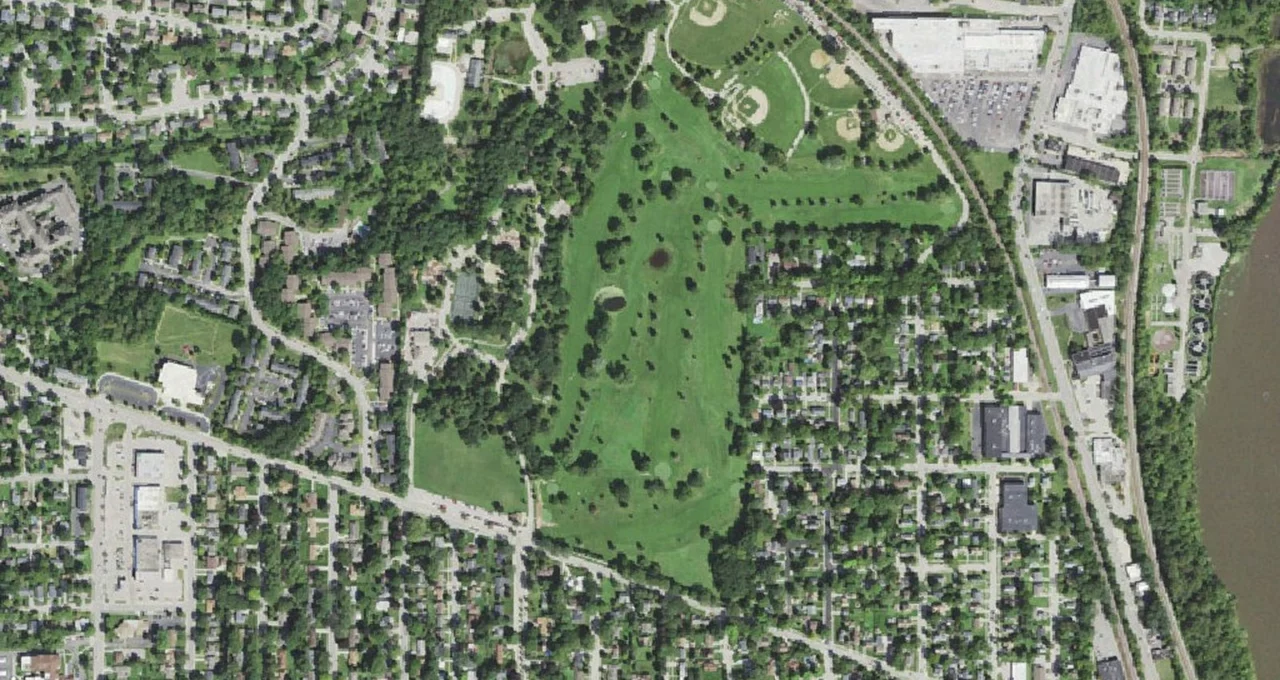
Wing Park Golf Course from the air. Aerial imagery USGS, domaine public.
Wing Park Golf Course
Holes
9
By
36
Length
3,131 yards from the Blue tees on published scorecards (rating 34.6, slope 114); a booking platform gives 3,077 yards
Green fee
—
Best season
April 1 to October 31, according to a booking platform
Wing Park Golf Course is a public nine-hole course owned and run by the City of Elgin, Illinois, inside Wing Park on the city’s west side. The course gives its address as 1012 Wing Street. It was laid out by Tom Bendelow, a designer credited with more than six hundred courses, and opened on September 5, 1908. It has been in play ever since, and in 2009 it was listed on the National Register of Historic Places, which describes it as the “oldest and best preserved nine-hole municipal golf course in Illinois.”
The course is a par 36 with five par 4s, two par 3s and two par 5s. Scorecards published by golf apps and a regional course guide give 3,131 yards from the Blue tees (rating 34.6, slope 114 for men), 2,778 yards from the White tees (32.9 and 107 for men) and 2,629 yards from the Red tees (35.4 and 115 for women). The course’s own site does not publish a scorecard, but it says the holes are regulation in length and the greens are the size of postage stamps.
Other figures circulate. A booking platform lists 3,077 yards with a rating of 70.8 and a slope of 115, which reads like an 18-hole equivalent of the nine-hole card, and shows 2,775 yards for the White tees. One golf app carries a much shorter card of about 2,808 yards from the Blue tees and calls the course a par 35, while its own card adds up to 36. This page follows the 3,131-yard card, on which three independent sources agree hole by hole.
A course built for everyone, in 1908
The history is the main reason to seek Wing Park out, and it is unusually well documented, thanks to the National Register listing. According to that record, as summarized on Wikipedia, golf reached the Chicago area in the 1890s as a game for the wealthy, and by 1900 the city and its suburbs had twenty-six courses. Public golf followed: New York opened the first municipal course in the country at Van Cortlandt Park in 1895, and Chicago opened Jackson Park to the public in 1899.
Elgin was then a manufacturing town, home to the Elgin National Watch Company and a Gail Borden condensed milk plant. Its first course, the private nine-hole Elgin Country Club, was laid out by Bendelow west of the city in 1901. The park came next. William H. Wing, an attorney from a family that had settled in Elgin in 1846, donated 121.5 acres of his estate to the city in 1902 for a public park, which opened on August 2, 1903. The land was part farmland, part native woods.
When an interurban line, the Elgin and Belvidere Electric Company, reached State Street, four blocks east of the park, in 1907, the city decided to put a golf course on the southern part of the property. It hired Bendelow, who, according to the National Register record, staked the course in a single day. The course was built in two months for $1,250. It was deliberately simple and meant to be playable by beginners, with parallel fairways, small greens and the natural ground left largely as it was. When it opened in 1908, Elgin became, by that record’s account, the smallest city in the country with a public golf course.
A club formed around it. The Wing Park Golf Club was organized on September 14, 1912, with 88 charter members, bought land across from the course entrance and built a Craftsman bungalow clubhouse with a veranda facing the course; it then sold another 200 memberships at $25 each. The club hosted tournaments on the public course, including the Elgin City Championship, played there from 1910 to 1961, according to a regional course guide. By 1921 the course was so busy that the city barred non-residents on weekends, and in the mid-1920s it introduced a fee of fifty cents for residents and a dollar for non-residents. A plan drawn up in 1926 to buy adjacent land and expand to eighteen holes was stopped by the Great Depression, which is one reason the original nine survived. The regional guide puts the course at 52 acres and says the tees, fairways and greens keep their original configuration. All of the holes were named in the early years, and the course still uses names such as “The Lark,” “Purgatory,” “Speedway” and “A Wee Drop.”
What it asks of you
Wing Park is not an executive course. It plays as a full-length nine, with two par 5s and a par 4 of more than 400 yards, and its defense is precision rather than length. The regional guide describes narrow fairways, mostly parallel as Bendelow intended, separated by a scattering of trees. There are only a few bunkers and one pond, which sits between the 6th and 7th holes. The ground is mostly flat and easy to walk.
The real test is the greens. The course itself calls them postage stamp in size and says they challenge any ball striker to get it close. On a layout this old, the approach shot is where the score is made or lost: a missed green leaves a chip to a small target rather than a long putt. A slope of 114 from the back tees puts the course close to the standard difficulty for an average player.
Here is the card from the Blue tees, as published by golf apps and matched by the regional guide’s totals:
- 1st: par 4, 313 yards (White 271, Red 265).
- 2nd: par 4, 380 yards (White 355, Red 339).
- 3rd: par 4, 295 yards (White 263, Red 255).
- 4th: par 4, 350 yards (White 320, Red 295).
- 5th: par 3, 175 yards (White 152, Red 144).
- 6th: par 5, 571 yards (White 517, Red 507).
- 7th: par 5, 465 yards (White 416, Red 406).
- 8th: par 4, 433 yards (White 368, Red 321).
- 9th: par 3, 149 yards (White 116, Red 97).
The opening stretch of four par 4s is short enough to reward position over power, and the 3rd, under 300 yards, is the shortest of them. The round then turns on the long holes. The 6th, at 571 yards, is the longest hole and the hardest on the stroke index, and it is followed immediately by the second par 5, which at 465 yards is short for its par. The 8th, a par 4 of 433 yards, is the longest two-shot hole and ranks second on the stroke index. The round ends with the 9th, a par 3 of 149 yards and the easiest hole on the card. The stroke indexes for the other holes differ between the two apps that publish them, so this page gives only the ones on which they agree.
What golfers are saying
Wing Park draws fewer written reviews than a destination course, and most of what exists sits on golf apps, booking platforms and local review sites. The points below summarize what recurs in that material. They are other people’s opinions, not ours; nobody from Panxis has played the course, and we name and quote no one.
What comes up in its favor
- Value is the most frequent compliment: reviewers describe a cheap, quick nine that gets you in and out quickly and suits practice.
- The staff and starter are described as friendly, and the other golfers as welcoming.
- Pace of play is generally described as good, with groups well spaced so that nobody feels rushed.
- Reviewers like the variety of hole lengths, and note that this is a real nine with par 5s rather than a short executive layout.
- Fairways and greens are often described as well kept for a municipal course.
What comes up against
- The greens are very small, which some find hard to hit and hold.
- Course condition scores lower than value in app ratings, and not every reviewer finds the course as well kept as the majority.
- The course can get crowded at peak times, with waits on the tee.
- There is no outdoor driving range, so full shots before a round mean the indoor bays or a trip elsewhere.
How to play it
Wing Park is open to the public. Tee times are booked by phone with the golf shop or online, through a page on the course’s site where golfers must first accept the booking terms. The course recommends booking, especially at weekends. According to those terms, prepaid tee times are not refunded; if you cancel or the weather turns, the course issues a rain check, but the online booking fee of $3.49 per player is not covered by it. Rain checks and gift cards cannot be redeemed online and must be used by booking through the shop. Two players share a cart as standard practice, a single golfer can only book alongside a twosome or threesome, proper dress is required and each golfer must have their own clubs. Booking platforms add that walking is allowed and metal spikes are not, and the regional guide gives tee times ten minutes apart.
The facilities
Rental clubs and gas-powered carts are available in the pro shop, as are pull carts. There is a putting green near the first tee but no outdoor driving range; the regional guide points golfers who want to warm up to the Highlands of Elgin, another course about ten minutes away by car.
The clubhouse has changed recently. For years the course made do with a small building, described by the regional guide as a renovated version of a 1925 clubhouse and used mainly as a snack shop. The city then commissioned a new clubhouse, which local press reported in 2024 would include a golf shop, simulators and a bar. It opened in 2026, and the course site now points to Chip Shots Golf & Whiskey Bar, run in the new building by the owners of an Elgin tap room. According to its own site, it has three simulator bays, open daily from 11 a.m. to 9 p.m., for four to six people per bay at $45 an hour, a whiskey bar and a food truck on site, with a winter indoor league and other events. A regional magazine adds three indoor hitting bays in a three-season room and an outdoor seating plaza.
Getting there and when to go
The course is in Wing Park, on Wing Street, a few blocks west of State Street on Elgin’s west side. Its site gives the address as 1012 Wing Street, Elgin, IL 60123; booking platforms and golf apps use 1000 Wing Street and the regional guide 1010 Wing Street. The regional guide notes homes along the southeast side of the course and ball fields to the north.
A booking platform gives the season as April 1 to October 31. The course lists daily hours of 7 a.m. to 7:30 p.m., weather permitting, and announces a later start, at 8 a.m., from Sunday, September 28, as the days shorten. Schedules, frost delays and closures are the course’s call.
Green fees
The course publishes its 2026 rates. Nine holes cost $20 on weekdays and $22 at weekends for Elgin residents, and $23 and $25 for non-residents. Seniors aged 62 and over and juniors aged 17 and under pay $17 (residents) or $19 (non-residents) on weekdays, with proof of age. A same-day replay costs $15. A cart costs $8 for nine holes, and a pull cart $5. Since January 1, 2025, Illinois has required golf courses to collect 8.5% sales tax on cart, pull cart and club rentals, and the course applies it. Season passes are also sold, from $225 for a resident junior weekday pass to $1,295 for an unlimited adult pass with cart. See the course’s own rates page.
How this page was made
The factual frame comes from public sources: OpenStreetMap for the location; the course’s website for the address, the description of the greens and hazards, the hole names it quotes, the rentals, the booking terms, the hours and the 2026 rates; the Chip Shots website for the simulators and the bar; Wikipedia’s article on the course, based on the National Register of Historic Places record, for the history, the architect, the opening date, the club and the 2009 listing; Wikidata for the identifiers and the founding year; the GolfScout regional course guide for the acreage, the layout, the pond, the old clubhouse, the Elgin City Championship and the nearest range; the 18Birdies, Golfify and Hole19 apps for the scorecard, ratings and stroke indexes; the GolfNow and TeeOff booking platforms for the alternative length, the season and the course policies; Fox Valley Magazine for the new clubhouse’s layout; and a Historic Elgin page.
Where sources disagree, we say so. The length differs between scorecards, and we follow the 3,131-yard card. Historic Elgin gives 1909 as the opening year and calls Wing Park the first municipally owned course in Illinois, and one app calls it the oldest public course in the state; we follow the National Register wording and the 1908 date given by the course, Wikipedia and Wikidata. Figures for the cost and size of the new clubhouse appear in press summaries that we could not read in full, so we leave them out.
The opinion section summarizes reviews on golf apps, booking platforms and local review sites read in September 2026. We report recurring themes rather than individual voices, and we reproduce no quotations. Nobody from Panxis has played or visited this course, and this page is no substitute for a round.
The course has not paid for this page, has not seen it before publication and has no say over its content. This page contains no commercial link and earns us no commission. If you know the course and something here is wrong or out of date, write to us and we will correct it.
Other courses nearby
Closest to this one in our United States directory:
- Kemper Lakes Golf Club — 17 mi
- Rolling Green Country Club — 18 mi
- Rich Harvest Farms — 23 mi
- Tam O’Shanter Golf Course — 26 mi
The hole to know
The longest hole and the hardest on the stroke index: a par 5 of 571 yards from the Blue tees, ahead of the course's only pond, which lies between the 6th and 7th holes.