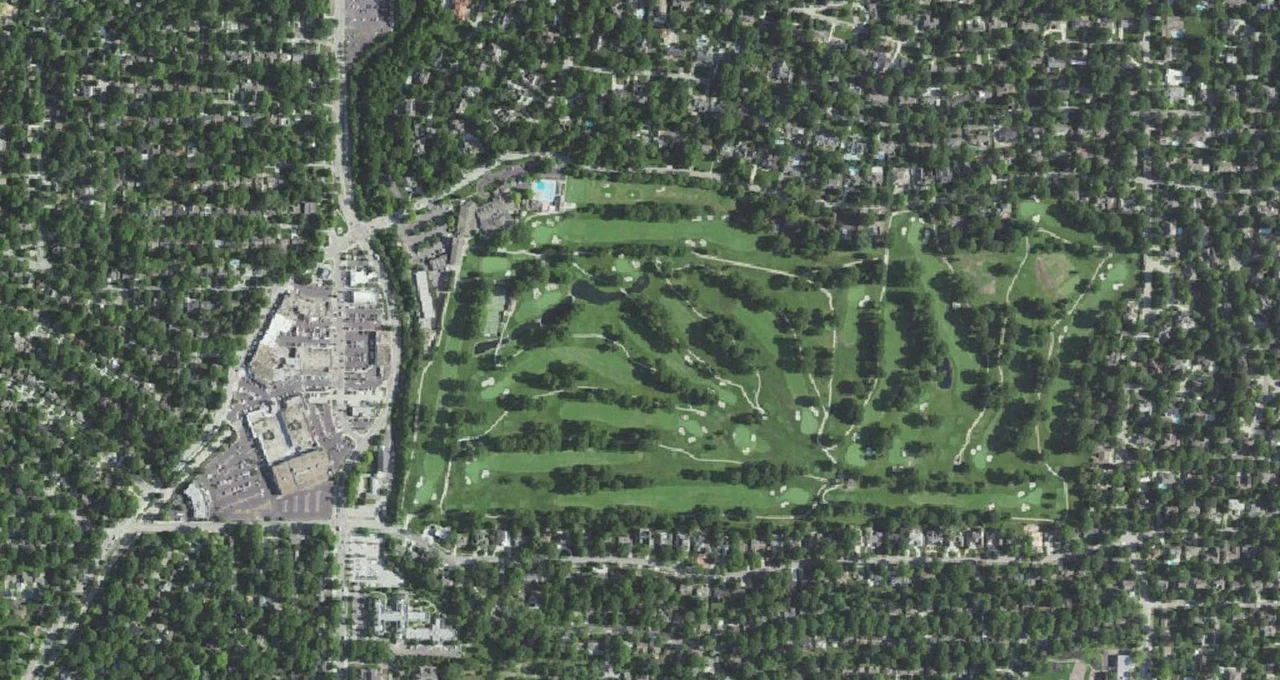
Indian Hills Country Club from the air. Aerial imagery USGS, domaine public.
Indian Hills Country Club
Holes
18
By
—
Length
—
Green fee
—
Best season
Roughly March to November
The club began in 1919 as the Community Golf Club, organised by the developer J.C. Nichols on land next to Mission Hills Country Club. Nichols was building the Country Club District, the planned suburb that made Kansas City a case study in twentieth-century American urban development, and a golf course was part of the plan. In 1925 Kansas City Country Club took over the original course and Nichols helped organise Indian Hills in its place.
A.W. Tillinghast designed it, and it opened in 1926. After ten days walking the site he called it one of the greatest opportunities he had ever had for creating a notable course, which is a striking thing to read from the architect of Winged Foot and Baltusrol.
What it asks of you
Tillinghast on rolling Kansas ground: bold bunkering set at the landing zones, greens sited on natural high points and pitched to reject the approach played from the wrong side, and a routing that uses every fold in the land.
It plays to a par of 70 at around 6,500 yards from the back tees, with a rating of 72.3 and a slope of 131, so the numbers say what the ground says. This is the same hand that built Winged Foot and Bethpage Black, working on a smaller and gentler property, and it repays a slow walk more than a hard one. The club has hosted more than fifty USGA and state amateur qualifying events, which is the practical measure of whether a course of this length still asks enough.
The course has been altered more than its reputation suggests. Floyd Farley remodelled it in 1958, Bob Dunning in 1965, and Tom Clark revised two holes in 1984, so what is on the ground is Tillinghast’s routing carrying three later hands.
What players say about it
Access is by membership or a member’s invitation, so the public record consists of guest accounts, architecture writing and rating panels rather than visitor reviews. The notes below summarize themes that recur across those public sources. They are other people’s opinions, not ours: we have not played the course, and we do not name or quote individual reviewers.
What comes up in its favor
- The Tillinghast attribution is the first thing anyone mentions, and it carries real weight among people who know the architect’s work. The club’s own professional has said publicly that fellow professionals react to it.
- The green sites draw consistent praise. Placing them on natural high points was the decision that made a modest property interesting.
- The routing over rolling ground is well regarded, and the course is described as walkable and enjoyable rather than punishing.
- The competitive record, with a long list of qualifying events, is treated as evidence that the course still works at a serious standard.
What comes up against
- The successive remodels are the main reservation. What survives is Tillinghast’s plan under three later interventions, and purists say so.
- The course is short by modern standards, and better players find it more charming than testing from any tee.
- Access is closed, with no visitor tee sheet, and the review record is thin because of it.
- The clubhouse is modern rather than historic, having been rebuilt in 1972 and renovated twice since, which disappoints visitors expecting a 1920s building to match the course.
Getting there and when to go
Mission Hills is on the Kansas side of the state line, ten minutes from the Country Club Plaza and downtown Kansas City, and around half an hour from Kansas City International. The neighbourhood itself, laid out as part of the Country Club District, is worth the drive whether or not you get on the course.
The season runs from roughly March to November, with spring and autumn giving the firmest turf. Kansas summers are hot and the course plays softer. Guest play is arranged through a member.
Green fees
Guest conditions and rates are set by the club and are not published. See the club’s own site.
How this page was made
The factual frame comes from public sources: OpenStreetMap for the location, Wikipedia and published architecture coverage for the history, the design and the later remodels, and the club’s own site for access. The opinion section summarizes public commentary and guest accounts read in September 2026; we report recurring themes rather than individual voices, and we quote only remarks that were themselves made publicly and on the record.
We have not played this course, and nothing here is a substitute for that. The club has not paid for this page, has not seen it before publication and has no say in what it says. If you know the course and something here is wrong or out of date, write to us and we will correct it.