Personal launch monitors: which numbers are real
One number justifies the category for an amateur: carry distance, which almost no club golfer has honestly. The rest is decoration, and the sticker price is often not the real price.
In brief
- Radar units need outdoor space; camera units work in a bay but want light.
- Carry distance, ball speed and launch with spin are the three numbers that matter.
- Check the three-year cost including the software tier, and whether data exports.
- Mat numbers flatter iron strikes; use the device to compare, not to publish.
- Rent an hour of bay time first: it may be all you actually needed.
A launch monitor used to be a fitting-bay machine that cost as much as a car. Consumer units now sit in the price range of a driver, and the useful question has changed from whether you can afford one to whether the numbers it gives you are worth having.
The short answer is that one number justifies the whole category and the rest are decoration for most amateurs. That number is carry distance, and almost no club golfer has an honest chart of it. Everything below is about getting that number reliably, and about not paying for the ones you will never use.
What every unit measures, and what it guesses
There are two technologies and the difference matters more than the brand.
Radar units track the ball through the air with Doppler radar and calculate the rest from its flight. They are excellent outdoors, where the ball has room to fly, and they infer club data rather than seeing it.
Camera-based, or photometric, units photograph the ball and the clubhead in the first inches after impact and measure directly. They work in a confined indoor bay, which radar does not, and they generally read spin more accurately, but they want good light and often a marked ball.
The important habit with either is asking which numbers are measured and which are modelled. Manufacturers rarely draw a bold line, and the specification page usually will not either. Carry distance and ball speed are reliable on almost everything sold today. Spin rate, spin axis, club path and face angle vary enormously by unit and by price, and on the cheapest devices some of them are estimates dressed as readings.
The three numbers worth caring about
Carry distance tells you what club to hit and is the single most valuable thing an amateur can learn. A golfer with an honest carry chart stops coming up short on approach shots, which is the most common amateur miss by a wide margin.
Ball speed tells you whether a change actually added speed or only felt like it. It is the number to watch in a speed-training programme, because it strips out the effects of strike and conditions in a way that distance does not.
Launch angle, paired with spin, explains why your drives balloon or run out. High launch with high spin is the classic amateur driver flight and costs real distance, and it is fixable through loft, shaft and strike location once you can see it.
Everything else is interesting, and almost nobody uses it to improve. Which leads directly to the next point.
What the categories cost in 2026
| Unit | Type | Approximate U.S. price | Note |
|---|---|---|---|
| Garmin Approach R10 | Radar | Around $499 | No subscription required for the basic app |
| Rapsodo MLM2PRO | Radar with cameras | From about $699 | Full feature unlock is a substantial extra |
| FlightScope Mevo+ | Radar | Around $1,100, plus about $600 for the Pro package | Outdoor range needed |
| Bushnell Launch Pro | Camera | From roughly $2,499 | Higher tiers unlocked by subscription |
Prices are the published U.S. figures in 2026 and move with promotions and model changes, so check before buying. The pattern to take from the table is more useful than the individual numbers: the sticker price is frequently not the real price, because the software tier that unlocks the data you wanted is sold separately.
The subscription question
This is the single biggest trap in the category. Several units are sold at an attractive hardware price and then gate the useful features behind an annual or lifetime software fee: simulator play, shot video, club data, or the ability to export your own numbers.
Before comparing two devices, work out the three-year cost of each including whatever tier gives you the numbers listed above. A unit at $700 with a $500 unlock is more expensive than one at $1,000 without, and the comparison tables online rarely present it that way.
Ask specifically whether your data is exportable and whether the app keeps working if you stop paying. A carry chart you cannot get out of an app you no longer subscribe to is not a carry chart.
Indoors, outdoors and the honest caveats
Radar units want space, typically several feet behind the ball and a good deal in front of it, which a two-car garage does not have. Camera units work in a confined bay but want consistent lighting, and many want a ball with a marking on it.
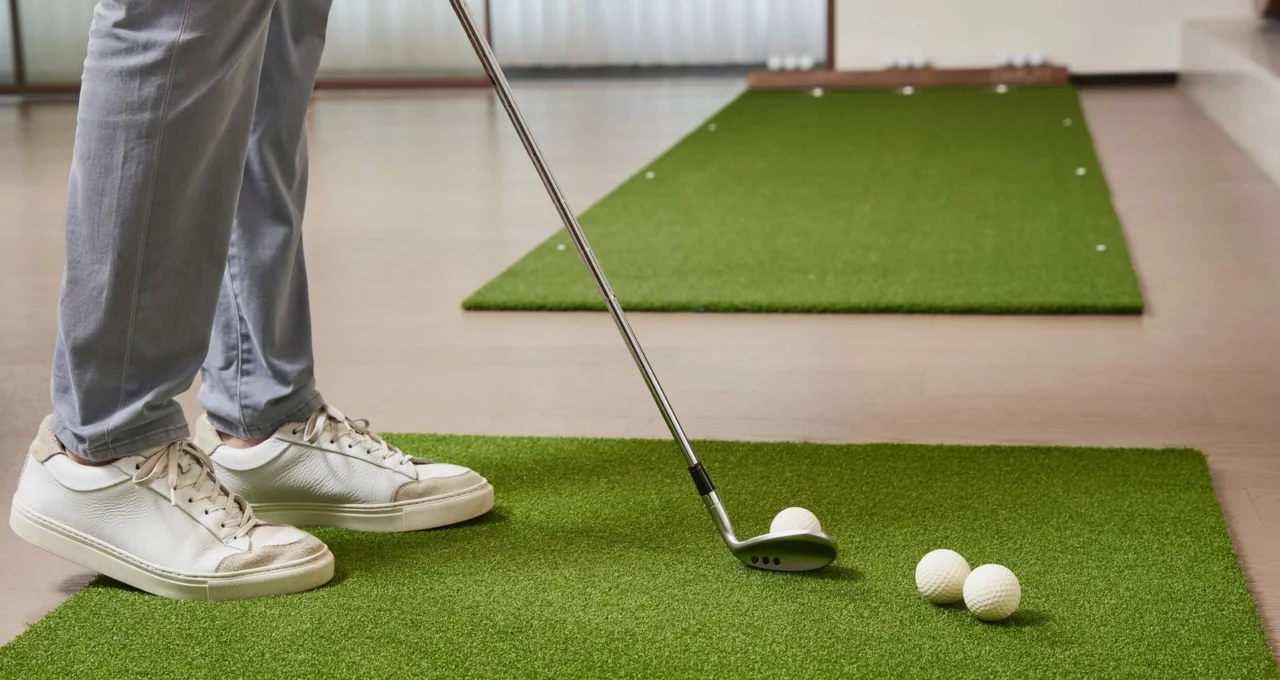
Numbers from a mat differ from numbers off turf. A mat forgives a fat strike that grass would punish, so indoor carry numbers tend to flatter you by a few yards on iron shots. Air matters too: a heated bay in January is not the same air as a course in July, and elevation changes carry by a meaningful amount in Denver or Albuquerque.
The practical rule is to use the device to compare, not to publish. Comparing two shafts in the same session is exactly what these units are good at. Announcing that you carry a 7-iron 165 because a garage said so is exactly what they are not.
Where they genuinely help
Three uses justify the purchase for an amateur.
Building a carry chart for every club, which almost no club golfer has and which changes club selection on every approach shot for the rest of your golfing life. This is the one that pays.
Testing whether a swing change did anything measurable, rather than trusting how it felt. Feel is an unreliable narrator, and ten shots before and ten after settles the argument.
Winter practice with feedback, which is the difference between maintaining a swing through four months and drifting for four months. Hitting into a net with no information is how bad habits set.
Where they do not
A launch monitor will not tell you why your club path is out to in. It reports the number, and chasing club-path numbers without a coach is how golfers spend a winter building a compensation for a problem they have diagnosed wrongly.
It will not fix your short game, your course management or your putting, which is where most amateur strokes actually go. A player who buys a $2,000 device and spends the winter hitting drivers has bought an expensive way to make the same mistake faster.
And it will not make range time into practice by itself. Feedback only helps when it answers a question you asked before the session started.
What to look at before buying
Decide first whether you will use it indoors, outdoors or both, because that narrows the field faster than anything else and rules out half the market immediately.
Then check what is measured rather than calculated at your price point, work out the three-year cost including software, and confirm your data is exportable. Finally, consider whether you need to own one at all: for most golfers, two sessions a year to build and refresh a carry chart is the entire benefit, and that can be rented.
Where to try and buy in the U.S.
Large U.S. golf retailers generally keep consumer units in store and will let you hit with one before you buy, which is worth an hour of a Saturday. A big sporting-goods chain will carry the mainstream models, and the manufacturers sell directly with return windows that are generally long enough to test properly.
Before spending anything, rent bay time. Indoor simulator centers have spread through most American cities in the past few years and are typically booked by the hour with a commercial-grade monitor included, which is more accurate than anything in this price range. One hour produces a carry chart for the whole bag, and for a great many golfers that is the entire reason they were considering a purchase.
If you want your on-course numbers instead of range numbers, shot-tracking systems such as Arccos and Shot Scope record real distances from real lies across a season, which for club selection is arguably better data than a launch monitor produces, at a fraction of the price.
Panxis Golf has no commercial relationship with any manufacturer, retailer or facility mentioned here, and earns no commission on anything sold by them.
Before you spend
- Rent bay time for an hour and build a carry chart. If that is all you wanted, you may not need to own one.
- Confirm which numbers your intended unit measures rather than models.
- Work out the three-year cost including any software tier, and check the data is exportable.
- Decide indoors or outdoors before you decide on a brand.
- If the honest answer is that you would use it for entertainment, price it as entertainment.
The device is a measuring instrument, not a coach. Used to answer a specific question it is excellent value; used as entertainment it is an expensive way to hit balls into a net.