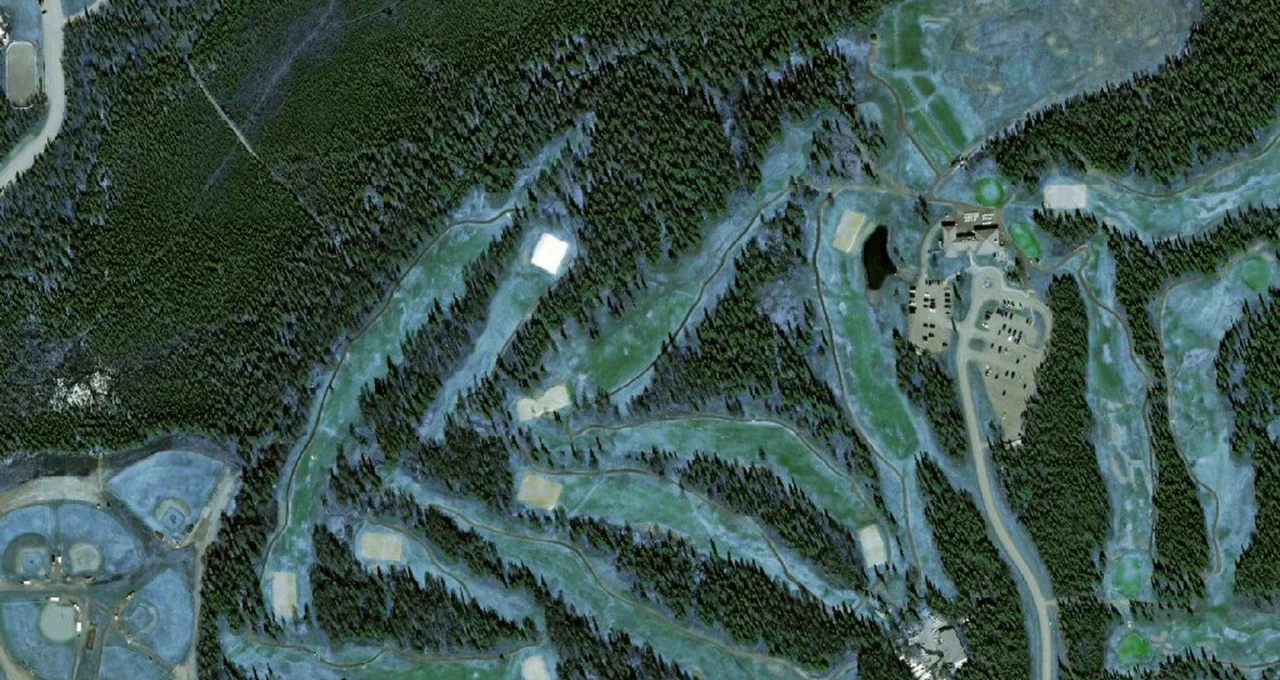
Anchorage Golf Course from the air. Aerial imagery USGS, domaine public.
Anchorage Golf Course
Holes
18
By
72
Length
6,601 yards from the Black tees on the course's scorecard (rating 71.4, slope 129); the course rounds it to 6,600, and directories give other ratings
Green fee
—
Best season
Early May to mid-October according to the course (April to October in its FAQ, weather permitting); golf shop open year-round; last tee time 10 p.m. in summer
Anchorage Golf Course is a public 18-hole course at 3651 O’Malley Road, on the lower hillside of South Anchorage, Alaska, in the part of the city locals call the Anchorage Bowl. It was designed by Bill Newcomb and opened in 1987, and its website describes it as a Municipality of Anchorage public facility. The course plays through birch and spruce woods between the city and the foothills of the Chugach Mountains, and on a clear day it looks out over the downtown skyline, Cook Inlet and, far to the north, Denali.
On the scorecard the course publishes, it is a par 72 of 6,601 yards from the Black tees, with a course rating of 71.4 and a slope of 129. The course itself rounds that to “a 6600 yard test.” In the summer of 2022 it hosted the 60th U.S. Senior Women’s Amateur, the first championship the United States Golf Association had ever staged in Alaska, which made Alaska the last of the fifty states to receive one. Since 2008 the layout has been reworked hole by hole by the architect Forrest Richardson, a project his firm says should be finished in 2028.
A municipal course on the hillside
The course’s own history is told briefly, and mostly by the architects. According to Forrest Richardson’s firm, routing ideas for the site were first drawn up by Robert Trent Jones Jr. in the mid-1980s. In the end the Municipality of Anchorage contracted Bill Newcomb, described by the same source as a golf developer and designer, to design and build the course on its behalf, and it opened in 1987. Richardson’s page adds that, besides serving the community, the project was meant to give golf to the Alyeska Resort, the ski area in Girdwood; for perspective, Girdwood is about 26 miles away in a straight line. We found no other source on that point.
The setting is what the course leads with. Its website lists the views of the Chugach Range, the city skyline, Cook Inlet and Denali, and its seasonal event tent, the Little Bears Pavilion, adds Mount Susitna and Mount Foraker to the panorama. The course also says it has the only grass driving range in Anchorage, with a ball dispenser at each end, and its FAQ puts the range at up to 50 hitting stations. Visit Anchorage, the city’s tourism office, quotes the course’s operations manager calling it “a wooded wonderland, a truly Alaskan experience,” and says the course takes part in the Audubon Cooperative Sanctuary Program, the environmental certification scheme for golf courses.
Wildlife is part of the deal. The course mentions moose, foxes, waterfowl and bears; Visit Anchorage adds eagles; and a USGA official told Alaska Public Media in 2022 that she had seen moose on the driving range during a site visit. Anchorage is a city that shares its green spaces with moose, so give any animal on the course plenty of room and let it move on before you play.
The clubhouse holds a restaurant, O’Malley’s on the Green, and the course runs a busy schedule of weddings, banquets and corporate outings alongside the golf. Its annual amateur championship, the Anchorage Open, is a 36-hole stroke-play event with gross and net divisions for men, women and seniors; the 2026 edition was played on August 29 and 30, and the course publishes results back to 2012.
Alaska’s first USGA championship
For decades Alaska was the only state that had never hosted a USGA national championship. GOLF.com noted in 2020 that the state had held U.S. Open local qualifying every year since 2009, usually one of the smallest qualifying sites anywhere, but nothing more. Forrest Richardson’s firm tells how that changed: in 2017 the architect met Mike Davis, then the USGA’s chief executive, at a conference, and Davis, intrigued by how work got done in such short growing seasons, took up the idea of bringing an event north. In October 2020 the USGA announced that Anchorage Golf Course would host the 2022 U.S. Senior Women’s Amateur, and Davis called it “a monumental occasion.”
The championship ran from July 30 to August 4, 2022. It is open to women aged 50 and over with a low handicap, and the format was the usual one: 132 players, two rounds of stroke play, then six rounds of match play for the low 64. Alaska Public Media reported players from 35 states and 11 countries, with a single Alaskan in the field, who struck the opening tee shot; admission was free. The early match-play days brought surprises, with the medalist, Lynne Cowan, and the three-time defending champion, Lara Tennant, both knocked out on August 2.
The title went to Shelly Stouffer of Nanoose Bay, British Columbia, who beat Sue Wooster of Australia 4 and 3 in the final on August 4, becoming the first USGA champion crowned in Alaska. The Pacific Northwest Golf Association reported that she was 5 up after nine holes, won all six of her matches by at least 3 and 2, and had shot a 4-under-par 68 in the second stroke-play round, the only score under par in the field, which it called a competitive course record.
A long renovation in a short season
Forrest Richardson began working on the course in 2008, preparing master plans for what his firm calls a ten-year process of remodeling, which in practice has stretched further. The scope it lists is broad: rebuilt greens, all new bunkering, added tees to lengthen the course and make it more playable for everyday golfers, tree clearing and wider fairways. A new short-game area and an expanded practice range are already done. The firm puts the total budget at five million dollars, with the work carried out in-house rather than by an outside contractor.
The constraint is the calendar. “In Alaska you need to work according to the schedule of Mother Nature, and her schedule is nothing like we’re used to,” Richardson says on his firm’s page. Spring can arrive as late as May, turf needs time to grow in before the season ends, and so only a few holes are disturbed each year. The course was prepared specifically for the 2022 championship, and Visit Anchorage credits bunker upgrades, the bigger range and the new short-game area with getting it ready. A local golfer writing for Visit Anchorage adds that the work done for the USGA left the public with a better course.
Two projects remain. The firm’s page, updated in December 2025, gives 2028 as the target date for finishing the greens and bunkers. It also describes the Little Bear, a planned six-hole course of par 3s from 70 to 120 yards meant for teaching children and bringing new players into the game, for which trees have been cleared and money is still being raised. The name, Richardson explains, comes from the little bear that lives in that part of the property. The master plan posted on the course’s website, drawn by Richardson’s firm, shows the Little Bear next to the 10th and 18th holes, along with a list of planned amenities around the clubhouse, and proposes a longer course of 6,730 yards from the back tees. Those plan yardages are targets, not the current card.
What it asks of you
The course describes itself as “rolling, tree-lined fairways” leading to “well-guarded, undulating greens.” Its FAQ calls the ground “reasonably hilly” and warns that the back nine is harder to walk than the front. A blogger who played it in June 2013 found no major elevation changes but plenty of ups, downs and doglegs, mounding along the fairways and around the greens on the front nine, and few flat lies; the Visit Anchorage writer mentions blind shots. Trees line most holes, and the local rules put out of bounds along the fence line to the right on holes 6, 7, 8, 14, 15 and 17. While you play the 4th, the 7th hole is out of bounds, and on the 18th so is the parking lot on the right.
The card gives the following pars and Black tee yardages. The front nine is a par 36 of 3,180 yards, the back nine a par 36 of 3,421 yards. The handicap figure is the men’s stroke index.
- 1st: par 4, 347 yards, stroke index 14.
- 2nd: par 4, 348 yards, stroke index 8.
- 3rd: par 3, 177 yards, stroke index 16. The Top 100 Golf Courses website singles out its boomerang-shaped, steeply banked green.
- 4th: par 4, 460 yards, stroke index 2. The longest par 4 on the card and the second hardest hole for men.
- 5th: par 4, 334 yards, stroke index 12.
- 6th: par 5, 484 yards, stroke index 4. Top 100 Golf Courses notes water down the left; the master plan shows a pond in the southeast corner of the property.
- 7th: par 4, 388 yards, stroke index 10.
- 8th: par 3, 149 yards, stroke index 18. The shortest hole and the easiest on the men’s card.
- 9th: par 5, 493 yards, stroke index 6.
- 10th: par 4, 412 yards, stroke index 13.
- 11th: par 4, 389 yards, stroke index 5.
- 12th: par 4, 380 yards, stroke index 15.
- 13th: par 3, 217 yards, stroke index 9. The longest short hole.
- 14th: par 5, 586 yards, stroke index 1. The longest hole and the hardest on both the men’s and the women’s cards, with the fence line out of bounds on the right.
- 15th: par 4, 331 yards, stroke index 17.
- 16th: par 3, 184 yards, stroke index 11.
- 17th: par 5, 535 yards, stroke index 3.
- 18th: par 4, 387 yards, stroke index 7. A USGA official told Alaska Public Media that you can see Denali behind you as you walk up this fairway.
The card lists five sets of tees. For men, the Black tees (6,601 yards) are rated 71.4 with a slope of 129, the Blue tees (6,267 yards) 70.0 and 126, the White tees (6,002 yards) 68.2 and 125, and the Gold tees (5,466 yards) 65.9 and 110. For women, the Gold tees are rated 71.8 with a slope of 129 and the Red tees (4,773 yards) 68.0 and 117. The card shows a single par of 72 for every set.
The shape of the round is easy to read from those numbers. The front nine is the shorter half, with two short par 4s in the first five holes but also the 460-yard 4th. The back nine is about 240 yards longer and carries the two longest holes, the 14th and the 17th, both par 5s over 530 yards that the 2013 blogger called long and tight. The par 3s are not a rest either: three of the four measure 177 yards or more from the Black tees. The card prints “cart path only” on six holes, including all four par 3s, and marks a pace of play hole by hole, with the turn at 2 hours 12 minutes and the round at 4 hours 30, which is also the course’s official rated pace.
Weather is the other variable. The course’s FAQ says temperatures in June, July and August are usually in the 60s or 70s °F, with some days in the 80s, that rain can come at a moment’s notice but thunderstorms are extremely rare, and that you should bring layers. Early in the season, turf can still be filling in; the blogger who played in mid-June 2013 found inconsistent fairways and bumpy greens, a complaint that has not been repeated as much in recent accounts.
What golfers are saying
Anchorage Golf Course has a modest number of public reviews compared with courses in the Lower 48, spread across travel and tee-time sites, a few golf blogs and local guides, and on one large tee-time site we found no reviews at all. The points below summarize what recurs. They are other people’s opinions, not ours; nobody from Panxis has played the course, and we name no one.
What comes up in its favor
- The views come first in almost every account: Denali, the Chugach and the city from the clubhouse area, with one blogger saying the best view on the course is from the putting green above the range.
- Playing under the midnight sun is a draw in itself; several visitors came specifically to finish a round close to or after midnight in June.
- Wildlife is a recurring story, mostly moose; one reviewer jokingly said they only played seventeen and a half holes after conceding the 4th to a cow moose standing in the pond by the green.
- Recent reviewers and local writers describe the course as the best maintained in the area, with lush fairways and greens, and credit the work done for the 2022 championship.
- Staff are often described as friendly, and the layout, with its doglegs and contours, gets praise for feeling like mountain golf without big climbs.
What comes up against
- Conditions early in the season have drawn criticism, with older reviews describing bumpy greens and patchy fairways in June.
- Mosquitoes, especially on the lower, wetter ground of the back nine on summer evenings.
- Pace of play can be slow at busy times, though some reviewers excuse it given how short the season is, and others report a quick round.
- Walkers should note that accounts differ on which nine is hardest on the legs: the course says the back nine, while one blogger found the back nine flatter. Either way, the course is hilly enough that it suggests a cart if your home course is flat.
Who can play
The course is open to the public and every golfer registers in the pro shop before playing. Tee times can be booked online with a credit card, or by phone at (907) 522-3363, up to five days in advance; visitors from outside Alaska can ask to book further ahead through an out-of-state request form or the tournament office at (907) 522-7825. The course does not take reservations for single players, but says a walk-on single can usually be fitted in within the hour. Foursomes are the maximum, and on busy days, particularly Thursday through Sunday, you may be paired with other golfers. Each player needs their own set of clubs, and rental sets are available. The course asks you to arrive at least 30 minutes early. Changes and cancellations must be made by phone, at least 24 hours ahead, or a no-show charge may apply.
Walking is allowed, and riding carts and pull carts can be rented. Carts must stay at least 30 yards from the greens and follow the 90-degree rule where conditions allow; on some days carts are kept off the fairways altogether. Children must be at least 6 to go on the course, even to watch, and riders over that age pay a fee. The dress code is relaxed: jeans are fine, but you need a golf shirt or T-shirt, no profane or graphic clothing, and soft spikes or soft-soled shoes. Coolers are not allowed, and Alaska law forbids bringing your own alcohol. The course runs lessons, a golf school, junior programs and leagues, and has a free app with GPS yardages, tee-time booking and standby notifications.
The season, according to the course page, runs from early May to mid-October, while the golf shop stays open year-round; the FAQ is broader, putting Alaska’s season at April to October depending on the weather, with the peak from June to early September. In season the shop is open from 5:30 a.m. to 10 p.m., and the last tee time is 10 p.m. To finish 18 holes in June or July, the course advises teeing off by about 8 p.m.
Getting there
The entrance is on the north side of O’Malley Road, east of the New Seward Highway; the course’s directions put it about one and a half to two miles from the highway, depending on which way you come, with a sign on the left as you drive east. From the airport, Minnesota Drive turns into O’Malley Road at the highway. The course says it is about a 15-minute cab ride from Ted Stevens Anchorage International Airport. In a straight line, the airport and downtown Anchorage are each about 7 miles away, the O’Malley Road interchange on the New Seward Highway about 1.5 miles, Girdwood about 26 miles, Wasilla about 34 miles and the summit of Denali about 140 miles. These distances are measured on the map and not by road.
Green fees
Anchorage Golf Course is a pay-and-play public course. It publishes separate rates for non-residents and Alaska residents, for 18 holes, nine holes and twilight, reduced rates for resident seniors and for juniors, cart and club rental fees, punch cards, early-morning and evening season passes and prepaid range keys. Rates change from year to year, so check them on the course’s own rates page, or on its out-of-state page if you are visiting, before you book.
How this page was made
The factual frame comes from public sources: OpenStreetMap and Wikidata for the location and identifiers; the course’s website, anchoragegolfcourse.com, for the scorecard image, the course description, the season, the range, the rules and FAQ, the tee-time and cancellation policies, the directions, the Anchorage Open and the master plan image; the web page of Forrest Richardson Golf Course Architects, updated in December 2025, for the early history, the renovation, its budget and the Little Bear; GOLF.com and the USGA announcement reproduced on the course’s website for the 2020 announcement; Alaska Public Media, the Pacific Northwest Golf Association, AmateurGolf.com and Wikipedia for the 2022 championship; Visit Anchorage for the Audubon program and local perspective; Top 100 Golf Courses for the 3rd and 6th holes; and travel, tee-time and blog reviews for the opinion section. Wikipedia has no article on the course.
Where sources disagree, we say so. This page follows the scorecard on the course’s own website, which is undated: 6,601 yards from the Black tees, rated 71.4 with a slope of 129. Other directories give different figures: one lists 6,601 yards at 72.6 and 134, another 6,616 yards at 72.1 and 130 with different ratings for every tee, and a golf app lists a 6,035-yard set that matches no tee on the current card. Ratings and yardages have probably moved with the renovation, which may explain the gap. The ZIP code is 99507 on the course’s website and 99516 in one directory. The season is early May to mid-October on the course page, April to October in its own FAQ and May 15 to October 1 in a directory. Rankings vary by source: Richardson’s firm says Golfweek ranks the course first in Alaska, Visit Anchorage says Golf Digest voted it best in the state, and Top 100 Golf Courses places it second in Alaska. The link with the Alyeska Resort comes only from the architect’s page. The course’s own FAQ and one blogger disagree on which nine is flatter.
Some details will age: the renovation target of 2028, the Little Bear project, the 2026 Anchorage Open dates, the hours, the booking rules, the staff quoted, and the card itself once the master plan’s longer tees are in play. Nobody from Panxis has played or visited this course, and this page is no substitute for a round. The reviews were read in October 2026, and we report recurring themes rather than individual voices.
The course has not paid for this page, has not seen it before publication and has no say over its content. This page contains no commercial link and earns us no commission. If you know the course and something here is wrong or out of date, write to us and we will correct it.
Other courses nearby
Closest to this one in our United States directory:
- Columbia Edgewater Country Club — 1531 mi
- Circling Raven Golf Club — 1602 mi
- Bakersfield Country Club — 2234 mi
- Canyon Gate Country Club — 2287 mi
The hole to know
A par 5 of 586 yards from the Black tees, the longest hole on the course and stroke index 1 on both the men's and the women's cards, with out of bounds along the fence line on the right under the local rules.