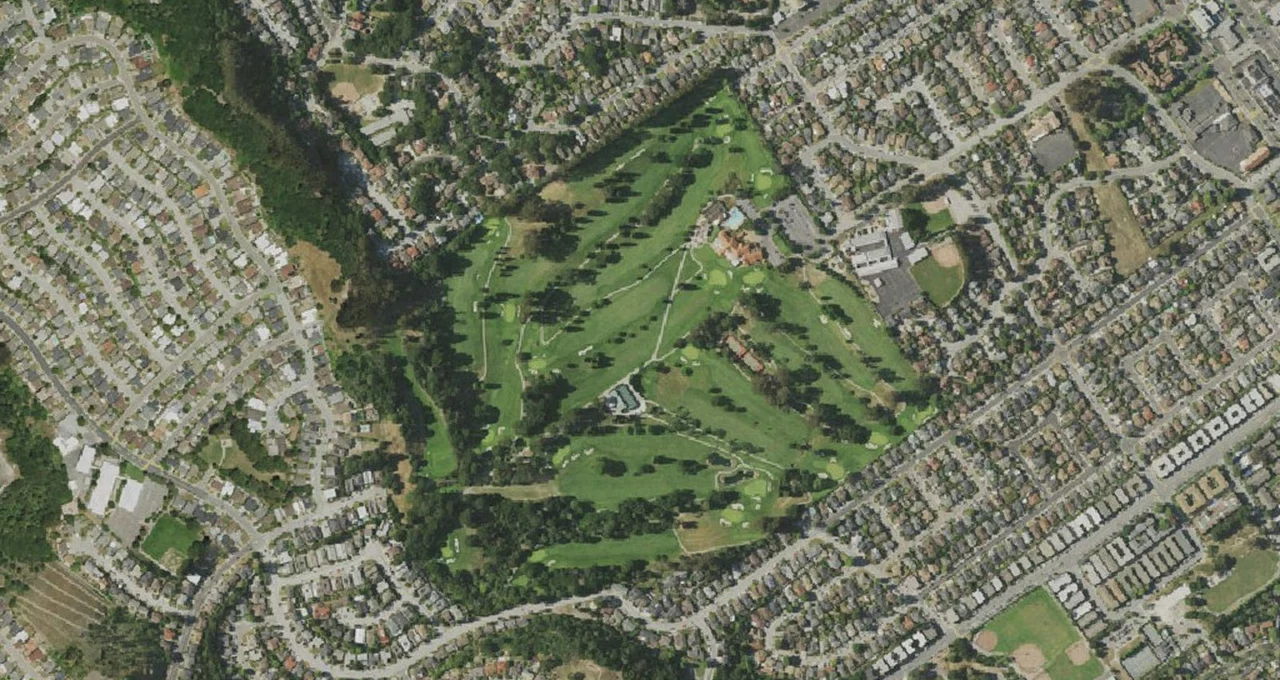
Green Hills Country Club from the air. Aerial imagery USGS, domaine public.
Green Hills Country Club
Holes
18
By
71
Length
6,351 yards from the back tees on the club's scorecard (rating 70.7, slope 138 according to course directories); other listings give 6,328 yards (71.5, 139) or 6,428 yards
Green fee
—
Best season
—
Green Hills Country Club is a private, member-owned club in Millbrae, on the San Francisco Peninsula, with an 18-hole par 71 designed by Alister MacKenzie. It opened on April 27, 1930, under another name, the Union League Golf and Country Club, and took its present name in 1945. The club’s address is 500 Ludeman Lane, Millbrae, CA 94030, about two miles in a straight line from San Francisco International Airport. The club’s website describes the course as a qualifying site for the USGA and the Northern California Golf Association (NCGA), and it presents the layout with the features MacKenzie is known for: small, undulating greens and strategically placed bunkers.
This is a private course. The club states on its membership page that you must be a member or the guest of a member to use its facilities. There are no public tee times, and no green fee is listed here. If you do not know a member, Green Hills is a course to read about rather than to book.
The length depends on the source. The scorecard published on the club’s golf page lists five sets of tees without naming them; the back set adds up to 6,351 yards and the next two to 6,033 and 5,724 yards, all to a par of 71. Course directories label those three sets Blue, White and Red, followed by Combo and Gold sets for shorter hitters, and give the Blue tees a course rating of 70.7 and a slope of 138, the White tees 69.4 and 135, and the Red tees 68.2 and 132 for men. Other listings give different figures: Golf Digest and GolfNow, as indexed by search engines, list 6,328 yards from the back tees with a rating of 71.5 and a slope of 139; the Top 100 Golf Courses website lists Black tees at 6,428 yards, Blue at 6,085 and White at 5,844; Stymie gives the Blue tees 6,211 yards. We could not reach the USGA course rating database to settle the question. This page follows the club’s own scorecard for every hole yardage below, and cites the 70.7 and 138 ratings that directories attach to it.
A Union League club on the Peninsula
The club began as a project of San Francisco’s Union League Club. According to Wikipedia, which draws on San Mateo Times articles of the period and on the club’s archives, members chose a site in Millbrae in 1927; the land had been a nursery, and the members liked it for its fertile soil, its water supply, its varied terrain and its position outside the fog belt. The MacKenzie Society, whose club history it says was supplied by Green Hills itself, dates the decision to 1928, describes a group of San Francisco doctors and businessmen behind it, and says the land had been an orchard and garden that grew plants for the 1915 Panama-Pacific International Exposition. Both sources give the property as about 143 acres, a figure the Top 100 Golf Courses website repeats.
Ground was broken on January 6, 1929. MacKenzie laid out the course with the help of H. Chandler Egan and Robert Hunter, according to Wikipedia; Willis Polk and Company designed the original clubhouse. Charles T. Magill, a member of the Union League Club, was the general contractor. Wikipedia reports that the course was ready by January 1930 but that the members held back the opening to protect the young greens, and that a washout on the 1st fairway called for about 7,800 feet of drain tile. The club opened on April 27, 1930, with more than 200 golfers on the course that day. MacKenzie, according to the same article, had predicted in 1929 that the course would rank among the top three in the San Francisco district and among the finest on the coast. A 2026 review on the Top 100 Golf Courses website counts Green Hills as the sixth of the eight courses MacKenzie designed in Northern California.
Depression, a new name and lost bunkers
The timing was poor. By 1932, according to the MacKenzie Society, membership had fallen to about 60, and in 1933 the club was reorganized and became semi-public. The sources disagree on the name it took: the MacKenzie Society and the history section of the Wikipedia article say Millbrae Golf and Country Club, while the opening lines of the same Wikipedia article say Millbrae Country Club. This page uses the first. Cost cutting during the Depression and the war years took a heavy toll on the design: Wikipedia says many of MacKenzie’s bunkers were filled in and sodded over, and the MacKenzie Society says that only about 18 of the original 100 or so bunkers remained when the club was reorganized again in the mid-1940s. In 1945 it became the private Green Hills Country Club.
The MacKenzie Society adds a detail that sets the tone for what followed: members with their own shovels dug out a few of the buried bunkers. Restoration has since become a long-running project rather than a single event. A June 2000 newsletter of the Golf Course Superintendents Association of Northern California credited the superintendent at the time, Walt Barret, with twelve years of work on the original design, including new stone bridges, natural plantings, bunker restoration and some green and tee remodels. Wikipedia places the restoration of many MacKenzie features and bunkers in the 1990s, without naming who led it.
More recent work is documented in the 2026 Top 100 Golf Courses review. It says the architect Mike DeVries restored a bunker at the back left of the 13th green in 2006, and that Todd Eckenrode of Origins Golf Design restored the par-4 11th in early 2024, working from the club’s aerial photographs and ground photographs of the original hole: two fairway bunkers were put back in their original places, three greenside bunkers that MacKenzie had not built were removed, and five restored bunkers were added, one of them behind the green in place of a tree and a cart path. The same review reports tree removal by the club’s own staff over the last two decades, including a group of trees between the 3rd, 4th and 5th holes that has been gone since 2017, and plans to naturalize the waterway that crosses much of the back nine and to replace the irrigation ponds near the 16th green with a bunker. We found no announcement from the club confirming those plans, so treat them as proposals.
The clubhouse
The original clubhouse of 1930 was extended over the decades and then replaced. Wikipedia says it was demolished in 2007 and that the new building opened in 2009. The MacKenzie Society gives a fuller account: planning began around 2002 and 2003, financing and construction contracts were settled around 2006, and the 23,000-square-foot building was substantially complete at the end of 2008, with a grand opening in November. It notes that the project finished just before the Great Recession, which cost the club members for a time, and that membership has grown again since the club restructured its financing at the end of 2018.
What it asks of you
Green Hills is short by modern standards and tight on the ground. The Top 100 Golf Courses website describes rolling, hilly terrain with deep barrancas and creek crossings, views of San Francisco Bay, and small, subtly contoured greens that reward precise approaches. The 2026 review on the same site adds that houses press on the property from most sides, especially the north and east, although the boundaries are nearly the same as in MacKenzie’s time, and that netting is needed at the 6th and 8th greens to protect the neighbors. The card has three par 5s, four par 3s and eleven par 4s, with 36 on the front nine and 35 on the back. On the club’s men’s stroke index, the 9th is the hardest hole, followed by the 18th, the 5th and the 16th; the 15th is ranked the easiest.
The sources do not agree on the turf or the hazards. GolfPass lists bentgrass greens and fairways, Stymie lists poa annua, and the OpenGolfAPI listing counts 69 bunkers where Stymie gives a range of 41 to 50. We did not find a club statement on either point and leave them open.
The front nine
Yardages below are from the back tees on the club’s scorecard, and the descriptions follow the club’s own hole notes. The 1st is a downhill par 4 of 348 yards; the green slopes from back to front, so club selection on the approach matters, and the 2026 Top 100 review says the green, set diagonally into a hill, may still hold original MacKenzie bunkers. The 2nd is a par 5 of 508 yards that climbs from the tee; a drive kept to the right gives a chance to go for the green in two, the second shot plays downhill to a guarded green, and the club warns that a long layup often leads to bogey. The 3rd, a par 5 of 509 yards, has eucalyptus trees down the left and a fairway that drops from about 250 yards into a guarded green; the club advises staying right on the second shot to leave a short pitch.
The 4th is a par 3 of 178 yards that the club says will test long irons and fairway woods: the uphill tee shot must carry a bunker on the right, and the green has two tiers, so a ball on the wrong level or an aggressive play at a front pin can roll off. The 5th, a par 4 of 410 yards and third on the stroke index, rewards a drive down the left side, which follows the natural contour, before an uphill approach to a green that falls sharply from front to back and from left to right. The 6th, 400 yards, has a blind tee shot with an aiming rock in the fairway; a drive on the left kicks right, a miss to the left is dangerous, and an approach that lands short with too much pace can run to the back of the green or into the back bunker.
The 7th is a short uphill par 3 of 146 yards, and the club’s advice is simply to take enough club to carry the bunker and the false front. According to the 2026 Top 100 review, this is a newer hole, built when the driveway and parking lot were enlarged; in 1930 the 7th was a par 4 across what is now the parking lot. The 8th, a par 4 of 381 yards, plays downhill to a shallow, sloping green; the club suggests studying the pin from the tee, because the approach is the hard part. The 9th, 364 yards, returns uphill to the clubhouse and ranks first on the men’s stroke index despite its modest length: a straight drive leaves a full approach, and the club recommends taking extra club because the wind often blows against you.
The back nine
The 10th, a short par 4 of 347 yards, demands an accurate drive; a creek runs in front of a green that slopes severely from right to left, and a miss on the left calls for a skilled up-and-down. The 11th, 353 yards, is the hole the club calls one of its marquee holes, played as MacKenzie intended: an aiming bunker off the tee guides the drive into the fairway, and bunkers surround the green. This is the hole restored by Eckenrode in 2024. The 12th, a par 4 of 364 yards, has the creek crossing in front of the approach, which often plays downwind to a firm green that slopes away; the club warns against the back bunker.
The club says its Amen Corner begins at the 13th; the Top 100 Golf Courses website places it across the 13th, 14th and 15th. The 13th is an uphill par 3 of 166 yards, with a deep bunker on the right and a steep slope on the left. The 14th, a par 4 of 370 yards, starts with a downhill drive along a barranca that runs the length of the right side, then an uphill approach that often leaves a delicate pitch to a green sloping from left to right. The 15th, a par 3 of 171 yards, is the hole the club describes with the most enthusiasm: the tee shot crosses the largest barranca on the course and plays uphill, often into the wind, to a two-tiered green.
The 16th is the longest hole on the course, a downhill par 5 of 540 yards with a barranca down the right and water guarding the green; the club says longer players can reach it in two, at a real risk. The 17th, an uphill par 4 of 364 yards, has bunkers on the left of a green that slopes severely from back to front, so a miss to the right with enough distance is the safer one. The 18th, a par 4 of 432 yards and second on the stroke index, asks for the fairway off the tee: the green sits uphill and can be reached in two, but trees can block the line, and the two-tiered surface punishes an approach to the wrong level.
Championships and events
The club describes Green Hills as a qualifying site for the USGA and the NCGA. The MacKenzie Society lists U.S. Open qualifying, USGA Mid-Amateur qualifying and events of the NCGA and of the Women’s Golf Association of Northern California, along with the MacKenzie Cup; Wikipedia also mentions U.S. Senior Open qualifying. A charity auction listing for a round at the club, found in search results, names U.S. Open qualifying in 1987, U.S. Senior Open qualifying in 2005 and 2007 and a Mid-Amateur qualifier in 2011; we could not confirm those years with the USGA. For many decades, according to Wikipedia, the club also hosted a golf tournament for the Babe Ruth cancer fund that drew baseball players and entertainers, including Ty Cobb, Bing Crosby, Lefty O’Doul and Leo Durocher. The June 2000 superintendents’ newsletter shows the club hosting that association’s superintendent and professional tournament that year.
What golfers are saying
Because Green Hills is private, public reviews are scarce. The material behind this section is the detailed review on the Top 100 Golf Courses website, comments from Golf Digest panelists and listings on golf booking sites as shown in search results, and the description published by the Top 100 Golf Courses website. The points below are other people’s opinions, not ours; nobody from Panxis has played the course, and we quote no one by name.
What comes up in its favor
- The MacKenzie pedigree and the history of the place, which reviewers find worth the visit in themselves.
- The greens, described as fast, tricky and well rolling, with enough movement to punish a careless putt.
- The restored holes, the 11th above all, and the back nine in general, with a strong finish from the 13th onward.
- Views that have opened up as trees have been removed, and views of the Bay from higher ground.
- A hilly site that some panelists still find walkable.
What comes up against
- Inconsistency from hole to hole, with the front nine judged weaker than the back.
- A cramped feel in places, with houses close to several holes and narrow fairways.
- Bunkers and holes that are not MacKenzie’s, including the newer 7th, which dilute the original design.
- Steep slopes that make for a demanding round.
- Uncertainty over whether the restoration will be carried through on the rest of the course.
Who can play
Green Hills is private. The club’s membership page says it is member-owned and organized as a nonprofit social club, and that you must be a member or the guest of a member to use its facilities. It describes several membership categories: an equity membership with voting rights and full access to golf, tennis, fitness, the pool and dining; a non-equity category for new members under 40 with a set number of rounds per year; social categories with limited golf or no golf; a corporate category for several designees; and a junior program for ages 13 to 20. Prices are not published here; inquiries go through a form on the club’s website or by phone. One directory, Stymie, describes Green Hills as a public, daily-fee course; that contradicts the club’s own pages, which this page follows.
According to the golf page, the pro shop takes tee times and lesson bookings for members and is open Tuesday to Sunday, while the pro shop and the course are closed on Mondays. Golfers may play by cart or on foot, the club says, without publishing cart rules. The guest information page sets out an attire policy that bans denim on the golf course. The club also hosts charity and corporate golf events, with a driving range among the services listed for those events; outside players may come across the course that way.
The facilities
The club’s amenities page lists three dining areas, the MacKenzie Grille, the Sunset Room and the Lounge, plus terrace seating with views of the course and the hills; two outdoor tennis courts near the halfway house; a swimming pool open from Memorial Day to Labor Day and on weekends through October; a fitness room; locker rooms; junior golf camps; and social events through the year. The club also markets its clubhouse for weddings and private events.
Getting there
The club is at 500 Ludeman Lane, Millbrae, CA 94030, and its main phone line is 650-588-4616. Measured in a straight line on the map from the middle of the course, San Francisco International Airport is about two miles to the east, the Millbrae station served by BART and Caltrain a little over a mile to the east, Union Square in downtown San Francisco about thirteen miles to the north, and San Jose Mineta International Airport about 31 miles to the southeast. These are not road distances. For directions and contact details, start with the club’s website.
How this page was made
The factual frame comes from public sources consulted in October 2026: OpenStreetMap and Wikidata for the location; the club’s website for the address, the private status, the membership structure, the scorecard, the par, the hole descriptions, the stroke index, the pro shop hours, the attire policy and the amenities; Wikipedia for the founding, the construction, the opening day, MacKenzie’s 1929 prediction, the clubhouse dates and the Babe Ruth tournament; the MacKenzie Society for the land, the Depression years, the lost bunkers and the new clubhouse; a June 2000 newsletter of the Golf Course Superintendents Association of Northern California for the restoration work of the 1990s; the Top 100 Golf Courses website and its 2026 review for the course description, the DeVries and Eckenrode restorations, the tree removal and the history of the 7th; and course directories for the tee names, ratings and slopes. Where sources disagree, as they do on the length, the ratings, the name the club took in 1933, the year the site was chosen, the turf, the bunker count and the club’s status, we say so and name the source we follow.
Several sources could not be read directly: the USGA course rating database, Golf Digest and GolfPass, which blocked automated requests. For those, we relied on the excerpts shown by search engines and say so above. We could not confirm the years of the USGA qualifiers with the USGA, or the planned work on the back nine waterway and the 16th with the club. The opinion section summarizes a small number of public reviews; we report recurring themes rather than individual voices, and we reproduce no quotations. Nobody from Panxis has played or visited this course, and this page is no substitute for a round.
The club has not paid for this page, has not seen it before publication and has no say over its content. This page contains no commercial link and earns us no commission. If you know the course and something here is wrong or out of date, write to us and we will correct it.
Other courses nearby
Closest to this one in our United States directory:
- Bakersfield Country Club — 246 mi
- Kern River Golf Course — 248 mi
- El Caballero Country Club — 322 mi
- Riviera Country Club — 329 mi
The hole to know
A par 3 of 171 yards from the back tees, closing the stretch the Top 100 Golf Courses website calls the club's Amen Corner: the tee shot crosses the largest barranca on the course and plays uphill, often into the wind, to a two-tiered green.