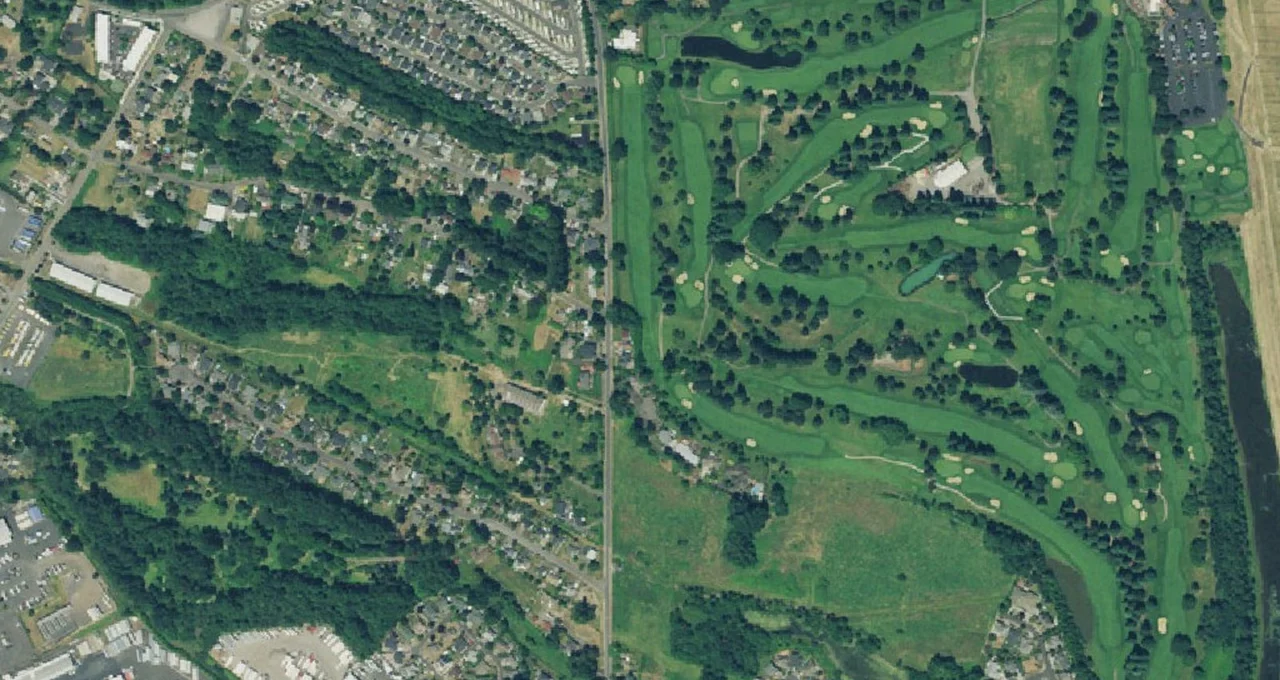
Columbia Edgewater Country Club from the air. Aerial imagery USGS, domaine public.
Columbia Edgewater Country Club
Holes
18 (Macan Course), plus the nine-hole par-3 Mason Course
By
71 (Wikipedia, LINKS Magazine, Stymie)
Length
6,823 yards from the Black tees; rating 73.2 and slope 137 according to the club, 73.4 and 134 according to Wikipedia and Stymie
Green fee
—
Best season
Year-round; the club says the course is kept firm and playable all year
Columbia Edgewater Country Club is a private golf club in Portland, Oregon, on the flat land between the Columbia River and Portland International Airport, about five miles northeast of downtown according to LINKS Magazine. The club gives its address as 2220 NE Marine Drive, Portland, Oregon 97211, and Wikipedia places the course immediately west of the airport at an elevation of about 20 feet. Its main course, the Macan Course, is an 18-hole layout of 6,823 yards from the back tees, played as a par 71 in Wikipedia, LINKS Magazine and the Stymie course directory. The club also has the Mason Course, a nine-hole par-3 course, and a practice facility it describes as nationally recognized.
The club was established in 1924 as Columbia Country Club and its course opened on July 11, 1925, according to the club’s history page and a June 2025 profile in the magazine of the Pacific Northwest Golf Association (PNGA). The architect was Arthur Vernon Macan, usually written A.V. Macan, the Irish-born designer who shaped a large part of early golf in the Pacific Northwest and British Columbia. For more than half a century the course has been best known as the home of the LPGA Tour’s Portland Classic, which it has staged far more often than any other venue, and in the early 1960s it also hosted the PGA Tour’s Portland Open, won there by Billy Casper and Jack Nicklaus among others.
A century by the Columbia
The ground has a longer history than the club. A neighborhood history published by the East Columbia Neighborhood Association says that in 1846 a settler named John Switzler pastured cattle, sold to Fort Vancouver across the river, on land that is now part of the golf course. When the club was formed in 1924, it chose Macan to lay out the course, and the club says the result, opened in July 1925, was the seventh 18-hole course in Portland. The club’s history page credits Macan with work on more than 60 courses over his career and names some of his other designs in the region: Seattle Golf Club, Inglewood Golf Club, Overlake Golf and Country Club, and Marine Drive Golf Club. Top 100 Golf Courses describes him as Dublin-born and notes that his first and perhaps best-known design was Royal Colwood in British Columbia; the Stymie directory gives his dates as 1882 to 1964.
The first clubhouse opened in June 1926 on the bank of the Columbia River, across Marine Drive from the course. Tom Doak, in the third volume of his Confidential Guide to Golf Courses as quoted by the Planet Golf site, suggests that the club must have been at its most charming in those years, when the clubhouse sat on the water and members often arrived by boat, long before the noise of jets taking off from the airport next door. The club’s history page includes a photograph, credited to the Oregon Historical Society, of Walter Hagen teeing off at Columbia in 1929, and the club lists the Oregon Open of 1929 and 1930 and the Oregon Amateur of 1928 among its earliest championships.
The setting brought risk as well as charm. On May 30, 1948, a levee break on the Columbia destroyed the wartime city of Vanport, a few miles to the west, and the neighborhood association says the water also reached East Columbia, where the club sits. LINKS Magazine writes that the flood nearly destroyed the course too, and that a tree-planting program, including 300 sequoias, helped save it. The club’s own history page, which we read in October 2026, does not tell this part of the story, so the flood damage and the sequoias rest on the magazine’s account. LINKS also says that Macan returned in 1958 to make improvements to his course, six years before his death.
The original clubhouse burned to the ground in a Christmas tree fire in 1979, according to both the club and the PNGA profile, and the current clubhouse was built in 1980. In 2024 the club carried out a large renovation that, in the club’s words, modernized and updated the entire facility. A reviewer on Top 100 Golf Courses who visited in June 2024 noted that the clubhouse was still closed for the work at the time, with a reopening expected later that summer.
Changes to the course, and a partial return
Like most courses of its age, the Macan Course has been altered several times. According to LINKS Magazine, Bob Cupp and John Fought made changes in the 1990s and Arthur Hills made more in 2001. In 2004 the club decided to undo much of that work, especially Hills’s, and asked Dan Hixson, its former head professional, to draw up a long-range plan to make the design more cohesive. Hixson has said in a profile published by the Pacific Northwest section of the PGA that he left the head professional’s job at Columbia Edgewater in 1998 to become a golf course designer. We did not find a public document that describes, hole by hole, what the 2004 plan changed, and the club’s course page does not discuss the renovation history.
How much of Macan’s work survives is a matter of opinion among writers on architecture. Doak’s guide, as quoted by Planet Golf, says that most of Macan’s interesting greens have been redesigned over the years, and it singles out only the par-4 8th as still standing out. Doak gave the course a 5 on his ten-point scale. LINKS Magazine, by contrast, credits the 2004 plan with bringing the design back toward a more unified whole. Readers interested in Macan’s original intentions should treat today’s course as a Macan routing with later layers, rather than a preserved Golden Age layout.
Tournament history
The club’s course page lists a long record of events. The PGA Tour’s Portland Open was played here in 1961, 1962, 1963 and 1966. Wikipedia’s article on the tournament gives the winners: Billy Casper in 1961 at 273, one stroke ahead of Dave Hill; Jack Nicklaus in 1962 at 269, one ahead of George Bayer; George Knudson in 1963, who beat Mason Rudolph in a playoff by chipping in for an eagle on a par 5 at the first extra hole; and Bert Yancey in 1966, three strokes ahead of Casper, with a total of 102 putts for 72 holes that stood as a tour record for more than a decade. The club also lists the Northwest Open of 1963 and 1970, the Oregon Amateur in 1928, 1938, 1952, 1961, 1973, 1984, 1997, 2007 and 2020, a sectional qualifier for the 2010 U.S. Open and the 2022 Pacific Coast Amateur.
The LPGA connection is the defining one. The Portland Classic, first played in 1972 and described by Wikipedia as the LPGA Tour’s oldest continuous event, came to Columbia Edgewater for the first time in 1974, when JoAnne Carner won. The tournament then moved between several Portland clubs, and Wikipedia lists Columbia Edgewater as the venue in 1974, 1977 and 1978, 1982 and 1983, 1986 to 1988, 1990 to 2008 (with no tournament in 2001, after the September 11 attacks), 2013 to 2020 and 2022 to 2024; the event went to Pumpkin Ridge from 2009 to 2012 and to Oregon Golf Club in 2021. Its winners table shows the 2025 and 2026 editions at Columbia Edgewater as well, and the club’s page lists the event, now called The Standard Portland Classic, through 2027. The PNGA counted 37 editions at the club in June 2025, which matches the Wikipedia list up to 2024.
The roll of honor at the club includes Nancy Lopez (1987 and 1992), Patty Sheehan (1990), Juli Inkster (1999), Annika Sorenstam (2002 and 2003), Lorena Ochoa (2007), Cristie Kerr (2008), Suzann Pettersen (2013), Brooke Henderson (2015 and 2016), Stacy Lewis (2017), Hannah Green (2019), Georgia Hall (2020) and, most recently, Akie Iwai in 2025 and Jeeno Thitikul in 2026, who closed with a 64 according to the LPGA’s report of August 17, 2026. Henderson’s first win, in 2015, came as a 17-year-old Monday qualifier who won by eight strokes, according to Wikipedia. Several scoring records were set here: Sorenstam’s 199 for 54 holes in 2002, Chanettee Wannasaen’s 262, 26 under par, for 72 holes in 2023, and Sei Young Kim’s round of 61 in 2019, which Wikipedia lists as the lowest in the tournament’s history. Sorenstam and Beth Daniel share the next-lowest round, a 62, both recorded at Columbia Edgewater.
A note on the club’s own list: it gives the LPGA years as 1974 to 2008 in a single run, which does not match the year-by-year venues in Wikipedia, where several of those editions were held at Portland Golf Club and Riverside Golf and Country Club. We follow the year-by-year list.
What the course asks of you
From the back tees, called Black on the scorecard published by Stymie, the Macan Course measures 6,823 yards: 3,415 on an outward nine of par 36 and 3,408 on an inward nine of par 35. By modern championship standards it is not long, and its defense lies elsewhere. LINKS Magazine describes the ground as flattish and wooded, with holes framed by evergreens and the occasional willow, and a handful of water hazards. The club counts 54 bunkers. The Golf Course Gurus review site calls the land mostly flat, with gentle contours around the greens, and describes a compact layout that is easy to walk.
The routing, as described by Top 100 Golf Courses, is made of two loops: the front nine turns counterclockwise through the middle of the property and the back nine runs clockwise around the outside. Because the holes point to every point of the compass, the wind that funnels along the Columbia River changes from hole to hole, and the same site says this makes club selection difficult. Doak notes a surprising amount of roll on the fairways for a course set on river bottomland.
The greens are what most writers single out. LINKS calls the gently sloping Poa annua greens among the best in the Pacific Northwest, and the club quotes Sorenstam saying they were the best she had ever seen. The club says its greens are mowed six to seven days a week and rolled three to four times a week in season, with a fairway topdressing and drainage program dating from 1970 and a rough sanding program added in 2005. The club presents this work as what keeps the course firm and playable year round.
Some holes stand out on the card. The opening hole is a par 5 of 514 yards, and the 3rd, at 594 yards, is the longest hole on the course. The 6th, a par 4 of 400 yards, is rated the hardest hole on the stroke index. The 8th, a par 4 of 420 yards and third on the stroke index, is the hole Doak names as the one where Macan’s work still shows. The par 3s come in a variety of lengths: the 4th (181 yards), which Golf Course Gurus calls the signature hole, the 7th (204), the 11th (186) and the 17th (141), the shortest hole on the course and the one the same reviewer picks as the best par 3. The back nine has only one par 5, the 14th at 520 yards, and its run of long par 4s gives it weight: the 13th (440 yards, second on the stroke index), the 16th (460) and the 18th (456), a demanding finishing hole. Golf Course Gurus picks the short 2nd, a par 4 of 347 yards, as the best birdie chance and the 16th as the hole most likely to cost a stroke.
The scorecard offers several sets of tees: Black at 6,823 yards, a Black and Blue combination at 6,578, Blue at 6,380, a Blue and White combination at 6,190, White at 5,985, a White and Red combination at about 5,660 and Red at 5,365, according to Stymie. The Mason Course offers a different kind of golf: the club describes nine par-3 holes of 55 to 135 yards, 860 yards in all, that can be played in about an hour. Top 100 Golf Courses says it was designed by Bunny Mason, the club’s head professional from 1960 to 1972. Next to it is a short game area with a 14,000-square-foot target green and four practice bunkers, and the all-grass driving range has been named one of the Golf Range Association of America’s top 50 private ranges for 13 years in a row, according to the club.
What golfers say
Public opinion of Columbia Edgewater is thinner than for a public course, because few outsiders play it. We read the reviews on Top 100 Golf Courses, which shows an overall rating of 4 out of 5 and, when we read it in October 2026, two recent written reviews from 2024; the review on Golf Course Gurus, which gives the course a B grade and ranks it 14th in Oregon; Planet Golf, which shows an average of 4.8 out of 5 from five ratings; and the descriptions in LINKS Magazine and Doak’s guide. The GolfPass page, which carries user reviews, could not be opened when we checked. This is a small sample, mostly from people who chose to write about the course, and it should be read as such.
What people like is consistent. The condition of the course, and especially of the greens, comes first in almost every account. Reviewers praise a well-kept course that stays playable all year, the practice facilities, the friendly staff, and the pleasant, unhurried feel of a compact course that is easy to walk. Golf Course Gurus finds the tree-lined corridors clear to read and considers the course underrated nationally, and one Top 100 reviewer enjoyed the riverside setting and the variety of holes.
The criticisms come mainly from architecture writers rather than players. Doak’s modest rating rests on the loss of most of Macan’s original greens and on the airport noise, and a 2015 post on the Golf Club Atlas forum also judged that Macan’s design is not well preserved. The aircraft are a matter of taste: one Top 100 reviewer counts the planes passing overhead as part of the experience, while Doak treats them as a drawback. The flat site will suit some players more than others. Beyond the clubhouse renovation of 2024, which one reviewer mentioned, we found no recurring complaint about service or conditioning.
Rankings vary by source: Top 100 Golf Courses places the course 19th in Oregon and Golf Course Gurus 14th. The club itself says the course is consistently rated among the best in the Northwest.
Getting there and playing
The club is on NE Marine Drive in north Portland, next to Portland International Airport. The course lies on the land side of Marine Drive, with the Columbia River on the other side of the road.
Columbia Edgewater is a private members’ club, as Wikipedia, Wikidata and the Oregon Golf Association’s course guide describe it, and the club’s site presents membership categories rather than public tee times. The Stymie directory describes it as open to daily-fee play, which conflicts with every other source we read, and we do not follow it. The club does not publish a public tee time system. Its guest page explains that guests must follow the club’s dress code: collared shirts with sleeves for men, tailored shorts or trousers with pockets, no cargo styles, no denim anywhere on the course or practice areas, and no metal spikes. For any question about guest play, the club refers visitors to the pro shop or the membership office. The club also hosts a limited number of outside golf tournaments on the Macan Course, usually on Mondays in summer, and every event is subject to approval by its board.
The club says the course is kept firm and playable all year, and Top 100 reviewers and the Oregon Golf Association repeat the point. The Stymie directory gives a typical season of May to October, which seems to describe the drier months rather than a closing period. Stymie says walking is permitted and carts are available, and LINKS calls the course a pleasant walk; the club itself does not publish its cart or caddie policy.
How we built this page
The facts come from public sources: OpenStreetMap for the location; the club’s website, columbiaedgewater.com, for the address, the founding, the clubhouses, the tournament list, the conditioning program, the Mason Course, the practice facilities, the dress code and the outside event rules; the PNGA’s magazine (June 2025) for the founding name, the opening date, the clubhouse fire and the count of LPGA events; Wikipedia and Wikidata for the elevation, the par, a rating and slope, the grasses and the winners of the Portland Open and the Portland Classic; the LPGA for the 2026 result; LINKS Magazine for the 1948 flood, the sequoias, the 1958 visit by Macan and the later changes; the Pacific Northwest PGA for Dan Hixson; Planet Golf for Tom Doak’s assessment; Top 100 Golf Courses, Golf Course Gurus and the Golf Club Atlas forum for the routing, the reviews and the rankings; the East Columbia Neighborhood Association for the early history of the land; the Oregon Golf Association’s course guide for the club’s status; and the Stymie directory for the scorecard, the tees and the walking policy.
Where sources disagree, we say so. The rating and slope from the Black tees are 73.2 and 137 on the club’s course page and in GolfPass search results, but 73.4 and 134 in Wikipedia and Stymie. Wikipedia describes the greens and fairways as Poa annua, LINKS also speaks of Poa annua greens, while Stymie lists bent grass greens and Bermuda grass fairways; we follow Wikipedia and LINKS. The founding year is 1924 for the club and Wikipedia, while the club’s home page, the Oregon Golf Association and other directories give 1925, the year the course opened. The club’s tournament page lists the Portland Classic from 1974 to 2008 without interruption, while Wikipedia’s year-by-year list shows several of those editions at other Portland clubs. The Oregon Golf Association’s guide shows an address in Woodburn, which does not match the club’s address. Stymie calls the course a daily-fee facility; every other source describes a private club. The flood damage of 1948 and the planting of sequoias are reported by LINKS Magazine but not by the club.
Some details will age: the tee ratings, which are revised periodically, the rankings and review counts read in October 2026, the guest rules and the LPGA schedule, which the club lists through 2027. The opinion section reports recurring themes rather than individual voices, and it rests on a small number of public reviews. Nobody from Panxis has played or visited this course, and this page is no substitute for a round.
The club has not paid for this page, has not seen it before publication and has no say over its content. This page contains no commercial link and earns us no commission. If you know the club and something here is wrong or out of date, write to us and we will correct it. The club’s own history page has photographs from its early years.
Other courses nearby
Closest to this one in our United States directory:
- Circling Raven Golf Club — 298 mi
- Bakersfield Country Club — 731 mi
- Canyon Gate Country Club — 757 mi
- Las Vegas Country Club — 761 mi
The hole to know
A par 4 of 420 yards from the Black tees, third on the stroke index, and the hole Tom Doak singles out as still showing A.V. Macan's original work.