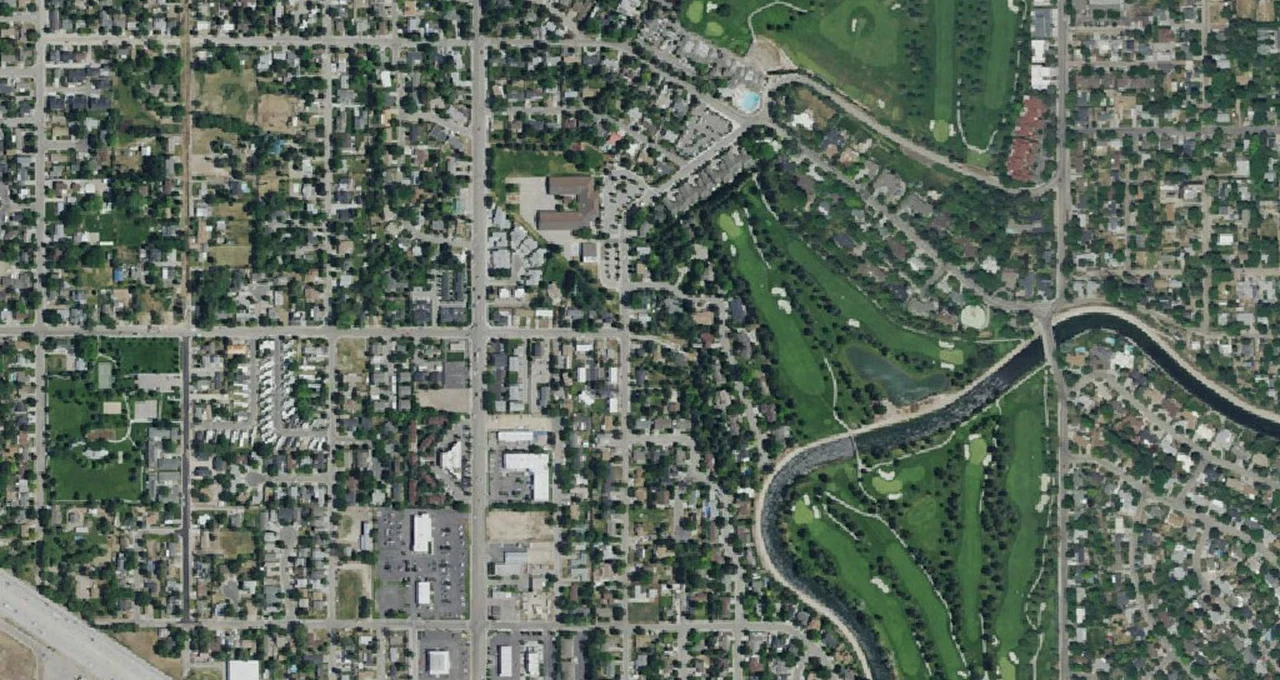
Hillcrest Country Club, Boise from the air. Aerial imagery USGS, domaine public.
Hillcrest Country Club, Boise
Holes
18
By
71
Length
6,789 yards from the Black tees (rating 72.6, slope 133) on the card republished by Stymie; Wikipedia, citing USGA data, gives 6,825 yards (71.6, 130); the club's course tour adds up to 6,810 yards; 6,880 yards for the 2026 Boise Open (PGA Tour)
Green fee
—
Best season
—
Hillcrest Country Club is a private 18-hole golf club at 4610 Hillcrest Drive in Boise, Idaho. It sits on the bench above the city, on Boise’s southwest side and just northwest of Boise Airport, at an elevation of about 2,800 feet, according to Wikipedia. The club traces its roots to 1925 and dates its current identity to 1940. It is a member-owned club, and the course is reserved for members and their guests. It is not open to the public, and this page is no invitation to turn up with your clubs.
Outside Idaho, Hillcrest is best known for one week a year. Since 1990 it has been the only home of the Boise Open, now the Albertsons Boise Open presented by Chevron, which has been on the schedule of what is today the Korn Ferry Tour since the tour’s first season, when it was called the Ben Hogan Tour. The 2026 edition was played from August 13 to 16 on a par 71 of 6,880 yards, according to the PGA Tour. Two players have shot 59 here in competition.
A note on names before going further. Several clubs in the United States are called Hillcrest Country Club, among them a well-known club in Los Angeles and another in Indianapolis. Everything on this page concerns the club in Boise, recorded in OpenStreetMap as relation 3944800 and in Wikidata as Q15224055, and we set aside every source that described one of the others.
From Idaho Country Club to Hillcrest
The club’s history page starts in 1925, with the Idaho Country Club, which it describes as one of only two golf courses in the Treasure Valley at the time. Its founders, Harry and John Eagleson, planned a full 18-hole course. They hired George H. Otten of Portland, Oregon, to lay out the course and landscape the grounds, and J.E. Tourtellotte drew the plans for the clubhouse. The Great Depression cut the project short, and the course remained a nine-hole layout. Wikipedia agrees that the Idaho Country Club, formed in 1925, built the original nine holes.
What happened next is told differently by the two main sources. Wikipedia says the clubhouse and course were bought in 1935 and renamed Boise Country Club. The club’s history page instead dates the purchase to January 1940, when a group of investors led by the attorney J.L. Eberle and the realtor Ernest Day bought the property and formed the Boise Country Club, which operated as a public facility. Both agree on what came later in 1940: the club was incorporated as Hillcrest Country Club. According to the club, C.J. Strike, a leader of Idaho Power, served as its first president from 1940 to 1945. We cannot reconcile the 1935 and 1940 versions of the purchase, so this page gives both. The founding year shown in directories varies for the same reason: the PGA Tour gives 1940 for the course, while the Hole19 app lists 1925.
Three names on the design
The second nine is the work of A. Vernon Macan, an Irish-born amateur golfer who settled in Victoria, British Columbia, and designed many courses in the Pacific Northwest and southern British Columbia, according to Wikipedia. The club says only that Macan helped Hillcrest add nine holes to complete the 18-hole layout, without giving a year. Wikipedia says the second nine opened in 1958, and the Top 100 Golf Courses website places Macan’s work in the late 1950s. The PGA Tour and several directories list Macan as the course architect, without mentioning anyone else.
The third name is Robert Muir Graves. The club says the course underwent a full renovation under the architect Robert Graves, in a section of its history that covers 1950 to 1970, at the same period a swimming pool was added and the clubhouse was significantly expanded. Wikipedia dates the Graves renovation to 1968, Top 100 Golf Courses puts it about a decade after Macan’s work, and a 2025 spectator’s guide published by The Golf News Net says Graves carried out a complete restoration in the mid-1960s. We follow no single date here: the sources agree on the architect and on the decade, not on the year.
Who built which nine is worth getting right, because it explains the layout. According to Wikipedia, the newer nine is the southern one. On OpenStreetMap, holes 1 to 9 lie north of West Targee Street and holes 10 to 18 south of it, so the southern half, numbered 10 to 18 on the members’ card, is the nine attributed to Macan, and the northern half is the original nine from the Idaho Country Club days. Top 100 Golf Courses notes that the property is split into two halves by a busy intersection. The Golf News Net guide credits Otten with the original nine and Macan with the added one, though it is not consistent about which nine it calls front or back, because, as explained below, the nines are reversed for the tournament.
Off the course, the club’s history names Martin Watson as head of golf operations in 1952 and Grover Compton as the man who maintained the grounds. The present clubhouse opened in 2011, according to Wikipedia. American Builders Quarterly describes the project as a 55,000-square-foot remodel that joined two separate buildings, one for dining and banquets and one for the golf shop, locker room and grill, into a single clubhouse, with the open patio between them enclosed as an indoor and outdoor space. The work ran from 2005 to 2011, in two phases so that one building stayed open, and was scheduled around the Boise Open each summer.
The tournaments
Long before the Boise Open, Hillcrest hosted the Idaho Centennial Ladies’ Open on the LPGA Tour, held over Labor Day weekend in 1963. According to Wikipedia, Mickey Wright won the 54-hole event by four strokes over Kathy Whitworth.
The Boise Open arrived in 1990. The club and Wikipedia agree that the first edition was won by Ricky Smallridge; Wikipedia gives his total as 199, 14 under par, over 54 holes. The event has carried several sponsors’ names, Ben Hogan, Nike and Buy.com among them, and Albertsons has been the title sponsor since 2002, according to Wikipedia. It has moved around the calendar: late July from 2013, mid-September as part of the Web.com Tour Finals from 2016, then late August from 2019. In 2026 it was the 20th of 25 events in the Korn Ferry Tour season, with a purse of $1 million, according to the PGA Tour.
Low scores are the rule. Russell Knox shot 59 in the second round in 2013, with two eagles and eight birdies according to the club; Wikipedia dates that round to July 26, 2013. The PGA Tour adds that David Kocher matched it with a 59 in the final round in 2023, so the 18-hole record is now shared. The club gives the 72-hole record as 256, 28 under par, set by Martin Piller in 2015; the winners table on Wikipedia shows that Chan Kim equaled that score in 2023. Recent winners, according to the PGA Tour and Wikipedia, include Will Gordon in 2022, Chan Kim in 2023, Matt McCarty in 2024 and Emilio González in 2025, at 22 under par; Wikipedia and the PGA Tour leaderboard give the 2026 title to Ross Steelman, at 257, 27 under par.
The club says the tournament had raised more than $33 million for local charities as of 2023. Its history page also lists several well-known players as past champions, with years that do not match the winners lists published by Wikipedia and the PGA Tour, which give 2000 to Tim Clark, 2003 to Roger Tambellini, 2007 to Jon Mills and 2014 to Steve Wheatcroft. We could not settle the difference and leave that list out.
What it asks of you
By modern championship standards, Hillcrest is not long. Its par of 71 is given by Wikipedia, the PGA Tour, ESPN’s tournament scorecards and the course directory Stymie, which republishes a full set of tee ratings. On that card, the Black tees measure 6,789 yards with a course rating of 72.6 and a slope of 133, and the course offers eleven tee and rating combinations down to 5,273 yards from the Gold tees, rated 64.9 and 114 for men and 70.2 and 122 for women. Other figures circulate. Wikipedia, citing USGA data, gives 6,825 yards from the back tees with a rating of 71.6 and a slope of 130. The course tour on the club’s website lists four unlabeled yardages per hole, the longest of which add up to 6,810 yards. Older directory listings show a par 72 of 6,769 yards with a slope of 128, and the tournament plays at 6,880 yards. We could not reach the USGA course rating database to say which set is current; ask the golf shop or check the card on the first tee.
The course is relatively flat, with elevated tees and greens, and water is in play on 12 of the 18 holes, including six ponds and the New York Canal, according to Wikipedia. Top 100 Golf Courses describes the canal as a concrete waterway running along the edge of the property, with holes of the members’ back nine playing across or along it. A 2010 review on Golf Course Gurus describes a classic, old-school layout with tree-lined fairways and gentle doglegs that rewards accuracy, course management and shotmaking more than raw power, and The Golf News Net guide describes greens framed by bunkers on both front corners. The professionals’ scores show that the course can be had; the water is what punishes the rest of us.
The par of 71 is split unevenly. On the members’ card republished by Stymie, the front nine is a par 35 of 3,226 yards from the Black tees, with one par 5, and the back nine a par 36 of 3,563 yards, with two. The stroke index ranks the 5th as the hardest hole, followed by the 14th, the 2nd and the 10th; the 13th is ranked the easiest.
The members’ front nine
The yardages below are from the Black tees on the Stymie card, in the members’ order, with the number the hole carries during the Boise Open in brackets. The descriptions come from the sources named. The 1st (10th) is a par 4 of 355 yards that Golf Course Gurus, in 2010, picked as the signature hole; The Golf News Net describes what it calls an illusion bunker there, which appears to sit beside the green from the fairway but is in fact about 30 yards short of it. The 2nd (11th) is a par 4 of 459 yards, third on the stroke index, with a long carry from the tee into a tree-lined fairway set at an awkward angle, according to The Golf News Net. The 3rd (12th) is a par 4 of 405 yards and the 4th (13th) a par 3 of 211 yards.
The 5th (14th), a par 4 of 439 yards, is ranked the hardest hole on the course. The 6th (15th) is the short one: a par 4 of 295 yards, which Golf Course Gurus listed as its birdie hole and described, in the tournament order, as a drivable par 4 that can matter on Sunday. The 7th (16th) is the only par 5 on this nine, at 535 yards. The 8th (17th), a par 3 of 133 yards and the shortest hole on the course, plays over a pond; more on it below. The 9th (18th), a par 4 of 394 yards, closes the nine and, in the tournament order, the championship.
The members’ back nine
The southern nine, attributed to Macan, opens with the 10th (1st), a par 4 of 404 yards and fourth on the stroke index. The 11th (2nd) and 12th (3rd) are back-to-back par 5s of 536 and 553 yards, the two longest holes on the course, which The Golf News Net calls a rarity and Golf Course Gurus counted among its favorites, picking the 12th as its best par 5. The 13th (4th), a par 3 of 181 yards, plays over water, according to Golf Course Gurus and The Golf News Net.
The 14th (5th), a par 4 of 449 yards, is second on the stroke index. The 15th (6th) and 16th (7th) are par 4s of 414 and 418 yards, the 17th (8th) a par 3 of 196 yards, and the 18th (9th) a par 4 of 412 yards that closes the members’ round. The Golf News Net says the New York Canal winds through several holes of this nine, which it calls the front nine because it follows the tournament order, and that it complicates the judgment of distance. We found no published hole-by-hole description from the club itself.
A word on the club’s own card. The course tour on the club’s website follows the tournament order, with the par 5s at holes 2, 3 and 16. It labels holes 4 and 13 as par 4s, although they measure 182 and 216 yards and every other card we found treats them as par 3s; with those two labels the pars add up to 73 rather than 71. We read this as a labeling slip and follow the par 71 given everywhere else.
What golfers are saying
Public reviews of a private club are scarce, and Hillcrest is no exception. This section draws on the reviewer comments shown by Golf Digest, as indexed by search engines, on the 2010 review published by Golf Course Gurus, on the user ratings of the Hole19 app, which contain almost no written text, and on the descriptions published by Top 100 Golf Courses and The Golf News Net. These are other people’s opinions, not ours; nobody from Panxis has played the course, and we quote no one by name.
What comes up in its favor
- The greens, described by reviewers on Golf Digest as fast and consistently good.
- Conditioning and landscaping across the property, which Golf Course Gurus described as immaculate.
- A traditional, tree-lined layout with strategic bunkering that rewards placement and shotmaking more than length.
- The water: the ponds and the canal give the round its character, and the short par 3 over a pond is singled out as a spectators’ favorite during the Boise Open.
- The tournament history: the only written review on Hole19 mentions the Albertsons Boise Open.
What comes up against
- A couple of quirky holes, according to reviewers on Golf Digest.
- A course that is pleasant rather than outstanding in the view of Golf Course Gurus, which did not rank it among Idaho’s ten best; Top 100 Golf Courses places it 13th in the state.
- A property cut in two by city streets, which Top 100 Golf Courses notes, and which links the two nines across a busy intersection.
- Relatively modest length, which some will see as a strength and others as a limit for strong players.
Access and how to play it
Hillcrest is a private club. Play is reserved for members and their guests, and the club does not publish green fees, guest fees or tee time booking for visitors; this page lists none. One course directory describes it as a public daily-fee course, which is contradicted by the club’s own website and by every other source we consulted. The club says prospective members are encouraged to visit and tour the course, and membership inquiries go through its website. If you have a host, ask them about guest rules, carts and dress code: the club does not publish them, and we found no reliable public statement of its walking or cart policy.
The one week when anyone can see the course is the Albertsons Boise Open in August, when the public comes as spectators. The Golf News Net described grandstands at the 10th and at the 15th to 18th holes, in the tournament order, for the 2025 edition.
The facilities
Beyond the course, the club lists four outdoor tennis courts and two heated indoor courts, with dedicated pickleball lines, a fitness space with group classes and personal training, a pool with a swim team, structured programs and open swim time, dining and a calendar of social events. The golf program includes instruction, clinics, youth clinics and tournaments, according to the club. The club describes itself as family-oriented, with many multi-generational member families. It does not publish details of its practice facilities, and we give none here.
Getting there and when to go
The club is at 4610 Hillcrest Drive, Boise, ID 83705, and its phone number is 208-343-5425, according to the club’s website; some directories list another number, 208-343-1769. On OpenStreetMap, the northern nine runs up to West Overland Road and West Targee Street separates the two halves; the club lies just northwest of Boise Airport, according to Wikipedia. The club does not publish a season. Its history page notes Boise’s mild climate, and the Boise Open is played in the heat of August, with highs in the upper 80s to low 90s Fahrenheit forecast for the 2026 edition, according to the PGA Tour.
How this page was made
The factual frame comes from public sources consulted in October 2026: OpenStreetMap and Wikidata for the location, the hole layout and the identity of the club; the club’s website for the address, phone number, private status, history, founders, early staff, architects named in its history, the Boise Open records and charity total, the facilities and the course tour; Wikipedia for the elevation, the 1925 and 1935 dates, the opening of the second nine in 1958, the 1968 Graves renovation, the water hazards, the 1963 LPGA event, the reversal of the nines, the 2011 clubhouse, the yardage and ratings attributed to the USGA, and the tournament’s names and winners; the course directory Stymie for the tee ratings and the members’ hole-by-hole card and stroke index; the PGA Tour for the 2026 dates, yardage, purse, records and recent winners, and ESPN for the tournament par by nine; Top 100 Golf Courses and The Golf News Net for the layout and the attribution of the nines; Golf Course Gurus, Golf Digest and Hole19 for public opinion; American Builders Quarterly for the clubhouse project. Where sources disagree, as they do on the year of the purchase that preceded Hillcrest, the founding year, the date of the Graves renovation, the length and ratings, the par shown on the club’s course tour and the list of past champions, we say so and name the source we follow.
Several sources could not be read directly: the USGA course rating database, Golf Digest and GolfPass, which blocked automated requests. For Golf Digest, we relied on the excerpts shown by search engines. We found no source for a renovation of the course after the Graves era, for the grass on the greens and fairways, for the practice facilities or for the guest and cart policies, and we removed those subjects rather than guess. The opinion section summarizes public reviews; we report recurring themes rather than individual voices, and we reproduce no quotations. Nobody from Panxis has played or visited this course, and this page is no substitute for a round.
The club has not paid for this page, has not seen it before publication and has no say over its content. This page contains no commercial link and earns us no commission. If you know the course and something here is wrong or out of date, write to us and we will correct it.
Other courses nearby
Closest to this one in our United States directory:
- Circling Raven Golf Club — 268 mi
- Columbia Edgewater Country Club — 345 mi
- Canyon Gate Country Club — 516 mi
- Las Vegas Country Club — 518 mi
The hole to know
A par 3 of 133 yards from the Black tees on the members' card, the shortest hole on the course, played over a pond according to Top 100 Golf Courses; it becomes the 17th during the Albertsons Boise Open, when spectators gather around it.