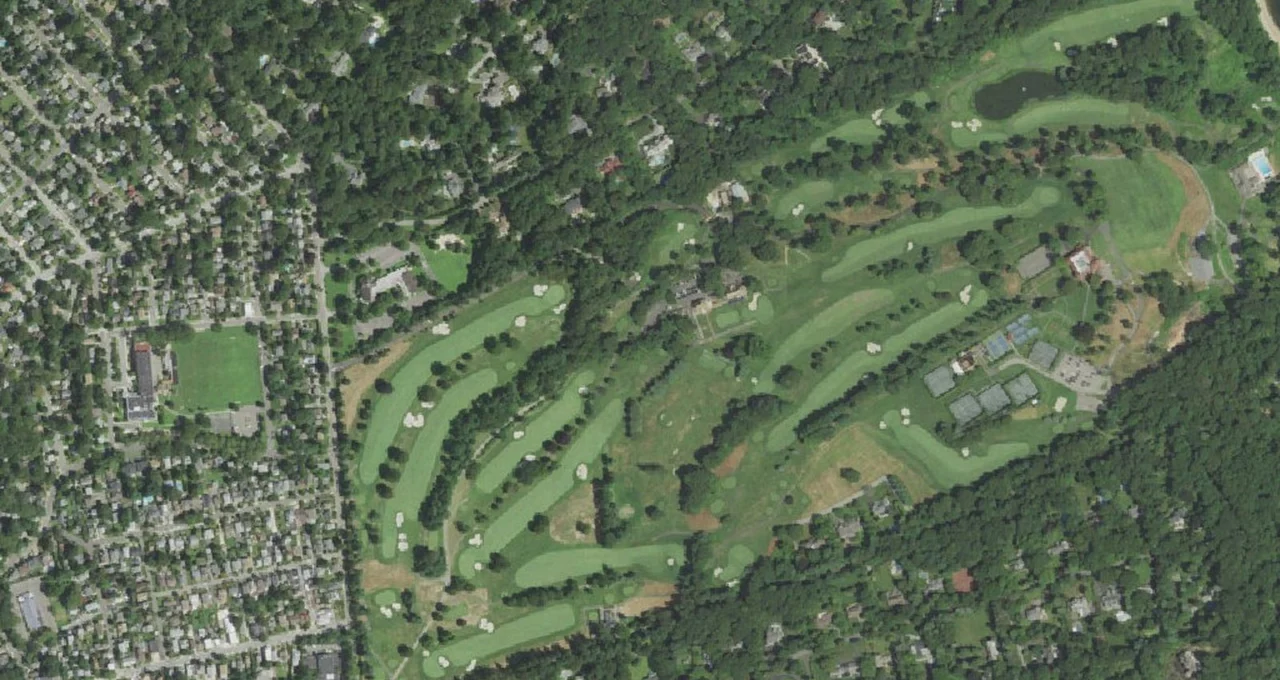
Village Club of Sands Point from the air. Aerial imagery USGS, domaine public.
Village Club of Sands Point
Holes
18
By
71
Length
6,549 yards from the Black tees on the 18Birdies scorecard (rating 71.8, slope 133); GolfNow gives 6,584 yards (71.6, 132)
Green fee
—
Best season
Mid-March to mid-December, per the club; the course stays open in winter when the weather allows
The Village Club of Sands Point is a private golf and country club in the Incorporated Village of Sands Point, on the Port Washington peninsula of Long Island’s North Shore, in Nassau County, New York. Its address is 1 Thayer Lane, Sands Point; some golf directories list it under Port Washington, the neighboring postal town. What makes it unusual is its owner. The club belongs to the Village of Sands Point itself, which bought the property in 1994 and runs it as a municipal park and club, open to village residents and to non-residents who take a membership. It is private in the sense that you need a membership to play, and municipal in the sense that the taxpayers of a small village own the ground.
The 18-hole course is a par 71. It began as a nine-hole layout by Robert Trent Jones Sr., built when the property was the IBM Country Club, and was expanded to 18 holes by Tom Doak, the architect later known for Pacific Dunes, Old Macdonald and the Blue course at Streamsong. The club gives 2001 as the year of the expansion; Doak’s own website dates the project to 2000, and encyclopedic entries say construction ran from 2000 to 2001 and the enlarged course opened in 2001. The club says there are five sets of tees and that the course looks out over Hempstead Harbor and, in the distance, the Manhattan skyline.
Published scorecards do not agree on the length. The hole-by-hole card on the 18Birdies golf app gives 6,549 yards from the Black tees, with a course rating of 71.8 and a slope of 133, and its hole yardages add up to exactly that total. GolfNow and TeeOff list the Black tees at 6,584 yards, rated 71.6 with a slope of 132, and GolfNow’s summary box gives 6,654 yards as the overall length. This page follows the 18Birdies card, because it is the only one with hole-by-hole figures that add up. On that card the other men’s tees are Blue at 6,366 yards (70.9 and 132), Blue/White at 6,197 (70.2 and 129), White at 6,024 (69.4 and 127), White/Yellow at 5,754 (68.0 and 126) and Yellow at 5,505 (66.7 and 124); for women, the Green tees measure 5,120 yards (69.9 and 122). The combination tees explain why a card lists more than the five sets the club mentions.
From Guggenheim estate to village club
The land was a Gold Coast estate before it was a golf course. According to the club, Isaac Guggenheim began building the manor house in 1916 and completed it in 1918; the club’s pages give both years as the founding date of the estate. After Isaac’s death in 1922, his brother Solomon R. Guggenheim, the founder of the Guggenheim Museum, bought the property in 1924. The house, known as Villa Corola, was redesigned in the Italian Renaissance style by the architect H. Van Buren Magonigle, with gardens, stables and greenhouses around it.
The sources differ slightly on what came next. The club says Solomon Guggenheim died in 1948 and that IBM bought the estate in 1953; encyclopedic entries place his death in 1949 and say IBM acquired the land after it and developed the IBM Country Club on 208 acres in the 1950s; GolfNow gives 1953 as the year the course was built. IBM used the estate as a country club and a training and executive retreat for its New York area employees, and Robert Trent Jones Sr. designed a nine-hole course for it.
By the early 1990s IBM planned to sell, and a developer proposed to build 135 homes on the property. Encyclopedic entries report that the village bought it from IBM in 1994 for $12.7 million to keep it from being developed, financing the purchase with bonds and higher property taxes; the club dates the sale to December 1994. The village club opened in 1995, and the pool on the shore of Hempstead Harbor followed on July 4, 1996. The expansion plans were contested by some residents in the late 1990s, including in court and in a village election, before the project went ahead. The club gives the area of the property as approximately 210 acres; encyclopedic entries give 208.
The expansion to 18 holes was largely funded, according to encyclopedic entries, by the sale of nearby land the village had acquired in the 1950s. When the course was enlarged, the historic dairy barn became the golf pro shop and the old chauffeur’s garage became a bar and grille with locker rooms upstairs, the club says. The mansion is still used for formal dining and events.
One more source point needs care. KemperSports, a golf management company, says on its website that it took over full management of the club in late 2017, when golf membership was at a low of 151 members, and that golf membership grew by 250 percent over the following four years. That is the company’s own account of its work; we could not confirm from the club’s website whether the arrangement is still in place.
How the course came together
Doak has been unusually frank about this project. On his firm’s website he calls it his first municipal project and says it might be his last: he writes that he was unprepared for how much politics altered the design, and that because constraints only became known when someone objected, almost all of them made the plan worse as it evolved. In a 2004 discussion on the GolfClubAtlas forum, a post under his name gave one example. The 4th hole was originally meant to sit between the 3rd and the 5th, with short walks from green to tee, but after some 25 versions of the routing, the owner of one of the private houses inside the property threatened legal action unless the hole was moved away from his front yard, even though the centerline was 200 feet from his property line. The village gave way and the hole was moved.
The sources also differ on how much of the Jones nine survives. The club says the original nine holes were renovated and nine new holes were added. Doak’s website says five of the old holes were incorporated into the new 18-hole design. This page does not try to reconcile the two; both describe a course that mixes older holes with Doak’s work, with the back nine made up mostly of new holes, as a player described it on the same forum in 2004.
One golf club directory attributes the course to A. W. Tillinghast. That appears to be a confusion with Sands Point Golf Club, a separate private club on Middle Neck Road in the same area, which is a Tillinghast course. The club’s own site, Doak’s website and encyclopedic entries all credit Robert Trent Jones Sr. and Tom Doak, and this page follows them.
What it asks of you
On paper, this is not a long course: 6,549 yards from the back tees at par 71, with a slope of 133 from those tees and 127 from the Whites. That puts it in the moderate-to-hard range for a mid-handicap golfer rather than at the extreme. The challenge comes less from distance than from ground and shape. The club describes rolling hills, large greens, doglegs and water features, and golf apps list the course as hard, with fast greens.
The card is lopsided in an interesting way. The front nine is a par 37 of 3,501 yards, with three par 5s; the back nine is a par 34 of 3,048 yards, with three par 3s and a single par 5. In total there are five par 3s, four par 5s and nine par 4s. The par 5s come early: the 1st (509 yards), the 3rd (540) and the 8th (545), then only the 17th (490) on the back. A player who wants to score has to do it on the way out; the inward half is shorter but has fewer obvious chances.
The par 4s span a wide range. The shortest is the 12th at 311 yards and the 6th at 342; the longest are the 9th at 455 yards, rated the second-hardest hole on the card, and the 15th at 450 yards, rated the hardest. The 13th (425) and the 18th (436) give the round a firm finish. The par 3s are the most varied group: the 7th at 158 yards, the 5th at 170, the 14th at 176, the 16th at 191 and the 11th at 204.
Holes worth knowing
The 14th is the hole mentioned most often. It is a par 3 of 176 yards from the Black tees, and in 2004 a player on the GolfClubAtlas forum described it as a gorgeous shot of about 180 yards over a rugged ravine. More recent reviews on a golf booking site call it superb, one of the best holes on Long Island, and describe the tee shot as all carry and very scenic.
The 13th, a par 4 of 425 yards, has a blind tee shot according to reviews, and the green is set against the water of Hempstead Harbor. The same 2004 forum post praises its approach to a boldly contoured green and calls the run from the 12th to the 14th excellent.
On the front, the same player picked out the 3rd, the 8th and the 9th as well-bunkered long holes that sit naturally on the land. Those are a par 5 of 540 yards, a par 5 of 545 yards and the 455-yard par 4 that closes the nine. The 17th, a par 5 of 490 yards and the shortest of the four, has a green complex that the forum post compared to a gentle punchbowl; with the 18th, it was described as a very engaging finish.
Beyond these, the public record says little about individual holes. We have not found a hole-by-hole guide published by the club, and we have not filled the gap with guesses.
What golfers are saying
Because this is a private club, public reviews are scarce: ratings on golf apps from members and guests, a few written reviews on booking sites and an old discussion on a golf-architecture forum. The points below summarize what recurs in that material. They are other people’s opinions, not ours; nobody from Panxis has played the course, and we name no reviewer.
In its favor, conditioning comes up most: reviewers describe the greens as in great shape and the course as well groomed, and app users rate the greens as fast. The views over Hempstead Harbor are a constant theme, and the par 3 14th is singled out repeatedly. Reviewers also mention friendly and helpful staff, and golf apps rate the pace of play as fast. Players who have written about the design like the bunkering on the long front-nine holes and the green contours on the back nine.
Against, the material is thinner. On golf apps, value and course condition score somewhat lower than the overall rating. The course is described as hard, and the blind tee shot on the 13th is the kind of feature some players dislike on a first visit. The most pointed criticism comes from the architect himself: Doak’s account of the project says the design got worse as local objections accumulated, and the 4th hole ended up away from the compact routing he had first drawn, with its short walks from green to tee. We found no substantial recent criticism of conditions or service in the public record.
How to play it
The Village Club of Sands Point is a private club and does not sell public tee times. The club is open to residents of the Village of Sands Point and to non-residents who take a membership; the club says it offers a range of membership categories and invites prospective members to tour the property. Doak’s website notes that out-of-town members pay higher annual dues, for whatever places are left. The club does not publish its dues or initiation fees, and we give none here.
The club’s website has an inquiry form for golf outings, and the mansion hosts weddings and private events. Guest policies for golf are not published on the club’s website; ask the club directly.
The facilities
Besides the course, the club lists a grass practice tee equipped with Toptracer range technology, a short-game area for chipping, pitching and bunker practice, a practice putting green and an indoor training facility with two hitting bays, FlightScope launch monitors and a putting area, open all year. There is a pro shop, group and private instruction from PGA professionals, junior clinics in spring and fall, and a PGA Junior League team. Golf apps list motor carts and pull carts.
Outside golf, the club has 12 Har-Tru tennis courts, 6 platform tennis courts, 8 pickleball courts and a swimming pool overlooking Hempstead Harbor near the property’s beach. Formal dining is in the Guggenheim mansion and casual dining at the Grille.
Getting there and when to go
The club is at 1 Thayer Lane in Sands Point, on the east side of the peninsula, between Middle Neck Road and Hempstead Harbor. By car it is, in the club’s words, just minutes from the Long Island Expressway. By train, the Long Island Rail Road’s Port Washington Branch ends at Port Washington station, about 20 miles from Penn Station in Manhattan; the club puts the journey at 40 minutes by train from New York City. From the station, the last stretch is by car or taxi.
The club says its golf facilities are open from mid-March to mid-December, and that the course stays open through the winter when the weather allows; the indoor facility is open all year.
Green fees
The Village Club of Sands Point is a private club and publishes no green fees, dues or guest fees. Membership and outing conditions are set by the club. See the club’s own site.
How this page was made
The factual frame comes from public sources: OpenStreetMap and Wikidata for the location; the club’s website (home, About Us, Golf, Membership, Golf Outings and The Mansion pages) for the address, the architects, the par, the number of tee sets, the history of the estate, the 1994 purchase, the season and the facilities; the English Wikipedia article on the Village Club of Sands Point, and the newspaper articles it cites, for the 1995 opening, the purchase price, the proposed housing development, the 1996 pool opening, the disputes over the expansion and the 2000 to 2001 construction; Tom Doak’s firm website for his account of the project and the five retained holes; the scorecard on the 18Birdies app for hole yardages, pars, handicaps, ratings and slopes; GolfNow and TeeOff for the alternative tee lengths and ratings; a 2004 thread on the GolfClubAtlas forum, read through the Internet Archive, for the relocation of the 4th hole and early impressions; the KemperSports website for its management account; and Wikipedia’s article on Port Washington station for the rail link. Where sources disagree, as they do on the length, the dates and the acreage, we say so and say which one we follow.
The opinion section summarizes app ratings, booking-site reviews and forum posts read in September 2026. We report recurring themes rather than individual voices, and we count nothing. Nobody from Panxis has played or visited this course, and this page is no substitute for a round.
The club has not paid for this page, has not seen it before publication and has no say over its content. This page contains no commercial link and earns us no commission. If you know the course and something here is wrong or out of date, write to us and we will correct it.
Other courses nearby
Closest to this one in our United States directory:
- North Hempstead Country Club — 2 mi
- Trump National Golf Club Westchester — 22 mi
- TPC River Highlands — 76 mi
- Keney Park Golf Course — 85 mi
The hole to know
The hole players mention most: a par 3 of 176 yards from the Black tees, played over a rugged ravine, all carry, and described in reviews as one of the best holes on Long Island.