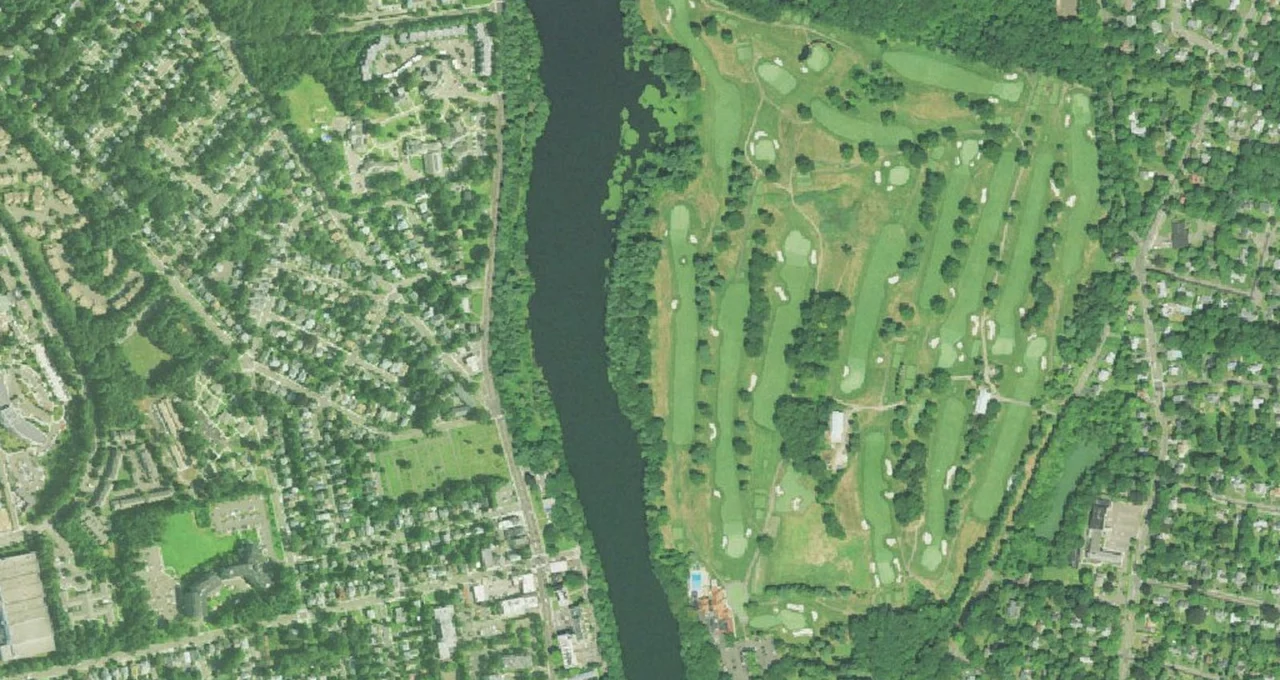
New Haven Country Club from the air. Aerial imagery USGS, domaine public.
New Haven Country Club
Holes
18 (club website, Wikipedia; OpenStreetMap maps an 18-hole course)
By
70, 34 out and 36 in, with four par 3s and two par 5s (club course tour, Wikipedia, 18Birdies); GolfNow, TeeOff and GolfLink list 71, the par Global Golf Post gives for 2010
Length
6,560 yards Black, 6,270 Green, 5,819 White, 4,945 Bronze (club course tour; tee names and ratings from 18Birdies: men 71.8/131, 70.7/128, 68.2/119, 64.4/109; women 76.8/136, 76.9/134, 74.1/129, 69.5/118). Wikipedia gives a Gold card of 6,602 yards (71.8/131); GolfNow and GolfLink 6,580 yards (72.3/134)
Green fee
—
Best season
—
New Haven Country Club is a private golf and social club at 160 Hartford Turnpike in Hamden, Connecticut, on the east shore of Lake Whitney, just north of the city it is named after. It was founded in 1898, which makes it one of the older golf clubs in the United States, and its 18-hole course was redesigned in the early 1920s by Willie Park Jr., the Scottish two-time Open champion. The club’s own course tour lists a par of 70, 34 out and 36 in, and four sets of tees that add up to 6,560, 6,270, 5,819 and 4,945 yards. On 18Birdies, the longest set is rated 71.8 with a slope of 131 for men.
If you are not a member, the short answer comes first: you cannot simply book a round here. The club’s guest information page says that golf guests “must be with an NHCC member at all times” and are subject to the club’s guest limits. The rest of this page explains what the public record says about the course, what it asks of you, what golfers have written about it, and the few ways a non-member actually ends up on the first tee. It draws on the club’s website, Wikipedia and Wikidata, Global Golf Post, newspaper previews of the Connecticut Open, AmateurGolf.com, Top 100 Golf Courses, a 2008 playing report on Golf Community Reviews, 18Birdies and other golf directories, all read in November 2026.
Which course is this?
The name invites confusion. New Haven Country Club is not in New Haven: it sits in the town of Hamden, which borders the city to the north, and OpenStreetMap, Wikidata and the club itself all give the Hamden address. It is also not the historic New Haven Golf Club, the nine-hole course of 1895 where the club’s founders first played, on ground that Wikipedia places at what is now Albertus Magnus College. And it is not the Yale Golf Course, the university’s Seth Raynor and Charles Blair Macdonald layout in New Haven, which some rankings and search results mention in the same breath. Directory searches for “New Haven” golf also turn up courses in New Haven, Indiana, which have nothing to do with this club.
The Wikidata entry for the club (Q29641691) describes it as a “country club in Hamden, Connecticut”, links it to the English Wikipedia article and to the OpenStreetMap outline of the course (way 289318195). That OpenStreetMap record carries the street address, the telephone number (203) 248-4488 and the club’s website, and tags the course as 18 holes. Wikidata and Wikipedia place the club a little west of the OpenStreetMap point used for the map on this page; both fall on the club’s grounds.
The club is active. In November 2026 its website carried event and wedding menus dated 2026, and AmateurGolf.com lists two events played at the course in 2026: the Julius Boros Challenge Cup on May 14 and a U.S. Senior Open final qualifier on May 27.
History: from a students’ overflow to a Park redesign
The club’s story starts with a crowding problem. According to Global Golf Post, which marked the club’s 125th anniversary in a September 2023 feature by Tom Yantz, the Scottish cabinet maker Robert Pryde worked with the Yale professor Theodore S. Woolsey and the businessman Henry Hotchkiss in 1895 to build the New Haven Golf Club’s nine holes near the present Albertus Magnus College. Yale students took to the new game and crowded the course. The club’s history page says that Woolsey and the other charter members chose a site outside New Haven “at least in part to create a distance buffer” from those students. Wikipedia adds that one of the new club’s provisions allowed Yale students to play as guests but not to become members.
Global Golf Post gives March 24, 1898, as the founding date and names Pryde as the builder and designer of the first course. The club says land was bought next to Lake Whitney, a lake preserved by the New Haven Water Company, the original course was laid out, and construction of the clubhouse began in 1899. A suspension footbridge over the lake gave members access from Whitney Avenue and its trolley line. Wikipedia, on the other hand, says the club leased the farmland for its first 17 years and that members voted to buy it in 1915. The club’s own pages do not say when the purchase happened.
Early members listed by the club include Eli Whitney III, grandson of the inventor, Henry Sargent, Winthrop Bushnell, Frank Bigelow, Henry Hotchkiss, Walter Camp, often called the father of American football, and William Howard Taft, who taught law at Yale after his presidency. The club quotes The Connecticut Magazine of spring 1900 calling it “the leading social organization of the city”. Its “Our Story” page, taken from a 1948 history of the club’s first fifty years, says that Harry Vardon visited in 1900 and praised the site. Global Golf Post adds that the club was one of 12 charter members of the Connecticut League of Golf Clubs, the forerunner of the Connecticut State Golf Association.
The clubhouse is still the 1899 building. The club credits it to the New York architect Grosvenor Atterbury and says it was modeled on Scottish clubhouses of the time. On the date of its red tile roof, sources differ: a photo caption on the club’s history page says it was added in 1911, while Wikipedia says 1913.
The course you play today is Park’s. The club writes that “by 1920” the members decided the course needed a redesign and chose Willie Park Jr., and that Park supervised the construction himself, which it says he did on only a handful of his courses. The dates vary by source. Top 100 Golf Courses dates the design to 1920, Wikipedia says it was “completely redesigned in 1921”, and Global Golf Post and a 2008 Golf Community Reviews article say 1922. A July 2022 preview in Hearst’s Connecticut papers tied that year’s Connecticut Open to the 100th anniversary of the opening of Park’s course, which points to 1922 for the opening. Sources also disagree on how many courses Park designed: 114 according to the club, about 170 according to Global Golf Post.
According to Global Golf Post, Park’s routing map was found by a member in 2019 and handed to the head professional Bill Wallis, who had been looking for it for more than a decade and has run the golf program since 2008. The same 2023 article reported that the board had announced a plan with Brian Schneider of Renaissance Golf Design, of Traverse City, Michigan, to make the course “the most authentic and well-preserved” Park course in the country, with possible changes such as enlarging some greens and altering some fairway bunkers. We found no public record of whether, or how far, that work has been carried out, so treat descriptions of individual bunkers and green sizes with some caution. Wikipedia also says that thousands of trees have been cut in recent years to open views of Lake Whitney, without giving dates.
The club has changed in other ways. Wikipedia, drawing on a 1998 New York Times article on the centennial, says women were allowed into the grill room for dinner only in 1991, and that the membership has become more diverse, absorbing members from area clubs that closed around the Great Recession. Global Golf Post counted 443 active memberships in all classes in 2023.
A tournament venue for the state
The course is one of the regular stages of Connecticut golf. Wikipedia’s list of Connecticut Open winners places the championship at New Haven Country Club nine times: 1934, 1939, 1949, 1956, 1969, 1985, 2002, 2018 and 2022. Previews in Hearst’s Connecticut papers called 2018 a “record eighth” hosting and 2022 the ninth, more than any other venue; the 2022 edition was won by Peter Ballo. The club’s Wikipedia article and the 2023 Global Golf Post feature both still say six Connecticut Opens, which does not match the list of winners.
Wikipedia and Global Golf Post also credit the club with 14 Connecticut Amateur Championships, and Wikipedia lists the New England Amateur in 1941 and 1998 and the Women’s Western Championship. The Julius Boros Challenge Cup, the annual match between Connecticut amateurs and the Connecticut Section PGA, has been played here many times, and AmateurGolf.com lists the 2026 edition on May 14. The USGA used the course for a U.S. Senior Open final qualifier on May 27, 2026, according to the same site.
The course record is a 58, shot by Evan Beirne in 2010 according to Global Golf Post, which notes that the course was a par 71 at the time; Wikipedia links the score to a New Haven Register article about a Hamden Hall graduate. Global Golf Post says his scorecard is kept in the club archives.
What it asks of you
This is not a long course by modern standards, and the club does not pretend otherwise. Its strength lies in elevation and greens. The 1948 club history quoted on the website describes a course on two levels: a lower part running north along Lake Whitney and an upper part bordering Hartford Turnpike and Ridge Road. Expect uphill and downhill shots, several blind ones, and putting surfaces that the club itself calls “famously rolling and difficult”.
The par of 70 is built from four par 3s, two par 5s and twelve par 4s. The front nine has two par 3s and no par 5, for a par of 34; the back nine opens and closes with par 5s, at the 10th and the 18th, for 36. From the longest tees on the club’s course tour, the front nine measures 3,088 yards and the back nine 3,472.
The club’s hole notes, written for members, are frank about where the trouble lies:
- The 2nd, a par 3 of 157 yards from the back, plays uphill and “longer than indicated on the card”, to a “very difficult, unforgiving back to front sloping green”.
- The 9th, a par 3 of 178 yards, falls from “a massively elevated tee” to a multi-level green ringed by five bunkers.
- The 10th, a par 5 of 507 yards, has a pot bunker in the middle of the fairway 60 yards short of the green, and is reachable in two for long hitters.
- The 11th, a par 4 of 424 yards, is the club’s signature hole and its number 1 handicap: a sharp dogleg up the hill with a blind second shot to the largest green on the course. “Don’t be surprised to three putt,” the club writes.
- The 12th, a par 3 of 187 yards, is the only hole where water is in play: a pond runs across the front and up the left of a green that slopes steeply from back to front. Top 100 Golf Courses calls it the most photographed hole and describes a creek wrapped around the green, crossed by a footbridge without railings.
- The 13th, a par 4 of 377 yards, climbs all the way and has a false front that the club calls “radically sloping”.
- The 16th, a par 4 of 395 yards, turns right and downhill, usually with a blind second shot to a green that slopes “severely from back to front”.
- The 18th, a par 5 of 575 yards, comes back to the clubhouse and, according to the club, usually plays into a prevailing wind.
Read together, those notes give you a plan. Keep the ball below the hole whenever you can, take an extra club on the uphill holes (the club says so for the 2nd, 5th and 13th), and on multi-tiered greens such as the 7th try to finish on the same level as the pin. The driving range does not prepare you for every shot: Wikipedia says that, because of the lack of space, it is an iron-only facility for most good players, with a maximum carry of about 190 yards and limited-flight balls for longer clubs. The club’s guest rules ask you not to hit beyond the white stakes by the 9th hole. There is a short game area with two bunkers, built in 2015 according to Wikipedia, and the practice putting green in front of the clubhouse is for putting only.
What golfers say
Public reviews are few, which is normal for a private club, and most of what follows comes from members, tournament players and invited guests. Keep that in mind: people who play here by invitation tend to write warmly about it.
For. The most quoted judgment is from Del Kinney, a former executive director of the Connecticut State Golf Association, cited by The New York Times in 1998 and by the club: “New Haven is very demanding and sneaky tough, but a very fair test. In fact, it’s the best in the state from the perspective of being both fun to play and challenging.” The amateur Rick Dowling III, three-time Connecticut Amateur champion, told Global Golf Post in 2023: “With its rich history, I feel like I’m walking on sacred golf ground there.” Mike Moraghan, executive director of the state association, spoke in the same article about the effect of the Scottish-style clubhouse on visitors as they approach it.
A writer on Golf Community Reviews who played an outing here in July 2008, shortly after a round at Sunningdale near London, saw strong resemblances between the two in the fairways and greens, and called the round practice green in front of the clubhouse “the single best green that I have ever putted on”. On 18Birdies, where the rating was based on 50 reviews when we read it, the course averaged 4.9 out of 5, with course condition rated 5.0, green speed described as fast and pace of play as fast; the most recent review shown was from May 2025. Top 100 Golf Courses shows an average reader score of 4.5 out of 5 and ranks it 26th in Connecticut, and GolfPass showed a 5.0 rating from just two reviews.
Against. The same qualities are what golfers complain about. The 2008 Golf Community Reviews writer found the course greens more demanding than Sunningdale’s: putts from above the hole “tend to hook away”, and he described two playing partners on the 13th whose putts ran off the front of the green, one of them about 30 yards down the slope. He also failed twice to escape the thick rough in one stroke. The head professional Bill Wallis said in 2023 that the course “can and often does beat you up”, and that the greens are its most deceptive and demanding part. 18Birdies users rate the difficulty as hard. The iron-only range, the blind shots at the 11th and 16th and the uphill holes that play longer than the card are recurring limits for a first-time visitor. Finally, the sample is thin: GolfLink and Hole19 had no written reviews, and the 18Birdies ratings come without text, so there is no detailed, recent critical review to set against the praise.
Playing as a visitor
Every source we read describes the club as private. Wikipedia lists it as private, 1Golf says play is by invitation only, and the club’s guest page is explicit: golf guests “must be with an NHCC member at all times” and are subject to “the current guest limits and costs”. The same rule applies at the pool. Some booking sites, including GolfNow and TeeOff, carry a listing for the course, and at least one directory describes it as open to daily-fee play; nothing on the club’s own pages supports that, so do not expect to book a tee time there.
In practice, a non-member plays here in one of these ways:
- As a member’s guest. This is the normal route. Your host arranges the round and the club’s guest limits apply.
- At a golf outing or event. The guest page addresses visitors “attending a golf outing”, and the club hosts corporate and social events for 20 to 300 guests. It does not publish conditions for outside golf outings, so ask the club directly at (203) 248-4488.
- In a competition. USGA, Connecticut State Golf Association and Connecticut PGA events are held here regularly, from state championships to U.S. Open and U.S. Senior Open qualifiers. If you qualify for one of them, you play the course.
- By joining. The club offers a Class A golfing membership (family or individual), a Class D membership for applicants under 37, and a Class B social membership that includes the golf course but limits it to four rounds a year, with green fees charged. Membership inquiries go through the club; it does not publish its dues on the public site.
If you do come as a guest, the club’s rules are worth reading in advance. Men need a collared shirt, tucked in; women a shirt with a collar or sleeves; no denim, athletic wear or open-toed shoes, and hats worn brim forward. There are no tee times as such, but each group gets a starting time, with 10 minutes between groups, and is expected to play nine holes in two hours or less and 18 in four hours or less. The club uses TagMarshal devices to track pace of play. Carts are club-owned, two players per cart, kept on the paved paths at the par 3s and at least 60 feet from greens; hand carts are club-owned too. The guest rules also mention players “or their caddies”, but the club does not describe a caddie program on its public pages. A lightning detection system sounds one blast to stop play and three to resume. Fees for guests are set by the club; ask your host or the golf shop.
Getting there and when
The address is 160 Hartford Turnpike, Hamden, CT 06517, and the main number is (203) 248-4488. The club warns that some GPS systems send drivers to its maintenance facility further down the road: the main entrance is directly across from Killdeer Road, with two brick pillars at the top of the driveway bearing the club’s name. Guests may park anywhere in the lot, and there is a bag drop. The map on this page shows the position recorded in OpenStreetMap.
The club does not publish season dates for the course. In southern Connecticut, as across the northern United States, the main golf season runs roughly from April to October. The club’s 1948 history, quoted on its website, calls the course “perhaps loveliest in June”, when the mountain laurel blooms along the lake, and mentions winter golf on “short winter fairways” and winter greens in January and February; that describes the club 80 years ago, not a current policy. The 2026 events listed on AmateurGolf.com were played in May.
How this page was made
This page was written from public sources read in November 2026. We read the club’s website (home, welcome, history, our story, join our club, guest information, host an event, course tour and the pages of the 1898 Foundation, which supports the clubhouse); the Wikidata entry Q29641691; the English Wikipedia articles on the club and on the Connecticut Open; OpenStreetMap’s record for the course; Global Golf Post’s feature “At 125 years old, New Haven is a walk in the Park” by Tom Yantz (September 2023); the Golf Community Reviews article of July 8, 2008; Top 100 Golf Courses; AmateurGolf.com’s course and event pages; 18Birdies; Hole19; and search excerpts from GolfPass, GolfNow, TeeOff, GolfLink, Stymie and 1Golf, and from July 2022 and July 2018 Connecticut Open previews in Hearst’s Connecticut newspapers.
The New York Times article of 1998, the New Haven Register article on the course record, the GolfPass and GolfLink pages and the newspaper previews could not be read in full: we used them through Wikipedia’s citations or search excerpts only. We did not read the USGA’s course rating database or the Connecticut State Golf Association’s records.
Where sources disagree, we say so above. The figures that differ most are the card and the ratings. The club’s course tour gives four tees totaling 6,560, 6,270, 5,819 and 4,945 yards, matched by 18Birdies, which names them Black, Green, White and Bronze and rates them 71.8/131, 70.7/128, 68.2/119 and 64.4/109 for men (76.8/136, 76.9/134, 74.1/129 and 69.5/118 for women). Wikipedia reproduces a Gold card of 6,602 yards with the same par of 70 and the same 71.8/131; its 1st hole is 423 yards against 430 on the club’s tour. GolfNow, TeeOff and GolfLink give a par of 71, 6,580 yards and 72.3/134, which may reflect the older par 71 that Global Golf Post mentions for 2010. Hole19 shows a single tee of about 6,036 yards and Stymie a par of 74; we did not use either. Other disagreements concern the year of Park’s redesign (1920, 1921 or 1922), the date of the clubhouse roof (1911 or 1913), the number of courses Park designed, the number of Connecticut Opens held here (nine on the list of winners, six in two other sources) and whether the 12th green is guarded by a pond or a creek. We left out the club’s purchase price for the land and any fee: the club does not publish its guest or membership costs.
Nobody from Panxis has played or visited this course, and this page is no substitute for a round. New Haven Country Club has not paid for this page, has not seen it before publication and has no say over its content. This page contains no commercial link and earns us no commission. If you know the club and something here is wrong or out of date, write to us and we will correct it.
Other courses nearby
Closest to this one in our United States directory:
- TPC River Highlands — 24 mi
- Gillette Ridge Golf Club — 33 mi
- Keney Park Golf Course — 34 mi
- Trump National Golf Club Westchester — 50 mi
The hole to know
The club's signature hole and number 1 handicap: a par 4 of 424, 411, 400 or 315 yards depending on the tee, a sharp dogleg up the hill with a blind second shot to the largest green on the course, where the club warns you not to be surprised by a three-putt.