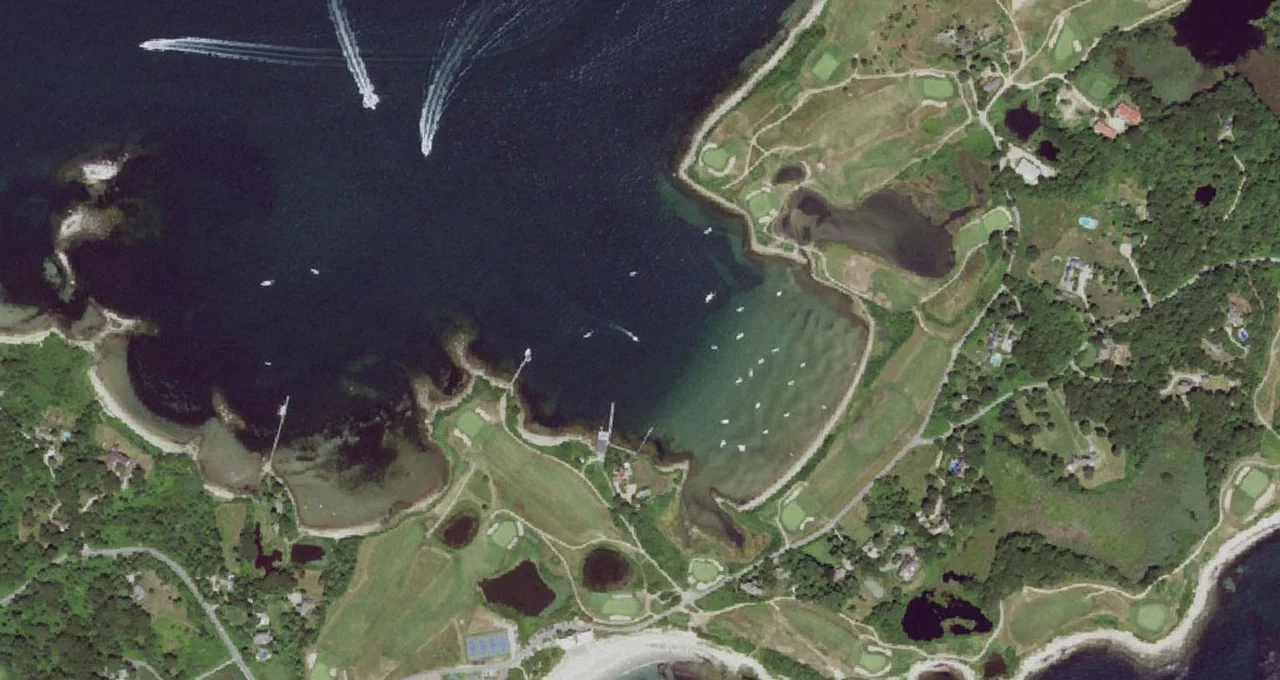
Fishers Island Club from the air. Aerial imagery USGS, domaine public.
Fishers Island Club
Holes
18
By
72
Length
6,597 yards from the Black tees on app and course-rating listings (rating 72.8, slope 144); the club publishes no scorecard, and other sources give 6,556 to 6,616 yards
Green fee
—
Best season
—
Fishers Island Club is a private golf, tennis and beach club on Fishers Island, a narrow strip of land at the eastern end of Long Island Sound, a few miles off New London, Connecticut. The island belongs to New York, and the club gives its address as 20449 East Main Road, Fishers Island, NY 06390. Its 18-hole course was designed by Seth Raynor, opened in 1926 and occupies the eastern end of the island, where the land falls away to Block Island Sound on one side and Fishers Island Sound on the other.
It is one of the most highly ranked courses in the United States. The club itself states that Golf Digest placed it 10th in the country in 2025; Wikipedia records a 9th place on the magazine’s 2023 list of America’s 100 Greatest Golf Courses. The Top 100 Golf Courses website currently lists it 10th in the United States and 20th in the world. Members call it the Big Club, according to Wikipedia, to tell it apart from the smaller Hay Harbor Club on the same island, and it is often described in golf writing as the Cypress Point of the East.
The course is a par 72 in most sources, at a little over 6,500 yards from the back tees. The club publishes no scorecard on its public website, so the figures on this page come from golf apps, a course-rating listing and published course tours, and they do not all agree. The details are set out below.
A course finished without its architect
The project began as a real estate venture. According to Wikipedia, the developer Frederick S. Ruth recommended that Fishers Island Farms, Inc. hire two men he had already worked with at Mountain Lake, in Florida: Frederick Law Olmsted Jr. to plan the residential land, and Seth Raynor to design the golf course. The Cultural Landscape Foundation, which lists the course in its register of designed landscapes, dates the formation of the club and the hiring of the designers to April 1925. Olmsted’s plan covered a large estate; Wikipedia puts it at 1,600 acres, the Cultural Landscape Foundation at 1,800 acres. Wikipedia adds that the full residential scheme never materialized because of the stock market crash of 1929.
Raynor, who had begun as surveyor and construction manager for Charles Blair Macdonald at the National Golf Links of America, never saw the course open. He died of pneumonia in West Palm Beach, Florida, on January 23, 1926, according to Wikipedia. His associate Charles Banks completed the work, and the course opened in July 1926. One ranking site, Top 100 Golf Courses, dates the design to 1927; every other source consulted for this page, Wikipedia among them, gives 1926.
The original clubhouse, a Norman farmhouse-style building by the Boston architect Charles R. Wait, had a varied life. Wikipedia reports that it housed students of the Ethel Walker School after a dormitory fire in 1933 and served the U.S. Navy as a training facility during the Second World War. By the early 1960s it was running heavy annual deficits, and on September 19, 1963, the board had it destroyed in a controlled fire after an attempt with dynamite failed. The club today describes a main clubhouse with two dining rooms, one for about 50 guests and one for about 200.
The golf course itself has changed remarkably little. The Cultural Landscape Foundation notes that the 1938 hurricane damaged part of the 2nd green, that back tees have been added over the years, and that bunkers and greens that had lost their straight edges through decades of mowing have been restored to their original contours. Gil Hanse is named as the club’s consulting architect by The Fried Egg, and two other sources date that role to 1995.
What it asks of you
Fishers Island is a course of Raynor’s template holes: versions of classic holes from Scotland and from Macdonald’s National Golf Links, adapted to the ground. Wikipedia lists the Alps, Biarritz, Cape, Double Plateau, Eden, Punchbowl, Redan and Short among them, and course tours add a Road hole and a Knoll. The routing, as The Fried Egg describes it, starts on fairly low, subtle ground, climbs onto bold rolling terrain at the eastern point of the island and then returns to flatter land near the clubhouse. The Cultural Landscape Foundation notes that little earth was moved, except around three holes that wrap around a tidal pond.
Several independent sources say the fairways have no irrigation system, so the course plays firm and fast, and turns brown in a dry summer. Two course tours note that there is only one fairway bunker on the course, on the 9th, and that it is easily carried. The defense lies elsewhere: in raised greens with steep fronts and falls, deep and often penal greenside bunkers, long grass off the fairways, blind shots on a few holes and the wind off the water. The ranking site lists brutal rough and profound bunkering among the course’s characteristics, and it stresses accurate approach play over length.
The card below gives the Black tee yardages published on golf apps and course-rating listings, with the pars of the course tour by the photographer Jon Cavalier and the hole names he uses. The 18Birdies app gives the same par of 36 on each nine.
- 1st, Raynor’s Start: par 4, 398 yards. A green open across the full width of the fairway, a small pond on the right and deep bunkers by the green.
- 2nd, Redan: par 3, 183 yards. A softer version of the template, with a slope that feeds the ball from the right.
- 3rd, Plateau: par 4, 325 yards. A short hole over a ravine, climbing to a green set against the sky; long is dead.
- 4th, Punchbowl: par 4, 417 yards. An Alps and Punchbowl combination, with a carry over a chasm and a sunken green with an internal ridge.
- 5th, Biarritz: par 3, 225 yards. An uphill tee shot to a tiered green surrounded by deep bunkers.
- 6th, Olinda: par 5, 551 yards. A tee shot over a ridge, then heavily rolling ground.
- 7th, Latimer: par 4, 374 yards. A short, downhill par 4 with a green that seems to hang over the water; long is wet.
- 8th, Road Hole: par 5, 463 yards. A tight fairway between long grass and water, with a road-style bunker behind the green.
- 9th, Double Plateau: par 4, 361 yards. The only fairway bunker on the course, and a heavily contoured two-level green.
- 10th, Knoll: par 4, 396 yards. A steep rise in front of the green; short approaches roll back a long way.
- 11th, Eden: par 3, 163 yards. A green on a natural peninsula, guarded by Hill and Strath bunkers.
- 12th, Winthrop: par 4, 383 yards. A reverse Redan approach, with a ridge running in from the left.
- 13th, Waterloo: par 4, 397 yards. Ponds on both sides of the approach and a narrow land bridge to the green.
- 14th, Cape: par 4, 418 yards. A dogleg left around a large pond, with an oak behind the green.
- 15th, Long: par 5, 538 yards. A ridge across the fairway and an open-fronted green.
- 16th, Short: par 3, 145 yards. A green guarded by bunkers that look more natural than on most of Raynor’s Short holes.
- 17th, Coast Guard: par 4, 417 yards. A long, straight hole with an easily carried pond and a green full of internal ridges.
- 18th, Home: par 5, 443 yards. A short par 5 to a raised, tiered green with a deep bunker on the left.
On those cards the front nine measures 3,297 yards and the back nine 3,300, for 6,597 yards in all. The course-rating listings that carry this card give the Black tees a rating of 72.8 and a slope of 144, and the Blue tees, at 6,503 yards, 72.4 and 142. Forward tees range from 5,982 yards for the White to just over 4,000 yards for the shortest Green set.
The stretch from the 3rd to the 7th is the one most writers single out. The 4th, the 5th and the 11th are often named among the best versions of their templates anywhere: the Cavalier tour calls the 5th the most beautiful Biarritz in the world and the 11th the finest Eden in the United States. The two short par 5s, the 8th and the 18th, are reachable in two for strong players in firm conditions, which makes the closing hole, as the same tour puts it, a fine match play finish. The 10th, with its steep false front, is described as perhaps the hardest hole on the course.
What golfers are saying
Because the club is private, there are fewer public reviews than for a public course, but it has been written about at length by rating panelists, architecture websites, golf travel bloggers and app users. The points below summarize what recurs in that material. They are other people’s opinions, not ours; nobody from Panxis has played the course, and we name and quote no one.
What comes up in its favor
- The setting is the first thing almost everyone mentions: saltwater views from nearly every tee and green, rocky shoreline, and the sense of arrival created by the ferry crossing.
- The greens are the most praised feature of the design, for their bold movements and their subtler internal contours. Several writers rank them among the best sets they have played.
- The template holes are seen as some of Raynor’s finest, especially the Punchbowl, the Biarritz, the Eden and the Short, and the run of holes on the high ground in the middle of the round draws the strongest praise.
- The firm, unirrigated fairways and the club’s traditional maintenance are welcomed by writers who prefer playability to manicured looks, and conditions are generally reported as excellent.
- The course is felt to be largely as it was in 1926, and its resistance to lengthening is often counted as a virtue.
- App reviewers describe the pace of play as fast.
What comes up against
- Several critics find the holes near the clubhouse, at the start and end of the round, less inspiring than the middle of the course, and one architecture site rates the whole course a notch below the very top because of those weaker holes.
- The par 5s are seen by some as the least interesting holes, partly because they are short by modern standards.
- One critic finds the raised, perched greens repetitive over a full round.
- The weather can take the views away. Some visitors played in thick fog and saw little of the course, or in wind and rain that limited what they could take in.
- Access is the underlying objection: the course is private, and most golfers will never play it.
Who can play
Fishers Island Club describes itself as a private golf, tennis and beach club, and the beach and oceanfront access are reserved for members. The club publishes no visitor policy, no tee time system and no green fees on its public website. According to the Top 100 Golf Courses site, play requires the sponsorship of a member. The published accounts of rounds on the course are all those of golfers invited by members or by the club. There is no public route onto the course, and this page does not suggest one.
Besides the golf course, the club lists five tennis courts, golf and tennis pro shops, a beach club with a snack bar, and the main clubhouse with its two dining rooms. Visitor accounts describe golf carts in use, including one waiting at the dock for golfers arriving by private boat; The Fried Egg, for its part, praises the course as a walk.
Getting there
The island is reached by boat. The club’s own directions send visitors to New London, Connecticut, where the Fishers Island Ferry dock is directly behind the Amtrak station. From Boston or New York, the club says, the train ride to New London takes about three hours from South Station or Penn Station. By car, the club gives exit 84S on I-95 southbound from Boston, or exit 83 northbound from New York, then directions to the Transportation Center on State Street and across the tracks to the ferry dock.
The ferry is run by the Fishers Island Ferry District, and the crossing takes about 45 minutes, according to the club. Drivers must arrive at least 25 minutes before departure, and a vehicle reservation is recommended at peak times; tickets are sold in the brick building at the dock. The ferry district takes online reservations for cars and adds a fuel surcharge to tickets; its site notes that one ferry ramp on Fishers Island is closed for construction from September 8 to December 1, 2026. The club says it will arrange to pick up visitors who come without a car. Some golfers charter a private boat instead, a crossing of about ten minutes according to one account. For travelers coming from Long Island, the club also points to the Cross Sound Ferry between Orient Point and New London.
Green fees
The club publishes no green fees, and none are given here. The course is open only to members and their guests.
How this page was made
The factual frame comes from public sources: OpenStreetMap for the location; the club’s public website for the address, the description of its facilities, the 2025 Golf Digest ranking and the directions; Wikipedia’s articles on the club and on Seth Raynor for the history, the development project, the clubhouse and Raynor’s death; The Cultural Landscape Foundation for the 1925 founding, the 1938 hurricane and the restoration of bunkers and greens; the Top 100 Golf Courses site for its rankings and its description of the course; The Fried Egg for the routing, maintenance and consulting architect; a course tour by Jon Cavalier on the Geeked on Golf site for the hole names, pars and descriptions; the Stymie and 18Birdies listings for the tee yardages, ratings and slopes; the Fishers Island Ferry District for the ferry service; Wikidata for the identifiers.
Where sources disagree, we say so. The club does not publish a scorecard, and the totals vary: 6,597 yards on app cards for the Black tees, 6,616 yards on Wikipedia with a rating of 72.0, 6,566 yards on the Top 100 Golf Courses site, and 6,556 yards in two course tours. Individual holes vary with them; the course tour gives 172 yards for the 2nd and 207 for the 5th, where the app cards give 183 and 225, probably from different tees. One listing, Stymie, gives a par of 70 against 72 everywhere else; this page follows the par 72 of Wikipedia, the 18Birdies card and the course tour. Ratings and slopes come from app listings and not from the club. The design is dated 1926 everywhere except on the Top 100 Golf Courses site, which gives 1927. Olmsted’s estate is put at 1,600 acres by Wikipedia and 1,800 by the Cultural Landscape Foundation. The Golf Digest ranking is 9th in 2023 according to Wikipedia and 10th in 2025 according to the club. The club’s website gives its phone number as 631-788-7225, where the Top 100 Golf Courses site lists a different number.
The opinion section summarizes reviews by rating panelists, architecture websites, golf travel blogs and app users, read in October 2026. We report recurring themes rather than individual voices, and we reproduce no quotations. Nobody from Panxis has played or visited this course, and this page is no substitute for a round.
The club has not paid for this page, has not seen it before publication and has no say over its content. This page contains no commercial link and earns us no commission. If you know the course and something here is wrong or out of date, write to us and we will correct it.
Other courses nearby
Closest to this one in our United States directory:
- TPC River Highlands — 43 mi
- Keney Park Golf Course — 52 mi
- TPC Boston — 61 mi
- Brae Burn Country Club — 81 mi
The hole to know
The Biarritz, a par 3 of 225 yards from the Black tees on app cards (207 yards in a published course tour): an uphill tee shot to a tiered green surrounded by deep bunkers.