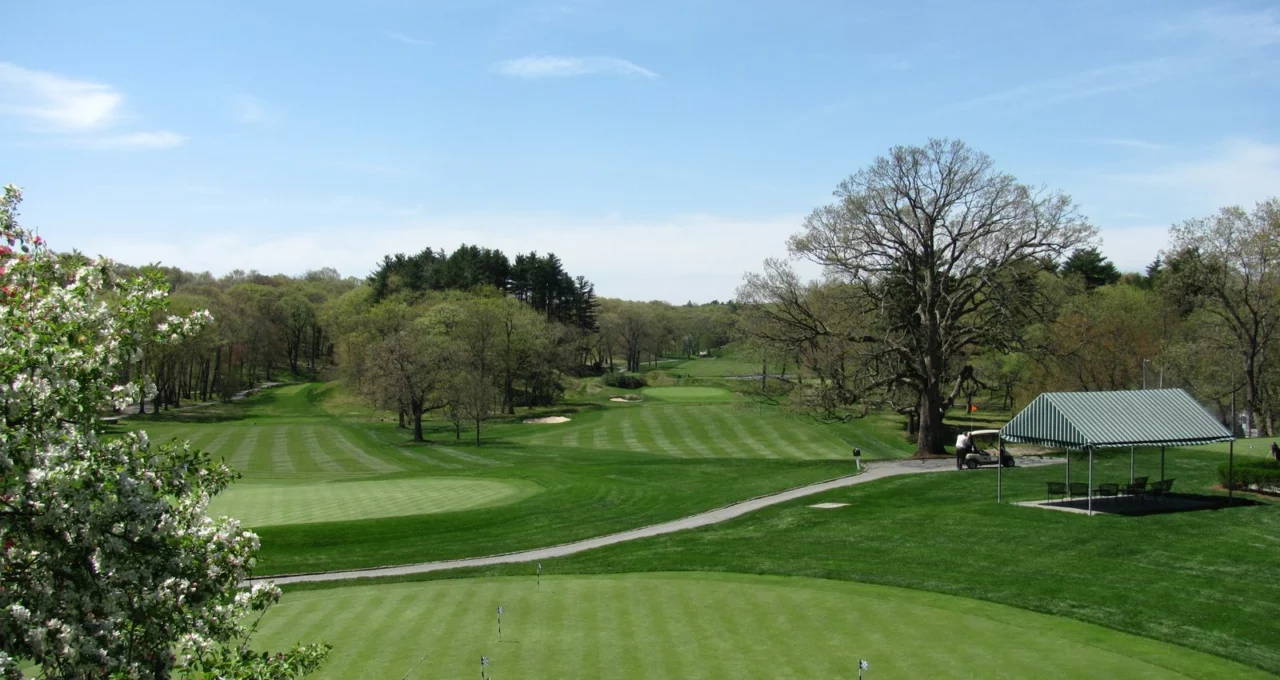
Brae Burn Country Club — Photo John Phelan / Wikimedia Commons, CC BY 3.0
Brae Burn Country Club
Holes
18
By
—
Length
—
Green fee
—
Best season
Roughly April to November
The first nine holes on the present property were built in 1897 and the club expanded to eighteen in 1903, four years after the clubhouse went up. Donald Ross redesigned the course in 1912 and reworked it again in 1928 for the U.S. Amateur, and the layout has changed little since.
In June 1919 Brae Burn staged the U.S. Open, remembered for the duel between Mike Brady and Walter Hagen. Brady led after two rounds and after three, shot 80 in the last, and Hagen took the title in the play-off with 301. The club has also held the Curtis Cup and several national amateur championships, and its competitive record is longer than its public profile.
What it asks of you
Ross on genuinely hilly New England ground. The hills, or braes, are in the name, and almost nothing here is level: uphill approaches to crowned greens, downhill tee shots that run out further than they look, and stances that make the number on the yardage book a starting point rather than an answer.
The front nine works across classically rocky terrain with pronounced side slopes, and the routing over that ground is the part architecture writers admire most. The back nine sits on gentler land, where Ross built up mounding to create the movement the site did not provide. It is a shortish course by modern measure and it does not need length: the greens are among the more severely contoured in Massachusetts, and getting the ball onto the correct portion of them is the whole examination.
This is early-to-middle Ross rather than the settled style of his later work. Intimate green sites, chocolate drop mounds, and bunkers caught between Victorian pits and the shapes he would arrive at a decade later. The quirks are part of what people come to see.
What players say about it
Access is by membership or a member’s invitation, so the public record consists of guest accounts, architecture writing and rating panels rather than visitor reviews. The notes below summarize themes that recur across those public sources. They are other people’s opinions, not ours: we have not played the course, and we do not name or quote individual reviewers.
What comes up in its favor
- The routing is the headline. It is repeatedly described as one of Ross’s most ingenious, precisely because of how much difficult ground it makes usable.
- The quirk is treated as a feature. Reviewers who like early Ross come away pleased that the experimentation of that period was never smoothed away.
- The par fours draw strong praise, several of them described as genuinely hard without being unfair.
- The views across the Charles River valley and the sense of an old New England club are consistently mentioned.
What comes up against
- The set of par fives is regularly called the weak point of the course, and that criticism appears in more than one independent account.
- Two of the par threes are very long, and players who cannot carry a long iron find them close to unplayable from the back tees.
- The walk is strenuous. On a hot day the hills are the thing guests remember rather than the architecture.
- Access limits everything, including the review record: there is no visitor tee sheet and few published accounts.
Getting there and when to go
West Newton is eight miles west of Boston, on the Massachusetts Turnpike and the commuter rail, which puts the club unusually close to a major city for a course of its era. Logan airport is around half an hour away outside rush hour.
The season runs from roughly April to November. Late spring and September give the best combination of firm turf and comfortable walking; midsummer is humid and the hills feel longer. Guest play is arranged through a member.
Green fees
Guest conditions and rates are set by the club and are not published. See the club’s own site.
How this page was made
The factual frame comes from public sources: OpenStreetMap for the location, Wikipedia and published architecture coverage for the history, the championships and the design, and the club’s own site for access. The opinion section summarizes public commentary and guest accounts read in September 2026; we report recurring themes rather than individual voices, and we do not reproduce or attribute quotes.
We have not played this course, and nothing here is a substitute for that. The club has not paid for this page, has not seen it before publication and has no say in what it says. If you know the course and something here is wrong or out of date, write to us and we will correct it.