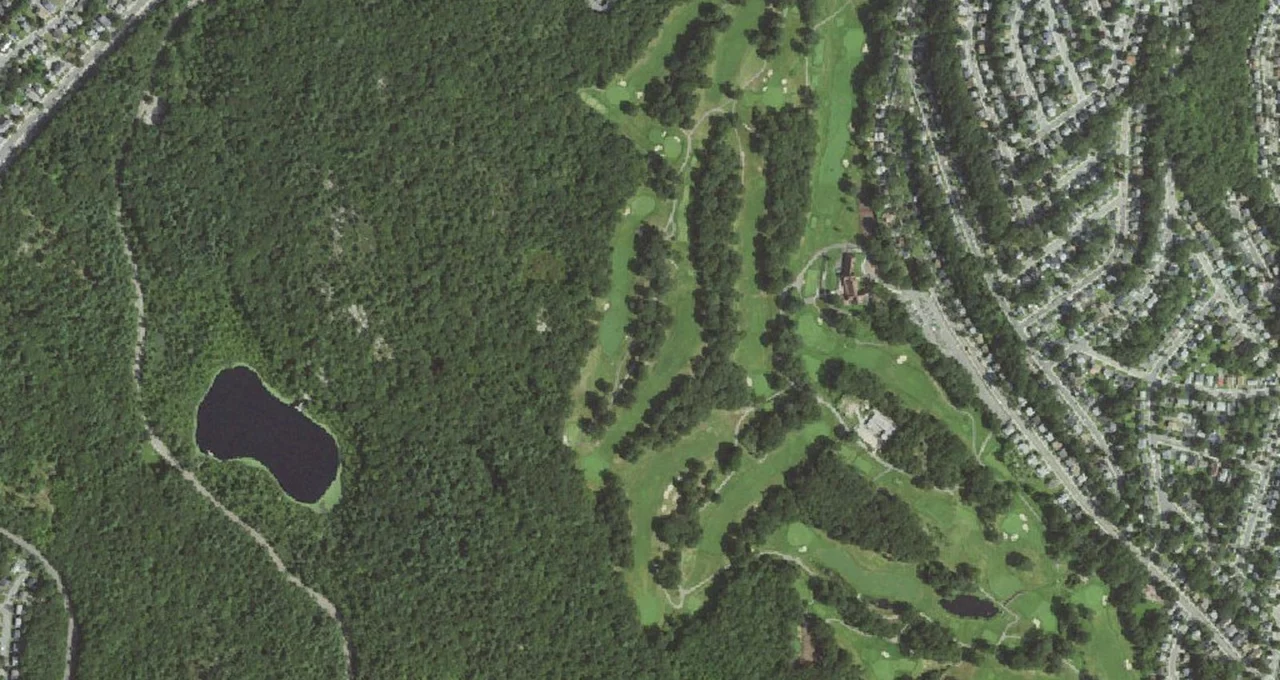
George Wright Golf Course from the air. Aerial imagery USGS, domaine public.
George Wright Golf Course
Holes
18
By
70
Length
6,440 yards from the Blue tees on the club's course tour; course directories give 6,506 yards from the 2017 Blue tees (rating 71.9, slope 133)
Green fee
—
Best season
—
George Wright Golf Course is the City of Boston’s second municipal course, an 18-hole par 70 at 420 West Street in Hyde Park, on the southern edge of the city, with part of its land extending toward Roslindale according to Wikipedia. It is owned by the city and run by its Parks and Recreation Department. The club’s website describes it as a public course designed by Donald Ross that opened in 1938, with funding from the Works Progress Administration used to finish construction. The site covers 156 acres, enclosed by a stone wall nearly three miles long, and a Norman-style clubhouse stands on its western edge. The course is named after George Wright, a member of the Baseball Hall of Fame who played for the Cincinnati and Boston Red Stockings and who, according to the club, helped bring golf to Boston.
The length depends on the source. The hole-by-hole course tour on the club’s website lists three sets of tees: Blue at 6,440 yards, White at 6,096 yards and Red at 5,132 yards. A course directory that carries the current ratings, with tee sets labeled 2017, gives longer figures: Blue at 6,506 yards (course rating 71.9, slope 133), White at 6,237 yards (69.9 and 129) and Gold at 5,522 yards (66.2 and 120) for men, and Red at 4,908 yards (68.8 and 122) for women. Wikipedia uses the 6,506-yard card. Older listings, which Wikidata follows for the slope, give 6,440 yards with a rating of 69.5 and a slope of 126. We could not reach the USGA course rating database to settle the question, so this page gives both cards and treats the 2017 ratings as the most recent.
One discrepancy needs flagging. The club’s course tour lists the 15th as a par 4 of 510 yards from the Blue tees, but its own description calls it a three-shot hole that long hitters can reach in two, the directory card lists it as a par 5, and only a par 5 there gives the par 70 that the club’s home page announces. This page treats the 15th as a par 5.
A course blasted out of ledge and swamp
The land was once part of the Grew estate. According to Wikipedia, Henry Sturgis Grew bought several hundred acres in 1847 in what was then western Dorchester, and he was among the founders of the town of Hyde Park, incorporated in 1868. In the late 1920s, according to the club, a citizens’ group that controlled the estate wanted a private club built there, and Donald Ross, who lived in nearby Newton, was commissioned. The stock market crash of 1929 ended that project. Wikipedia tells the story differently: it says the land was sold in 1925 to a development company that planned a private course designed by Wayne Stiles, not Ross, and that the city took the land by eminent domain in 1930 for a municipal course.
The ground was mostly rock and wetland. Wikipedia reports a remark attributed to Ross on first seeing it, that a suitable course there would need either a fortune or an earthquake. The club’s history describes the work that followed: about 60,000 pounds of dynamite to remove ledge, 72,000 cubic yards of soil to raise the ground above swamp level and 57,000 linear feet of drainage pipe, with as many as 1,000 men on the site at one point. Construction began in 1931 and passed through several city and federal relief programs before the Works Progress Administration carried it to completion. Wikipedia gives the opening date as April 23, 1938, with Mayor Maurice J. Tobin hitting the ceremonial first drive.
Sources disagree on several points of this history. The club and Wikipedia name Walter Irving Johnson, a former Ross associate, as the engineer who took over the project in 1932 for the Metropolitan District Commission; an article in Golf Course Architecture names another Ross engineer, James McGovern, as the man who revived it. The same article says the course was built by the Public Works Administration between 1933 and 1938, where the club and Wikipedia credit the Works Progress Administration. For the opening year, the club, Wikipedia and The Cultural Landscape Foundation say 1938, while the Top 100 Golf Courses website gives 1936 and a course directory gives 1939. This page follows the club.
Decline and revival
The postwar decades were hard on the course. The Cultural Landscape Foundation reports that it declined after the Second World War, closed in the early 1970s, was leased in the early 1980s to an operator who renovated it, and then declined again. Wikipedia describes budget cuts in the 1970s and early 1980s and a period during which the Massachusetts Golf Association leased the course; we found no other source for that lease. Golf Course Architecture quotes local memories of a nearly abandoned course with out of bounds stakes used as flagsticks.
The city took back day-to-day operations in the early 2000s: the club, Wikipedia and The Cultural Landscape Foundation say 2004, while the American Society of Golf Course Architects and Golf Course Architecture say 2003. The city hired the architect Mark Mungeam to restore both of its courses, George Wright and Franklin Park. According to the American Society of Golf Course Architects, his work at George Wright included full rebuilds of the 1st and 13th holes from tee to green, the renovation of 25 of the course’s 34 bunkers, the enlargement of 10 tees, a new irrigation system and the clearing of overgrown forest, which reopened angles of play and brought the boundary wall back into view. The Top 100 Golf Courses website adds that the greens were the first priority.
Recognition followed. The club says Golf Digest named George Wright the best municipal course in Massachusetts, and Wikipedia dates that award to 2009; the club also cites a Golfweek ranking of 14th among the country’s municipal courses in 2009. In June 2021, Golf magazine placed it third on its first list of the 30 best municipal courses in America, as reported by The Boston Globe; Golf Course Architecture attributes that ranking to Golf Digest, which appears to be a mix-up. In July 2018 the course hosted the 110th Massachusetts Amateur, the first time the championship was staged at a public, daily-fee facility. According to Mass Golf and New England Golf, the first round was played at Franklin Park and the rest at George Wright, where Patrick Frodigh beat Herbie Aikens 4 and 3 in the 36-hole final on July 13. Wikipedia lists a course record of 63, set in 2008, which we could not confirm elsewhere.
What it asks of you
George Wright is short on paper and hard in practice. The routing runs over the ledges of Bearberry Hill and down to the wetlands of Stony Brook, according to Golf Course Architecture, and Wikipedia notes that more than half the holes play over hills that often hide the target. Golf Digest describes rocky outcrops, constant changes of elevation, many blind shots and smallish greens. A course directory lists bentgrass greens, bluegrass fairways and between 31 and 40 bunkers, with water in play. The card has four par 3s, twelve par 4s and two par 5s. On the directory’s stroke index, the 9th is the hardest hole, followed by the 10th, the 5th and the 15th; the 17th is ranked the easiest. The club asks for a pace of 4 hours 20 minutes for 18 holes.
The front nine
The yardages below come from the Blue tees on the club’s course tour, with the directory’s 6,506-yard Blue card in brackets, and the descriptions follow the club’s own notes. The 1st is a par 4 of 377 yards (394) with room off the tee, trees on the left, out of bounds on the right and mounds to avoid left of the green. The 2nd, a par 4 of 321 yards (364), leaves an uphill approach to a green guarded on the left by a bunker. The 3rd, a par 5 of 515 yards (527), is reachable in two for long hitters, but the club recommends playing it as a three-shot hole because the landing area is narrow and deep bunkers sit in front of the green. The 4th, a par 3 of 165 yards (159), has deep bunkers at the front and a fescue slope behind.
The 5th, a par 4 of 412 yards (426) and third on the stroke index, is a dogleg right with a semi-blind downhill approach; the club suggests aiming the drive at the top of the hill. The 6th, 395 yards (384), runs down a tight, tree-lined fairway to a green whose front bunkers sit well short of the putting surface. On the 7th, 400 yards (433), a drive to the hilltop leaves a downhill approach, while a drive to the right leaves a blind one. The 8th is an uphill par 3 of 185 yards (167) that plays longer than its yardage, with trouble on the left. The 9th, 453 yards (449), is the hardest hole on the card: the club describes the approach as often played from an uneven lie at more than 200 yards.
The back nine
The 10th, a par 4 of 462 yards (462), is the second half of that demanding pair: a drive of at least 220 yards is needed to set up a downhill approach to a fairway that falls away on both sides, and the large, contoured green tends to leave an uphill putt. On the 11th, 362 yards (350), the club suggests aiming at a large rock outcrop on the left. The 12th, 412 yards (412), is a downhill dogleg right; Wikipedia notes that its hill is a local sledding spot in winter. The 13th, 390 yards (386), rebuilt by Mungeam, hides two ponds on the left and a false front on the green. The 14th, a par 3 of 191 yards (189), asks for a tee shot through a corridor of trees to a green with another false front.
The 15th, 510 yards (507), is the par 5 discussed above: a drive over the hill opens a chance to reach the green in two, while a drive caught on the slope turns par into a good score, with trees and out of bounds down the right. The 16th, a par 4 of 340 yards (346), calls for a drive left of center to avoid a fairway bunker and out of bounds. The 17th, a par 3 of 170 yards (167), is exposed to the wind, with greenside bunkers that call for a high shot. The 18th, a par 4 of 380 yards (384), is a tree-lined dogleg right with bunkers on the right of the fairway, water crossing in front of a short drive and a deep bunker beside the green.
What golfers are saying
The material behind this section is the user reviews on two golf review and booking sites, as shown in search results, the summary of the Golf Digest panel review as indexed by search engines, comments from course raters quoted in the press and the Top 100 Golf Courses page. The points below are other people’s opinions, not ours; nobody from Panxis has played the course, and we quote no one by name.
What comes up in its favor
- The land itself: reviewers describe dramatic movement, rock outcrops, false fronts and fall-offs that they associate with Ross.
- The greens, described as fast, firm and consistent; the Golf Digest panel summary compares them with those of high-end private clubs.
- Conditioning, which several reviewers credit to the course staff and to the restoration work since the 2000s.
- The quality of the design as a whole, called difficult but fair, and judged by one rater cited in the press to have no weak holes.
- The fact that a course of this standard is a public, city-run facility.
What comes up against
- The number of blind shots: some reviewers find them excessive or repetitive, and some think certain holes go too far in their elevation changes.
- A tiring walk on such hilly ground, although others find it walkable.
- Tee times that are hard to get, especially on weekends.
- Slow rounds, and greens that can get slow, according to some reviews.
- Older reviews describe tees in poor shape and a course in need of renovation; they predate part of the restoration work.
How to play it
George Wright is open to the public. Tee times are booked online through the club’s website or at the golf shop, with separate pages for holders of the city’s season permit and for other players, as well as booking policies and group booking options. According to the club’s rules, players must check in at the golf shop and show a receipt to the starter, who sets the groups; permission is needed to start on the back nine; everyone on the course must carry a set of clubs, so walkers and spectators may not tag along. Shirts and shoes are required and metal spikes are not allowed.
Walking is allowed. Carts are rented to drivers 18 and over with a valid license, two players per cart, and must stay on the paths when cart path rules are in effect. A course directory lists a pitching and chipping area and a putting green but no driving range. The club runs a junior golf program and offers the course for tournaments and outings. This page lists no green fee; rates are on the club’s website.
The facilities
The club’s website lists a golf shop and a grill that serves food and drinks, and says the course is available for functions during the season. The Norman-style clubhouse dates from the original construction. The club does not describe other sports facilities, and this page does not list any.
Getting there and when to go
The course is at 420 West Street, Hyde Park, MA 02136, in the south of Boston. The club’s website does not publish the season dates; Wikipedia gives April 1 to November 30, a range we could not confirm with the club, and the phone number of the golf shop is 617-364-2300. Contact details and tee times are on the club’s website.
How this page was made
The factual frame comes from public sources consulted in October 2026: OpenStreetMap for the location; the club’s website for the address, the par, the 6,440-yard Blue card, the hole descriptions, the history of the construction, the namesake, the awards, the rules and the services; Wikipedia and Wikidata for the opening date, the land history, the course record and the season; The Cultural Landscape Foundation for the acreage, the stone wall, the clubhouse and the decline; the American Society of Golf Course Architects and Golf Course Architecture for the Mungeam restoration; Mass Golf and New England Golf for the 2018 Massachusetts Amateur; The Boston Globe for the 2021 Golf magazine ranking; course directories for the 2017 tee sets, ratings, stroke index, grasses and practice areas. Where sources disagree, as they do on the length, the ratings, the par of the 15th, the opening year, the origin of the private project, the engineer, the relief program and the year the city took over, we say so and name the source we follow.
Several sources could not be read directly: the USGA course rating database, Golf Digest, the two golf review and booking sites that carry user reviews, and a part of the club’s website, which blocked automated requests. For those, we relied on the excerpts shown by search engines and say so above. We could not confirm the Massachusetts Golf Association lease mentioned by Wikipedia, the 2008 course record or the season dates with a second source. The opinion section summarizes public reviews; we report recurring themes rather than individual voices, and we reproduce no quotations. Nobody from Panxis has played or visited this course, and this page is no substitute for a round.
The club has not paid for this page, has not seen it before publication and has no say over its content. This page contains no commercial link and earns us no commission. If you know the course and something here is wrong or out of date, write to us and we will correct it.
Other courses nearby
Closest to this one in our United States directory:
- Blue Hill Country Club — 6 mi
- Brae Burn Country Club — 7 mi
- TPC Boston — 21 mi
- The Bay Club at Mattapoisett — 44 mi
The hole to know
A par 4 of 453 yards from the Blue tees on the club's card (449 on the 2017 card), first on the stroke index: the club says the approach often comes from an uneven lie at more than 200 yards.