Home golf simulators under A$1,000: double garages, Melbourne winters and summer heat
A thousand Australian dollars buys a compact launch monitor, not a golf room. This month three popular units come in under that line, from A$849.99 to A$998.95, and a fourth, the camera-based Square Golf, sits just above it. Here is what each one needs in a garage, what it costs after the box and what owners say once they hit into a net through a cold winter or a hot summer.
In brief
- Australian prices read on 27 October 2026, including GST: Garmin Approach R10 A$849.99 to A$998.95, Rapsodo MLM2PRO A$899.95 to A$899.99, Voice Caddie SC4 Pro A$849.99 in a bundle with an alignment stand.
- The Square Golf Home Edition, a camera unit that sits beside the ball, costs A$1,199 to A$1,199.99 here, so it misses the A$1,000 line.
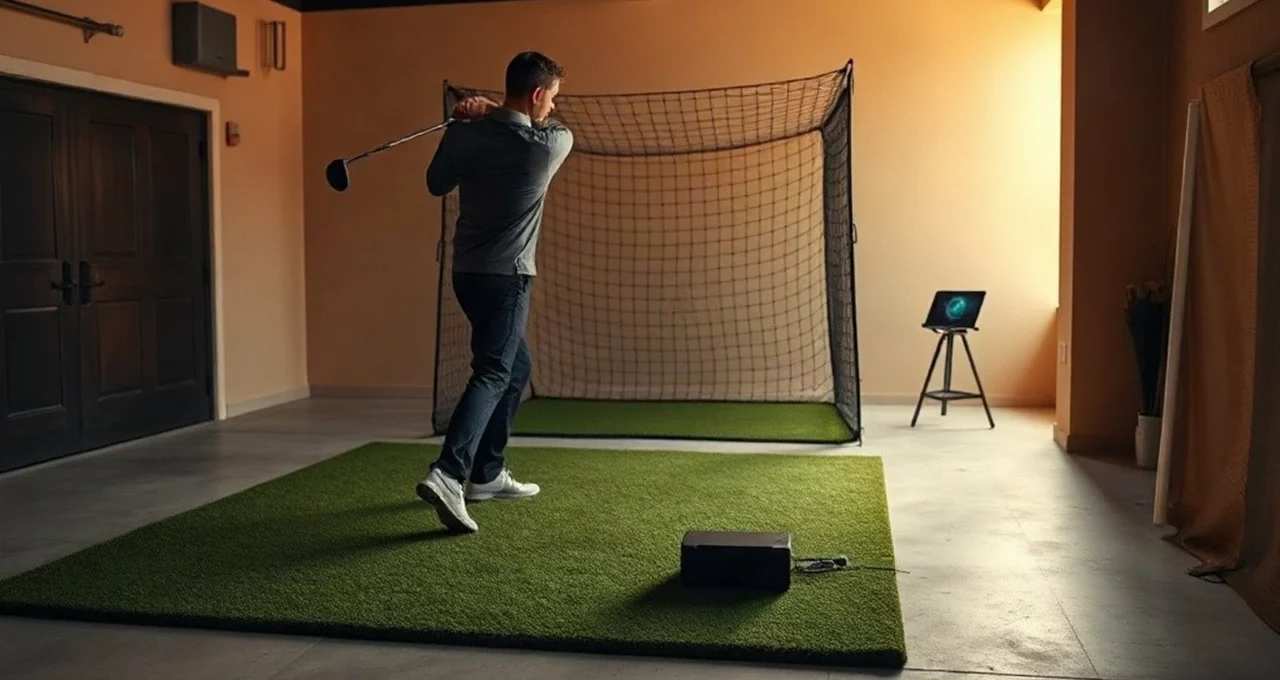
- The radars sit 1.5 to 2.4 metres behind the ball: a double garage of about 6 metres is deep enough, but a ceiling around 2.4 metres often rules out the driver.
- Owners praise ball speed, launch and the Rapsodo's swing video; they complain about short indoor carries, unreliable spin, memberships and lost mishits.
Ask a Melbourne golfer about July and you will hear about frost on the fairways at 8 am, a car park in the dark by a little after five, and a fortnight of grey drizzle that turns a Saturday round into a lottery. Ask someone in Townsville about February and the story flips: 35 °C by mid-morning, an afternoon storm on the radar and a course that floods by three. Different problems, same conclusion. Plenty of Australians end up wondering whether a launch monitor, a net and a mat in the double garage would keep their swing ticking over when the course is not much fun.
Now is a sensible time to do the sums. Spring has arrived, daylight saving gives most of the south-east long evenings again, and buying before summer means the gear is set up before the heat, the storms and next winter. This page looks at what A$1,000 actually buys in Australia this month, where the line falls, and what owners report once these units move indoors.
Nobody at Panxis Golf set up these units or hit balls in front of them. Everything below comes from the makers’ published specifications, Australian retail listings read in October 2026 and what owners say in public reviews and forums.
Where the A$1,000 line falls in Australia
Overseas buying guides usually feature four compact units: the Garmin Approach R10, the Rapsodo MLM2PRO, the Voice Caddie SC4 Pro and the Square Golf Home Edition. Australian pricing changes that line-up. Three of them can be bought here for under a thousand dollars. The fourth can’t.
| Unit | How it reads the ball | Where it sits | Australian price, Oct 2026 | RRP shown |
|---|---|---|---|---|
| Garmin Approach R10 | Doppler radar | 1.8 to 2.4 m behind the ball | A$998.95 at one retailer, A$849.99 at another | A$999.99 |
| Rapsodo MLM2PRO | Radar plus two cameras | Behind the ball | A$899.95 at one retailer (sold out online on the day), A$899.99 at another | A$1,099.99 |
| Voice Caddie SC4 Pro | Doppler radar, screen on the unit | About 1.5 m behind the ball | A$849.99, bundled with an alignment stand; no price found for the unit alone | A$999.99 (bundle) |
| Square Golf Home Edition | Cameras | Beside the ball | A$1,199 to A$1,199.99 | Over budget |
Three things stand out. First, the R10 is listed for almost a hundred and fifty dollars less at one national online retailer than at the other, so it pays to look twice. Second, the cheapest way into the SC4 Pro in Australia this month comes with an extra accessory in the box, because the unit on its own was not listed by either of the retailers checked. Third, the Square Golf, the only camera unit in the group and a popular pick overseas for small rooms, costs just under A$1,200 at the Australian simulator specialists that list it. Its newer Omni sibling, which also works outdoors, is listed at A$2,999.
If even A$850 is more than you want to spend, the original Rapsodo Mobile Launch Monitor is still on Australian shelves at A$399.95. It uses radar plus the camera of an iPhone or iPad, so it does not suit Android users, and it does not report spin. It gives carry distance, club and ball speed, smash factor, launch angle and direction, which is enough for a lot of range work.
The three units in detail
The specifications below are the makers’ own, as reproduced on Australian retailers’ listings. Where an American figure was given in feet or ounces, it has been converted.
Garmin Approach R10
The R10 is a radar about the size of a smartphone that sits on the ground behind you and looks down the target line. It pairs with the Garmin Golf app on your phone, and Garmin supplies a clip so the phone can sit on your bag.
- What it reports: club head speed, ball speed, spin, launch angle, launch direction and smash factor, among more than a dozen metrics, with dispersion charts in the app.
- Video: the app can film each swing on your phone and lay your numbers over the clip.
- Setup: the Australian listing says to place the R10 between 1.8 and 2.4 metres behind the tee, with its base above the mat if you hit off one.
- Battery: up to 10 hours.
- Virtual rounds: more than 42,000 courses, but playing them needs an active Garmin Golf subscription. The range and the shot data do not.
Rapsodo MLM2PRO
Rapsodo combines a radar with two cameras. One camera films your swing, the other watches the ball at impact, and your phone or tablet, Apple or Android, mounts on the unit.
- What it reports: thirteen metrics, including ball speed, club speed, launch angle and direction, carry and total distance. Spin rate and spin axis need two things: a Premium membership and Rapsodo’s RPT balls, which carry a printed pattern the camera can read.
- In the box at Australian retailers: the unit, a tripod, a carry case, a charging cable, a sleeve of three RPT balls (Titleist Pro V1 or Callaway Chrome Soft X, depending on the listing) and 45 days of Premium.
- Setup: setup guides based on Rapsodo’s documentation put the unit roughly 2.1 to 2.4 metres behind the ball, with about 2.4 metres from the ball to the net.
- Premium: course play, the simulation modes and connections to third-party simulator software depend on it. The Australian listings say the membership renews automatically every 12 months and can be cancelled at any time.
Voice Caddie SC4 Pro
Voice Caddie, also sold under the Swing Caddie name, is the only one of the three you can use without a phone. The numbers appear on a screen built into the unit, and it can read your carry distance out loud.
- What it reports: carry and total distance, ball speed, club speed, smash factor, launch angle and spin. The Pro adds spin axis, side spin, back spin and dispersion, which the earlier SC4 did not show.
- Setup: about 1.5 metres behind the ball, on the same level as the ball. That is the shortest gap of the three, which matters in a single garage.
- Software: the VOICECADDIE S app gives a 3D driving range, practice modes and distance calibration for air pressure. There is no subscription, and the Australian listing includes access to five E6 Connect simulator courses.
- Hardware: about 590 grams, a 10-hour battery and a stated operating range of 0 to 50 °C. The bundle sold in Australia adds a stand with a laser alignment line and a bubble level.
The cost after the box
The purchase price is the easy number. What you will be paying in year two and year three is less obvious, and it reverses the ranking.
- Garmin R10: the range, the data and the video are free. Virtual rounds need a paid Garmin Golf membership. No Australian price from Garmin itself was found, so none is given here.
- Rapsodo MLM2PRO: the two Australian retailers checked include 45 days of Premium. Rapsodo’s own Australian sales site, run with an Australian golf magazine, advertises a bundle at $1,099 with the first year included, so the offer depends on where you buy. Without Premium you lose spin, course play and most simulation. Rapsodo does not publish an Australian dollar price for the membership on its subscription page, so none is given here.
- Voice Caddie SC4 Pro: no subscription. What you pay at the counter is what it costs, plus five E6 Connect courses. A wider E6 library is a separate purchase.
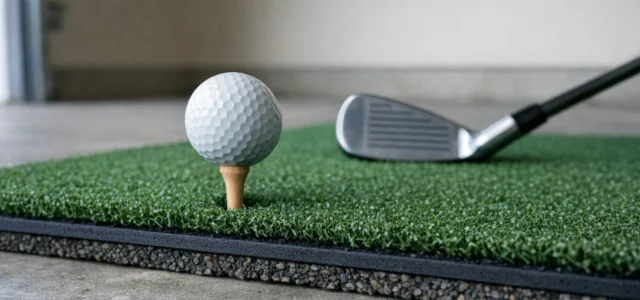
Then come the extras that every setup needs. A net or an impact screen to stop the ball, a hitting mat that will not jar your elbows on a heavy shot, and something to look at: for most owners at this price that means a phone, a tablet or the TV already on the garage wall. With a unit at A$850 to A$1,000, those parts take you past a thousand dollars almost straight away. A projector and a full enclosure belong to a much bigger budget.
Owners of the Rapsodo should also budget for balls. Three RPT balls come in the box, and owners say they are too few for a proper session and that the pattern wears.
What golfers are saying
The opinions below come from published reviews, the makers’ owner forums and retailer comments, most of them American or British. No detailed Australian owner reviews turned up, but nothing in these complaints is specific to one country.
What owners like
- Ball speed and launch they can trust. This is the praise that comes back for all three. A reviewer who set the SC4 Pro next to a far dearer camera system found nearly every number close, with spin the only one clearly off. Garmin owners who checked the R10 against a launch monitor at a fitting studio report the same: speed and launch line up.
- Numbers on every swing, all year. Owners describe the real value as a carry chart for every club and a reason to hit thirty balls on a weeknight, more than as a game. One member review on the MyGolfSpy forum describes using the MLM2PRO mostly in the garage and finding the readings very consistent.
- The impact camera on the Rapsodo. MLM2PRO owners single out the swing video with the shot tracer as the feature that turns a net session into something closer to a lesson.
What owners complain about
- Short carries indoors. On Garmin’s own R10 forum there is a long thread from owners whose driver carries indoors come up well short of what they hit on the course, with spin that looks too high and launch that looks low. Some report a modest improvement after firmware updates; others say nothing they tried, from levelling the unit to moving the net, made a difference.
- Spin is the soft spot. SC4 Pro reviewers name spin as the figure most often wrong, by a couple of hundred rpm in one review. On the Rapsodo, spin only appears with the special balls and a Premium membership.
- Memberships that creep up. MLM2PRO owners mention the yearly renewal more than anything else, and note that third-party simulator software will not connect without it. R10 owners make a similar point about virtual rounds.
- Mishits and dropped connections. Reviewers of the SC4 Pro say it occasionally loses shots that go well offline, Rapsodo’s help pages deal with phones dropping the connection, and R10 owners report odd readings on tops and shanks.
No one is quoted by name and nothing here has been counted. These are the points that recur in public reviews and forum threads, not measurements.
Where Australians set one up: double garages, summer heat and Melbourne’s winter
Overseas, the home simulator is usually a basement or a spare-room project. In Australia, where few houses have a basement, it is almost always the garage, and the way Australians build and the weather they live with shape the choice more than the brand does.
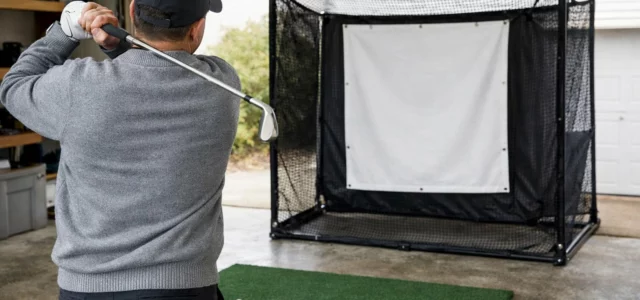
- The double garage. A double lock-up garage on a suburban block is commonly around 5.5 to 6 metres deep. That is enough for any of these radars: put the R10 2 metres behind the ball and the net about 2.4 metres in front, and you still have room for the car to stay out on the driveway. Width is rarely a problem. The ceiling is. Many project-home garages sit around 2.4 metres, and a full driver swing often needs more. Swing slowly with your arms up before you buy anything; plenty of owners settle on irons and wedges indoors and leave the driver for the range.
- The single garage or carport. In townhouses and older terraces, a single garage of about 3 metres wide changes the maths. The SC4 Pro’s 1.5 metre gap behind the ball helps, but a right-hander standing near one wall needs to think hard about a shank into the plasterboard. A carport gives you height but not shelter from wind or rain, which the radars do not like.
- Summer heat. A closed garage under a metal roller door and a tiled or Colorbond roof can get far hotter than the air outside on a 38 °C afternoon. The SC4 Pro’s stated limit is 50 °C, and phones and tablets overheat well before that. Owners in Adelaide, western Sydney and Perth tend to use the garage early in the morning or after dark from December to March, with the door up and a fan going.
- The tropical wet season. From about November to April, Darwin and far north Queensland get heavy afternoon storms, and Brisbane gets its share. A garage net is a way to keep hitting when a course is closed for lightning or waterlogged after a deluge. Humidity is hard on hitting mats and nets stored in a damp garage, so let them dry out between sessions.
- Melbourne’s winter. From June to August, daytime highs in Melbourne commonly sit somewhere around 13 to 15 °C, the light is gone by about half past five, and many club courses are soft underfoot with preferred lies. This is the season the southern states buy launch monitors for. A cold garage drains phone and tablet batteries faster, so keep a charger within reach.
- Twilight and daylight saving. Daylight saving began on 4 October 2026 in New South Wales, Victoria, the ACT, South Australia and Tasmania, while Queensland, Western Australia and the Northern Territory stay on standard time. In the southern states that means twilight golf after work until autumn. In Brisbane and Perth, where it is dark earlier, the garage gets more use on weekday evenings.
If you would rather try before buying, Australia has a growing number of public simulator venues. X-Golf, an indoor simulator franchise, opened its 30th Australian venue on the Gold Coast in November 2024, and Toptracer ball-tracking now runs in the bays of driving ranges in Sydney, Melbourne, Brisbane, Perth and Hobart. An hour in a simulator bay or a range bay with ball tracking is a cheap way to find out whether you will actually use the numbers. Many club pros also teach with a launch monitor and will happily show you what the data means.
Buying one in Australia
These units go through a handful of channels here. National golf chains carry the Garmin and the Rapsodo, both in store and online, and their prices can differ by more than a hundred dollars on the same day, as this month shows. Online golf retailers often have the widest range and the most bundles. Specialist simulator stores sell the Square Golf and the bigger setups, and many of them will quote a package with a net, a mat and a screen. Your club pro shop may be able to order one in. The second-hand market is lively, especially in spring when owners upgrade, but check whether the membership transfers: the Rapsodo listings checked say the Premium membership is non-transferable.
Ask who handles warranty claims in Australia and how long a repair takes. Beyond the maker’s warranty, the Australian Consumer Law gives you rights if a product is not of acceptable quality, so a sensor that fails within a season is worth raising with the seller.
Before you hand over the money
- Measure the garage twice. Depth from the back wall to the net, and the ceiling height above where you will stand. If the ceiling is low, plan on irons only.
- Work out year three, not day one. On the Rapsodo and for course play on the Garmin, add the membership before you compare prices.
- Think about when you will use it. If it is for Melbourne’s winter, buy for a cold, dark garage. If it is for a Queensland summer, plan around heat, storms and humidity.
- Trust the speeds, not the spin. At this price, ball speed and launch are the reliable numbers indoors. Treat spin as a trend.
Under A$1,000 in Australia, a home simulator is a practice station with a phone screen, not a golf room. Bought that way, it is the thing that keeps a swing in shape through a wet July or a 40-degree January.
How this page was put together
This page presents products and reports public opinion. It is not a test: nobody at Panxis Golf set up, used or measured these units, and no club was swung in front of them. Specifications come from the makers’ published material as reproduced on Australian retailers’ listings: Garmin for the Approach R10, Rapsodo for the MLM2PRO and the original Mobile Launch Monitor, Voice Caddie for the SC4 Pro, and Square Golf for the Home and Omni editions. Figures published in feet and ounces have been converted to metres and grams. Setup distances for the MLM2PRO come from setup guides based on Rapsodo’s documentation and vary by source.
Prices were read on 27 October 2026, in Australian dollars including GST. Drummond Golf, checked first, listed the Garmin Approach R10 at A$998.95, the Rapsodo MLM2PRO at A$899.95 (shown as sold out online on that date) and the original Rapsodo Mobile Launch Monitor at A$399.95; it did not list the Voice Caddie SC4 Pro or the Square Golf. Golfbox listed the R10 at A$849.99, the MLM2PRO at A$899.99 and the Voice Caddie SC4 Pro Plus Alignment Stand Bundle at A$849.99, with the recommended prices shown on the page (A$999.99, A$1,099.99 and A$999.99). The Square Golf Home Edition was read at A$1,199.99 at Bayside Golf and A$1,199 at GolfBays Australia, and the Omni at A$2,999 at both. The A$1,099 bundle with a year of Premium is from Rapsodo’s Australian sales site run with Australian Golf Digest. No Australian price for the SC4 Pro on its own was found, and no Australian dollar price for the Garmin Golf or Rapsodo Premium memberships was published by either brand, so none is given. Prices and stock change often, especially before Christmas.
The note on simulator venues comes from Australasian Leisure Management’s report on the Gold Coast X-Golf opening and from the published bay details of Australian Toptracer ranges. What golfers say was read in published reviews from Plugged In Golf, PlayBetter, Golfer’s Authority and Golfer Geeks, in owner threads on Garmin’s Approach R10 forum and the MyGolfSpy forum, in Rapsodo’s help pages and in retailer customer reviews. Some were read only through search excerpts, and several review sites also sell these units. We found no detailed Australian owner reviews to draw on. No one is quoted by name, nothing is counted, and no impression is presented as a statistic. There are no commercial links on this page, no affiliate arrangement and no commission of any kind. If content on this site is ever paid for by a brand, it will carry an advertising notice at the top of the page, before the first line.