Garmin R10 this winter: the four numbers to trust, and where in the UK to try a launch monitor
Clocks back, practice under a roof, and a radar that shows fourteen figures after every swing. Only four of them come with a published margin of error; those are the ones to read all winter.
In brief
- Garmin puts a margin on four R10 readings you can use: ball speed (1 mph), launch angle and launch direction (1 degree each) and carry (5 yards).
- Set the unit six to eight feet behind the ball, keep the ball eight feet from the net indoors, and check alignment with a short wedge.
- Total distance, club path, face angle, smash factor and spin with ordinary balls are calculated or unverified: switch them off.
- In September 2026 a British golf retailer had the Approach R10 new at £479; virtual courses need a paid membership after a 30-day trial.
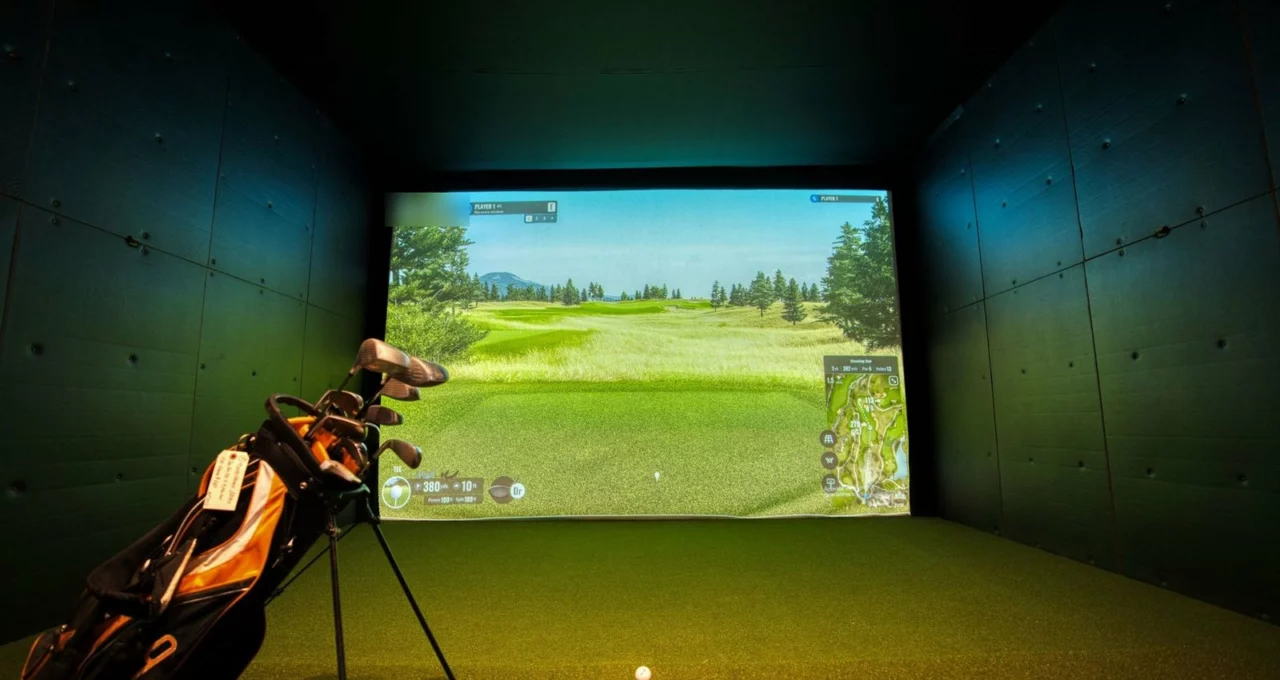
Once the clocks go back, a lot of British golf moves under a roof. The after-work nine disappears, the range bay with the heater becomes the only place to hit balls on a weekday, and a small radar box starts to look like a sensible purchase, or turns up under the tree in December. Then the first evening with it arrives. Every swing produces fourteen figures, all of them wobble, and by the end of the basket the only thing anyone remembers is the drive that went furthest. That is not a failure of the gadget. It is a reading problem, and it has a short answer: a handful of numbers on the screen are measured well, most are worked out from those, and only four deserve your attention through the winter.
The example used here is the Garmin Approach R10, because it is the unit many UK golfers buy as their first launch monitor, and because Garmin is unusually clear about which of its figures come with an accuracy claim. Nobody at Panxis Golf has hit a single ball in front of one. Everything below comes from Garmin’s own documents, a price read at a British retailer and a reading of what owners say in public.
One rule sorts the whole screen
Before looking at any particular number, ask one question of it: has the manufacturer been willing to put a margin of error on it? If the answer is yes, you can build on it. If the answer is no, treat it as a hint at best.
There is a physical reason behind that. A small Doppler radar sat on the ground behind you is good at following the ball, which is large, leaves the face in one clear direction and keeps flying for a while. It has a much harder time with the clubhead, which is thin, fast and close to the turf, and with spin, because a golf ball looks much the same from whichever side you view it. So the device measures a few things directly and calculates the rest, and every calculation stacks its own error on top of the last one.
Apply the rule to the R10 and four numbers survive: carry, ball speed, launch angle and launch direction. Club head speed also has a published margin, but at five miles an hour either side it is too loose to judge one swing against another. If you are still weighing up whether a radar or a camera unit suits you, our overview of launch monitors in the UK explains the difference. This page assumes the box is already in your bag.
What Garmin says about the Approach R10
The R10 sends its data to the Garmin Golf app on a phone or tablet. Garmin’s product page and owner’s manual give the following:
- The hardware. 88.5 x 70.25 x 25 mm, 148 grams on its own and 220.8 grams on its tripod. Up to 10 hours of battery, water rated to IPX7, and an operating range of minus 10 to 55 degrees Celsius, which covers anything a British winter range is likely to throw at it.
- Fourteen metrics. Club head speed, face angle, club path, angle of attack, ball speed, launch angle, launch direction, spin axis, spin rate, apex height, smash factor, carry distance, total distance and deviation.
- Five published margins. Ball speed within 1 mph, launch angle and launch direction each within 1 degree, club head speed within 5 mph, carry within 5 yards. The other nine carry no accuracy claim at all.
- Special balls. Garmin says Titleist Pro V1 and Pro V1x balls with Radar Capture Technology make spin readings up to 30 times more accurate and carry up to 50 percent more accurate.
- Software. Virtual rounds on more than 43,000 courses need a paid Garmin Golf membership once a free 30-day trial ends. Links to third-party simulator software such as E6 Connect and Awesome Golf come with their own, separate subscriptions.
In September 2026 a British golf retailer was selling the Approach R10 new at £479. That is roughly what a new driver costs, and a better argument for learning to read the screen than for buying a bigger one.
Before you read anything: get the set-up right
A misplaced radar produces confident, precise and wrong numbers. The manual is short on this, and every line of it matters.
- Distance behind the ball. Six to eight feet, which is 1.8 to 2.4 metres. Enter the exact figure in the app when it asks. Guessing costs accuracy.
- Room in front. Indoors, keep the ball at least eight feet from the net. Add the space behind the ball and the swing itself, and it is clear why plenty of British garages and spare rooms turn out to be a few feet too short.
- Alignment. Point the red mark on the unit along the target line, then play a short, straight wedge. If the launch direction on the screen does not match the flight you saw, turn the device slightly and repeat. An alignment that is two degrees out makes every direction reading two degrees out, all evening.
- Conditions. Set weather and altitude in the app to the place you normally play. Most UK courses are not far above sea level, but a cold, damp November evening is a very different atmosphere from a warm June one, and a carry chart built in one will not suit the other.
- The mat. Winter practice on a mat hides a heavy strike that wet turf would punish at once. Expect indoor iron carries to look kinder than the ones you will get off a soggy fairway in January.
Launch direction: where the ball set off
Start with the number most people skip. Launch direction is the angle, left or right of your target line, at which the ball leaves the face. Because the face at impact largely decides where the ball starts, this is the most trustworthy clue a consumer radar gives you about the face, and Garmin backs it with the same one-degree margin as launch angle.
On its own it is only half the story, so pair it with where the ball finished. A drive that starts three degrees left and bends back to the middle is a very different problem from one that starts three degrees right and keeps going into the gorse. Over twenty balls, a clear bias to one side is worth more than any feeling you had on the range, and it tells your pro something useful at your next lesson.
Launch angle: why some shots never get up
Launch angle is the vertical angle of the ball as it leaves the club. It explains most flights that simply feel wrong: the drive that climbs and drops short, the long iron that never gets airborne, the wedge that comes out lower than you pictured. With a one-degree margin it is sharp enough to compare two settings or two swings.
It earns its keep with the driver. In winter a lot of golfers find their tee shots coming out low and dying on soft ground, and a loft change is the obvious thing to try. Our guide to adjusting your driver for a UK winter explains how to change one setting at a time; the R10’s launch angle is how you check whether that change did anything. Through the bag, look at the gaps: if your 5-iron and 7-iron launch at almost the same angle, one of them may not be worth carrying.
Ball speed: the average, never the peak
Ball speed is the best-measured figure on the screen, within one mile an hour by Garmin’s account, and it is the plainest answer to “did I catch that one?” For the same club, more ball speed means a quicker swing, a better strike, or both.
Use it to judge anything sold to you as extra distance: a speed-training programme, a new shaft, a higher tee peg. Take the average of ten swings each time. A driver average that climbs from 125 to 129 mph over a winter is a real change. One swing at 135 mph is a nice swing and nothing more.
Smash factor, ball speed divided by club head speed, looks tempting as a strike-quality score. But with club head speed carrying a five-mph margin, the ratio jumps about too much to mean anything from one shot to the next. Ball speed on its own does the job better.
Carry: a range, not a record
Carry is how far the ball flies before it lands, and over a British winter it is the only distance that counts, because a ball landing on a waterlogged fairway barely moves again. It is also the number golfers flatter most, since memory keeps the flushed shot and quietly deletes the thin one.
So never read carry one ball at a time. Hit ten with the same club, set aside the obvious duff, and write down three figures: the shortest sensible carry, the typical one and the longest. An 8-iron that carries between 128 and 141 yards is a far more useful fact than the 145 you would like to quote in the bar, and the width of that spread is an honest measure of your consistency. Our piece on knowing your wedge numbers applies the same idea to part swings.
Remember the published margin of 5 yards. A change of three yards from one week to the next is noise; a change of twelve is worth noticing.
The figures you can switch off
- Total distance. The roll is modelled, not measured. On a real course it depends on the grass, the slope and how much rain fell overnight, and in winter it is often close to nothing. Stick to carry.
- Club path and face angle. On the R10 these are inferred from the ball flight, and Garmin publishes no accuracy for either. Over many shots they may point the right way, but they are not precise enough to rebuild a swing, and chasing them is a reliable way to spend a winter fixing a problem you do not have.
- Spin rate and spin axis. Unless you are hitting the Titleist RCT balls Garmin mentions, spin is the figure that moves most for no visible reason, especially indoors with whatever balls were in the garage. Our guide to choosing a golf ball covers the balls themselves.
- Apex, deviation and smash factor. All three are calculated from other numbers. They add error, not information.
- The best shot of the night. It is not one of the fourteen, yet it is the one everybody reads first. Ignore it.
Thirty balls on a dark November evening
The simplest way not to drown in data is to bring a question with you. Write it on your phone before the first ball: “What does my 9-iron really carry off a mat?” or “Does a lower tee peg change my driver launch?” Then split the basket.
- Ten balls to warm up with a short iron, screen face down.
- Ten balls with the club in question, reading only the number that answers your question.
- Ten balls with the one change you are trying, reading that same number again.
Compare the two averages and the two spreads, note them, and go home. One question answered in half an hour beats two hours of watching figures scroll past. Our guide to a range session that counts works on the same principle, screen or no screen.
What golfers are saying about the Approach R10
The R10 comes up constantly on golf forums, in simulator groups and in public retailer reviews, and the same points keep returning. This is a summary of what recurs, not a tally.
On the plus side
- Outdoor carry and ball speed. Owners who have compared it with a professional launch monitor at a fitting often report that the range numbers were close enough to build a reliable yardage chart.
- It goes anywhere. The small size and the battery that outlasts a long practice session are mentioned again and again, often as the reason it won over bulkier units.
- A cheap way into simulator golf. Many see it as the most affordable route to virtual rounds at home that still feel like proper golf.
On the minus side
- Spin indoors. The commonest complaint: with ordinary balls in a garage or small room, spin figures leap about and the curve on screen does not always match the ball in the net.
- Path and face. Golfers who bought it to cure a slice often say these two readings disagreed with their coach or with a professional unit.
- Space. Buyers regularly underestimate how much room the device needs behind and in front of the ball.
- Subscriptions. Owners point out that virtual courses need a membership and some simulator software costs extra, which moves the real price up.
For an independent review with measured data, Golf Insider UK’s review of the R10 sets it against a professional launch monitor, shot by shot.
Where to try a launch monitor in the UK before you buy
You do not have to own a radar to use these four numbers. Winter is, in fact, the easiest time to borrow one, because the places that have them are quieter than in spring.
- Golf shops with a hitting bay. Most larger stores have a launch monitor in a fitting bay. Weekday mornings are the easiest to book; ask whether a session is free or charged, and whether the charge comes off a purchase.
- Indoor simulator venues. Rented by the hour, often with a professional-grade unit, and a good way to build a carry chart in one visit while the rain hammers on the roof.
- Driving ranges with radar in every bay. A growing number of British ranges track each ball on a screen at the bay. Carry and ball speed are all you need from them.
- Your club professional. A pro with a launch monitor knows your swing and can tell you what your launch direction pattern actually means. Our advice on what a fitting tells you explains the numbers you are likely to see.
If you do decide to buy, a few questions sort the offers quickly. Which metrics work out of the box and which need a membership? How long is the return window, and does it cover a unit that does not fit your room? Is the warranty handled by the shop or by Garmin? For a second-hand unit, check that the tripod, the charging cable and the app registration all pass cleanly to you.
And whatever you use, keep a note after each session of the same four things: carry spread, average ball speed, launch angle and start direction. By the time the clocks go forward again, that list will tell you more about your game than any single evening on the screen.
How this page was put together
This is a guide and a reading of public opinion, not a test. The dimensions, weights, battery life, water rating, operating temperatures, list of metrics and accuracy figures of the Garmin Approach R10, together with the claims about Titleist balls with Radar Capture Technology and the number of virtual courses, come from Garmin’s product page. The placement distances, the space in front of the ball, the wedge alignment check and the weather setting come from Garmin’s owner’s manual for the device. The price of £479 was read on the Express Golf website, a British golf retailer, in September 2026. What golfers say was read on golf forums, in simulator communities and in public retailer reviews; nobody is quoted by name, nothing is counted, and an impression is never presented as a statistic.
Nobody here has hit a ball in front of this launch monitor. There is no commercial link on this page, no affiliate arrangement and no commission of any kind. If a piece of content on this site is ever paid for by a brand, it will carry an advertising notice at the top of the page, before the first line.