Links wind and 38 gram shafts: what to change in your bag after 50 in the UK
After 50 the swing rarely breaks; the clubs stop matching a player who swings a few miles an hour slower. Regrip first, look at shaft weight before flex, add loft, replace only what you hit from beyond 180 yards, and in Britain test any lightweight club in wind before you commit, because higher and lighter was written for still air.

In brief
- Ping's G440 MAX HL driver comes in 9, 10.5 and 12 degrees with 38 or 45 gram ALTA Quick shafts; in September 2026 one British retailer listed it at £529 and another at £499, against a recommended £575.
- Shot Scope's amateur data: beyond 200 yards a hybrid is close to twice as effective as a long iron, and inside 180 yards the gap more or less disappears.
- A high launching lightweight build suits still air; on a breezy links try the 45 gram shaft before the 38 and hit the demo club outdoors.
- Senior golf starts earlier than you think: the R&A's Women's Senior Amateur is open from 50, its Senior Amateur and England Golf's English Senior Men's Stroke Play from 55.
The first thing to go is rarely the drive. It is the hands. Some morning in your early fifties you notice that gripping the club takes a bit of doing, that the first three holes are spent loosening up, and that by the time you are loose you are three over. The lost yardage turns up later and gets all the attention, but the hands are where it starts, and they are the cheapest thing on the list to fix.
What follows is a bag audit for a golfer past 50, arranged by cost and return. None of it touches your swing, which is largely fine. The clubs were specified for a player who swung a few miles an hour quicker, and nobody has told them.
Grips first, because they are cheap and they work
A stiffening hand squeezes harder. A hard squeeze tightens the forearm, and a tight forearm takes speed out of the downswing before it starts. You cannot feel it from the inside, which is why it goes uncorrected for years.
A midsize or oversize grip spreads the load across the palm rather than the fingers, and a softer compound takes some of the shock before it reaches the wrist and the elbow. It is a morning’s job in the pro shop, not a new set. The price is some feel around the greens, so plenty of players go bigger in the long clubs and leave the wedges and putter as they are.
Shaft weight, not shaft flex
Ask a club golfer over 50 what they changed and the answer is usually senior flex, the specification that tells you least, because nothing standardises it: one manufacturer’s regular is another’s stiff.
Weight is the specification that moves the ball, and it is printed on the shaft. Ping’s HL range is the clearest example on sale because the company says openly who it is for: golfers who do not generate enough clubhead speed from traditionally weighted clubs. The published specification for the G440 MAX HL driver reads as follows.
- Lofts of 9.0, 10.5 and 12.0 degrees, with a hosel adjustable by 1.5 degrees either way.
- A 460cc head at 46 inches.
- Two stock shafts: the ALTA Quick 35 at 38.0 grams and the ALTA Quick 45 at 45.0 grams, against the 55 to 70 gram shafts in most bags.
- A Lamkin UTx Lite grip and a lighter back weight than the standard head.
- On the G440 K HL, the stability model, a 28 gram rear weight.
Every one of those takes weight out rather than adding softness. Ping’s own claim for the HL build is nine yards on average for slower swing speeds. That is the seller’s figure, so read it as an order of magnitude rather than a promise.
Loft, and the pride problem
The 9.5 degree driver is what good players use. It is also, below roughly 90 miles an hour, a club that will not launch the ball high enough to carry properly. The 12 degree HL head exists because it works at those speeds, and nobody forty yards up the fairway can read your sole plate.
Before you buy anything, use the hosel you already own. Most recent drivers adjust, and a degree and a half costs nothing.
The clubs above a 5 iron
This is the one decision here backed by independent data rather than a manufacturer’s claim. Shot Scope’s published amateur numbers compare hybrids with long irons by distance: beyond 200 yards the hybrid is close to twice as effective, and the advantage narrows until, inside 180 yards, it more or less disappears.
So the instruction is narrower than the marketing. Replace the clubs you play from beyond 180 yards, which after 50 usually means everything above a 5 iron, and leave the rest alone. A 7 wood or a 9 wood does the same job as a hybrid for many players.
The change that is mostly marketing
The soft, low compression ball sold to slower swingers does less than the box implies. MyGolfSpy’s robot testing found that a softer ball did not give slower swings extra ball speed off the driver. Buy a ball for its flight and its cover, not for a compression number.
What it costs in pounds
In September 2026 one British retailer listed the G440 MAX HL driver at £529 against a recommended price of £575, with the ALTA Quick 35 build offered in all three lofts, and another had it at £499 against the same £575. Prices move with promotions, so treat the recommended figure as the planning number, and remember that a shaft or loft combination outside the listed variants may be a custom order with a lead time.
What golfers are saying
The praise that recurs: less fatigue over 18 holes, described as still having a proper swing on the 16th tee; a real carry gain when loft and weight are changed together rather than one at a time; and relief in the hands and elbows after going to a bigger, softer grip, mentioned as often as any distance claim.
The complaints that recur: that senior flex is a label with no agreed meaning, so two shafts marked the same feel nothing alike; that a very light shaft can feel like nothing in the hands, with owners of Ping’s ALTA shafts in particular reporting decent numbers but no sense of where the head is unless they swing hard; that a higher launching, lighter build balloons into a headwind; and that an HL set outside stock options means a wait and no easy return. The practical lesson is to live with one light club for a few rounds before committing a whole bag.
Where to get fitted in the UK, and why wind, winter and the seniors’ calendar matter
Start with the clubs you own. Your club professional can put your irons on a loft and lie machine and weigh the shafts, and half an hour tells you whether you are carrying heavy steel you have no business carrying at your speed. It is the only measurement in this article that concerns your actual clubs, and it costs far less than a new driver.
For a launch monitor fitting, some large golf retailers offer a free in-store custom fitting, booked online or through your nearest shop, and fit on a GCQuad launch monitor through a structured process that starts with a consultation. Others run a dedicated fitting centre and offer advice by email or face to face, and some say their staff include PGA Professionals. Whoever you book, ask for a shaft weight comparison rather than a flex comparison. A fitter who only offers regular and senior versions of the same shaft has not answered the question.
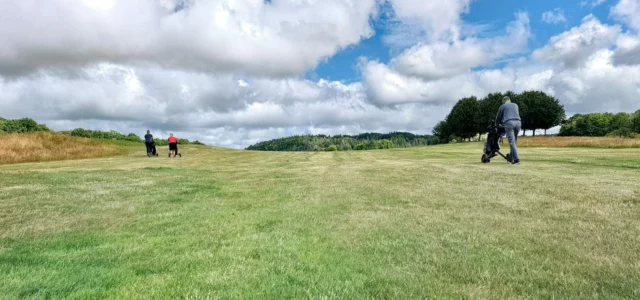
Then make the fitting British. The standard senior advice, higher and lighter, was written for still air. An HL driver is built to launch higher and carry further, which is exactly right on a sheltered parkland in June and less straightforward into a two club wind on a links in October, when a high, slow ball climbs, stalls and drops short. That is where the balloon complaint comes from, and in this country it is not occasional. If most of your golf is coastal and breezy, stop short of the extreme: try the 45 gram option before the 38, keep a loft that holds a flight, and hit the demo club outdoors on a windy afternoon rather than only in an indoor bay. A club that is wonderful in July and unusable in February is not a bargain.
The winter pulls the other way. From November to March much British golf is played off soft, wet turf, often from mats and to temporary greens, and the ball sits down in lies that a long iron cannot rescue. A high launching fairway wood or hybrid earns its place there in a way it rarely does in a dry August. If you buy one club this autumn, buy the one that gets the ball up off a damp lie.
Finally, the calendar, because senior golf in Britain starts earlier than most players assume and it is where you will see this equipment on the first tee. The R&A’s Women’s Senior Amateur Championship is open to players aged 50 and over, and its Senior Amateur Championship to players aged 55 and over; in 2026 both were played at Frilford Heath from 7 to 10 July, with a handicap limit of 2.4 for the men’s event. England Golf’s English Senior Men’s Stroke Play Championship is open to golfers aged 55 or over on the first day, over 54 holes, and at the English Senior Women’s Amateur Championship players aged 60 or over can qualify for the Ann Howard Trophy flight. Below championship level, most county unions run senior sections and matches, and your county’s own page will tell you its age and handicap rules, which differ from one county to the next.
None of those events asks what loft you play, but they are a good place to see what golfers of your age and speed have settled on.
How this page was put together
This is a presentation and a reading of public opinion, not a test. The specifications are Ping’s published figures for the G440 MAX HL and G440 K HL, taken from ping.com. The hybrid and long iron comparison is Shot Scope’s published amateur data, and the ball findings are MyGolfSpy’s robot testing. The prices were read in September 2026 at two British retailers, Golf Gear Direct and The Golf Shop Online, in pounds, and have not been converted from any other market. Fitting services and senior eligibility come from the websites of American Golf, Golf Gear Direct, The Golf Shop Online, The R&A and England Golf. What golfers say was read in public golf forums and open review threads; nobody is quoted by name, nothing is counted, and an impression is never presented as a statistic.
Nobody here hit any of these clubs. There is no commercial link on this page, no affiliate arrangement and no commission. If a piece of content on this site is ever paid for by a brand, it will carry an advertising notice at the top of the page, before the first line.
The order to do it in
- Regrip: midsize or oversize in the long clubs, softer compound, one morning’s work.
- Have your professional weigh and measure what you already play before you replace any of it.
- Turn the adjustable hosel you own before buying a new driver.
- Replace only what you play from beyond 180 yards, with winter lies in mind.
- Test any lightweight club outdoors, in wind, before committing a full set to it.
Do those five and the yardage usually comes back. Spend the winter hunting the swing you had at 40 and you will find a perfectly serviceable swing, in a set of clubs that stopped suiting it years ago.