Sore wrists from a garage mat? Pile, foam and concrete matter more than thickness
FORB, SimSpace, ForeMat and TrueStrike: UK prices in October 2026 from £39.99 to £714, and why a mat's thickness tells you little about what your lead wrist will feel on garage concrete or a patio.
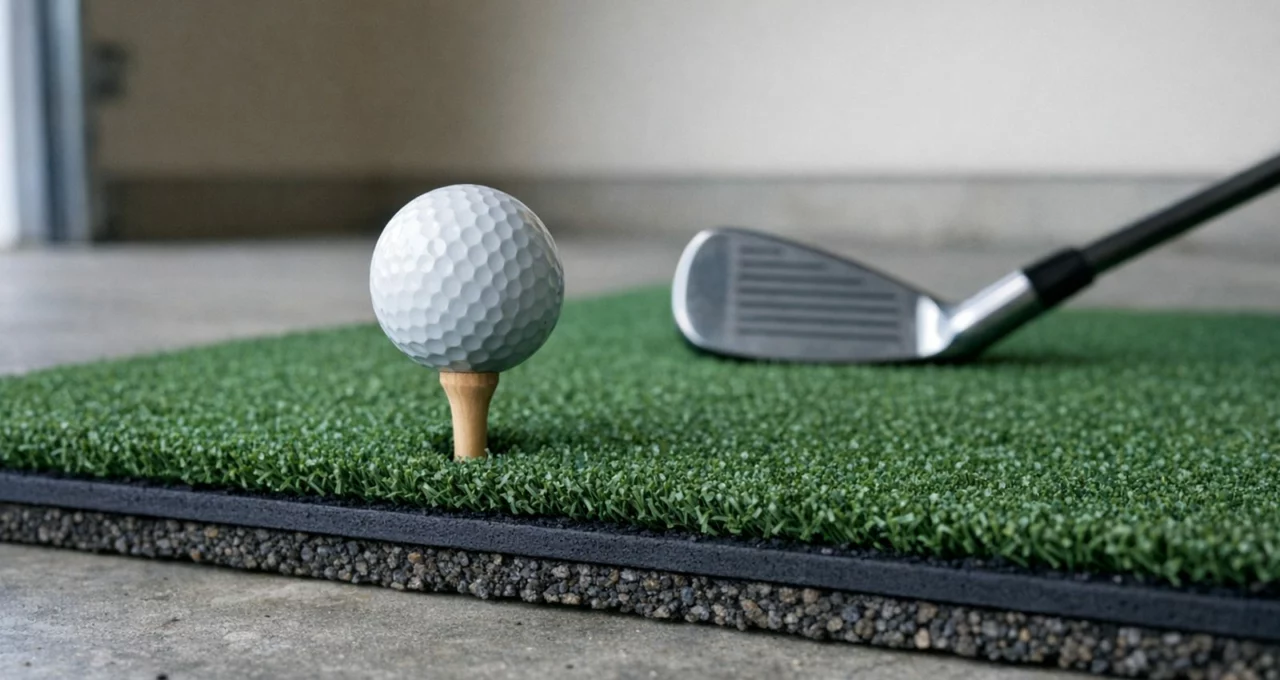
The complaint usually arrives in January. A golfer buys a mat, puts it on the garage floor, hits a couple of hundred balls over a few evenings and wakes up with a lead wrist that aches when turning a door handle. The mat gets the blame, and the next one bought is the thickest that will fit in the boot. Read the British and American threads where owners describe this, though, and the thickness of the mat is rarely what they end up changing. What changes is what the club meets at the bottom of the swing: how short and dense the fibres are, what sits under them, and what sits under that.
This page looks at six hitting mats sold in Britain this autumn, from under £40 to over £700, with the figures their makers publish, prices read in October 2026, what owners say about them, and a section on the floors British golfers actually put a mat on: the concrete of a single garage, a patio of paving slabs, a lawn that is wet from October to April, and the small winter mat many clubs ask members to carry.
Nobody at Panxis Golf has hit a ball off any of these mats. This is a presentation of products and a reading of published opinion, not a test, and it contains no medical advice. If a wrist or an elbow keeps hurting, see a GP or a physiotherapist before buying anything.
Why a mat can feel like a wall
On grass, a well-struck iron meets the ball and then the ground, and the ground gives. The leading edge cuts in, a divot comes out, and the club keeps moving. A mat cannot be cut. What it can do is let the head pass through or over the surface with as little drag as possible. When it does not, golfers describe two things: the club “grabs” in the turf and the hands feel it, or it bounces off a hard layer and the shock travels up the shaft.
The surfaces that owners associate with sore joints have a common profile: a short, dense nylon turf on a thin backing, laid straight onto concrete or tiles. The surfaces they say are kinder either let the club through the fibres, like a stiff brush, or have something that moves underneath the strike area, such as a gel insert. Thickness on its own says very little. A 40 mm mat with a soft fibre layer can sit on a hard floor and still grab; a thin strip of bristles can be easy on the hands.
There is a published professional view worth reading in full rather than paraphrasing. In an article on wrist injuries from the European Tour Performance Institute, published by the Confederation of Professional Golf, a consultant physiotherapist on the European Tour writes that reducing load can mean hitting fewer balls or avoiding hard ground or mats, “which often increase the stress on these tissues”, and that stopping practising on hard winter mats may help symptoms settle. That is about load and recovery, not about any product, and it is not a reason to self-diagnose.
What to read on a mat’s specification sheet
British listings are uneven: some give every layer in millimetres, others give nothing but the size. These are the lines that matter, and the questions to send to the seller when a line is missing.
- Fibre or turf height. Short turf, around 13 to 17 mm, plays firm and fast. Longer pile, around 30 mm, lets the club travel further into the surface and will hold a real tee, but it can also hide a heavy contact.
- Underlay or foam thickness. This is the layer that does the cushioning. A listing that only gives the total thickness does not tell you how much of it is foam.
- Total thickness. Useful for one thing above all: matching the height of your stance area, so you are not standing below or above the ball.
- Hitting strip versus stance area. A 1.5 m square mat gives you both on one piece. A hitting strip or a strike insert gives you only the part the club touches, and you need something of the same height to stand on.
- Tees. Pre-cut holes for rubber tees, or turf deep enough for a wooden tee at any height. The difference matters for drivers.
- A replaceable strip. Mats wear where the club meets them. A strike section that can be swapped is cheaper than a new mat.
FORB Academy: the thin end of the range
FORB is a British training brand, and some of its listings carry the FORZA name. The Academy is the kind of mat many people start with: light, roll-up, cheap.
- What the maker lists: 5ft by 3.2ft (1.5 m by 1 m), a 13 mm polyethylene artificial turf on a double-layer latex backing, three rubber tees of 35, 45 and 55 mm that are pushed through the mat. Described as super-lightweight, rolls up for storage, indoor and outdoor use, “can be used on any flat surface”. No foam layer, total thickness or warranty is stated.
- Price: read at a British retailer in October 2026: £39.99, against a previous price shown as £79.99.
The maker’s own description is about protecting a lawn or a fairway from divots, and that is what it suits best. There is no cushioning layer listed, so on concrete there is very little between the club and the slab. One buyer’s review mentions adding a rubber floor mat underneath, which is the sensible instinct.
FORB Driving Range 5ft x 5ft: foam listed, base optional
A step up from the same brand, and a useful example of a listing that does give the layers.
- What the maker lists: 5ft by 5ft (1.5 m by 1.5 m). Hitting mat thickness 30 mm without the rubber base, of which the foam backing is 15 mm and the artificial turf 15 mm. Optional heavy-duty anti-skid rubber base, in a standard size of 1.6 m square or a pro size of 1.7 m square, with drainage holes. Weatherproof, indoor and outdoor, year-round use. Tees are not included.
- Price: read at a British retailer in October 2026: £199.99 for the mat alone, against a previous price of £249.99; £329.99 with the standard rubber base.
On paper this is the profile owners describe as reasonable: short turf with a real foam layer. The rubber base is not a luxury on a hard floor; it is the part that stops the mat sliding and adds another layer under the strike. Without tees in the box, budget for rubber range tees too.
SimSpace Standard Hitting Mat: short pile, rubber below
SimSpace is a British home simulator brand that also sells its own range of mats. The Standard is its mid-price square mat.
- What the maker lists: 1.5 m by 1.5 m (4ft 11in square). Turf 17 mm, rubber base 12 mm, total 29 mm. A short, firm pile that the maker says “reduces club bounce through impact”, six perforated tee holes for left- and right-handed players, rubber and plastic tees included. A smaller Slim version is 1.5 m by 1.2 m.
- Price: read at a British retailer in October 2026: £199.99, and £159.99 for the Slim.
The maker also says the foam base helps absorb shock and reduce impact on the hands and wrists. That is the maker’s claim, made for most mats at every price, and nothing on the listing measures it.
SimSpace Tee Turf: long pile and a real tee
The same brand’s longer-pile mat shows the other side of the thickness question.
- What the maker lists: 1.5 m by 1.5 m. Turf 30 mm, rubber base 12 mm, total 42 mm. Standard wooden tees go straight into the turf with no pre-cut holes, so tee height can be set as on the course; plastic tees of various heights included. The maker says the deeper turf lets the club move through the fibres more naturally.
- Price: read at a British retailer in October 2026: £289.99.
For driver practice, a real tee at a real height is a genuine advantage. The trade-off owners describe with long-pile surfaces is that they are forgiving in the wrong way: a club that arrives an inch behind the ball can still slide through the pile and send the ball away looking respectable, where on a wet British fairway in November it would have come up yards short.
ForeMat 3D Premium Fibre Mat: three layers listed
ForeMat is sold by several British golf retailers and its listing breaks the mat into layers, which is what a buyer comparing thicknesses wants.
- What the maker lists: 150 cm by 150 cm, 18.5 kg. A 15 mm nylon turf surface, a 10 mm layer of “high-elasticity textile fiber”, and a 10 mm closed-cell foam rubber base. Tee acceptance, a replaceable strip and a warranty are not stated on the listing.
- Price: read at a British retailer in October 2026: £229.99, against an RRP of £399.99.
The two cushioning layers together are thicker than the turf, which is the profile people asking about sore wrists are usually told to look for. Ask the seller how tees fit before buying if you want to hit drivers, and note the weight: 18.5 kg is a two-person carry up a garden path.
TrueStrike Mk7: a gel insert under the strike
TrueStrike takes a different approach. Rather than a thicker mat, it puts a gel-filled section under the strike area, with a “ruckable” top surface, so the head can move down and through the way it would into turf. It is the dearest option here, and the one forum regulars mention most often alongside imported bristle-type strips.
- What the listings show: the Mk7 Portable includes one gel section (gel bag, strike surface and strike surround), two edge trims, and 25 long and 25 short TrueTees. It does not include a stance area. The Mk7 Single adds three range mat sections to stand on, a ball tray, an edge trim and a tee holder. No dimensions, layer thicknesses or warranty period are given on the British listing read, and the brand’s former website no longer carries product information, so those figures are left out here.
- Price: read at a British retailer in October 2026: £354 for the Portable and £714 for the Single.
With the Portable, the stance surface is your problem: whatever you stand on has to come up to the height of the strike section, or every shot is played from an odd lie.
The six mats side by side
| Mat | Size | Turf | Cushion layers listed | Total listed | Tees | UK price, Oct 2026 |
|---|---|---|---|---|---|---|
| FORB Academy | 1.5 m x 1 m | 13 mm PE | Latex backing only | Not stated | Rubber, through the mat | £39.99 |
| FORB Driving Range 5ft | 1.5 m x 1.5 m | 15 mm | 15 mm foam, rubber base optional | 30 mm without base | Not included | £199.99 (mat only) |
| SimSpace Standard | 1.5 m x 1.5 m | 17 mm | 12 mm rubber | 29 mm | Six holes, rubber tees | £199.99 |
| SimSpace Tee Turf | 1.5 m x 1.5 m | 30 mm | 12 mm rubber | 42 mm | Real tees | £289.99 |
| ForeMat 3D Premium Fibre | 1.5 m x 1.5 m | 15 mm nylon | 10 mm fibre, 10 mm foam | Not stated | Not stated | £229.99 |
| TrueStrike Mk7 Portable / Single | Not stated | Strike surface over gel | Gel section | Not stated | TrueTees included | £354 / £714 |
The thickest mat in the table is not the one with the most cushioning, and the dearest is the only one built around something that moves under the club.
What golfers are saying
The comments below were read on the Golf Simulator Forum, The Sand Trap, the Golf Monthly forum, Plugged In Golf and British retailers’ customer reviews. They are what recurs, not a count.
What owners like:
- Surfaces that let the club through. The single most repeated recommendation on the Golf Simulator Forum for players with sore elbows is a bristle-type hitting strip, usually a Fiberbuilt, which one owner compares to hitting off a dense hairbrush. Several posters who had elbow pain on nylon-turf mats say it eased after they switched. Fiberbuilt is an American brand; British posters note that buying one here usually means import costs.
- The gel strike section. TrueStrike owners on the Golf Monthly forum and the Golf Simulator Forum describe irons coming off the gel section much as they do off a fairway, and the stance mats as firm without being hard. A long-time owner on The Sand Trap reports years of heavy use at a teaching academy, with the cover and gel replaced rather than the whole mat.
- A cheap mat used for what it is. Buyers of budget roll-up mats, in retailer reviews, are content when the mat is used to protect a lawn or for chipping and short irons on a soft surface, and several add a rubber floor mat underneath rather than laying it on concrete.
What owners complain about:
- The floor, not the mat. On The Sand Trap, a long thread on mats and injury keeps returning to the surface underneath: an experienced poster argues the hard floor under a mat causes more trouble than the mat itself, and another suspected cheap rubber mats on concrete for his shoulder pain.
- Grabby turf. On the Golf Simulator Forum, one poster with elbow pain says it was how much the turf grabbed the club, more than how firm it was, that made the difference, and others note that players who take a divot suffer on a dense mat where sweepers may not.
- Forgiving enough to hide a fat one. The same owners who praise the forgiving strips concede they do not slow the club much on a heavy contact. A British poster comparing strips observes that a firmer winter-tee type surface “will punish fat shots” where the bristle strip may not. A mat that never punishes a heavy contact can teach one.
- Tees and wear. On bristle strips, posters say standard rubber tees sink too far and taller ones are needed. On TrueStrike, a commenter under the Plugged In Golf review describes the strike turf beginning to tear after months of steep, divot-taking swings, and a former owner found the mat would not sit flush with the surrounding floor. Even a gel design is no guarantee: one owner of a home-built TrueStrike-style mat reported wrist pain after months of iron practice.
Nobody is quoted by name, nothing has been counted, and none of this is a measurement or medical evidence. Forum posts describe individual experiences.
Where British golfers hit off a mat, and what each floor asks
The underlying question is the same everywhere: what is under the mat, and does it give? In Britain the answer is usually a concrete slab, a patio of flags or a wet lawn.
The garage slab
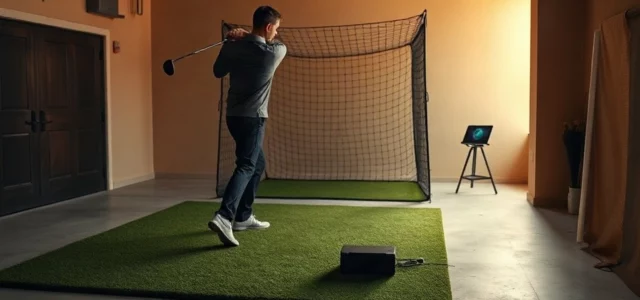
Most British garages have a bare concrete floor, often with a slight fall towards the door for drainage, and in winter it is cold and can sweat. That is the hardest base a mat can sit on. A rubber base under the mat, or interlocking rubber gym tiles under both the mat and the stance area, adds a layer between the strike and the slab and stops the mat creeping. Check the fall with a spirit level: on a sloping slab every ball sits slightly above or below your feet. If the garage is also where the net goes, yesterday’s page on what British buyers regret about garden and garage nets covers the width and height a full swing needs.
Patio slabs and paving
Paving flags are hard and rarely perfectly level, and the joints between them can let a thin mat rock or flex in one spot. A mat with a full-size rubber base bridges the joints better than a roll-up mat on its own. On a patio, drainage holes matter: a mat that holds rain on top of slabs stays wet for days in a British autumn, and a wet surface grips the club differently.
The lawn
Grass under a mat is the softest base of the three, which helps the joints, but the mat moves and the ground under it changes with the weather. Wet clay in January is not dry soil in July. A lawn also dies under a mat left down for weeks: lift it after each session. The thin roll-up mats are designed for exactly this use.
Sheds and garden rooms
A timber floor on joists gives more than concrete, but it also carries sound, and a strike on a hollow floor can be heard through the garden. Put rubber under the mat for noise as much as for the strike, and check the floor is rated for the weight: a 1.5 m mat at 18.5 kg plus a person swinging is a real load on a lightweight shed base.
The club’s winter mat
Many British clubs ask members to play fairway shots off a small mat through the winter to protect the turf. These are thin, often carried in the bag, and put down on whatever is underneath, sometimes frozen ground. The physiotherapist’s article linked above mentions hard winter mats specifically. If your wrist complains from November, the club mat may be part of the picture as much as anything at home.
Cold
Foam and rubber firm up in the cold. A poster on The Sand Trap recommends gel-based mats partly because they stay pliable in winter. In an unheated garage in January, a mat will not feel the way it did in the shop, so give it time to settle at room temperature before deciding.
Where to buy, and what to ask
Large golf retailers with simulator bays sometimes have mats you can hit off, which is the best test of how a surface treats your hands. Specialist home-simulator sellers usually give the most detailed specifications. Online-only sellers are often cheapest, and second-hand mats appear regularly when people dismantle a garage setup. Whoever you buy from, ask:
- the thickness of each layer, not just the total;
- whether a real wooden tee goes in, and at what heights;
- whether the strike strip or insert is replaceable, and what a replacement costs;
- what the returns policy is if the mat does not suit you, and who pays to send back a parcel of 15 to 20 kg;
- whether the mat is rated for outdoor use and frost.
Before you buy a thicker mat
- If it hurts, stop and get it looked at. Persistent wrist or elbow pain is a reason to see a GP or a physiotherapist, not a reason to change mats and keep hitting.
- Change what is under the mat first. A rubber base or gym tiles between a good mat and a concrete slab may do more than a thicker mat on bare concrete.
- Read the layers. Turf height and cushion thickness, separately. A long pile is not a cushion.
- Hit fewer balls. A session of fifty balls with a purpose is easier on the joints than two hundred in a row, and the article linked above makes the point about load.
- Keep an eye on contact. Put a strip of tape or a line on the mat just ahead of the ball, or film the strike: a forgiving surface can disguise a heavy contact that grass would not.
- Match the stance height. Whatever you hit from, stand on something of the same height.
The best mat for a British garage is often not the thickest one but the one on the right floor, with layers you can read and a strike that lets the club keep moving.
How this page was put together
This is a presentation of products and a reading of published opinion, not a test. Nobody at Panxis Golf has hit a ball off any of these mats. Specifications come from the published product information: FORB and FORZA product pages for the Academy and Driving Range mats, SimSpace’s product pages for the Standard, Slim and Tee Turf mats, the ForeMat 3D Premium Fibre Mat listing, and the TrueStrike Mk7 listings, which give the contents of each kit but no dimensions or layer thicknesses. The professional view quoted is from the European Tour Performance Institute’s article on wrist injuries, published by the Confederation of Professional Golf in April 2016 and linked above.
Prices were read in October 2026, in pounds sterling: FORB Academy £39.99 and FORB Driving Range 5ft x 5ft £199.99 (mat only) or £329.99 (with standard rubber base) at Net World Sports, which also owns the FORB brand; SimSpace Standard £199.99, Slim £159.99 and Tee Turf £289.99 at SimSpace Golf, the brand’s own shop; ForeMat 3D Premium Fibre Mat £229.99 (RRP £399.99) at ClickGolf; TrueStrike Mk7 Portable £354 and Mk7 Single £714 at GolfBays. Prices change often, especially before Christmas.
What golfers say was read in threads on the Golf Simulator Forum about mats and joint pain, wrist problems on a home-built TrueStrike-style mat, and buying mats in the UK; in a thread on The Sand Trap about mats and injury prevention; in a thread on the Golf Monthly forum about choosing a mat; in the Plugged In Golf review of TrueStrike and its comments; and in customer reviews on the retailers’ pages. Some threads are several years old. Nobody is quoted by name, nothing is counted, and no impression is presented as a statistic or as medical evidence. There is no commercial link on this page, no affiliate arrangement and no commission of any kind. If content on this site is ever paid for by a brand, it will carry an advertising notice at the top of the page, before the first line.