Hitting mats and sore wrists: what a frozen garage slab and a basement floor do to the feel
Maxfli, SimSpace, Real Feel Country Club Elite, Carl's HotShot, The Net Return Pro Turf and TurfHound: Canadian prices in October 2026, from C$262.99 to C$1,799, and why cold concrete matters more than thickness.
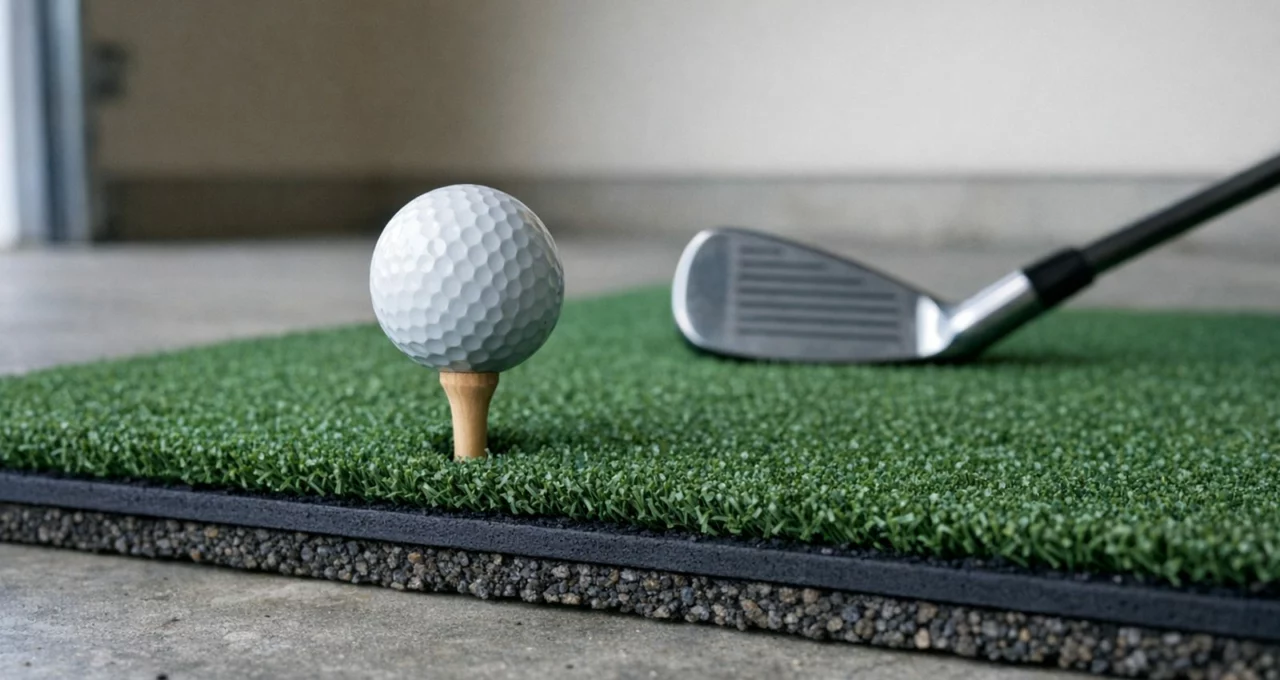
Sometime in January, in a garage where the thermometer on the wall reads minus five, a golfer hits the fortieth 7-iron of the evening and feels it in the lead wrist. It was fine in November. Nothing about the swing has changed, and the mat is the same one that came home in the fall. What has changed is the slab underneath, which is now as cold and hard as the driveway outside, and the foam in the mat, which has stiffened with it. When Canadians complain about wrist and elbow pain from a home mat, they usually ask for a thicker one. The thickness on the box is rarely the problem.
This page looks at six hitting mats sold in Canada this fall, from a C$262.99 3 x 5 foot mat to a C$1,799 modular system, with what their makers publish, their Canadian prices in October 2026 before tax and what owners say in public. It is a presentation of products and a reading of public opinion, not a test. No mat on this page was hit off, stood on or measured by Panxis Golf.
The short version: it is the stop, not the thickness
On a fairway in July, a good iron strike takes the ball, then a strip of turf and soil, and the club keeps going. The ground gives way, and the energy goes into the divot. On a mat, nothing gives way. The club has to slide across the surface or push into it, and whatever it cannot get through comes back up the shaft. A golfer who sweeps the ball barely notices. A golfer who hits down and takes a deep divot on the course feels every mat as a floor.
Owners describe two separate ways a mat can hurt. The first is the sudden stop: a surface so firm, or a floor so hard under it, that the club bottoms out. The second is grab: short, dense nylon that holds the leading edge for a fraction of a second, so the wrist takes a twist as well as a jolt. A mat can be thick and still grab. A mat can be thin and slide well. That is why two golfers can own the same mat and disagree completely about it.
One honest limit before going further. We found no controlled study that measures how often hitting mats cause wrist or elbow injuries, and nothing on this page is medical advice. It reflects what makers publish and what golfers report. If a joint is still sore a few days after a session, the person to see is a family doctor or a physiotherapist, not the next mat in the cart.
What winter does to a mat and to the floor under it
This is the part that matters more in Canada than almost anywhere else. Most home mats are a nylon turf glued or stitched over a foam or rubber base. Foam is soft because it is full of trapped air and flexible cells, and cold makes those cells stiffer. Owners who practise in unheated or lightly heated garages describe a mat that felt noticeably harder in the coldest weeks than it did in the fall, and some say the turf itself felt more bristly. None of the makers on this page publishes how their foam behaves below freezing, so treat that as owner experience, not a specification.
The floor changes too. A concrete garage slab in a Canadian winter is about as unforgiving a surface as you will find indoors, and a basement slab under thin carpet or vinyl is not much kinder, even if it is warmer. A mat on bare concrete gets no help from below. Whatever cushioning it has is all the cushioning there is.
Two practical consequences follow. Let a mat that has been stored in the cold warm up before hitting off it, if you can, and if the garage is where you hit, plan for a layer under the mat, not only a better mat. Owners most often describe rubber stall mats or interlocking gym tiles, which also stop the mat from creeping toward the net.
Reading a listing: four numbers, often only one given
“Thickness” on a Canadian listing can mean any of these, and they do different jobs.
- Pile height. The length of the turf fibres. Longer fibres let the club sink a little and can hold a real wooden tee, but a long, dense pile can also hold the club and hide a fat shot.
- Underlay. The foam or rubber layer that takes the shock. This is the part that protects joints, and it is the part listings describe least clearly.
- Total height. Turf plus base. A tall mat with stiff foam can be harsher than a lower mat with a softer layer.
- Hitting area versus stance area. A small hitting square leaves your feet lower than the ball, which changes the lie of every club. A stance mat keeps them level.
If a listing gives only one number, it is usually the total. Ask for the others before you buy.
Maxfli 3 x 5 Hitting Mat
The entry point on this page, and the kind of mat that comes home on impulse in October. Maxfli describes an imitation Bermuda grass surface over 3/8-inch foam padding, about 10 mm, with four indented tee holes, for indoor and outdoor use, measuring 3 by 5 feet. That foam layer is the thinnest underlay among the six mats here.
Who it suits: a golfer who wants a surface for chipping and half swings in a finished basement, or a test of whether the habit will last, rather than full iron sessions on a slab.
Price read in Canada in October 2026: C$262.99.
SimSpace Standard Hitting Mat
SimSpace sells mats for simulator rooms, and its Standard mat is one of the few on this page whose listing breaks the layers down properly. The dealer listing gives a 1.5 by 1.5 metre hitting surface, or 4 feet 11 inches square, with a 17 mm turf pile over a 12 mm rubber base, 29 mm in total, and six perforated tee holes, three for left-handed and three for right-handed players. The description calls the surface firm and consistent and says the rubber base absorbs impact.
Who it suits: a golfer who wants a firm, square stance-and-hit mat for a basement bay and prefers honest feedback on contact over a cushioned feel.
Price read in Canada in October 2026: C$380.
Real Feel Country Club Elite
The Country Club Elite is the mat that many wrist-pain threads begin with, sometimes as the mat that caused the problem and sometimes as the mat that fixed it. It is a one-piece construction, nylon turf over foam, sold in sizes from a narrow strip to a full stance mat. The maker lists a 1-inch pile, a 5/8-inch high-density foam backing, a total height of 1 3/4 inches, a surface that takes a real wooden tee and rubber tee holes around the edge.
Who it suits: a golfer who wants a familiar, durable surface that takes a tee for every club, and whose swing is shallow enough that the dense pile does not grab.
Prices read in Canada in October 2026: 10 x 30 inches C$249.99, 20 x 36 inches C$325, 3 x 4 feet C$799, 3 x 5 feet C$899.99, 5 x 5 feet C$1,449. The seller adds C$20 for shipping per unit. The two smallest sizes are strips for a stance mat or the range, not a full hitting station.
Carl’s HotShot
The HotShot is a system rather than a single sheet: a cushioned base with a removable insert where the ball sits. Carl’s offers three inserts, the Standard strip, the Foam Divot strip, which the listing describes as softer through impact, and the Gel Divot strip, which it describes as the most realistic turf interaction in the line. The base comes in 4 x 5, 5 x 8, 4 x 9 and 6 x 10 feet. The maker’s own material, as cited by dealers, says only the Standard strip accepts real tees. Pile and foam heights are not given on the Canadian listing.
Who it suits: a golfer who already knows the joints are the issue and wants to choose the insert according to the swing, then replace only the strip when it wears.
Prices read in Canada in October 2026: with the Standard strip, C$715 for 4 x 5 and C$1,550 for 6 x 10; with the Foam Divot strip, C$915 to C$1,715; with the Gel Divot strip, C$985 to C$1,799. Replacement strips: Standard C$179.99, Foam Divot C$585, Gel Divot C$689. That last line belongs in the purchase price, because the strip is the part that wears.
The Net Return Pro Turf
The Pro Turf is the large surface The Net Return sells alongside its nets, closer to a piece of good artificial grass than a padded hitting station. The maker lists 6 by 10 feet, about 3/4 inch thick, a 42-ounce nylon face over a 5 mm foam backing and two rubber tees, for indoor or outdoor use. The Canadian listing describes it as commercial-grade turf for high-volume practice.
Who it suits: a golfer who wants one surface for the whole bay in front of a net, and who will put a separate hitting strip on top of it or hit off a floor that already has some give.
Price read in Canada in October 2026: C$899. It costs about the same as a 3 x 5 Country Club Elite for a surface with far less foam, which is a good illustration of why price, size and thickness have to be read together.
TurfHound Golf Hitting Station and Tee Mat
TurfHound comes at the problem from the opposite side of the soft mats. Instead of a long pile, the maker describes a proprietary foam core embedded in a urethane blend under the grass layer, built to reproduce how the top quarter to half inch of soil responds to a club. This station measures 8 feet 6 inches by 4 feet 9 inches and includes two fairway turf panels and two short rough panels in a frame, with two telescopic tee holders and ten telescopic tees. The “feels like real turf” claim is the maker’s own and has not been checked by us.
Who it suits: a golfer building a permanent room who wants panels that can be swapped and a surface designed to imitate turf rather than cushion it.
Price read in Canada in October 2026: C$1,499.95. A version listed with a frame was shown at C$995.99 by the same seller; the two listings do not explain the difference, so ask before ordering.
Six mats side by side
| Mat | Size priced | Layers listed | Real tee | Replaceable parts | Canadian price, Oct. 2026 |
|---|---|---|---|---|---|
| Maxfli 3 x 5 | 3 x 5 ft | 3/8 in foam (about 10 mm) | Tee holes | Not stated | C$262.99 |
| SimSpace Standard | 1.5 x 1.5 m | 17 mm turf, 12 mm rubber, 29 mm total | Tee holes | Not stated | C$380 |
| Real Feel Country Club Elite | 3 x 5 ft | 1 in pile, 5/8 in foam, 1 3/4 in total | Yes | Not stated | C$899.99 |
| Carl’s HotShot, Foam Divot strip | 4 x 5 ft | Not stated | Standard strip only | Strips, from C$179.99 | C$915 |
| The Net Return Pro Turf | 6 x 10 ft | About 3/4 in, 5 mm foam | Rubber tees | Not stated | C$899 |
| TurfHound Hitting Station | 8 ft 6 in x 4 ft 9 in | Foam core in urethane, depth not stated | Telescopic tee holders | Panels | C$1,499.95 |
Read the underlay and replaceable-parts columns before the price. They tell you what will protect a wrist on a cold slab and what you will be paying for again in two winters.
What golfers are saying
The same points come back in owner reviews, simulator forums and golf discussion boards, whatever the brand. No Canadian forum with enough owner comments on these six mats was found, so this summary leans on North American threads where Canadian owners take part.
What owners like
- Pain that went away after a change of surface. The most common praise for premium and modular mats comes from golfers who say an elbow or wrist complaint stopped once they left a dense one-piece mat or added a softer insert, and that they can now hit a full session without waking up sore.
- A real tee on every club. Owners of mats that take a wooden tee say they would not go back to a fixed rubber tee, because it changes how they set up to the driver.
- Parts that can be swapped. Owners of strip and panel systems like being able to replace the worn spot instead of the whole mat, and to move to a softer or firmer insert as their swing or their joints change.
What owners criticize
- Soft mats that forgive the fat shot. The most repeated complaint about plush and long-pile surfaces: a club that lands an inch behind the ball still skids into it and the ball flies. Golfers describe arriving at their first round in April with contact far worse than the basement suggested.
- Dense turf that grabs. Golfers with a steep swing describe classic one-piece mats as holding the leading edge, with the jolt going straight into the lead wrist, while a sweeping partner finds the same mat perfectly fine.
- The slab coming through. Owners of thinner mats, and some owners of thick ones, say they still feel the concrete on a steep swing, and several say it got worse in the coldest part of the winter. The fix they describe is a rubber or foam layer under the mat.
- A hole where the ball sits. The tee spot takes almost every strike. Owners report flattened, burned or worn-through turf in one place, and say the price of a replacement strip was a cost they had not planned for.
Nobody is quoted by name, nothing has been counted and none of these impressions is a measurement.
Where Canadians hit off a mat: cold garages, low basements and the condo balcony
Where the mat goes decides as much as which mat it is.
The attached garage. The most common winter setup across most of the country, and the hardest floor in the house. Between December and March the slab can sit near or below freezing for weeks unless the garage is heated, and that is when owners describe the mat feeling hardest. If you hit here, budget for a rubber layer under the mat, keep the mat inside the house between sessions if it is light enough, and give it time to warm up when it comes out. Snowmelt dripping off the car is the other enemy: a wet mat on a cold slab is slippery and ages fast, so many owners roll theirs up or park it against the wall when the car comes in.
The finished basement. Warmer, which helps the foam, but the ceiling usually decides what you can hit. A mat adds height under your feet: the 1 3/4 inches of a Country Club Elite, or a few more inches if you build a platform. In a basement with an 8-foot ceiling, golfers often limit themselves to irons and wedges, and owners who do say a firmer, lower mat is enough. Over a slab with carpet or vinyl on top, a rubber underlay still helps, and it protects the flooring.
The balcony and the backyard deck. In Vancouver and on parts of the coast, some golfers keep hitting outside in winter. A wooden deck flexes and is kinder to the wrists than concrete, but rain and freeze-thaw cycles break down foam and turf quickly. Condo balconies come with rules: check your building’s bylaws before hitting a ball there, even into a net, and remember that a concrete balcony is a slab like any other.
Whatever the floor, keep your feet level with the ball: a small strip on the floor with your feet on concrete puts the ball above your stance. If you already have a net in the garage, the mat is often the first piece owners replace, as we noted in our look at what Canadian buyers regret about home nets. And if you are planning a full room, our page on simulators under C$1,000 for basements and cold garages covers ceiling height and floor space.
Where to buy. Canadians have four main routes. A big golf store or an indoor golf centre sometimes has mats laid out where you can take a few swings, which tells you more than any listing, and many indoor centres that run winter leagues can tell you which surface their bays use. A simulator specialist, usually online, carries the widest range and can say which mats pair with which launch monitor. A pro shop at your club can order a mat over the winter and may know which strip the members who bought one are happy with. And the second-hand market is busy every spring and fall; look closely at the tee spot before paying, because the worn strip is the expensive part. Whatever the route, ask whether the strip or panel is sold separately and at what price, what the warranty covers and for how long, who pays for shipping on a return, and whether a mat can be returned once it has been hit off. Shipping a large mat across the country is not cheap, and prices on this page are before GST, HST or provincial sales tax.
Before you order
- Start with your divot. If you take a deep one on the course, joint protection matters more than anything else on the box. If you sweep the ball, a firmer surface gives you more honest feedback.
- Ask for the layers. Pile height and underlay, separately. A tall mat with stiff foam is not a soft mat.
- Plan for the slab. In a garage, buy the underlay at the same time as the mat. In a basement, check the ceiling with the mat height included.
- Price the strip. Replacement inserts on this page run from C$179.99 to C$689. That is part of what the mat costs.
- Buy a stance area. Your feet should be on the same level as the ball.
- Stop early. A sore wrist after a session is a reason to change something, not to hit through it. If it lasts, see a professional.
The golfers who would buy their mat again are the ones who chose it for their swing and their floor. By the time the courses open, an iron to a green 150 yards away should feel like one struck off a tight lie, not like an iron off the garage.
How this page was put together
This is a presentation of products and a reading of public opinion, not a test. Nobody at Panxis Golf hit balls off, stood on or measured any of these mats for this page. Features and dimensions come from the makers’ published descriptions as reproduced on Canadian dealer listings: Maxfli for the 3 x 5 mat, SimSpace for the Standard mat, Real Feel Golf Mats for the Country Club Elite, Carl’s Place for the HotShot, The Net Return for the Pro Turf and TurfHound for the Hitting Station. Pile and foam heights for the Country Club Elite, and the size, face weight and foam of the Pro Turf, come from the makers’ published specifications; where a figure is not published, the table says so.
Prices were read on October 30, 2026, in Canadian dollars and before tax: at Hideaway Golf Simulators (hideawaygolf.ca) for the SimSpace Standard, the Real Feel Country Club Elite (including the C$20 shipping charge), the Carl’s HotShot mats and strips and The Net Return Pro Turf, and at Canadian Pro Shop Online for the Maxfli 3 x 5 mat and the TurfHound Hitting Station. The pages of Golf Town and Golf Avenue refused automated reading that day, and no Canadian-dollar price could be read for the SIGPRO Softy, Fiberbuilt or TrueStrike mats that are popular in the United States, so they are not on this page. No price was converted from another currency. Prices change often, especially before the holidays.
What golfers say was read in public owner reviews and in forums such as Golf Simulator Forum and The Sand Trap, some only through search excerpts. Nobody is quoted by name, nothing is counted, and no impression is presented as a statistic. We found no controlled study of injuries caused by hitting mats and no published data on how these mats behave below freezing; the explanations on this page reflect what makers and golfers describe, and they are not medical advice. There is no commercial link on this page, no affiliate arrangement and no commission of any kind. If content on this site is ever paid for by a brand, it will carry an advertising label at the top of the page, before the first line.