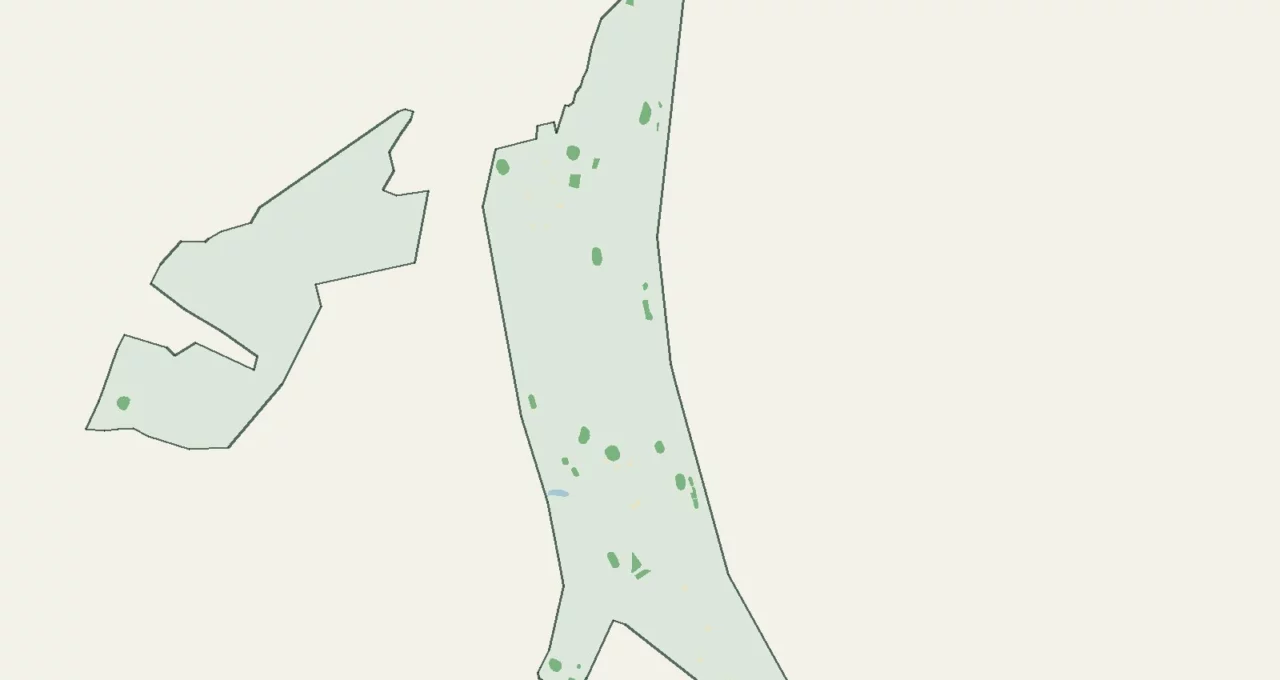
Layout of Abersoch Golf Club (Clwb Golff Abersoch) from OpenStreetMap survey data (ODbL licence).
Abersoch Golf Club (Clwb Golff Abersoch)
Holes
18
By
69 for men from the white and yellow tees; 72 for women from the red tees (club handicap tables, from 19 May 2026)
Length
5,847 yards from the white tees, 5,622 yellow, 5,268 red (GolfPass, Golfing Record, GolfNow scorecards); other sources give 5,671 to 5,873 yards from the back tees
Green fee
—
Best season
Generally playable all year round, according to the club; shortened in winter when the ground is waterlogged
Abersoch Golf Club, in Welsh Clwb Golff Abersoch, is an 18-hole members’ club on the edge of the sailing village of Abersoch, on the south-east coast of the Llŷn Peninsula in Gwynedd. Its course lies right behind the main beach, so close that the club warns golfers on the 5th to ignore the sand on their right if they can, and it looks across Cardigan Bay towards the mountains of Snowdonia. The club describes the layout as a blend of traditional links and parkland, and keeps its own bilingual website at abersochgolf.co.uk, with hole notes, visitor information and its handicap tables.
On paper this is a short course. The club’s World Handicap System tables, in force since 19 May 2026, give a par of 69 for men from both the white and the yellow tees, with a course rating of 68.9 and a slope of 119 from the whites and 67.9 and 117 from the yellows; women play the red tees as a par 72, rated 72.1 with a slope of 123. Scorecards published by golf directories put the white tees at 5,847 yards. The club’s own course page opens with a warning not to be deceived by that yardage, and the rest of this page explains why.
A Vardon course from 1907
The club gives 1907 as its foundation year, and Wikidata agrees. The English Wikipedia article on the club is more precise: it says the club was founded on Boxing Day 1907. The course itself appears to have come into play a little later. Top 100 Golf Courses says Harry Vardon pegged out the original holes in 1908, and GolfNow also lists 1908 as the year the course was built. Both dates can be true at once, a club formed at the end of one year and a course opened in the next, and we present them that way.
Every source we read credits the original design to Harry Vardon, the six-time Open champion, including the club itself, which calls him legendary on its About us page. Vardon’s first course here had nine holes, according to a review published by Top 100 Golf Courses in 2026 and to Golf Monthly, and it was extended to eighteen later. How and when that happened is less clear. Golf Monthly says that over time the course grew to a full eighteen with five parkland holes; a 2024 review on Top 100 Golf Courses speaks of thirteen original holes and five added later. A holiday cottage guide to the Llŷn names Martin Hawtree as the architect of the final nine, in the 1990s. We found no other source for that attribution, the club does not mention it, and we treat it as unconfirmed.
The sources also disagree about where Vardon’s holes are today. Golf Monthly says the original nine now make up the inward half; the 2026 Top 100 review says the traces of Vardon’s layout survive in the opening stretch, partly on the original green sites, with some fairways rerouted onto neighbouring land. We could not settle the question and have not tried to.
Several holes carry Welsh names. Golf Monthly says all eighteen are named after local landmarks, fields or views. The ones we found in print are Fron Grin for the 3rd, Porth Fawr for the 5th, Tai Morfa for the 7th and Tan y Bwlch for the 11th. Top 100 Golf Courses reports that Peter Alliss considered Tan y Bwlch one of the best links par 4s he had played; we could not trace the original remark. A booking site adds that the course was named Welsh Golf Course of the Year in 2018 by a golf magazine, which is presumably the award the club refers to on its home page.
What it asks of you
The club’s own notes are blunt about the character of the place. The first twelve holes, it says, are proper links: uneven bounces, uneven stances and, in summer, bare lies. The last six are set on reclaimed marshland and have more of a parkland feel. Other descriptions draw the line slightly differently. Top 100 Golf Courses and a golf travel company describe holes 1 to 12 and the closing 18th as links and holes 13 to 17 as parkland, which fits Golf Monthly’s figure of five parkland holes and the club’s own remark that the 13th is reached by a short walk past the clubhouse. Either way, a round here is two courses in one: a long stretch of firm, wind-exposed links land by the beach, then a quieter inland loop.
The card explains why the course plays longer than it looks. From the white tees, according to the scorecards published by GolfPass and Golfing Record, the front nine measures 3,216 yards and par 36 and the back nine 2,631 yards and par 33. There are only two par 5s, the 2nd and the 5th, and five par 3s, three of them on the inward half, including the 18th. Several par 4s are short, the 4th at 289 yards above all, but the hardest holes are long ones: the 7th, stroke index 1, at 459 yards, and the 11th, stroke index 2, at 440 yards, a hole the club says rarely has any wind assistance. The 3rd, a par 3, measures 246 yards from the white tees. The club adds that the wind off the bay means no two rounds are the same, and that course management matters more than length.
Water and ditches run through the club’s hole notes. The same ditch comes into play on the 1st, 3rd and 4th; the 2nd starts over a pond, doglegs sharply right across another ditch and climbs to a green backed by gorse; the 13th is, in the club’s words, a tale of two ditches; and the 17th, which the club calls a potential card wrecker, is shaped by a ditch at the bottom of the hill and trees on the right. A road comes into play on the first few holes, and on the 6th a wall behind the green makes going long expensive.
Holes that stand out
Yardages are from the white tees on the scorecards published by GolfPass and Golfing Record; descriptions draw on the club’s hole notes and the Top 100 Golf Courses reviews.
- 2nd: par 5, 470 yards, stroke index 3. Short for a par 5 on the card, but the club warns that hazards abound, and that an approach left short can roll back about 50 yards.
- 3rd, Fron Grin: par 3, 246 yards, stroke index 5. The club’s signature hole: a long, downhill shot from a high tee to a tight green, with a ditch short, the road to the right and a bunker at the back. The 2026 Top 100 review notes that the green falls sharply from front to back, which makes holding it awkward.
- 5th, Porth Fawr: par 5, 506 yards, stroke index 11. The longest hole, running along the beach through the dunes, with the prevailing wind pushing the ball towards the sand.
- 6th: par 3, 176 yards, stroke index 15. A green the club calls taco shaped; keep below the hole, it advises.
- 7th, Tai Morfa: par 4, 459 yards, stroke index 1. Dunes on the right, a narrow entrance to a long green and a bunker on the left.
- 8th: par 4, 355 yards, stroke index 9. A dogleg hugging the dunes, played over a big mound into a valley.
- 11th, Tan y Bwlch: par 4, 440 yards, stroke index 2. Four greenside bunkers and a narrow approach.
- 18th: par 3, 144 yards, stroke index 18. A short finish towards the bar, with a ditch along the left that the club says is more daunting from the white tees.
Holes 5 to 8
If one stretch defines Abersoch, it is the run from the 5th to the 8th, through the dunes beside the beach. The 2026 review on Top 100 Golf Courses, which the club reproduces on its own site, singles out these four holes as one of the finest sequences in Wales, built on natural landforms with few artificial features. It is the part of the course that the club, the reviewers and the directories all agree on.
What golfers say
Abersoch is reviewed on golf booking and review sites, chiefly Top 100 Golf Courses, GolfPass, Your Golf Travel, Golfbreaks and Hole19. The points below summarise what recurs. They are other people’s opinions, not ours; nobody from Panxis has played the course, and we name and quote no one.
What comes up in its favour
- The setting is the first thing golfers mention: the beach, the bay and the view of Snowdonia.
- The links holes by the dunes, above all the 5th to the 8th, are described as genuine, varied and memorable.
- The greens are often praised as true and well shaped, with interesting contours.
- Staff and members are repeatedly described as friendly and welcoming, and the clubhouse patio is liked.
- Golfers enjoy the mix of links and parkland, and the reduced early-morning rate is seen as good value.
What comes up against
- The parkland holes are widely seen as weaker than the links stretch, and the round can feel as though it fades after the 12th.
- Firm greens and fast-running ground can make approach shots hard to hold, and the course is described as something of a lottery at times.
- Some reviews report worn tees or disappointing greens, against an otherwise favourable picture of course condition.
- A public footpath crosses the course and comes into play on a few holes.
- Wind and weather can spoil a visit, and the front nine is found hard; facilities rate lower than the course itself.
Facilities and how to play it
Abersoch is a members’ club that welcomes visitors throughout the year, according to its visitors page. Tee times can be booked online through the club’s booking system or through the professional’s shop, on 01758 712622, the number the club gives on its groups and societies page. Groups of eight or more players are offered society packages that combine golf, food and use of the simulator, and the club says it is flexible about arranging bespoke days. Longer-stay visitors can buy green fee packages covering seven, fourteen or twenty-one days of golf, and there are sunrise and twilight rates.
Clubs, pull trolleys, electric trolleys and buggies can be hired; the club advises booking early. The professional’s shop stocks equipment and clothing and offers lessons. In the clubhouse, the club runs a GC Quad simulator, available all year and bookable by the half hour, for practice, club fitting or a round on a famous course when the weather turns. We found no mention of a driving range on the club’s site; directories list putting greens.
The clubhouse overlooks the 18th green and has a bar and a patio. According to the club, the bar is generally open from noon to 8pm, seven days a week, from March to December, and catering runs from 9am to 5pm, Tuesday to Sunday, from Easter to the October half-term holiday; hours depend on the season and demand. Non-golfers are welcome for a drink, in suitable clothing, and well-behaved dogs are allowed on the patio. The club lists accommodation partners in the village and elsewhere on the peninsula on its website.
Getting there and when to go
The course is on Golf Road, just south of the village centre, behind the main beach. Directories do not agree on the postcode: Top 100 Golf Courses, Golfbreaks, GolfNow and Visit Snowdonia give LL53 7EY, Golf Monthly gives LL53 7NN and Hole19 LL53 7EF, and the club’s own site does not state one that we could read. The map on this page shows the course’s location from OpenStreetMap.
By road, Abersoch is reached from Pwllheli along the coast through Llanbedrog. Without a car, Pwllheli is the end of the Cambrian Coast railway line, and the 18 bus runs a loop from Pwllheli bus station via Llanbedrog to Abersoch, according to the timetable published on bustimes.org; check the current times with Traveline Cymru before travelling with clubs. Visit Snowdonia notes a pay car park by the beach.
The club says the course is generally playable all year round, although it is shortened in winter when the ground is waterlogged. Abersoch is a busy resort in summer, which is also when the links play firmest and the bare lies the club mentions appear. Late spring and early autumn are likely to offer the best balance between ground conditions, light and crowds, with the clubhouse catering still running; in winter, the simulator is the club’s own answer to bad weather.
Green fees
Visitor, society and multi-day rates are set by the club: see the club’s visitors page for current prices.
How this page was made
The factual frame comes from public sources: OpenStreetMap for the location and outline of the course and its Welsh name; Wikidata for the identifiers and the 1907 foundation; the English Wikipedia article for the Boxing Day 1907 date, the Welsh name, Harry Vardon and a 5,847-yard, par 69 card; the club’s website for its history, the description of the course, the hole notes, the World Handicap System tables with par, course rating and slope for each set of tees, visiting, societies, hire, the shop, the simulator, the clubhouse and its hours, and the remarks on winter play; Top 100 Golf Courses for the 1908 pegging by Vardon, the hole names, the Peter Alliss remark and two reviews; Golf Monthly for the original nine, the five parkland holes and the Welsh hole names; a holiday cottage guide for the Hawtree attribution; GolfPass and Golfing Record for the hole-by-hole scorecard; GolfNow for its own figures and the 1908 date; Your Golf Travel for the 2018 award and the links and parkland split; Visit Snowdonia for the car park; bustimes.org for the bus route; and Top 100 Golf Courses, GolfPass, Your Golf Travel, Golfbreaks and Hole19 for the opinions summarised above.
Where sources disagree, we say so. The foundation is 1907 for the club, Wikipedia and Wikidata, while Top 100 Golf Courses and GolfNow date the course to 1908. Back-tee length is 5,847 yards on GolfPass, Golfing Record, Wikipedia and Top 100 Golf Courses, 5,873 yards in the summary boxes of GolfNow and Your Golf Travel, and 5,671 yards on Golf Monthly, whose page also describes a 117-yard 4th that does not match today’s card and probably reflects an older layout. Ratings differ too: the club’s tables, valid from 19 May 2026, give 68.9 and 119 from the whites, 67.9 and 117 from the yellows and 72.1 and 123 for women from the reds; GolfNow gives 69.1 and 120, 68.2 and 117, and 72.2 and 123; Golfing Record gives 68.6 and 123 from the whites and a par of 71 from the reds, against 72 on the club’s table. Top 100 Golf Courses gives the 7th as 456 yards against 459 on the scorecards. The club says the first twelve holes are links and the last six parkland; other sources count holes 13 to 17 as parkland and the 18th as links. The location of Vardon’s original holes differs between Golf Monthly and Top 100 Golf Courses, and only one source names Martin Hawtree. The club’s shop page gives two different first names for the professional, which is why we name no one. The postcodes differ as set out above.
The club’s contact page returned an error when we tried to read it, its scorecard is not published as text on the site, the Internet Archive was offline, so we could not read older versions of the club’s site, and the GolfPass, Coflein and Welsh Golf Courses pages refused our requests. The opinion section summarises reviews read in October 2026; several sites show only scores or a few texts, so we relied on what we could read. We report recurring themes rather than individual voices, and we reproduce no quotations from reviewers. Nobody from Panxis has played or visited this course, and this page is no substitute for a round.
The club has not paid for this page, has not seen it before publication and has no say over its content. This page contains no commercial link and earns us no commission. If you know the course and something here is wrong or out of date, write to us and we will correct it.
Other courses nearby
Closest to this one in our British directory:
- Holyhead Golf Club — 33 mi
- Storws Wen Golf Club — 36 mi
- Holywell Golf Club — 61 mi
- Royal Liverpool Golf Club — 67 mi
The hole to know
Fron Grin, the club's signature hole: a downhill par 3 of 246 yards from the white tees, stroke index 5, to a tight green that falls from front to back, with a ditch short, a road to the right and a bunker behind, and views across Cardigan Bay.