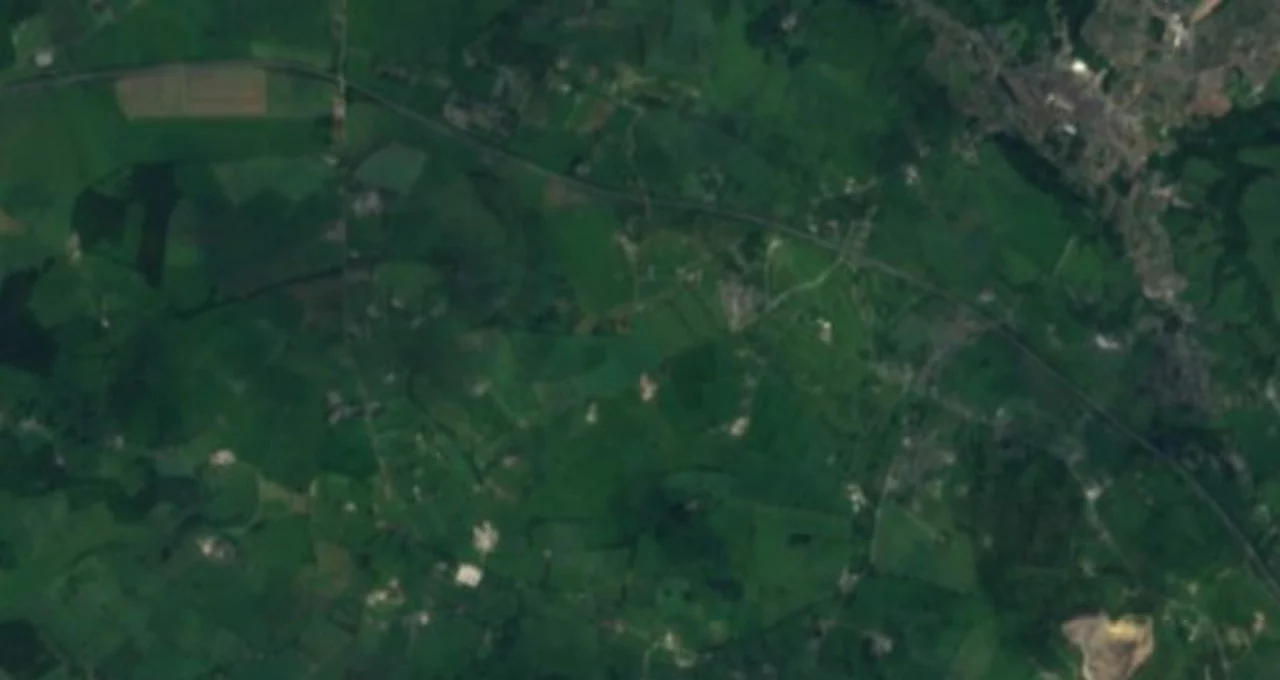
Holywell Golf Club from space. Sentinel-2 cloudless 2016 by EOX IT Services GmbH (contains modified Copernicus Sentinel data), CC BY 4.0.
Holywell Golf Club
Holes
18 (club scorecard; current layout since 1991)
By
70 from the white tees, 69 from the yellow, 70 for ladies from the red; 69 on the men's winter card (club scorecards)
Length
6,091 yards from the white tees, 5,813 yellow, 5,112 red; 5,538 on the men's winter card (club scorecards)
Green fee
—
Best season
Open all year; summer season April to September, winter season October to March with a shorter winter card; the club says it never uses temporary greens (club website)
Holywell Golf Club is an 18-hole course on Brynford Common in Flintshire, North Wales, on a limestone plateau that the club puts at 800 feet above sea level, a mile up the hill from the town of Holywell. It was founded in 1906 as a nine-hole course on land belonging to the Grosvenor estate of the Dukes of Westminster, grew to 18 holes in 1924, shrank back to nine after the Second World War and has been played on its present 18-hole layout since 1991. The club’s summer scorecard gives 6,091 yards and par 70 from the white tees, with a course rating of 69.9 and a slope of 120. The club’s website is holywellgc.co.uk.
The ground explains most of what makes the place unusual. Brynford Common was mined for lead and quarried for limestone for centuries, and the club’s own history records that old quarries lie under two fairways, that disused lime kilns guard three holes and that several tees stand over the entrances to lead mines that went down hundreds of feet. The common is still grazed, so golfers share the course with sheep, and a public road runs through the middle of it. The club describes the result as an inland links type course; visitors who have written about it tend to reach for the word quirky. It is a members’ club affiliated to Wales Golf that takes visitors and societies, with booking required.
Name and location
The club calls itself Holywell Golf Club, and Wikipedia gives its Welsh name as Clwb Golff Treffynnon. OpenStreetMap names the ground Holywell Golf Course and links it to the Wikidata item Q16994211, which carries the English Wikipedia article and a set of coordinates close to the centre of the course as drawn on the map; the map at the foot of this page uses the OpenStreetMap position. The club’s postal address is Clwyd Avenue, Brynford, Holywell, CH8 8LQ. Although the club takes its name from the town, the course lies in the community of Brynford, a village to the south-west of Holywell, and OpenStreetMap’s own address lookup places the middle of the course in Brynford, Flintshire.
How far the course is from the town depends on who is measuring. The club says a mile up the hill, Wikipedia a mile south-west of Holywell, and the description supplied to Visit Wales and repeated by Today’s Golfer and Golf Today a mile and a half inland. Holywell itself is the town the club calls the Lourdes of Wales, after the holy well that gives it its name. The club stresses that it is just off the A55, the North Wales Expressway, within easy reach of Chester, Merseyside and the North West; Golf Monthly places it just west of Chester, across the Dee estuary from Hoylake.
A course on the Duke of Westminster’s land
The club’s history page is unusually rich. Alongside the centenary book prepared by Ray Lewis and other members in 2006, which is available in the clubhouse, it publishes a long illustrated presentation written by member David H. Thomas in 2017, drawing on letters held in the Grosvenor Estate Archives and by Flintshire County Council. Most of what follows comes from it.
The correspondence begins on 24 March 1906, when the club’s first secretary, Trevor Eyton, wrote to the Grosvenor estate’s agent to ask on what conditions golf might be played on the common. Permission came back the next day, for an annual rent the presentation sums up as ten shillings a year. By the end of March the secretary was asking whether the Duke would become the club’s first president, and in May the Duke agreed. A written licence to play golf was signed on 18 June 1906. Its sixth clause, forbidding golf on Sundays, would cause trouble later.
The founders first wanted to use the old offices of the Clwt Militia lead mine as a clubhouse. The estate would not agree to the alterations, and after weeks of letters, including an offer not to disturb the elderly tenant living in the end cottage, the club accepted a temporary iron building near the road for a nominal rent. In August 1906 the Duke agreed instead to a new clubhouse nearby, and building was under way by January 1907. That clubhouse lasted until 1977, when it was demolished; a planned extension of 1929 was never built, and the club made do with wooden sheds donated by the textile company Courtaulds.
The first course had nine holes. The presentation takes the reader round them with photographs, and the yardages it gives describe a short, compact layout: holes of 257, 307, 365, 160, 461, 360, 233 and 391 yards, with a sixth hole that no longer exists because the land was taken by the A55. Expansion was slow. The club first asked the estate for land to extend to 18 holes in July 1913, asked again in 1914 and 1923, and received approval only in January 1924, eleven years after the first request. The presentation notes, with some amusement, that the estate’s agent had been offered honorary life membership a few months earlier. The extra nine holes of 1924 were mostly short, between 160 and 350 yards, and the presentation maps each of them onto parts of today’s course, several running onto what are now the 11th to 17th fairways.
Sunday golf came later. In November 1931 a general meeting voted to ask for it, on the grounds that Holywell was the only club in Flintshire that did not allow it and that its members were now mostly working professional and business men rather than the men of leisure of 1906. Local chapels and the parish church at Brynford protested, arguing among other things that parishioners could not reach public worship without crossing the links, and four past captains opposed the change too. The Duke cancelled the clause from 1 January 1932. A compromise with the religious bodies followed in February: no play from the two tees near Calcoed chapel, no caddies on Sundays, staff released in the evening to attend church and no Sunday competitions. The rent went up at the same time. In 1924 the Duke also gave the club a trophy, the Westminster Cup, still described by the club as its premier competition, played as match play after a qualifying medal round.
After the Second World War the course reverted to nine holes on a different layout. In the 1980s the club introduced alternate tees and an additional hole, and the quarry under today’s 2nd and 8th fairways was filled in around 1985. The 18-hole layout played today dates from 1991, and the club’s history includes six plans showing the course’s evolution from 1906 to that date. No source we read names an architect for the original course, the 1924 extension or the 1991 layout.
The recent past has not always been easy. Wikipedia, citing a 2007 book, says the club came close to bankruptcy in 2001 because of the foot-and-mouth outbreak and the sheep that roam the common; we found no other account of that episode. Today the club describes itself as one of the most financially stable in the area and says it is not for sale. A 2019 profile in the trade magazine The Golf Business mentions a refurbished dining room overlooking the course, new locker rooms and an exterior reclad in 2018.
What lies beneath
The second half of the club’s history presentation goes underground. To the north of the clubhouse lay the Clwt Militia mine, whose Wellington shaft, the ladder shaft by which miners went to work, descended to 300 feet; the presentation records 23 tons of lead ore extracted in 1849. The Golf Business profile says the mine produced lead and silver from the early nineteenth century until it closed in 1903. Near today’s 10th green and 11th yellow tee are the entrance and winding shafts of the New Pant-y-Ne mine, which descend 210 feet; a plan of 1895 to develop it with an engine house and a new, deeper shaft was never carried out, and its three lead lodes run under the professional’s shop. According to the club, the tees of the 1st, 2nd, 7th, 11th, 12th, 13th and 18th stand over former mine entrances, and capped mine shafts and cairns are listed among the obstructions in the local rules.
Limestone left even more visible marks. Two old quarries, already old on a map of 1871, underlie the 2nd fairway and most of the 8th; before they were filled in, a track running down into the quarry was a serious hazard on the way to what is now the 8th green. More quarries, shown on a map of 1910, lie to the right of the 14th and have to be carried on the 15th and 16th, and two lime kilns stand among them. The 16th is named Lime Kiln on the scorecard.
The common is older still. Wikipedia’s articles on the club and on Brynford, citing records held by the Royal Commission on the Ancient and Historical Monuments of Wales on its Coflein database, place two Bronze Age round barrows, known as Clwt Militia, on the course about two-thirds of a mile north-north-west of Brynford church. The 8th hole is called Tumulus. Coflein refused our requests, so we could not read its records in full.
What it asks of you
The club publishes summer and winter scorecards on its course page. They carry no date and no issuing body, but the figures match those listed by GolfNow. The summer card gives:
- White tees: 6,091 yards, par 70, course rating 69.9, slope 120.
- Yellow tees: 5,813 yards, par 69, course rating 68.6, slope 117.
- Red tees (ladies): 5,112 yards, par 70, course rating 70.0, slope 115.
The one-stroke difference between white and yellow comes from the 11th, named Fammau View, which is a par 4 of 300 yards from the white tee and a par 3 of 165 yards from the yellow. The white card goes out in 3,078 yards and par 34 and comes home in 3,013 yards and par 36. There are four par 3s from the white tees, the 4th, 6th, 12th and 15th, all between 134 and 188 yards, and two par 5s on the back nine, the 10th at 480 yards and the 14th at 521. The longest par 4 is the 7th, Claremont, at 445 yards and stroke index 1. For ladies the 7th is a par 5 of 417 yards and the hardest hole by index is the 9th, Jacob’s Well. The winter card shortens the men’s course to 5,538 yards and par 69, with a rating of 67.3 and slope of 114; the ladies’ figures do not change.
Every hole has a name on the card, from Magazine at the 1st through Pond, Captains, Hawthorns and Tumulus, to Road Hole at the 10th, Chapel at the 13th, The Bowl at the 14th, Dytors at the 15th, Lime Kiln at the 16th, Ffrith at the 17th and Home at the 18th.
The club’s course guide, written as a professional’s tip for each hole, gives a good idea of the problems. Its common thread is placement rather than length. On the 1st, heather mounds lie to the left and a drive carried over the road gives a better angle to the green. The 4th is described as an extremely tough par 3 whose green falls away on all sides, with all the trouble short; Golf Monthly adds bunkers either side and water to the left. The 7th has out of bounds on the right and an uphill approach, and the guide calls a par there a good score. The 10th is a par 5 to be played with the head, threading the drive between out of bounds on the left and humps on the right. On the 13th and 17th the guide suggests leaving the driver in the bag because the fairways narrow, and on the 18th, out of bounds right and heather left. Several greens slope from back to front, and the guide repeatedly warns against going long.
The finish is where the course is at its most distinctive. The 14th, The Bowl, is a par 5 played to a long, sunken green with a tier in the middle; the club calls it a cerebral test, and Golf Monthly, whose reviewer visited in 2020, describes an inviting downhill drive and a two-tiered bowl green where a three-putt is always possible. The 15th, named Dytors on the card and the Quarry by the club, is the hole the club calls its signature: a par 3 of 134 yards from the white tees, 124 from the yellow and 113 from the red, played over an old quarry to a green that slopes from back to front, with two lime kilns more than a century old beside it. The 16th asks for another tee shot over the quarry and warns against what the guide calls the Holywell bounce on firm, running ground.
Bunkers are few. The course is defined instead by the old workings, gorse, heather, humps and hollows, and by the road through the middle, which several holes cross. Golf Monthly notes that the wind is a major defence on an exposed site about three miles from the coast, and the club itself speaks of unpredictable breezes. The local rules reflect the setting: free relief from capped mine shafts, from horse hoof marks and, at the player’s discretion and with the marker’s consent, from animal dung, and a warning that parts of the course are open to walkers.
The limestone subsoil is the club’s main argument for winter golf. It says the course drains well, is closed only in extreme conditions and never uses temporary greens, and Visit Wales repeats the claim that it is one of the driest courses in North Wales.
What golfers say
Holywell has a modest but varied body of public opinion. We read the three reviews on Top 100 Golf Courses (written in 2022, 2023 and 2024, for an average of 3 out of 5), the Golf Monthly course review published in July 2020, the Wanderlog summary of 197 Google reviews (4.4 out of 5), and the visitor comments the club publishes on its own homepage. Search results also report a GolfPass recommendation rate of 95 per cent from 109 reviews, but GolfPass refused our requests and we could not read the reviews themselves. The points below summarise what recurs. They are other people’s opinions, not ours; nobody from Panxis has played the course, and we name and quote no one.
What comes up in its favour
- Character: the words quirky and fun recur, and reviewers like the way the course follows the natural ground, with undulating fairways and blind or intimidating tee shots that reward local knowledge.
- The closing stretch, especially the quarry holes and the par 3 15th, is singled out as the highlight; one reviewer found the back nine far better than the front.
- Greens are often described as well kept and true, sometimes as surprisingly good given the grazing sheep.
- Value for money, and a welcome described as friendly in both the professional’s shop and the bar.
- Year-round playability on the well-drained limestone.
What comes up against
- The sheep, and what they leave behind, come up in most of the reviews we read; for some they are part of the charm, for others a nuisance.
- Because the common is grazed, tees and fairways are kept longer and there is little mowing to define fairway and rough, so some holes feel loosely framed.
- One reviewer found the front nine flat and featureless compared with the back nine; another found the drive over the road through the course daunting.
- Greens are the main minor complaint in the Google summary, even though other reviewers praise them, so opinion on them is divided.
The written reviews are few, and individual opinions vary with the season and the weather on the day.
Facilities and how to play it
The club welcomes visitors and societies, and booking is mandatory. Visitors can reserve a tee time on the club’s online visitor booking page, run on the ClubV1 system; groups of four or more are asked to call the professional. The club’s PGA professional, Lewis Johnson, has been at the club since June 2022 and runs coaching in what the club calls a state of the art golf studio. The clubhouse has a bar and catering that the club and its visitors both praise, and hosts functions. A practice ground and a practice chipping area in front of the clubhouse are mentioned in the local rules. The club’s membership page refers to buggy and trolley hire.
The dress code is relaxed in the clubhouse, where dress restrictions apply only at formal presentation evenings, and asks for recognised golf attire on the course, with no denim or jogging trousers. Golf shoes must be removed before entering the clubhouse, but are allowed in the changing rooms, and hats come off indoors. Mobile phones are to be kept on silent. The club runs a junior section for ages 5 to 18, with free weekly sessions from April to October and a short BMW Academy Silver Course for beginners, as well as a seniors’ section for members over 55. Its open competitions include a junior open and the John Ball Scratch Open, and in 2026 it hosted the opening day of the Gateway to Wales mixed festival with Mold and Padeswood & Buckley.
The club is affiliated to Wales Golf and to the Union of Flintshire Golf Clubs, and lists reciprocal arrangements with West End Golf Club in Halifax and Athy in Ireland. Membership categories range from juniors through age-related rates to full, second-club, lifestyle and social membership, with prices on the club’s website.
Getting there and when to go
The club is at Clwyd Avenue, Brynford, Holywell, CH8 8LQ, a short way off the A55 North Wales Expressway, which makes it reachable from either direction along the North Wales coast and from Chester. The club’s telephone number is 01352 710040, with options for the secretary, the professional and the bar; its email address is secretary@holywellgc.co.uk, and the professional can be reached at pro@holywellgc.co.uk.
The course is open all year. The club divides its season into summer, from April to September, and winter, from October to March, with the shorter winter card in use for men. On a clear day, the club and Visit Wales say, the views run to Moel Famau and the Clwydian Range and, some forty miles away, to Snowdonia. Height and exposure cut both ways: the air is fresh, as the club likes to point out, but the wind can turn a short par 3 such as the 15th into a much longer shot.
Green fees
Holywell sets different rates for weekdays and weekends, for summer and winter, and for members’ guests, with packages for groups: see the club’s website for current prices.
How this page was made
The factual frame comes from public sources: OpenStreetMap for the location, outline and name of the course; Wikidata for the item linked to it; the club’s website for its description, history, course guide, local rules, dress code, junior and senior sections, membership categories, affiliations, open competitions, booking and contact details; the club’s summer and winter scorecards for lengths, pars, ratings, slopes, stroke indexes and hole names; the history presentation by David H. Thomas (2017), published by the club and drawing on the Grosvenor Estate Archives and Flintshire records, for the founding letters, the 1906 and 1924 layouts, Sunday golf, the Westminster Cup and the mines and quarries; Wikipedia’s articles on Holywell Golf Club and Brynford for the Welsh name, the barrows and the 2001 episode; The Golf Business (2019) for the Clwt Militia mine’s closure and the clubhouse works; Visit Wales, Today’s Golfer, Golf Today and GolfNow for third-party descriptions and figures; and Golf Monthly, Top 100 Golf Courses and Wanderlog for the opinions summarised above.
Where sources disagree, we say so. The distance from Holywell is a mile up the hill for the club, a mile south-west for Wikipedia and a mile and a half inland for Visit Wales and several directories. Wikipedia supports its foundation date of 1906 with a reference to The Golfing Annual of 1902, which cannot be right; the club’s letters of 1906 settle the date. Golf Monthly gives the altitude as around 800 metres, where the club and every other source say 800 feet. Golf Monthly also calls the 17th a short par 3, while the current scorecard makes it a par 4 of 333 yards; the review may reflect a different routing, and we follow the card. Pars vary between directories: the yellow tees are par 69 on the club’s card and GolfNow, par 70 on 1golf according to search results, and one directory, Bluetees, gives par 68 for the course. Visit Wales gives the postcode CH8 8LP, the club CH8 8LQ; Today’s Golfer gives a telephone number and Visit Wales an email address that differ from the club’s, and GolfNow and The Golf Business name earlier professionals. Wanderlog’s summary counts greens as the main complaint, while individual reviews praise them.
The 1golf club and scorecard pages, Coflein, GolfPass and Today’s Golfer’s full listing refused our requests or sat behind a payment wall, so what we know of them comes from search summaries or partial pages, and we have not relied on them for any figure. We found no architect’s name for any version of the course, no confirmation of the 2001 near-bankruptcy beyond Wikipedia, and no full record of the barrows. Green fee amounts are deliberately left out.
The opinion section summarises reviews and descriptions read in October 2026. We report recurring themes rather than individual voices, and we reproduce no quotations from reviewers. Nobody from Panxis has played or visited this course, and this page is no substitute for a round.
The club has not paid for this page, has not seen it before publication and has no say over its content. This page contains no commercial link and earns us no commission. If you know the course and something here is wrong or out of date, write to us and we will correct it.
Other courses nearby
Closest to this one in our British directory:
- Royal Liverpool Golf Club — 8 mi
- Prenton Golf Club — 10 mi
- Huyton & Prescot Golf Club — 20 mi
- Formby Golf Club — 22 mi
The hole to know
The Quarry (Dytors on the card), the club's signature hole: a par 3 of 134 yards from the white tees, played over an old limestone quarry to a green sloping from back to front, beside two lime kilns more than a century old.