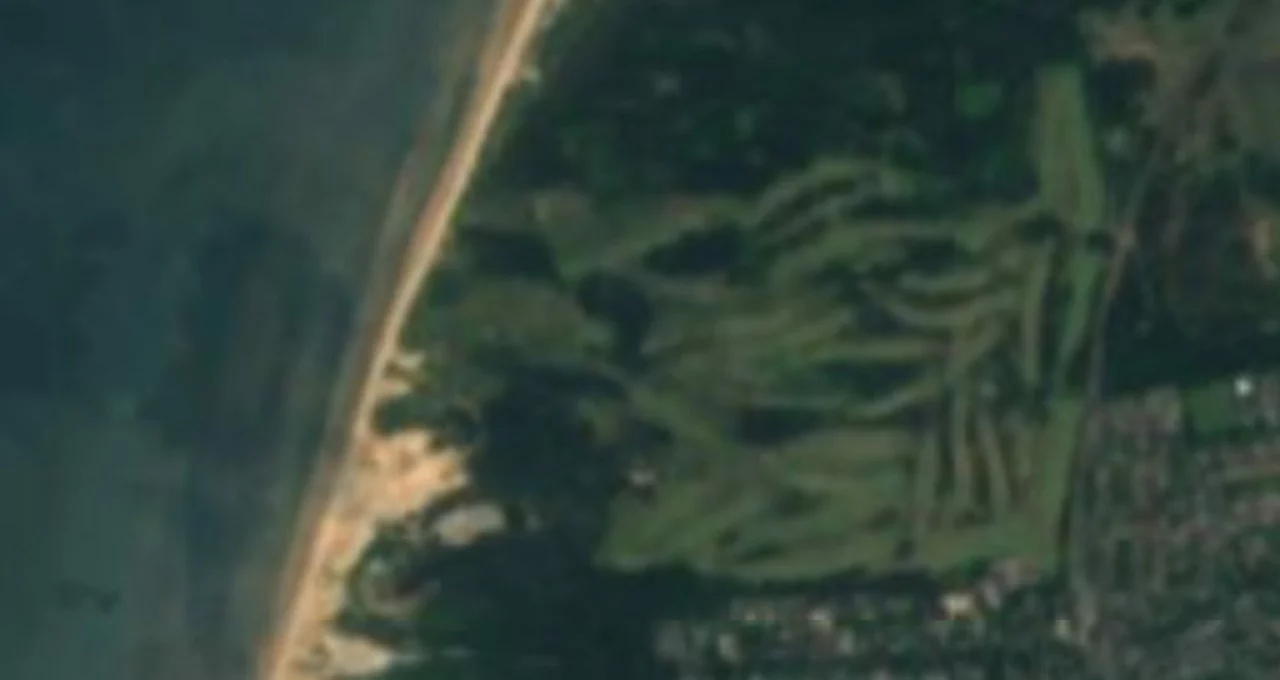
Formby Golf Club seen from space. Sentinel-2 cloudless 2016 by EOX IT Services GmbH (contains modified Copernicus Sentinel data), CC BY 4.0.
Formby Golf Club
Holes
18
By
72 (club scorecard)
Length
7,128 yards from the blue tees, 6,815 white, 6,502 yellow, 5,963 red, 5,208 silver (club scorecard)
Green fee
—
Best season
Open all year; winter maintenance from October to March may bring temporary greens, closed bunkers or a shortened course (club website)
Formby Golf Club is an 18-hole links on the Sefton coast at Freshfield, on the northern edge of Formby in Merseyside, about 14 miles north of Liverpool. Founded in 1884, it is one of the string of seaside courses between Liverpool and Southport, and it has hosted the Amateur Championship four times, the Curtis Cup in 2004 and the PGA Seniors Championship in 2021 and 2022. The club’s current card measures 7,128 yards from the blue tees, par 72. Its website is formbygolfclub.co.uk, and the address is Golf Road, Freshfield, Liverpool, L37 1LQ.
What sets Formby apart from its neighbours is the mixture of ground. The course runs through sand dunes, heather and tall pines, so that parts of the front nine feel closer to heathland than to the open, treeless links most visitors picture on this coast, while the holes nearer the sea are classic duneland. It is also a course that the sea is slowly taking back: the coastline at Formby Point is eroding, three holes have already been moved inland once, and two more are scheduled to follow in the coming decades.
Which club is this?
Two other names in the town cause regular confusion, so it is worth being precise. Formby Ladies’ Golf Club is a separate club with its own 18-hole course, and that course lies inside the Formby links: the men’s course runs anticlockwise around it, according to Top 100 Golf Courses. The ladies’ club was formed in 1896, when Formby Golf Club decided its women members should have a course of their own; it began with nine holes and was extended to 18 in 1907, and Top 100 Golf Courses gives it a length of 5,356 yards and a par of 71 from the red tees. The two clubs operate independently, though Formby’s dormy packages include a round on the ladies’ course and men are welcome to play there. This page is about Formby Golf Club, not the ladies’ club.
Formby Hall Golf Resort & Spa is something else again: a hotel and golf resort on Southport Old Road, on the other side of the town from the coast, with an 18-hole course and a nine-hole short course, and no connection to Formby Golf Club. If a booking site or satellite navigation offers you Formby Hall, it is not this course.
History: from nine winter holes to a championship links
According to the club’s own timeline, Formby Golf Club was founded in 1884 at the instigation of John Bushby, with an annual subscription of one guinea. LINKS Magazine says the first course had nine holes and was played only in the winter months. In 1887 the club’s president, Charles Weld Blundell, planted the first pine trees, which over more than a century have grown into the woodland that frames so much of the course today. The first clubhouse was built in 1891 and destroyed by fire in 1899; the present clubhouse dates from 1901 and was extended in 1998. Two of its fixtures have stories attached: the tower clock was presented in 1909 by Bruce Ismay, chairman of the White Star Line, and a curiosity known as the Hippo was given the same year by the widow of a member. During the First World War the club was used as a convalescent home.
The layout is the work of several hands. The club credits Willie Park Jr, twice Open champion, with establishing the links, and dates his work to 1912; Top 100 Golf Courses repeats 1912 but also cites an article placing the expansion to 18 holes around 1904, and LINKS Magazine puts it simply at the turn of the century. James Braid altered the course in 1922; LINKS says he lengthened the closing four holes. Harry Colt made further changes in 1933. Top 100 Golf Courses also credits Martin Hawtree and the architect James Taylor with later advice.
The most visible change came after the sea began to eat into the course. Donald Steel laid out new 7th, 8th and 9th holes on ground further from the shore and put a new tee on the 10th, turning it into a par 3. The sources do not agree on the date: the club’s timeline gives 1980, National Club Golfer the late 1970s, LINKS Magazine the early 1970s and Top 100 Golf Courses the early 1980s. National Club Golfer, citing the club’s secretary in 2019, reports that the old 9th green now lies some 25 yards out on the beach.
The work has not stopped. In October 2019, Golf Business News reported that Formby had commissioned Mackenzie & Ebert to produce a course assessment and a six-year development plan, with a budget of about £750,000. The plan, one major project a year, covered widening and re-bunkering the 1st fairway, reshaping the 6th into more of a dogleg, lengthening and reshaping the 8th, building dunes and dune slacks around the 16th, and new bunkers and tees across the course; no greens were to be changed. It also included designs to replace the 9th and 10th, which the club expects to be overtaken by erosion and blown sand. National Club Golfer, in an article first published in November 2019 and updated in 2024, gives the background: the club says the coast at Formby Point is retreating by about 2.5 metres a year (LINKS gives about two), Sefton Council projects that the coastline could reach the back of the 10th blue tee by 2085, and the new holes would need to be in play by about 2040. The club’s position then was that it could build most of the new holes while the existing ones stay in play. We found no report that the new 9th and 10th have been built, nor a detailed account of which other parts of the plan have been completed, so the description below follows the current card.
Formby’s championship record is long. The Amateur Championship has been played there in 1957, 1967, 1984 and 2009. The 1984 edition, in the club’s centenary year, was won by José María Olazábal, who beat Colin Montgomerie in the final; the 2009 edition was won by Matteo Manassero, who Top 100 Golf Courses says was the youngest winner in the event’s history at 16. The club also hosted the 33rd Curtis Cup in 2004, won by the United States, the Arnold Palmer Cup in 2016 and the PGA Seniors Championship in 2021 and 2022. Wikipedia lists it as a qualifying course for the Open in 1924, 1971 and 1996. It is ranked 39th in Britain and Ireland and 17th in England on the current Top 100 Golf Courses list.
What it asks of you
The club publishes a full scorecard on its course overview page, with five sets of tees. From the blue tees the course measures 7,128 yards; from the white, 6,815; from the yellow, 6,502; from the red, 5,963; and from the silver, 5,208. Par is 72, with 37 on the way out and 35 on the way home: three par 5s (the 3rd, 8th and 17th) and three par 3s (the 5th, 10th and 16th). The club also lists seven pairs of course rating and slope, from 67.3 and 121 at the low end to 77.4 and 144 at the top, but does not say which tees each pair applies to, so we do not attribute them; one Top 100 reviewer in 2026 quotes a slope of 136. Ask the club for the rating from the tees you intend to play.
The routing is the course’s main defence. Top 100 Golf Courses describes the first three holes running beside the railway line, screened by trees planted in the 1970s, the 4th turning towards the Irish Sea and the back nine coming home in a zigzag. Because the holes keep changing direction, the wind is seldom on the same side for long, and reviewers often say no two rounds feel the same. Pines border three sides of the property, heather lines much of the rough and the bunkering is described by nearly every source as strategic and penal. Top 100 Golf Courses quotes the verdict of the writer Bernard Darwin, who praised the greens and the lies and thought a player’s fate at Formby lay largely in his own hands.
The club’s hole-by-hole guide sets the tone from the start. The 1st, a par 4 of 434 yards from the blues, needs a fairway hit off the tee, with trees and heather down the right, and a green that slopes from front to back. The 3rd, at 560 yards, is the first par 5 and stroke index 3. The 5th is a short hole of 183 yards from the back, 162 from the whites, to a raised, undulating green with three pot bunkers on the left, the side the club tells you to avoid; reviewers single it out as one of the best holes on the course.
Steel’s stretch from the 7th to the 9th is where opinions divide. The 7th, 418 yards from the blues, climbs to a hilltop from which the sloping green comes into view; the club’s advice is to finish below the hole. The 8th, a par 5 of 481 yards with a two-tier green, is a scoring chance on the club’s own account, but it is also the hole Mackenzie & Ebert set out to lengthen, and National Club Golfer has written that it divides opinion. The 9th, 464 yards from the blues and stroke index 1, is the hardest hole on the card: an elevated tee, a pine-lined fairway and, in the club’s words, two strong shots needed to reach the green, often with a long iron or hybrid. The 10th is now a long par 3 of 217 yards from the back, close to the sea and exposed to the wind, which tends to carry the ball from right to left.
The back nine is mostly par 4s of around 400 to 430 yards across undulating linksland. The 12th, 423 yards from the blues and stroke index 4, plays downhill to a narrowing fairway with a large revetted bunker; the 13th has a heaving fairway of mounds, hollows and pot bunkers that reviewers rate among the course’s best. The 15th, at 403 yards, is stroke index 2: the club recommends a drive to the right to open up a two-tier green that is hard to reach in two. The 16th is the shortest hole on the course, 140 yards from the blues, a birdie chance with bunkers that punish any miss. The 17th is a par 5 of 537 yards, and the 18th, 440 yards from the blues, has fairway bunkers that the club suggests respecting rather than attacking, before a long green that makes club selection matter. Trains pass close to the 1st and 18th, according to a 2026 review, the only interruption on an otherwise quiet course.
The card, hole by hole
Blue yardage first, then white, with par and stroke index, all from the club’s course overview page.
- 1st: par 4, 434 yards (413). Index 11.
- 2nd: par 4, 400 yards (379). Index 9.
- 3rd: par 5, 560 yards (543). Index 3.
- 4th: par 4, 313 yards (313). Index 15.
- 5th: par 3, 183 yards (162). Index 17.
- 6th: par 4, 432 yards (407). Index 5.
- 7th: par 4, 418 yards (378). Index 13.
- 8th: par 5, 481 yards (481). Index 7.
- 9th: par 4, 464 yards (454). Index 1.
- 10th: par 3, 217 yards (189). Index 16.
- 11th: par 4, 422 yards (384). Index 12.
- 12th: par 4, 423 yards (407). Index 4.
- 13th: par 4, 431 yards (410). Index 10.
- 14th: par 4, 430 yards (413). Index 6.
- 15th: par 4, 403 yards (403). Index 2.
- 16th: par 3, 140 yards (129). Index 18.
- 17th: par 5, 537 yards (532). Index 8.
- 18th: par 4, 440 yards (418). Index 14.
From the yellow tees the course measures 6,502 yards and from the red 5,963. The silver tees, at 5,208 yards, shorten several holes sharply, among them the 3rd, 6th, 7th and 9th.
What golfers say
Public reviews of Formby are less numerous than for the Open venues nearby, and most of the detailed ones are on Top 100 Golf Courses. The material we read is the course page and individual reviews on Top 100 Golf Courses, including a feature from 2013 and reviews from 2017, 2025 and 2026, the course pages of National Club Golfer and LINKS Magazine, and summary ratings on Golfbreaks and Swyng. Several directories describe Formby as a hidden gem, overshadowed by Royal Birkdale, Royal Liverpool and Royal Lytham. The points below summarise what recurs. They are other people’s opinions, not ours; nobody from Panxis has played the course, and we quote no reviewer.
What comes up in its favour
- The setting, above all: pines, heather and dunes combine into a course that reviewers find unusually pretty for a links, with each stretch feeling different from the last.
- The variety of the holes and the routing, which turns the wind from every side and keeps the round interesting from start to finish.
- Greens and turf in good condition, firm and springy, with good sand in the bunkers in some reports.
- Particular holes come up again and again: the 5th, the 7th, the 9th, the 12th and 13th, and the short 16th.
- A warm welcome, a historic clubhouse with a formal but friendly atmosphere, and a sense of quiet on the course even when it is busy.
- It is considered fair: hazards are visible from the tee, the trees frame the holes more than they block them, and several tee options make it playable for mid and high handicappers.
What comes up against
- The bunkers are penal and easy to find, and some reviewers find the sand heavy; the heather in the rough is a constant threat.
- In a strong sea wind the back nine can play much harder than its yardage suggests, and missing greens often costs a shot.
- Some reviewers think the Steel holes from the 6th to the 9th feel contrived next to the rest of the course; others value the change of scenery they bring.
- A few of the gentler holes, notably at the start, are seen as lacking the drama of the best ones, and some greens sit close to the next tee.
- The course can be busy with visiting groups and caddies in summer, and one 2026 reviewer found it expensive.
- Older reports note difficult road access and limited parking.
Playing as a visitor
Formby is a private members’ club that takes visitors. Tee times can be booked online through the club’s booking page, by email or by telephone on +44 1704 872 164. The club states that Saturday and Sunday are members’ competition days and asks visitors to check live availability; Where2Golf, an older directory listing, gives weekday visiting plus Saturdays after 3.30pm and Sundays after 2.30pm. Visitors must show a current handicap certificate when they register, with maximum handicaps of 28 for men and 36 for women. The club accepts card payments only.
Electric and pull trolleys can be hired from the professional’s shop (+44 1704 835 396), and caddies can be arranged through reception. Buggy availability is unclear: one tour operator lists buggies for medical certificate holders only, another says none are available, and the club’s own visitor pages do not mention them, so ask in advance if you need one. Two travel listings mention a driving range, short-game area and putting green; the club’s pages say nothing about practice facilities but describe an indoor coaching studio with swing analysis and club fitting, and lessons seven days a week from the head professional, Andrew Witherup. Groups of up to 72 can be hosted, with refreshments and lunch.
The clubhouse has several bars, dining rooms and championship snooker tables. On the second floor, the dormy house offers six en-suite rooms, four twins and two singles, for up to ten guests overlooking the 18th green; dormy guests get unrestricted access to tee times, and the packages include two rounds at Formby and a round on the ladies’ course.
Getting there and when to go
The club is on Golf Road, Freshfield, L37 1LQ, next to Freshfield station on the Merseyrail line between Liverpool and Southport; reviewers note that the first tee is a short walk from the platform. By road, Where2Golf’s directions start from the A565 Formby bypass: west along Southport Road, then through Freshfield to Victoria Road, turning right into Golf Road immediately after the level crossing at the station, with the club entrance about 400 yards further on. The course borders the National Trust pinewoods at Formby, where Top 100 Golf Courses says red squirrels can sometimes be seen, and the estate is part of a Site of Special Scientific Interest.
Formby combines naturally with the other links of the Sefton coast and the Lancashire shore, from Royal Birkdale and Hillside to the north to Royal Liverpool across the Mersey estuary, which makes it a common stop on golf trips to the north-west of England. The course is open all year, but the club warns that winter maintenance can mean temporary greens, closed bunkers or a shortened course, and its winter period runs from October 2026 to March 2027. One 2026 reviewer suggests spring or autumn to see the course at its greenest, after a summer heatwave left it scorched. The heather flowers in late summer.
Green fees
Formby sets different rates for adults and juniors, on weekdays, Saturdays and Sundays, and by season: see the club’s website for current prices.
How this page was made
The factual frame comes from public sources: OpenStreetMap for the location and outline of the course; Wikidata for the identifier and the founding year; the club’s website for its history timeline, the architects it credits, the scorecard, the ratings, the hole descriptions, the visitor rules, the trolleys, caddies, dormy house, professional and contact details; the English Wikipedia article for the championships and Open qualifying years; Top 100 Golf Courses for the ranking, the routing, the acreage, the Formby Ladies’ club, the later architects and the reader reviews; National Club Golfer for the erosion figures, the Sefton Council projection and the planned new holes; Golf Business News for the Mackenzie & Ebert plan of 2019; LINKS Magazine for the early history and the Steel holes; Where2Golf for the directions, older visitor times and standard scratch scores; Golf Today for the location by Freshfield station; Perry Golf and Links Golf St Andrews for practice facilities and buggies; and Golfbreaks, Swyng and Where2Golf for the separate Formby Hall resort.
Where sources disagree, we say so. The date of Willie Park Jr’s 18-hole layout is 1912 for the club, around 1904 in an article cited by Top 100 Golf Courses, and the turn of the century for LINKS Magazine. Donald Steel’s new holes are dated 1980 by the club, the late 1970s by National Club Golfer, the early 1970s by LINKS Magazine and the early 1980s by Top 100 Golf Courses. The rate of erosion is about 2.5 metres a year in National Club Golfer and about two metres in LINKS. Top 100 Golf Courses gives the estate as about 470 acres on its course page and about 600 acres, of which 300 are used for the course, in a 2013 feature. Where2Golf gives standard scratch scores of 75, 72 and 70 from three sets of tees, which belong to an older card; the club now publishes ratings without saying which tees they apply to. Weekend access is limited to members’ competition days on the club’s site, while Where2Golf lists weekend afternoon visitor times. Buggies are listed for medical certificate holders only by one tour operator and as unavailable by another. Wikidata places the club about 500 metres from the point OpenStreetMap uses. The original designer of Formby Hall’s course is disputed between directories, so we name none. Golf Monthly’s and Today’s Golfer’s course pages could not be read, a National Club Golfer review page returned no article text, and we found no report on whether the new 9th and 10th holes have been built.
The opinion section summarises reviews and course descriptions read in October 2026. We report recurring themes rather than individual voices, and we reproduce no quotations from reviewers. Nobody from Panxis has played or visited this course, and this page is no substitute for a round.
The club has not paid for this page, has not seen it before publication and has no say over its content. This page contains no commercial link and earns us no commission. If you know the course and something here is wrong or out of date, write to us and we will correct it.
Other courses nearby
Closest to this one in our British directory:
- Royal Liverpool Golf Club — 14 mi
- Prenton Golf Club — 15 mi
- Huyton & Prescot Golf Club — 15 mi
- Holywell Golf Club — 22 mi
The hole to know
One of Donald Steel's holes built after coastal erosion: a par 4 of 464 yards from the blue tees, stroke index 1, from an elevated tee down a pine-lined fairway, needing two strong shots; the club plans to replace it as the sea advances.