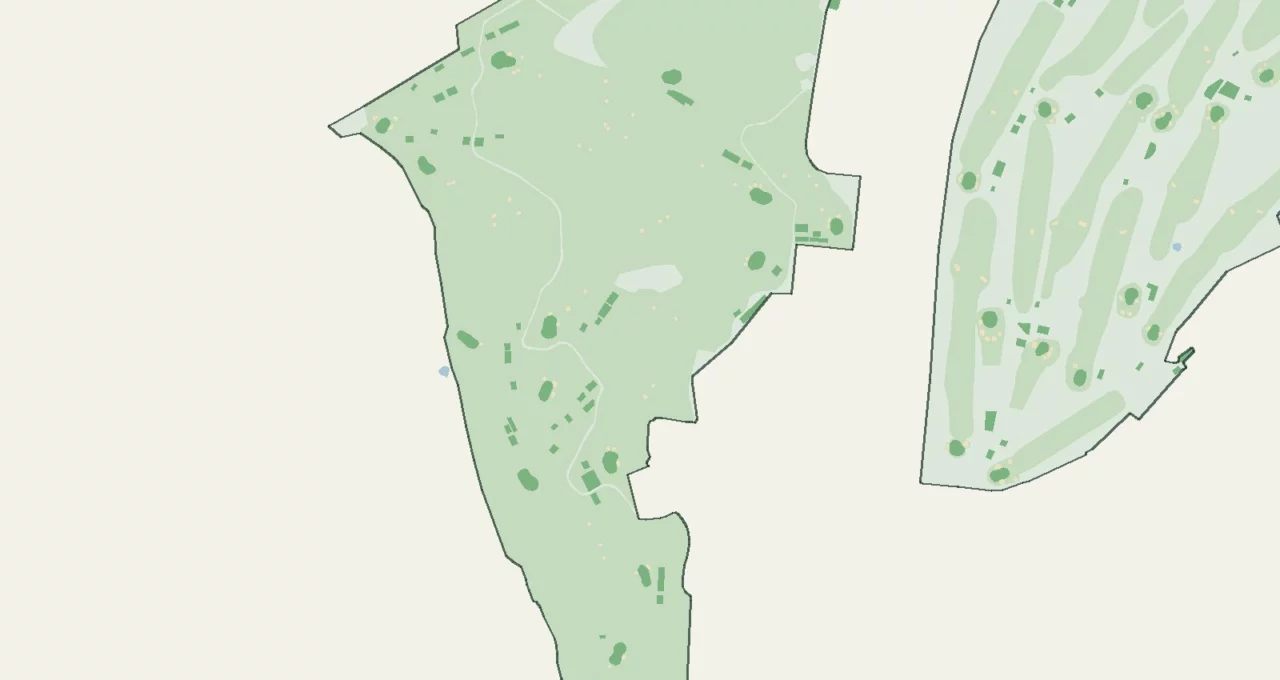
Layout of Royal Liverpool Golf Club from OpenStreetMap survey data (ODbL licence).
Royal Liverpool Golf Club
Holes
18
By
72 (men); 74 (women, black tees); 71 for the 2023 Open routing
Length
7,341 yards from the championship tees, 6,790 green, 6,331 yellow, 5,847 black (club course guide); 7,383 yards for the 2023 Open routing (Wikipedia, from the Open media guide)
Green fee
—
Best season
Visitor play from March to October on the club's 2026-27 schedule, none from November to February
Royal Liverpool Golf Club, known to almost everyone in golf simply as Hoylake, lies on the north-western corner of the Wirral peninsula, between the towns of Hoylake and West Kirby, with the Dee estuary and the hills of North Wales on one side and the Liverpool skyline on the other. The club’s address is Meols Drive, Hoylake, Wirral, CH47 4AL. It has a single eighteen-hole seaside links of par 72 for men, measuring 7,341 yards from the championship tees, 6,790 from the green, 6,331 from the yellow and 5,847 from the black tees, according to the club’s own hole-by-hole course guide. The club was founded in 1869, and it has hosted The Open thirteen times, most recently in 2023, when Brian Harman won the 151st Championship by six strokes.
Few clubs anywhere carry as much history. Hoylake staged the first Amateur Championship in 1885, the first international match between England and Scotland in 1902 and, in 1921, the match between Great Britain and Ireland and the United States that became the Walker Cup. It was here, in 1930, that Bobby Jones won the second leg of his Grand Slam. It is also one of the few great links where you can step off a suburban train a short walk from the course.
From racecourse to Open venue
According to Wikipedia, the club was founded in 1869 on what was then the racecourse of the Liverpool Hunt Club, and received the Royal title in 1871 through the patronage of Prince Arthur, Duke of Connaught, one of Queen Victoria’s younger sons. The club’s own timeline says the Liverpool Golf Club at Hoylake used the Royal Hotel as its first clubhouse. The racecourse has left its mark: the members’ first hole is still called Course and the eighteenth Stand, the seventeenth is named Royal after the old hotel, and a saddling bell from the Victorian racecourse hangs in the clubhouse. The present clubhouse, beside Meols Drive, opened in 1895.
Robert Chambers and George Morris, the younger brother of Old Tom Morris, were commissioned to lay out the original course, which the club describes as nine holes, extended to eighteen two years later. Harry Colt redesigned the links early in the twentieth century, and it has been altered many times since, mostly in answer to the distances modern players hit the ball. The Top 100 Golf Courses guide credits Donald Steel with new greens, tees and bunkers in 2001, which took the course beyond 7,000 yards; Martin Hawtree with a new 17th green, the removal of fourteen bunkers, swales around greens and broken ground in the rough in 2009 and 2010; and Martin Ebert, working with The R&A, with the most recent round of changes, including a new short hole. The club’s own course guide confirms that the 17th green complex is new since 2010 and that the second is the only green that remains from the original layout.
The club is closely associated with two of the great amateurs of the early game, both members. Wikipedia records that John Ball won the Amateur Championship eight times between 1888 and 1912 and in 1890 became the first Englishman and the first amateur to win The Open; Harold Hilton won The Open twice, in 1892 and at Hoylake in 1897, and the Amateur four times. The club marks Hilton’s 1897 win with the Harold Hilton Medal, an annual tournament for amateur golfers that Wikipedia says is open to players aged 30 or over with a handicap of five or less.
The Open list, the same on the club’s site and on Wikipedia, runs: 1897 (Harold Hilton), 1902 (Sandy Herd), 1907 (Arnaud Massy, the first winner from outside Britain), 1913 (J.H. Taylor), 1924 (Walter Hagen), 1930 (Bobby Jones), 1936 (Alf Padgham), 1947 (Fred Daly), 1956 (Peter Thomson, his third Open in a row), 1967 (Roberto De Vicenzo), 2006 (Tiger Woods), 2014 (Rory McIlroy) and 2023 (Brian Harman). The club points out that each of the thirteen was won by a different champion. After 1967 the Championship stayed away for 39 years. It came back in 2006, after the club had bought additional land and made improvements to the course, and Tiger Woods won by two strokes from Chris DiMarco; Wikipedia notes that, on a course baked hard and fast in a dry summer, he hit his driver only once all week. In 2014 Rory McIlroy won his first Open by two from Sergio Garcia and Rickie Fowler. The 151st Open was first allocated to Hoylake for 2022, and was played there in July 2023 after the cancellation of the 2020 Championship pushed the rota back a year.
The amateur record is as long. Wikipedia lists nineteen Amateur Championships at Hoylake, from the inaugural one in 1885 to June 2026, when the 131st Amateur, with a field of 288 players sharing the stroke-play rounds with West Lancashire, was won by Ireland’s Stuart Grehan, who beat the American Matt Moloney by one hole in the 36-hole final. The links has also staged the Walker Cup in 1983 and 2019, the latter in the club’s 150th anniversary year, the Curtis Cup in 1992, the Ladies’ British Amateur in 1896, 1989 and 1996, and the Women’s British Open in 2012, which Jiyai Shin of South Korea won by nine strokes, with a women’s course record of 64 in her second round.
What the course asks of you
Hoylake does not look like a classic links at first sight. Wikipedia describes the course as mostly level, with only the holes nearest the coast running through sandhills; the Top 100 Golf Courses guide counts six holes in the dunes and notes that houses border the links on three sides. What it does have is wind, and very little shelter from it. The club’s own course guide says the links demands shot selection, distance control and accuracy despite its flat appearance, and its hole notes repeatedly warn that holes play longer than their yardage.
The figures below are from the club’s course guide, which gives four tees per hole. The four totals match the 7,341, 6,790, 6,331 and 5,847 yards of the club’s tees. For men every set plays to par 72, with 36 out and 36 home; for women, playing from the black tees, the 1st and 14th become par 5s and the par is 74. Wikipedia, citing the media guide published for the 2023 Open, gives a course rating of 77.1 and a slope of 152 from the championship tees, 74.6 and 146 from the green, 72.2 and 139 for men and 78.7 and 153 for women from the yellow, and 69.4 and 127 for men and 75.1 and 146 for women from the black.
The round starts with one of the most famous opening holes in golf. Course, 425 yards from the back, is a sharp dogleg to the right around the practice ground, which is out of bounds and lies inside the course. The club’s guide puts out of bounds on one side of the tee shot and the clubhouse on the other, and advises driving as close to the corner as confidence allows, leaving an approach of some 190 yards. Road, the 2nd, is a short par 4 of 366 yards with three bunkers at driving distance and the only green left from the original course. Long, the 3rd, is a par 5 of 514 yards threading between gorse and bunkers to a two-tier green. The 4th, New, is the first par 3, 199 yards from the back, usually into a crosswind, with a cavernous bunker at the front right.
Telegraph, the 5th, is stroke index 1: a par 4 of 479 yards from the back tees and 421 from the green, with bunkers on both sides and gorse to the right, which the club says always plays a club longer than it looks. At Briars, the 6th, the first-time visitor faces an out of bounds hedge across the line about 190 yards out; the club’s advice is an easy swing to the wide part of the fairway. Dowie, the 7th, is a par 3 of 215 yards to a narrow green set among swales, and the 8th, Far, is the par 5 at the furthest point from the clubhouse, where, the club recalls, Bobby Jones took seven in 1930 on his way to the Grand Slam.
The 9th, Punch Bowl, opens the stretch of four holes along the shore, with Hilbre Island, a nature reserve in the estuary, as the backdrop to holes 9 to 12. The 10th, Dee, is a par 4 that bends left, with three bunkers on the right and broken ground in the left rough. The 11th, Alps, is a par 3 of 191 yards over mounds. The 12th, Hilbre, a long dogleg left par 4 of 454 yards, is described by the club as arguably the finest hole on the links.
The finish is long. The 13th, Field, is a par 5 of 614 yards from the back, and the 14th, Lake, a par 4 of 456 yards into the prevailing south-westerly wind to a deep two-tier green; there is, the club notes, no water on it despite the name. Then comes the 15th, Little Eye, the shortest hole on the course at 134 yards from the two back tees and 107 and 100 from the forward ones. The club says it was completely redeveloped for the 2020 season, with a new green raised into the dunes, steep run-offs on three sides and views over the Dee estuary, and named after one of the small islands visible from it. After the 2023 Open, according to The Fried Egg, the hole was refined again under Martin Ebert: a raised member tee, a short-grass run-off in place of the steep right-hand bunker and a gentler slope at the back. The same source notes that, because the hole was turned round to face the estuary, members playing from the forward tees face a walk back from the green to the next tee.
The 16th, Dun, is a par 5 of 611 yards played around the out of bounds line of the practice ground: the bold line skirts it for an easier third. The 17th, Royal, a par 4 of 458 yards, has the long, narrow green built in 2010, which the club calls one of the hardest on the course to hit and to putt. The 18th, Stand, is a par 4 of 453 yards between bunkers left and right to an undulating green.
The championship routing
For The Open, the order of play is different. At the 2023 Championship, according to Wikipedia and The Open’s course guide, play started on the members’ 17th, Royal, and the members’ 18th, so that the members’ 1st, Course, was played as the 3rd. The round then followed the members’ order and finished on the members’ 16th, Dun, a par 5 played as the 18th. Little Eye became the 17th. The Open card, as reproduced by Wikipedia from the 2023 media guide, measured 7,383 yards and par 71: the members’ 8th, Far, a par 5 for members, was played as a par 4 of 507 yards, the 10th of the Championship. On that card the 15th, the members’ 13th, measured 620 yards and the 18th 609. The par 3 that the 2014 Open had played as its 15th was the hole that made way for Little Eye.
The Open lengths have grown over the years. The 2006 Championship was played at 7,258 yards and par 72 according to the published scorecards, and the 2014 Open at 7,312 yards, also par 72. Previews of the 2014 Championship reported 13 fewer bunkers than in 2006, new swales around five greens and broken ground in the rough on four holes.
What golfers say
The points below summarise the golfer reviews published on Golfshake (around fifty reviews, the visible ones dating from 2020 to 2024), on the Top 100 Golf Courses guide (84 reviews, the most recent ones from 2023 to 2026) and on GolfPass, where there is a single review. They are other people’s opinions, not ours. Nobody from Panxis has played the course, and we name no reviewer.
What comes up in its favour
- The quality of the test. Reviewers describe a strategic, demanding links where every hole asks a question, and many say it improves with each round.
- Condition. Immaculate fairways and greens come up again and again, and several reviewers note how well the links drains, even after heavy rain.
- The welcome. Reviewers praise the staff, the starters and a clubhouse where visitors are treated as members for the day, which is also how the club puts it.
- History. Walking the links of Hilton, Ball, Jones and the modern Open champions, and seeing the memorabilia in the clubhouse, is a large part of the appeal.
- The coast holes, from the 9th to the 12th, with Hilbre Island and the estuary, and the run of strong finishing holes.
What comes up against
- A flat, plain first impression. Several reviewers found the opening holes underwhelming and the setting less dramatic than other Open links, with few dunes and houses around much of the course.
- Variety. On the Top 100 guide it is the lowest-scored category, and a few reviewers say the course did not fully live up to its reputation for them.
- Difficulty. Deep rough, many bunkers, out of bounds close to play and the wind make it a hard course for higher handicaps, and Golfshake warns that it does not suit beginners.
- Value for money is the lowest-scored category on Golfshake, and pace of play draws mixed comments.
- Little Eye divides opinion: some find it penal for ordinary golfers, and the walk from its green to the next tee is a recurring complaint.
Getting there and when to go
Hoylake is one of the best-connected Open venues. The club itself points out that there is a railway station very close by, with a frequent service to Liverpool and connections towards Chester. By our measurement on the map, Hoylake and West Kirby stations, both on the Merseyrail Wirral line, are each about two-thirds of a mile from the middle of the course. The club says Liverpool is within about 30 minutes.
Visitors are welcome but play on set days. The club’s tee booking page says that in normal weeks the visiting golfer allocation is on Monday, Tuesday and Friday, subject to availability, and that tee times are booked through the reservations team by telephone or email; when we read it in October 2026 the club said its 2027 visitor diary was open, and its current visitor schedule shows no visitor play from November to February. The club’s visitor notes add that weekend visitor play is not normally allowed, that Thursday is Ladies’ Day, that members have exclusive tee rights at set times and that all play starts from the 1st tee. Visitors must be competent golfers with a current club or society handicap; the club states no maximum, while the 1Golf and Golfshake listings give limits of 21 for men and 32 for women, and Golfshake also gives 20.
Caddies, forecaddies, electric trolleys and hire clubs are booked in advance through the shop, where the head professional acts as caddie master; pull trolleys are available on the day, and buggies only for golfers with a medical certificate. Practice facilities include short and long game areas and a large putting green in front of the clubhouse. The dress code is traditional: shirts tucked in, tailored knee-length shorts with long socks for men, no denim, training shoes or round-neck T-shirts, a jacket and tie upstairs after 6pm, and phones on silent on the course and away from the clubhouse except in the main reception.
The visitor season, on the club’s own schedule, runs from March to October. Wind is the course’s main defence whatever the month, and the Opens have all been played in summer, on firm, fast ground. In any season, check the latest visitor allocation with the club before planning a trip, since championships and club events take priority.
How this page was made
The factual frame comes from public sources: OpenStreetMap for the location and our distance measurements; the club’s website, read in October 2026, for the address, the hole-by-hole course guide with yardages, pars and stroke indexes, the timeline of the club’s history, the course history, the clubhouse, the visitor days, the visitor rules and the local area; the English Wikipedia article on the club for the foundation, the royal title, the architects, the list of championships, the course ratings and the 2023 Open card, which it takes from the official media guide of that Championship; The Open’s course guide for the 2023 routing; the Top 100 Golf Courses guide for the later changes to the course and its golfer reviews; The Fried Egg for the refinements to Little Eye after 2023; Golf Today, the Irish Times and Golf Bible for the 2026 Amateur Championship; ESPN’s published scorecards and previews by the Associated Press for the 2006 and 2014 Open lengths; Golfshake, GolfPass and 1Golf for golfer reviews and visitor listings. Wikidata identifies the club as Q2180101.
Where sources disagree, we say so. Wikipedia gives two slightly different sets of ratings from the same media guide: 77.1 and 152 or 77.0 and 152 from the championship tees, 74.6 or 74.5 from the green, and slopes that differ by one point on the yellow and black tees; Golfshake gives different standard scratch figures again, and an overall length of 7,350 yards. Wikipedia lists the black tee at the 1st as 395 yards, the club 396; the club’s note on the 14th speaks of 459 yards while its table says 456. The Top 100 guide says the course was lengthened by 90 yards for the 2014 Open, while the published Open cards give 7,258 yards in 2006 and 7,312 in 2014, a difference of 54. The Top 100 guide credits Martin Hawtree with removing fourteen bunkers in 2009 and 2010, while 2014 previews spoke of thirteen fewer than in 2006. Early previews of the new short hole called it Rushes; it was named Little Eye. The club describes the original 1869 layout as nine holes; Wikipedia does not give the number. The maximum handicap for visitors appears only in third-party listings, which disagree with each other, and not on the club’s own pages. OpenStreetMap places the course in the borough of Wirral, which is correct, with Hoylake as the town.
The opinion section summarises the golfer reviews on Golfshake, the Top 100 Golf Courses guide and GolfPass, read in October 2026. We report recurring themes rather than individual voices, and we reproduce no quotations from reviewers. Nobody from Panxis has played or visited this course, and this page is no substitute for a round.
The club has not paid for this page, has not seen it before publication and has no say over its content. This page contains no commercial link and earns us no commission. If you know the club and something here is wrong or out of date, write to us and we will correct it.
Other courses nearby
Closest to this one in our British directory:
- Huyton & Prescot Golf Club — 16 mi
- Longridge Golf Club — 41 mi
- Storws Wen Golf Club — 44 mi
- Huddersfield Golf Club — 60 mi
The hole to know
Little Eye, a par 3 of 134 yards from the back tees, rebuilt for 2020 with a green raised into the dunes facing the Dee estuary and run-offs on three sides; it was the 17th hole of the 2023 Open.