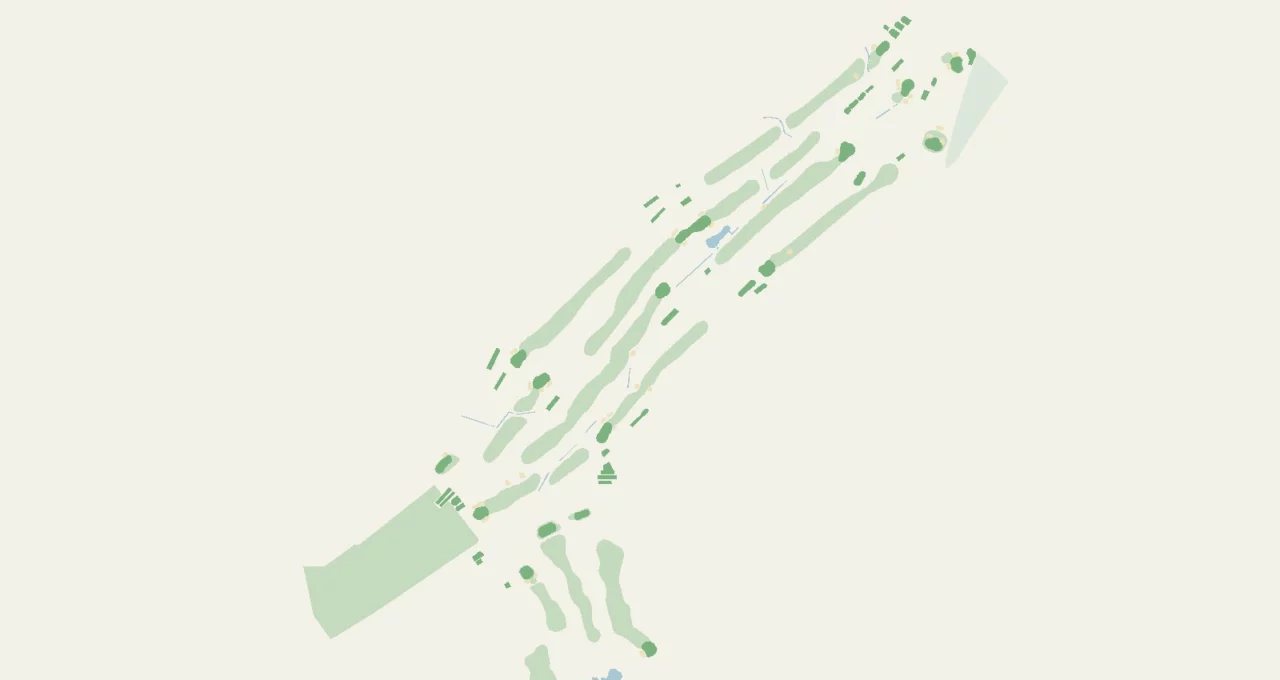
Layout of Longridge Golf Club from OpenStreetMap survey data (ODbL licence).
Longridge Golf Club
Holes
18
By
70 (white and yellow); 71 (red)
Length
5,904 yards from the white tees, 5,673 yellow, 4,979 red (club scorecard); 5,974 yards in the club's course introduction
Green fee
—
Best season
Year-round; preferred lies in season (club course status)
Longridge Golf Club sits high on Longridge Fell, the most southerly fell in England, a few miles north-east of Preston in Lancashire. The clubhouse is Fell Barn, on Jeffery Hill above the town of Longridge, postcode PR3 2TU, and the club places itself in the Forest of Bowland Area of Outstanding Natural Beauty, looking out over the Ribble Valley. Wikidata puts the course in the parish of Thornley-with-Wheatley, in the Ribble Valley district. The eighteen holes measure 5,904 yards and par 70 from the white tees on the club’s current card, with a standard scratch of 70. That is short by modern standards, and the club says so itself before adding the two things that make up the difference: greens that are a true test of putting, and a wind that can make the course play very like a links. The club describes itself as one of Lancashire’s oldest, and its history is unusual even by the standards of old clubs, because it began not as a golf club at all but as a cycling club, founded in Preston in 1877.
The course is not a famous one outside the county, and it does not appear in the national rankings. What it offers instead is a site: a hillside some 744 feet up, according to Wikipedia’s figure for the clubhouse, with views that the club lists as reaching the Ribble Valley, the Forest of Bowland and the Fylde coast.
From penny-farthings to Fell Barn
The club’s own history, published on its website in five parts, starts in a hotel bar. In 1877 a group of cyclists met at the White Horse Hotel on Friargate in Preston, and a week later at the Mitre Tavern on Fishergate formed a committee: Charles Horridge as honorary secretary, Dr Spencer as president and Harcombe Cuff as the first captain of Preston Cycling Club. For fifteen years it remained a small club of enthusiasts with runs on Wednesday evenings and Saturday afternoons. In 1892, with around 30 members, it rented a rambling country house called Broad Fall at Scorton, north of Preston, and slowly turned from a cycling club into a country club. The members rebuilt the house themselves and laid out a nine-hole golf course on the land around it. A report in the Lancashire Evening Post of April 1895, reproduced by the historical website Golf’s Missing Links, mentions golf as one of the latest additions to outdoor recreation at Scorton, and that site dates the golf section to 1895.
In August 1911 the thatched roof of Broad Fall caught fire and the house burned down. A Fleetwood Chronicle report of the time, also quoted by Golf’s Missing Links, says the members were playing golf on the adjoining links when the fire broke out and tried to put it out with buckets of water. Early in 1912 the club moved to another rented house, Inglewhite Lodge, which it had to leave in the autumn of 1915.
Meanwhile a separate Longridge Golf Club already existed. The Preston Herald reported in June 1913 that its members had decided to move their links from low-lying land at Alston to higher ground near Jeffrey Hill, a site said to command one of the finest views in Lancashire, and in August 1913 that play had begun over the full new course. The club’s history describes those golfers on a little nine-hole course a thousand feet up on Longridge Fell, with a small wooden hut for a clubhouse and an old barn beside it that they could not afford to buy. It also repeats a local tradition that troops had been camped on the fell in the 1850s to harden them for the Crimea.
The cyclists, now with money in the bank and determined to buy rather than rent, came to the fell. According to the club, William Ord, Gilbert Starkie and Laurie Clarke signed the deeds on 9 March 1917, and Preston Cycling Club acquired Fell Barn and 29 acres of land for £550, on the understanding that the two clubs would merge. The barn itself, the club says, had been a secret meeting place for Catholic Mass in the 1650s, and a deed of 1799 describes it as a dwelling house, weaving shop, shippon and hay roost. The members converted it into a clubhouse with their own labour. In the 1920s as many as 30 members could stay the Saturday night. The Depression and the Second World War ended the residential country club, and for some years afterwards, in the history’s own words, Longridge was a small and not particularly fashionable golf club.
The change came in the 1960s. The club took the name Longridge Golf Club and Preston Cycling Club, the order of the words reflecting the new priorities, and in 1963 built a ladies’ room, a dining room and a new bar. With a grant from the North West Regional Sports Council, approved in February 1970, and about half the money raised by the members, it bought 56 acres of the Derby Estate for nine new holes. The members built most of them by hand. They laid eleven new tees, cleared rock and dismantled dry stone walls; the history counts nearly 6,000 tons of stone moved, nearly 5,000 tons of topsoil and 9,650 square yards of turf. The greens were laid by a local contractor under the eye of Ray Birkbeck, the member in charge of the works, and the greenkeeper John Nicholson. No golf course architect is named in the club’s account or in any other source we read. The eighteen-hole course opened on 28 August 1971, in wind and rain, at 5,886 yards and par 71. A larger clubhouse followed in 1974, and the history ends with the members owning the 86 acres on which the course stands.
What the course asks of you
From the white tees the front nine is 3,014 yards and the back nine 2,890, each a par 35. From the yellow tees the course is 5,673 yards, par 70, standard scratch 69; from the red tees 4,979 yards, par 71, standard scratch 70. The club does not publish a slope rating on its site. There are two par 5s and four par 3s, and much of the challenge lies in the slopes. According to Wikipedia, four holes, the 1st, 2nd, 17th and 18th, lie on the south side of Forty Acre Lane and run up and down the hill, while the other fourteen sit on the north side and follow the ridge of the fell. The club’s buggy route has players crossing the road after the 2nd and again after the 16th.
The 1st, 329 yards, is a gentle start in the professional’s guide: no need for a driver, out of bounds on the left, and anything running over the crest of the hill tends to roll down to about 50 yards from the green. The pitch is to what the guide calls a tricky Mackenzie green, with a water hazard beyond it. The 2nd, only 254 yards, is harder than it looks because the slope makes the stance awkward; trees block the drive that goes right, bunkers guard both sides of the front of the green, and the guide warns that a putt from above the hole can be very tricky in summer, when the green is fast.
Across the road, the 3rd is the first of the par 5s at 513 yards, with trees either side of the fairway and a water hazard on the right. The professional suggests laying up between two clumps of trees and notes that the green, which slopes from left to right, is an original one, typical of what all the greens on the course were once like. The 4th, a par 4 of 424 yards and stroke index 5, wants the drive on the right side of a sloping fairway; balls kicking left are caught by a shallow bunker before they reach the water, and the guide again calls the green a Mackenzie green. The club does not explain the name, and we found nothing that links it to any particular architect. The 5th is a par 3 of 180 yards to a green sloping from back to front, with bunkers and a ditch for the short shot.
The 6th is stroke index 1, a par 4 of 436 yards that is often played into the prevailing wind. An open ditch waits on the left, trees on the right, and a second ditch crosses the fairway about 150 yards from the green, which is guarded by water on the left and shares its surface with the 10th. The 7th, 394 yards and stroke index 3, has out of bounds all down the right and a fairway sloping from the left; the guide warns that the views may make you complacent and that the wind tends to blow strongly from the west. The 8th is the hole the professional calls arguably the best on the course, a par 3 of 213 yards from the whites with a strong slope to the left, two bunkers and an out of bounds wall to the right, and a long, narrow green. The 9th, a par 4 of 271 yards uphill, is driveable for long hitters, but a bunker 50 yards short of the green and a ditch along the left catch many, and the green is exposed to the westerly wind.
The 10th, 372 yards, asks for a blind drive at a marker post, between trees on the right and a large crater on the left, to set up a second into the double green shared with the 6th; the guide says the approach looks shorter than it is. The 11th is the second par 5, 484 yards, a slight right to left dogleg from a remodelled tee, with out of bounds down the left, gorse and young trees on the right, two ditches across the line and a bunker 30 yards short of the green. Then come two short holes. The 12th, 137 yards, is the shortest on the course but plays longer than you expect, with a blind tee shot to a very tricky green; the professional’s advice is to take two putts and be thankful. The 13th, 167 yards, has out of bounds over the wall on the left and beyond the green, bunkers at the front and on both sides, and a front bunker closer to the green than it looks.
The 14th, 438 yards and stroke index 2, is played from a new back tee with out of bounds over the wall on the left and thick rough on the slope to the right for the whole length of the hole; undulations short of the green can kick the ball offline. The 15th, 371 yards, has deep rough to the left, a water ditch to the right and bunkers around the green. The 16th, 330 yards, has out of bounds on the left, a ditch across the fairway and three bunkers between it and the 3rd fairway. Back across the road, the 17th, 283 yards, plays steeply downhill to a green guarded by bunkers and a ditch in front, with out of bounds down the right. The 18th, 308 yards, climbs straight uphill to a narrow green in front of the clubhouse with out of bounds immediately behind it, so the last approach needs careful distance control. One online reviewer noted that you can see from the bar whether anyone hits the clubhouse with their approach.
What golfers say
Public opinion on Longridge is thin and mostly old. The points below summarise the user reviews on Today’s Golfer, which date from 2009 to 2015, and two testimonials from visiting societies in 2016 that the club itself publishes and has chosen. They are other people’s opinions, not ours. Nobody from Panxis has played the course, and we name no reviewer.
What comes up in its favour
- The views, by a distance. Reviewers describe seeing Preston, Blackpool and its tower, the Pennines and, on a clear day, the hills of the Lake District and North Wales.
- The greens, described as in very good or exceptional condition and, in summer, very quick.
- A different kind of test for the North West: an exposed hilltop course that plays almost like a links when the wind blows, with room for the driver on most holes.
- The welcome. Several mention a friendly clubhouse, good food and helpful staff, and the society testimonials praise the catering and the organisation of the day.
What comes up against
- Exposure. On top of the fell the course is open to the elements, and reviewers warn that wind and rain make it a very different proposition.
- Uneven lies. Being on a hillside, the course produces uphill, downhill and sidehill stances throughout the round.
- Patchy fairways in places, which one reviewer put down to the soil rather than to the greenstaff.
- Some holes become very easy downwind, while others, notably the long par 3, are a real problem into a strong wind.
Getting there and when to go
The club says it is about ten minutes from junction 31A of the M6, and publishes detailed directions on its location page: from the south via the B6242 and B6243 through Grimsargh to Longridge, then up Kestor Lane and on towards Jeffrey Hill; from the north via junction 32, the Garstang road and Goosnargh. The final stretch follows a sign for the golf club up a hill with a sharp bend, and the car park is on the right. The nearest railway station is Preston, about eight and a half miles away in a straight line by our measurement on the map, rather more by road; Longridge town centre is a little under two miles from the course.
Visitors book tee times online through the club’s booking page, from the 1st and 10th tees. The club’s green fees page says bookings are taken up to ten days in advance, and that parties of more than eight should contact the club secretary. The rates it lists cover weekdays, Saturdays after 1pm and Sundays, with separate rates for juniors, students, members’ guests and county card holders. Societies are offered packages with catering, buggy hire, a halfway house, nearest the pin and longest drive competitions, practice areas and clinics with the club’s PGA professionals. The club publishes its buggy route hole by hole, with strict instructions on the steepest slopes: drivers must be over 17 and not disqualified from driving, some holes are path only, and on the 17th the instruction is to drive straight down the slope with the brake applied. Upstairs in the clubhouse, the Greenwood Bar looks out over the Ribble Valley; the Campaign for Real Ale’s guide, surveyed in 2024, notes snooker, darts and quoits there.
The course is open all year. On the day we checked in October 2026, the club’s course status read open, with preferred lies on fairways and closely mown areas. The clubhouse opens from 7.30am to 8pm in summer and 8.30am to 5pm in winter, depending on daylight. Being so exposed, the course is at its best on a clear, settled day from late spring to early autumn, when the greens are at their fastest and the views at their longest. In winter, check the course status before setting out.
Green fees
Visitor rates vary by season and by day and are published by the club on its green fees page, with tee times bookable through its online booking page. On the day we checked, the green fees page still showed the winter rates for 2025 to 2026, so check the booking page for the current price.
How this page was made
The factual frame comes from public sources: OpenStreetMap for the location; the club’s website, read in October 2026, for the address, the five-part history, the scorecard, the hole by hole guide and professional’s tips, the buggy route, the directions, the opening hours, the visitor booking and green fees pages, the society arrangements and the testimonials; Golf’s Missing Links for the press reports of 1884, 1895, 1911 and 1913; the English Wikipedia articles on the club and on Longridge Fell for the elevation, the layout either side of Forty Acre Lane and the views; Today’s Golfer for its course listing and user reviews; GolfNow and GolfToday for their listings; the Campaign for Real Ale’s pub guide for the bar; Wikidata for the identifiers. The distances to Preston station and Longridge are our own measurements.
Where sources disagree, we say so. The club gives the course length as 5,904 yards on its home page and scorecard but 5,974 yards in the introduction to its course pages; GolfNow repeats both figures, and Today’s Golfer gives 5,969. The opening date of the golf club varies: Golf’s Missing Links dates the golf at Scorton to 1895, the press reports show a Longridge Golf Club on its new links by 1913, Wikipedia says the club was founded around 1915 and GolfNow gives 1915 as the year the course was built, while the club itself, through the cycling club, traces its roots to 1877. The club dates the deeds of Fell Barn to 9 March 1917, Wikipedia the merger to 17 March 1917. The club’s own pages spell the clubhouse Fern Barn in their footer and Fell Barn elsewhere, and spell the hill both Jeffery and Jeffrey. Wikipedia says the clubhouse doubles as the home of the Preston Wheelers cycling club, while the club’s history speaks of Preston Cycling Club. The club’s history places the early golf course a thousand feet up the fell, while Wikipedia gives the clubhouse elevation as 744 feet. The two versions of the club’s location page give different opening hours for the professional’s shop. Some directories describe a course of par 69 or 72 with a par 5 alongside a reservoir; nothing in the club’s card supports this, and we have not used them. We could not read GolfPass reviews, and we use nothing from them.
The opinion section summarises the user reviews on Today’s Golfer and the testimonials published by the club, read in October 2026. We report recurring themes rather than individual voices, and we reproduce no quotations from reviewers. Nobody from Panxis has played or visited this course, and this page is no substitute for a round.
The club has not paid for this page, has not seen it before publication and has no say over its content. This page contains no commercial link and earns us no commission. If you know the club and something here is wrong or out of date, write to us and we will correct it.
Other courses nearby
Closest to this one in our British directory:
- Skipton Golf Club — 24 mi
- Huyton & Prescot Golf Club — 31 mi
- Huddersfield Golf Club — 34 mi
- Royal Liverpool Golf Club — 41 mi
The hole to know
Par 3 of 213 yards from the white tees, with a strong slope to the left, two bunkers and an out of bounds wall to the right and a long, narrow green; the professional calls it arguably the best hole on the course.