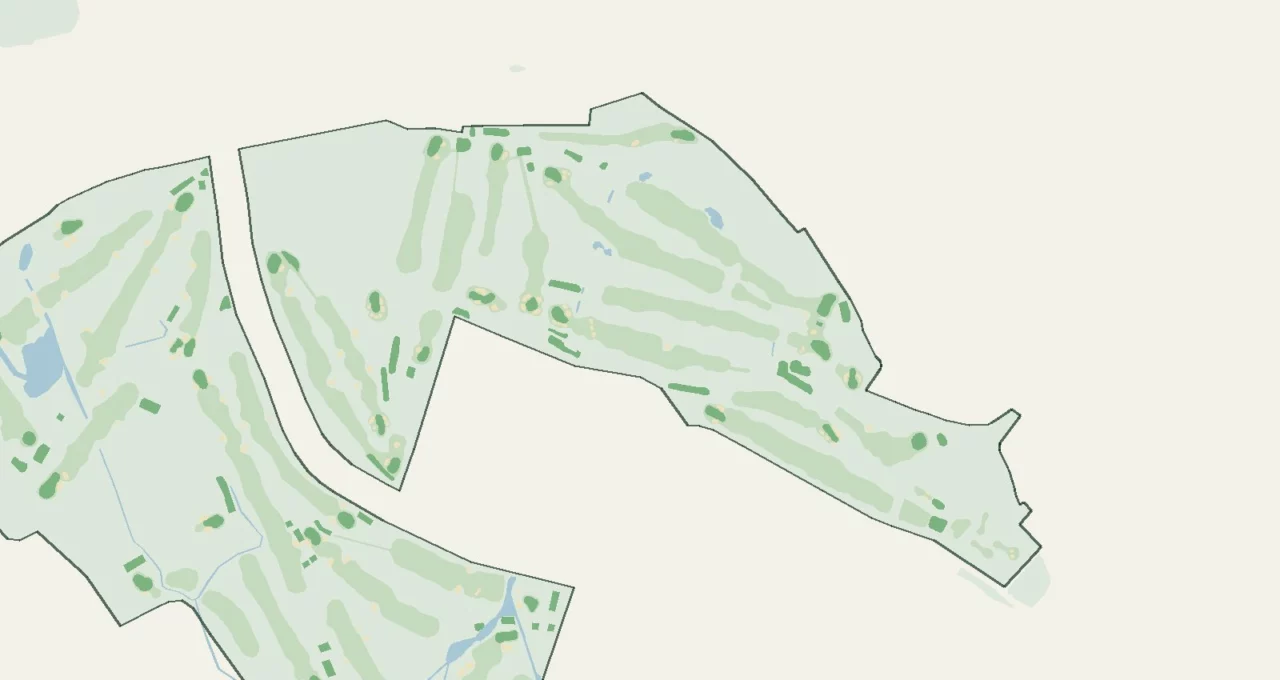
Layout of Chorlton-cum-Hardy Golf Club from OpenStreetMap survey data (ODbL licence).
Chorlton-cum-Hardy Golf Club
Holes
18
By
70 for men from all tees; 72 for women from the red tees (club scorecard 2024)
Length
6,040 yards from the white tees, 5,843 yellow, 5,389 red (club scorecard 2024); other sources give 5,994 to 6,048 yards from the back tees
Green fee
—
Best season
—
Chorlton-cum-Hardy Golf Club is an 18-hole members’ parkland course on Barlow Hall Road, in the southern suburbs of Manchester, about four miles from the city centre according to the club. It lies on the north bank of the River Mersey, which is all that separates it from Sale Golf Club on the far side, and its clubhouse is Barlow Hall, a Grade II listed manor house that was the birthplace of the Catholic martyr Saint Ambrose Barlow. The club keeps its own website at chorltoncumhardygolfclub.co.uk, with a scorecard, a hole-by-hole page and visitor information.
The club’s 2024 scorecard gives a par of 70 and 6,040 yards from the white tees, with a course rating of 70.5 and a slope of 137. That is short by modern standards, and the club does not pretend otherwise: its pitch rests on narrow fairways, water and an old dyke that crosses the layout, and well protected greens that it describes as fast and true. Visitors are welcome seven days a week, the club says, and tee times can be booked online or through the professional’s shop.
Barlow Hall, the clubhouse
Barlow Hall is the reason most write-ups of the club start with history. Historic England first listed the building at Grade II on 3 October 1974, with an amendment in 1994, and describes it as a manor house, now a golf club, with a sixteenth and seventeenth century core, eighteenth and nineteenth century additions and later twentieth century alterations. It was originally built as four ranges around a courtyard; the east range has gone. The listing notes that the house was badly damaged by fire in 1879 and partly reduced in the twentieth century, and it singles out a timber-framed, jettied oriel on the former hall, with a twelve-light window whose stained glass includes a pane lettered 1574.
The club’s own history page goes further back. It says a dwelling has stood on the site for over 800 years, probably timber-built at first and close to the Mersey, and that the Barlow family, an eminent Catholic family, lived there for some five centuries. It credits Alexander Barlow with rebuilding the hall in 1584, records a fire on 19 March 1879 that spared the 1574 bay window and the oriel above it, and repeats the local tradition of a priest hole and of an underground passage running about a mile to Hough End Hall. The club presents the passage as a belief, not a fact, and so do we.
The best known member of the family is Edward Barlow, known in religion as Ambrose. He was born at the hall in 1585, became a Catholic priest, was hanged at Lancaster in 1641 for his faith, and was canonised in 1970 as Saint Ambrose Barlow. The Wikipedia article on the club adds that his ghost is said to haunt the upper floors; that is folklore, and we pass it on as such.
From tenancy to ownership
The club gives 1902 as its foundation year on its home page and its Barlow Hall page, and National Club Golfer, Golfshake and Hole19 follow it. The Wikipedia articles on the club and on Barlow Hall instead give 1903, citing the club’s own clubhouse page as it stood in 2007 and The Golfing Annual of 1910. Companies House records that The Chorlton-cum-Hardy Golf Company Limited was incorporated on 28 June 1905. National Club Golfer says that in 1905 the members leased Barlow Hall as their clubhouse and opened the 18-hole course, which fits the incorporation date, and that the members bought the land and the hall in the 1950s. The company was renamed Barlow Hall Manor Ltd on 9 April 2021 and is still active.
The Wikipedia article on the club also states that a golf course existed on the site for centuries before the club was formed. We found no source for that claim and treat it with caution. The same article records that the club hosted the Mersey Championship in September 2011.
No source we read names the architect of the course, and none of the directories we checked fills in a designer field. We have not attributed it to anyone.
What it asks of you
The club’s scorecard has four sets of figures. From the white tees the course measures 6,040 yards, par 70, rated 70.5 with a slope of 137. From the yellow tees it is 5,843 yards, par 70, rated 69.4 with a slope of 134. Men playing from the red tees face 5,389 yards, par 70, rated 67.4 with a slope of 125. Women play the same red tees as a par 72, because the 1st and the 7th become par 5s, with a rating of 72.2 and a slope of 136. A slope well above the neutral figure of 113 means the course plays considerably harder for a higher handicap golfer than its modest yardage suggests, and that is the recurring theme in every description of Chorlton.
The shape of the card is unusual. The front nine, 3,278 yards and par 36 from the whites, holds most of the length; the inward nine is only 2,762 yards and par 34, with two of the four short holes. There are just two par 5s, the 8th and the 16th. Several par 4s are short enough to tempt a driver and narrow enough to punish one: the 2nd, 5th, 6th and 18th all measure under 290 yards from the back tees. The real tests are the long par 4s, notably the 1st, the 3rd and the 7th.
The ground itself, as the club describes it, is mainly low-lying meadowland beside the Mersey, planted with trees over the years. Two features break the flat: the ancient dyke that crosses the course and comes into play as a hazard, and the higher land of Spion Kop and Barlow Wood. Water comes into play on several holes, according to the club, and the greens are well guarded. Reviewers on Golfshake add that the holes are close together and that several greens are protected by more than one bunker; other descriptions mention undulating fairways and multi-tiered greens.
Holes that stand out
Yardages are from the club’s 2024 scorecard, white tees, unless stated otherwise. The descriptions draw on the National Club Golfer course page, the only detailed hole notes we found.
- 1st: par 4, 431 yards, stroke index 5. An opening hole with out of bounds on both sides of the fairway. National Club Golfer relays a story that Peter Alliss called it one of the toughest stroke index 5 holes in the country; we could not trace the original remark.
- 4th: par 3, 188 yards, stroke index 9. The longest of the short holes, with a bunker in front of the green. National Club Golfer says it plays to an average well above par.
- 7th: par 4, 472 yards, stroke index 1. The hardest hole on the men’s card and, for women, a par 5. It finishes uphill, and National Club Golfer calls it one of the longest par 4s in the North West.
- 8th: par 5, 527 yards, stroke index 11. The longest hole on the course.
- 14th: par 4, 388 yards, stroke index 2. National Club Golfer notes a crater from a Second World War bomb on the right.
- 15th: par 4, 331 yards, stroke index 10. Long and narrow in character despite its yardage, with out of bounds on the left, trees on the right and a hollow by the green known as the Valley of Sin.
- 16th: par 5, 519 yards, stroke index 6. A hole crowded with features: ruins, trees, a pond, grass bunkers, ditches, crab apple trees and a pot bunker, according to National Club Golfer.
- 17th: par 3, 125 yards, stroke index 18. See below.
- 18th: par 4, 265 yards, stroke index 16. A short closing hole played towards the clubhouse; the club says the action on it can be watched from the sun lounge and balcony of Barlow Hall.
The 17th, a short hole behind an oak
National Club Golfer names the 17th as the signature hole. It is the shortest on the course, 125 yards from the white tees on the club’s current card and 113 from the reds, and stroke index 18, but a small oak tree in the line of play forces a high, lofted tee shot. It comes straight after the busiest hole on the course and just before a short par 4 home, so it is the kind of hole that decides a match rather than one that defines a round.
What golfers say
Chorlton is reviewed on golf booking and review platforms, chiefly Golfshake, GolfPass and Hole19, and on general travel and map sites. Golfshake’s category scores put hospitality and value at the top and practice facilities, food and drink and course condition at the bottom. The points below summarise what recurs. They are other people’s opinions, not ours; nobody from Panxis has played the course, and we name and quote no one.
What comes up in its favour
- The greens are the most praised feature, often described as quick and true, including in wet weather.
- Course condition in general, fairways and tees included, is usually described as good.
- Golfers find the course interesting and challenging for its length, with varied holes that demand accurate tee shots and thoughtful play.
- Staff and members are described as friendly and welcoming, and the bar and catering team come in for praise on travel sites.
- The clubhouse and its setting are a draw in their own right, and value for money is generally rated well.
What comes up against
- Tight fairways, close-together holes and frequent obstacles make it unforgiving for higher handicappers.
- Some golfers find it short, and in dry summers the course can play firm and bouncy, which makes approach shots hard to hold.
- Low-lying ground means occasional reports of boggy conditions.
- Some recent reviews describe patchy fairways and inconsistent green speeds, against the generally favourable picture.
- Practice facilities and, on Golfshake, food and drink score below the rest; slow play behind society groups is mentioned too.
Facilities and how to play it
Chorlton is a members’ club that welcomes visitors. The club says tee times are available seven days a week; they can be booked online through the club’s visitor booking system or by calling the professional’s shop on 0161 881 9911. Societies are welcome on most days of the week, including Sundays, with packages that combine golf and catering for groups of at least twelve; enquiries go to the club secretary on 0161 881 5830 or secretary@cchgc.co.uk. The club also runs open competitions through the season, listed on its website.
Two-seater buggies, GPS electric trolleys and pull trolleys are available for hire and must be reserved in advance with the professional’s shop. The home page carries a course status panel that shows whether the course is open, whether preferred lies, fairway mats or temporary greens are in use and whether trolleys and buggies are allowed, which is worth checking in winter on a course this close to the river.
The professional’s shop stocks clothing and equipment, offers a repair workshop and opens daily, from early morning to late afternoon or early evening depending on the day. The professionals give lessons and run an indoor swing studio with a launch monitor and swing analysis system. The club mentions an indoor academy on its home page; it does not describe any outdoor driving range, and reviewers rate practice facilities as the weakest part of the offer.
In Barlow Hall itself, the ground floor holds the bar, a sun lounge, the dining room and a snooker room, along with the men’s locker room; the women’s locker room is on the first floor. The dining room seats up to 170, according to the club, and the hall is hired out for functions.
Getting there and when to go
The club is at Barlow Hall, Barlow Hall Road, Chorlton-cum-Hardy, M21 7JJ, the postcode the club gives for satellite navigation. It says the course is just off junction 5 of the M60, which makes it easy to reach by car from elsewhere in Greater Manchester or from Cheshire.
Without a car, Transport for Greater Manchester’s route 86 runs from Piccadilly Gardens in the city centre to Chorlton along Barlow Moor Road, with a stop by Barlow Hall Road, and it also calls at the Barlow Moor Road Metrolink stop. Check the walk from the stop down Barlow Hall Road to the clubhouse on a map before travelling with clubs.
The club does not publish seasonal opening hours for the course. The low-lying, riverside ground suggests that late spring to early autumn is the most reliable window for a visit, when the course drains best and buggies are most likely to be allowed; in winter, check the course status panel before setting out.
Green fees
Visitor, reciprocal and society rates are set by the club: see the club’s green fees page for current prices.
How this page was made
The factual frame comes from public sources: OpenStreetMap for the location and outline of the course; Wikidata for the identifiers; the club’s website for the scorecard, ratings, slopes, stroke indexes, the 1902 foundation date, the description of the course, the history of Barlow Hall as the club tells it, the clubhouse, booking, societies, hire, the professional’s shop, coaching and the postcode; Historic England’s list entry for Barlow Hall, read through British Listed Buildings, for the listing, the building’s dates and the 1879 fire; the Wikipedia articles on the club and on Barlow Hall for the 1903 date, Ambrose Barlow, the Egerton sale and the 2011 Mersey Championship; Companies House for the 1905 incorporation and the 2021 change of name; National Club Golfer for the 1905 lease, the purchase in the 1950s and the hole notes; Golfshake and GolfNow for their own yardages and ratings; Transport for Greater Manchester for the bus route; and Golfshake, Hole19, GolfPass, Tripadvisor and Wanderlog for the opinions summarised above.
Where sources disagree, we say so. The foundation year is 1902 for the club, National Club Golfer, Golfshake and Hole19, and 1903 for Wikipedia; the company behind the club dates from 1905. Back-tee length is 6,040 yards on the club’s card, 6,048 yards on GolfNow and Golfshake, and 5,994 yards on another Golfshake total and on Golfing Record. National Club Golfer gives the 7th as 470 yards and the 17th as 131 yards, against 472 and 125 on the club’s 2024 card, and one directory lists the 7th as a par 5 from the white tees, which is true on the club’s card only for women. The club’s card shows the 10th one yard longer from the yellow tees than from the whites, which looks like a typing error. On Barlow Hall, the club speaks of a thirteenth century hall, while Historic England dates the standing building to the sixteenth and seventeenth centuries. The club places the 1584 rebuilding in the reign of Henry VIII and National Club Golfer in that of Henry VII; 1584 actually fell in the reign of Elizabeth I. The club says the last Barlow at the hall died in 1773, and Wikipedia, citing the Victoria County History, says the estates were sold to the Egertons in 1785. The club’s postcode is M21 7JJ; Companies House records the registered office under M21 2JJ.
The opinion section summarises reviews on golf booking platforms, review sites and travel guides, read in October 2026; several of these sites refused our requests, so we relied on the parts we could read and on their published summaries. We report recurring themes rather than individual voices, and we reproduce no quotations from reviewers. Nobody from Panxis has played or visited this course, and this page is no substitute for a round.
The club has not paid for this page, has not seen it before publication and has no say over its content. This page contains no commercial link and earns us no commission. If you know the course and something here is wrong or out of date, write to us and we will correct it.
Other courses nearby
Closest to this one in our British directory:
- Huyton & Prescot Golf Club — 22 mi
- Huddersfield Golf Club — 26 mi
- Longridge Golf Club — 32 mi
- Waterton Park Golf Club — 37 mi
The hole to know
The signature hole according to National Club Golfer: a par 3 of 125 yards from the white tees on the club's 2024 card, stroke index 18, where a small oak tree in the line of play forces a high, lofted tee shot.