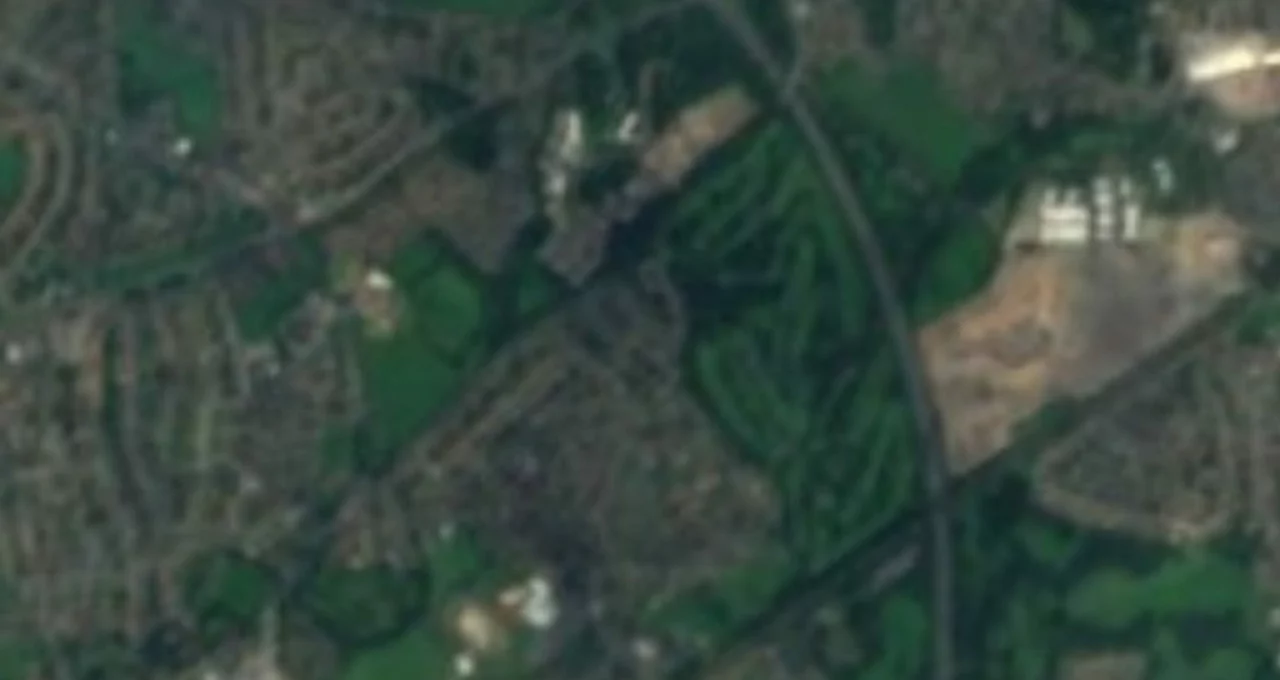
Huyton & Prescot Golf Club from space. Sentinel-2 cloudless 2016 by EOX IT Services GmbH (contains modified Copernicus Sentinel data), CC BY 4.0.
Huyton & Prescot Golf Club
Holes
18
By
68 (men's tees); 70 from the red tees
Length
6,021 yards from the white tees, 5,705 yellow, 5,252 red (rated card via Golfshake and Golf Sherpa)
Green fee
—
Best season
—
Huyton & Prescot Golf Club is a private members’ club at Hurst Park, Huyton, Merseyside, postcode L36 1UA, in the borough of Knowsley and, as the club puts it, about ten miles outside Liverpool. Its eighteen holes are laid out in the parkland of the old Hurst Park estate, around a Grade II listed house of the 1830s with a Victorian clock tower that now serves as the clubhouse. The club dates itself to 1905. The course plays to 6,021 yards and par 68 from the white tees, with a course rating of 70.1 and a slope of 131, according to the rated card published by Golfshake and Golf Sherpa; the club’s own hole guide adds up to the same 6,021 yards.
It is not a long course, and nobody at the club pretends otherwise. What it offers instead is a narrow, tree-lined layout with five par 3s, a single par 5, a stream that keeps turning up where it is least wanted, and greens that reviewers describe as quick. The club calls it one of the best tests of golf in the North West. Visitors who have played it tend to agree that it is harder than the card suggests, which is the polite way of saying that the scorecard is lying to you.
A family estate, a ring road and three names
The club’s history page, the fullest account we found, starts with the estate rather than the golf. Hurst Park flourished in the second half of the nineteenth century under the Evans family, who made their money first in printing and then in coal; the club notes that open-cast mining took place on land that is now part of the course. The English Wikipedia article names the colliery owner Richard Evans as the man who spent heavily on the estate and on the house. The property was later sold to another local family, the Athertons.
According to the club, a course was laid out in the parkland in 1904 under the guidance of James Braid, and the Athertons encouraged the formation of a club, then called Huyton Golf Club, which signed up 77 men and 45 women almost at once. The club keeps a Visitors Book signature of the Prince of Wales, who is said to have played while staying with the Earl of Derby at nearby Knowsley Hall, and a letter of thanks from his office after a hasty visit in 1933.
The name changed more than once. In 1939, the club says, the Athertons formed Huyton Golf Links Ltd to run the golf on a pay-as-you-play basis; the old club closed, some members left for Childwall or Woolton, and others formed Huyton and District Golf Club, which dealt with the new company for five years. In October 1945 the club became Hurst Park Golf Club. When the Athertons announced in December of that year that they had received a firm offer for the estate, a group of members raised the money to match it, formed a new company and revived the Huyton Golf Club name in December 1947. The present name, Huyton and Prescot Golf Club, dates from September 1948, once the sale was complete. The club celebrated its centenary in 2005.
Two sporting footnotes are recorded on the same page. The club professional Eric Green was selected for the Ryder Cup team of 1947, which played in America and lost, and a member of the ladies’ section, Sheila Vaughan, was picked for the Curtis Cup squads of 1962 and 1964, both of which also lost to the Americans. Huyton has a long tradition of sending its people abroad to be beaten by Americans, then.
The most important date for anyone playing today is 1965. That year, the club says, rumours of a new outer ring road for Liverpool were confirmed by the County Surveyor’s Office in Preston: the road would take land at the bottom of the course, near Prescot Brook. The holes had run up and down the hill from the clubhouse towards the brook, and the loss meant that all but four or five of them had to be redesigned and rebuilt. The new course was built largely on top of the old one, with temporary greens and tees keeping eighteen holes in play for about three years, and it opened to members in the spring of 1972. In other words, the Braid name is part of the club’s story, but most of the holes you will play date from the early 1970s. The club does not name the architect of the rebuilt course, and we did not find one in any other source.
The house itself has its own listing. Historic England’s entry, as reproduced by British Listed Buildings, describes Hurst Hall as a house of the 1830s, extended in the 1870s, now a golf clubhouse: two storeys and five bays in stucco on stone, with a Doric porch of paired fluted columns and a square clock tower carrying a datestone of 1877 with the initials JA. It was listed at Grade II in August 1981. In July 2022 the trade site Serviced Apartment News reported that plans had been approved to convert the upper floors into five serviced apartments, with a ground-floor extension; we could not confirm how far that project has gone.
What the course asks of you
From the white tees the front nine measures 449, 371, 360, 415, 153, 373, 178, 355 and 348 yards for 3,002 yards, and the back nine 391, 169, 417, 540, 187, 367, 401, 338 and 209 yards for 3,019 yards, according to the hole guide on the club’s website. Both halves are par 34. The par 3s are the 5th, 7th, 11th, 14th and 18th; the only par 5 is the 13th; everything else is a par 4, and four of those par 4s are over 400 yards. The yellow tees play 5,705 yards with a rating of 68.7 and a slope of 128. For women, the red tees measure 5,252 yards to par 70, with a rating of 71.6 and a slope of 127, where the 1st and the 12th become par 5s.
The opening hole sets the tone. At 449 yards it is stroke index 1, and the club’s own guide observes that all but scratch golfers receive a shot there and should feel free to use it. The 2nd, 371 yards, is played towards the green under the clock tower, with a pond and fountain to the left. The 3rd is a short par 4 for those who manage their way round: the club advises placing the tee shot on the crown of the hill and warns that greed leads to a hanging lie in the semi-rough. The 4th, 415 yards and stroke index 3, has a fairway bunker and a tree-filled dip in the normal driving zone, and bunkers around the green for those who lay up too far back.
The 5th is the club’s signature hole and the one most often named by visitors. It is only 153 yards, but there is a pond in front of the tee and the green is a plateau which the club describes as a well-known card breaker; a pull, a push or anything long is punished. The 7th, 178 yards, has mature woodland to the left and behind and a stream on the right. The 8th, 355 yards, is a blind tee shot on a sharp dogleg right, with a marker to aim at so that you do not have to go over the tall trees, and the stream again in front of the green. On the 9th, look to the right for an oak that the club believes is approaching 400 years old. If it is in your way, you are on your own.
The back nine opens with a 391-yard par 4 to a green that the club warns is hard to hold. The 11th, 169 yards, is stroke index 18 on paper, though the stream, trees and bunkers make the number look generous. The 12th, 417 yards, and the 16th, 401 yards and stroke index 2, both favour a draw from the tee; the 16th doglegs left and leaves an approach of more than 150 yards from a sidehill lie. The 13th, at 540 yards the only par 5, gives longer hitters a chance to reach the green in two if they avoid the bunker on the corner of the dogleg. The 14th, 187 yards, is another plateau green, with a hollow that the club calls a valley of sin on the left and a stream on the right. The 15th asks you to avoid five large bunkers on the approach, and the 17th is a dogleg right of 338 yards to a two-level green.
And then the finish. The 18th is a par 3 of 209 yards from the white tees, played in full view of the clubhouse windows. Few courses end with a long short hole, and fewer still with an audience; the club’s guide promises that once you are inside with a drink, it will be your turn to watch.
The club has been working through a seven-stage course development plan. The phases described on its website so far cover drainage on six greens, including the historically wet 7th, drainage on the 13th fairway and the removal of an old ditch by the 12th and 13th, a rebuilt 7th tee, tree clearance to bring more light and air to the turf, drainage and a new ditch on the 4th and 5th fairways, new water features behind the 7th green and a new competition tee on the 13th. Practice is modest: the club lists driving nets, a small practice ground with a green and bunkers, and a putting green.
What golfers say
Huyton & Prescot is reviewed most fully on Golfshake, where 103 reviews average 4.2 out of five and nine in ten reviewers say they would play again; the course is rated 4.4 on Hole19, from 71 ratings, and appears on Tripadvisor and The Social Golfer with far fewer reviews. The points below summarise what recurs. They are other people’s opinions, not ours. Nobody from Panxis has played the course, and we name no reviewer.
What comes up in its favour
- The challenge. Reviewers repeatedly describe a thinking golfer’s course that rewards accuracy and course management far more than length; at least one reviewer played the whole round with fairway woods from the tee.
- The greens, described again and again as fast and of high quality, and the course as a whole as well maintained.
- The welcome. Staff, members and the professional’s shop are often praised as friendly, and Golfshake’s hospitality score is the highest of its categories.
- The clubhouse, the food and the bar, and the setting: mature parkland around a handsome old house.
- The par 3s, at least for those who enjoy being tested, and the 5th in particular.
What comes up against
- The par 3s again, for those who do not: they are regularly named as the hardest holes on the course, which is not what most people expect from the short ones.
- Tight driving lines. A wayward tee shot tends to end among the trees, and several reviewers find the course unforgiving.
- Blind tee shots on some holes, where the flag cannot be seen from the tee, and greens that some find hard to read.
- Condition is not always rated highly: individual reviewers mention thin sand in some bunkers, tees in need of work, untidy rough, and greens that are at their best only in summer.
- Value. A minority feel the standard visitor fee is high for what they found on the day, and practice facilities get the lowest of Golfshake’s category scores.
Getting there and when to go
The club is on the eastern side of Huyton, between Huyton and Prescot, close to the M62 and the A5080 according to The Social Golfer. Liverpool Lime Street is about six and a half miles away in a straight line. By rail, the nearest stations are Prescot, a little under a mile from the course as the crow flies, and Whiston and Huyton, each between one and one and a quarter miles away; all three are on lines from Liverpool Lime Street. The club does not describe a walking route from any of them, so check before you set off with a bag on your back.
Visitors are welcome as individuals, as members’ guests and as societies. The club’s visitors page says that at weekends visitors are admitted only after 2pm and subject to availability, that society packages run from Monday to Friday, and that bookings are made by telephoning the professional’s shop on 0151 489 2022. Visitors should report to the shop before entering the clubhouse to collect course information and the key codes for the security doors and gates. The dress code is traditional: no denim, no tracksuits, no football shirts, no trainers for adults, and white socks with shorts. Mobile phones are not to be used in the clubhouse except in the locker rooms, foyer, patio and upper car park, and must be switched off on the course.
The club lists trolley hire among its facilities. We found no confirmation from the club that buggies are available, so ask when you book if you need one. We found no information on winter opening or temporary greens, and given the drainage programme on several holes, it is worth asking about ground conditions after heavy rain.
Green fees
Visitor and society rates vary by day and package and are published by the club on its visitors page. Directory listings quote a range of figures, some of them clearly out of date, and we do not repeat them.
How this page was made
The factual frame comes from public sources: OpenStreetMap for the location; the club’s website, read in October 2026, for the address, the history from the Evans family to the rebuilt course of 1972, the hole-by-hole guide with its yardages and stroke indices, the printed scorecard, the development plan, the facilities, the dress code and the visitor arrangements; Golfshake and Golf Sherpa for the course ratings and slopes; Historic England’s listing, as published by British Listed Buildings, for Hurst Hall; Serviced Apartment News for the 2022 planning report; the English Wikipedia articles on the club and on the local railway stations; Wikidata for the identifiers; Golfshake, Hole19, Tripadvisor and The Social Golfer for reviews. Distances to the stations and to Liverpool are our own straight-line measurements on the map.
Where sources disagree, we say so. The club’s history page dates the laying out of the course to 1904, as does Hole19; the club’s home page, Wikipedia and Wikidata give 1905 as the foundation. The rated card and the club’s hole guide give 6,021 yards from the white tees, but the printed card on the club’s website gives 6,000 yards white, 5,704 yellow and 5,282 red, with a standard scratch score of 69, 68 and 70. Golfingrecord gives the yellow tees as 5,758 yards with a standard scratch score of 67, Today’s Golfer gives 5,893 yards in its text and 5,652 in its table, and The Social Golfer gives par 69 and 6,009 yards in its description although its own card shows par 68. National Club Golfer’s profile, as indexed in October 2026, describes the round as culminating at a par 5 17th; every current card we found makes the 17th a par 4 of 338 yards and the 13th the only par 5. Golf Sherpa lists buggy hire and a driving range; the club lists trolley hire and driving nets, and Today’s Golfer says there is no driving range. The building is addressed as Hurst Park by the club, as Lyme Grove by British Listed Buildings, and as Fairway by some directories; use the postcode. Wikidata still gives an old web address for the club. We could not read the club’s National Club Golfer, Today’s Golfer, 1golf, Golfify or GolfPass pages directly.
The opinion section summarises reviews on Golfshake and Hole19, read in October 2026, together with what search engines showed of reviews on Tripadvisor and The Social Golfer. We report recurring themes rather than individual voices, and we reproduce no quotations from reviewers. Nobody from Panxis has played or visited this course, and this page is no substitute for a round.
The club has not paid for this page, has not seen it before publication and has no say over its content. This page contains no commercial link and earns us no commission. If you know the club and something here is wrong or out of date, write to us and we will correct it.
Other courses nearby
Closest to this one in our British directory:
- Royal Liverpool Golf Club — 16 mi
- Longridge Golf Club — 31 mi
- Huddersfield Golf Club — 45 mi
- Skipton Golf Club — 50 mi
The hole to know
Par 3 of 153 yards and the club's signature hole: a pond in front of the tee and a plateau green that the club calls a well-known card breaker.