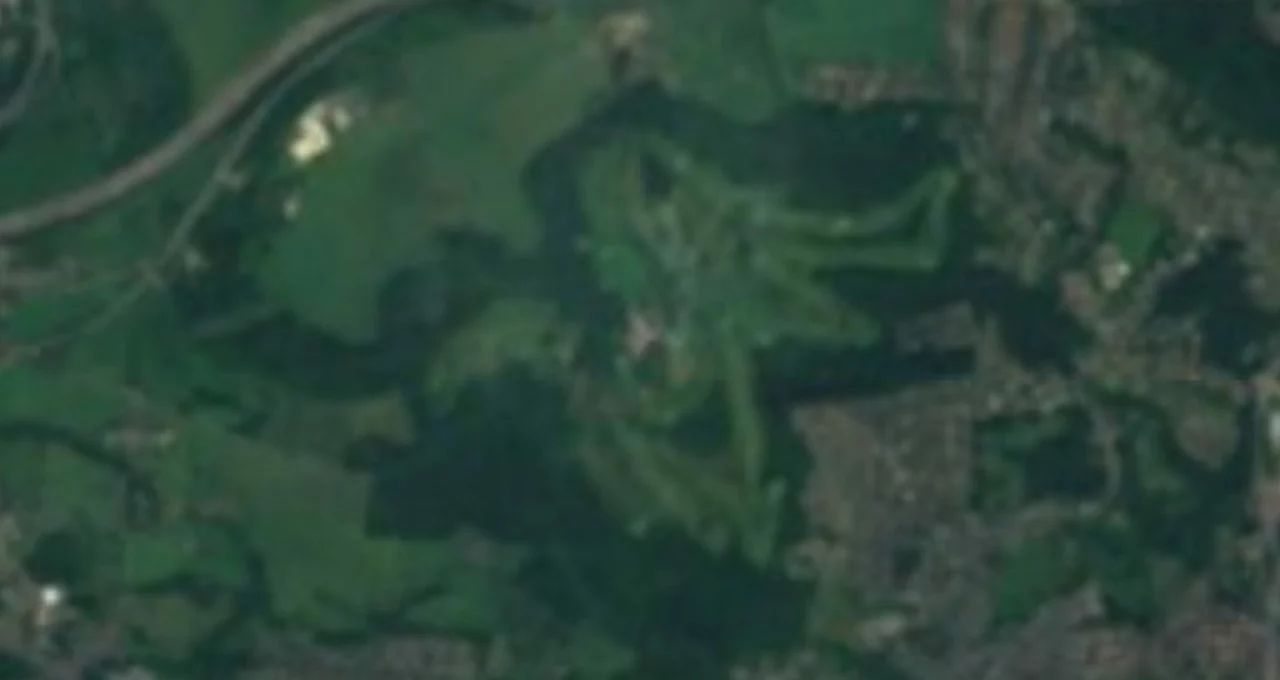
Huddersfield Golf Club from space. Sentinel-2 cloudless 2016 by EOX IT Services GmbH (contains modified Copernicus Sentinel data), CC BY 4.0.
Huddersfield Golf Club
Holes
18
By
71 (men's white and yellow); 73 (women's red)
Length
6,499 yards from the white tees, 6,172 yellow, 5,571 red (club summer card); winter card 5,850 yards, par 70
Green fee
—
Best season
Year-round; winter card and preferred lies in season (club)
Huddersfield Golf Club occupies much of the old Fixby estate on the northern edge of Huddersfield, West Yorkshire, and plays from Fixby Hall on Lightridge Road, postcode HD2 2EP. The club was founded in 1891, its first course was laid out by Tom Dunn, and its first professional was Sandy Herd, who went on to win the Open Championship in 1902. The present eighteen holes are par 71 and measure 6,499 yards from the white tees on the club’s summer card, with a course rating of 72.8 and a slope of 143, figures that should give any visitor with a handicap and a sense of self-worth something to think about on the drive up the hill. The clubhouse is Fixby Hall itself, a Grade II listed Georgian house that the club has rented, then leased, since the 1890s. The club calls itself the home of Yorkshire golf, and with some justification: one of its early captains originated the idea of county golf unions, and the Yorkshire Union was formed under his presidency in 1893 or 1894.
Fixby is not a household name outside the county, a point made by Golf Monthly and by more than one reviewer. Inside it, the course is well regarded. Top 100 Golf Courses places it tenth in its Yorkshire ranking, and the club lists among its credentials a place in a top 100 of parkland courses in Great Britain and Ireland and a run as a First Stage venue for the DP World Tour Qualifying School, which it gives as 2024 to 2027.
Dunn, Herd and the Thornhills’ house
The club’s own history says that Tom Dunn, one of the busiest course designers of the day, laid out the original courses in 1891: eighteen holes for men and nine for ladies. The appointment of the first professional, aged 23, was a good one. The club refers to him in one paragraph as Alex Herd and in another as Sandy Herd; they are the same man, Alexander Herd, and his 1902 Open title is the club’s proudest early boast. The memorabilia kept at Fixby include examples of his patented gutty ball, named the Fixby, and a cabinet of early clubs, many of them made by the resident clubmaker Bob Partington.
Herd did not leave the course as he found it, and neither did anyone else. The club credits later alterations to Herd, W. Herbert Fowler, Alister MacKenzie, Hawtree and Donald Steel. Top 100 Golf Courses gives the same list without MacKenzie and names the Hawtree as Fred Hawtree; Golf Monthly, in a course review published in 2017, singles out Fowler and MacKenzie. There is room for confusion in the club archive, since one of Huddersfield’s earliest captains was a Dr F. L. Mackenzie, the founder of the county union idea, who is a different man from the architect of Augusta National. In 1969 the present 12th and 13th holes were opened after the holes next to the present 17th were sold for housing, and the club marked the occasion with an exhibition match between Peter Oosterhuis, Gary Player, Joe Carr and Rodney Foster. Later, all the greens were relaid to USGA specification to designs by Cameron Sinclair; the club celebrated their reopening with another exhibition match in September 2004, and Top 100 Golf Courses dates the work to that year. The most recent change is a renovation of the bunkers, which the club says restored the traditional character of many holes.
The house is older than the golf by some distance. According to the club, the Thornhill family held the Fixby estate from the thirteenth century, after Sir Richard de Thornhill married Matilda de Fixby, and the hall evolved over centuries before being modernised in the Georgian style in the mid eighteenth century. The orangery was built in 1786 as a wedding present from Thomas Thornhill to his bride Eleanor Lynne, and the arms of both families are carved over its door. The Thornhills lived at Fixby until 1809, when they moved to Norfolk and the hall was divided. Their daughter Clara, whose portrait hangs in the dining room, was a friend of Charles Dickens, and the club repeats the local belief that Fixby gave him ideas for Great Expectations; it presents this as a thought rather than a fact, and so do we. Among the tenants was Richard Oastler, the factory reformer, who served as steward of the estate and campaigned for the Ten Hours Bill. When the golf club began renting rooms in the hall in 1892 the building was empty. It has leased the property from the Thornhill Estate since 1899.
The club has kept a busy calendar of championships. It has hosted the PGA’s Lawrence Batley Seniors’ Tournament for several years, national and international events for the Ladies’ Golf Union and the English Ladies’ Golf Association, the Senior Ladies’ Home Internationals in 2014, qualifying for the Brabazon Trophy, which Top 100 Golf Courses dates to 2009, the Yorkshire men’s and ladies’ championships, and the England Men’s Team Championships. In September 2024 it made its debut as a First Stage venue for the DP World Tour Qualifying School; the tour reported that England’s Benjamin Jones won the stage on sixteen under par, five shots clear, and that fifteen players went through to the second stage. A later professional, John Fallon, played in the Ryder Cup in 1955, the year he finished runner-up to Peter Thomson in the Open, and captained Great Britain and Ireland in Atlanta in 1963. The dining room bears his name.
What the course asks of you
The layout is two loops of nine that start and finish at the hall, which sits low on the property with the course climbing away on either side. From the white tees the front nine is a par 36 of 3,397 yards and the back nine a par 35 of 3,102. From the yellow tees the course measures 6,172 yards, par 71, with a rating of 71.4 and a slope of 140; from the red tees, 5,571 yards and par 73 for women, with a rating of 73.7 and a slope of 138. There are five par 3s, which Golf Monthly counts among the course’s charms, and four par 5s. The club says the greens, built to USGA specification, drain quickly and that the fairways often run fast; it also claims one of the best-draining courses in the area.
The opening hole, Camborne, is a par 4 of 472 yards from the white tees, mercifully downhill according to Golf Monthly. The professional’s tip on the club’s hole guide is to drive down the right half and not to miss the green on the left, where the ball runs away down the slope. The 2nd, Alison Dyke, a par 4 of 348 yards, plays at least a club longer than it looks because of a false front. The 3rd is a par 5 of 529 yards, and the 4th, Lane, 188 yards, is the first of the short holes: all carry to a two-tier green. The climb then begins in earnest. The 5th, Gernhill, a par 5 of 521 yards, is stroke index 1, a dogleg across cross bunkers, according to Top 100 Golf Courses, to a two-tier green; Golf Monthly says it takes you to the highest point of the course. The 6th, Shepherd’s Cot, 362 yards, goes uphill to a green that slopes severely from back to front, with out of bounds beyond a dry ditch to the right.
The 7th, Orangery, a par 4 of 374 yards, is a right-to-left dogleg whose corner bunkers the long hitter can carry, followed by a downhill approach to a tight green with out of bounds on the right. The 8th, Three Sisters, is a short par 3 of 150 yards to a well-guarded sloping green, and the 9th, Hall, is a par 4 of 453 yards and stroke index 3 that brings you back down to the house. It also crosses the fairway of the 1st, so players coming home and players setting out need to keep an eye on each other. Golf Monthly finds this odd; one Top 100 Golf Courses reviewer was surprised to meet golfers crossing from the 9th on the opening tee shot.
The back nine climbs again from the other side of the hall. The 10th, Dartmouth, is only 310 yards, but its second shot goes uphill to a two-tier green and plays longer than the card suggests. The 11th, Pheasantry, 175 yards, is played over a valley, all carry, with out of bounds down the slope on the right. Golf Monthly calls the next two holes absolute corkers. The 12th, Wells Ing, is a par 4 of 421 yards and stroke index 2, sweeping along the side of the hill to a raised green with a steep fall on the left: the advice from the professional and from the magazine is the same, which is to miss right if you must miss at all. The 13th, Bath House, 205 yards from the whites, is played from a high tee over rough ground to a small, slanting green guarded by a bunker on the left and a steep slope on the right.
The 14th, Grimescar, is a par 5 of 496 yards, a right-to-left dogleg with a blind second over the shoulder of the hill. The 15th, Mount, 372 yards, has gorse on the right and bunkers on the left of the landing area and a severely sloping front to its two-tier green. The 16th, Cowcliffe, a par 4 of 443 yards with a semi-blind drive over a marker post, is the hole Golf Monthly picks for its views. The 17th, Redan, 193 yards, is the last of the short holes, with bunkers left and right and the professional’s assurance that a three is always a good score. The 18th, Panorama, a par 5 of 487 yards, is a drive uphill to the brow of a hill, from which a good drive leaves hopes of getting home in two and a long look back over the course. The club’s local rules note public footpaths running down the left of the 6th and between the 1st, 9th and 18th; the Kirklees Way also crosses the course.
Golf Monthly’s earlier course of the week feature, from 2007, warned that the wispy rough punishes inaccurate driving and that the then new greens, with their severe slopes, demand approaches played to the correct side of the pin. Nothing in the more recent reviews suggests the greens have grown kinder.
What golfers say
Huddersfield has 19 reviews on Top 100 Golf Courses, dated between 2008 and September 2026, with an average of 4.5 out of five, and an average of 4.7 from 41 reviews on Hole19, whose page shows ratings but not the text of the reviews. The points below summarise what recurs on Top 100 Golf Courses and in Golf Monthly’s two pieces. They are other people’s opinions, not ours. Nobody from Panxis has played the course, and we name no reviewer.
What comes up in its favour
- Condition. Reviewers repeatedly describe the course in very good shape, with greens that roll true and bunkers that have been consistent since the renovation.
- The test. The course is described as one that asks for thought on almost every tee, with strong long par 3s and a good mix of long and short par 4s.
- Variety and character. Several reviewers say the course has as much of the moor or the heath about it as the park, with fast-running turf and elevation changes.
- The views, over the course, down to the hall and out across Huddersfield.
- Fixby Hall, which Golf Monthly once called one of the most attractive clubhouses in the country, and its food and terrace after the round.
What comes up against
- The hills. Uphill and downhill holes make for a demanding walk, and a trolley or buggy is suggested.
- Length and wind. From the back tees the course feels long, and on an exposed day the wind makes it harder still.
- The greens are heavily contoured and the rough can punish, which makes the course frustrating on an off day.
- The layout is compact in places, with holes crossing each other, and one reviewer felt visitors could have been told more about holes out of play on the day.
- Smaller points: the club is not easy to find for a first visit, member rules are worth checking in advance, and one reviewer thought the course overrated.
Getting there and when to go
The club says it lies midway between Leeds and Manchester, about five minutes from junction 24 of the M62, and directions are published on its location page. The nearest railway station is Huddersfield, on the line between Leeds and Manchester; by our measurement on the map it is a little under two miles from the course in a straight line, rather more by road and most of it uphill.
Visitors are welcome on weekdays and, from May to September, on Sundays; the club is closed to visitors on Saturdays all year and on Sundays outside the summer months. Tee times are booked through the club’s online booking system, and the club notes that visitor times vary with the season. Societies are offered packages including shotgun and two-tee starts, and may use the 400-yard practice ground and pitching area on the day of their visit, with range balls from the professional’s shop. Buggies can be hired by visitors through the professional’s shop, and pull and electric trolleys are available; the club publishes a buggy and trolley policy that applies in winter. The dress code asks for smart, conventional golf clothing and golf shoes on the course. The card sets a maximum of four hours for eighteen holes.
The course is open all year, with a winter card from the yellow tees of 5,850 yards and par 70. On the day we checked in October 2026, the club’s course status read open, with preferred lies. The drier months from May to September offer the best conditions, the fastest fairways and, not least, Sunday tee times.
Green fees
Visitor rates vary by season and by day and are published by the club on its green fees page, with tee times bookable through its online booking page.
How this page was made
The factual frame comes from public sources: OpenStreetMap for the location; the club’s website, read in October 2026, for the address, the 1891 foundation, the history of the course and its architects, Fixby Hall and the Thornhills, the events held, the summer and winter scorecards with their ratings and slopes, the World Handicap System tables dated July 2026, the hole guide, the local rules, the visitor days, the society arrangements, the buggies and the dress code; Top 100 Golf Courses for the Yorkshire ranking, the architects, the descriptions of the 5th and 12th and the user reviews; Golf Monthly for its 2017 course review and its 2007 course of the week feature; the DP World Tour for the 2024 Qualifying School stage; Hole19 for its rating; the English Wikipedia article on Fixby for the listed hall, Richard Oastler and the Kirklees Way; Wikidata for the identifiers. The distance from the station is our own measurement.
Where sources disagree, we say so. The club’s summer card gives 6,499 yards from the white tees; its home page rounds this to 6,500, Top 100 Golf Courses and GolfNow give 6,514, and GolfNow’s introduction 6,432. GolfNow also gives 6,216 yards from the yellow tees and 5,595 from the red, against 6,172 and 5,571 on the club’s card. The club’s hole guide gives the 13th as 197 yards from the yellow tees, while the card gives 153; the guide and the summer card also differ on the red yardages of the 4th and the 11th. Golf Monthly gives the 9th as 456 yards and Top 100 Golf Courses the 12th as 419, against 453 and 421 on the current card. Alister MacKenzie appears among the architects for the club and Golf Monthly but not for Top 100 Golf Courses. The club’s history page uses both Alex and Sandy for Herd. The club dates Fixby Hall to the mid eighteenth century in one page and describes an older house modernised in that period in another. The club has Richard Oastler arriving as steward in January 1821, while Wikipedia gives his stewardship as 1830 to 1838. We could not read the National Club Golfer ranking page, Today’s Golfer’s course page or GolfPass, and we use nothing from them.
The opinion section summarises reviews on Top 100 Golf Courses and Golf Monthly, read in October 2026, with Hole19’s average rating. We report recurring themes rather than individual voices, and we reproduce no quotations from reviewers. Nobody from Panxis has played or visited this course, and this page is no substitute for a round.
The club has not paid for this page, has not seen it before publication and has no say over its content. This page contains no commercial link and earns us no commission. If you know the club and something here is wrong or out of date, write to us and we will correct it.
Other courses nearby
Closest to this one in our British directory:
- Waterton Park Golf Club — 14 mi
- Sand Moor Golf Club — 17 mi
- Alwoodley Golf Club — 18 mi
- Skipton Golf Club — 23 mi
The hole to know
Bath House, par 3 of 205 yards from the white tees, played from a high tee over rough ground to a small, slanting green with a bunker on the left and a steep slope on the right.