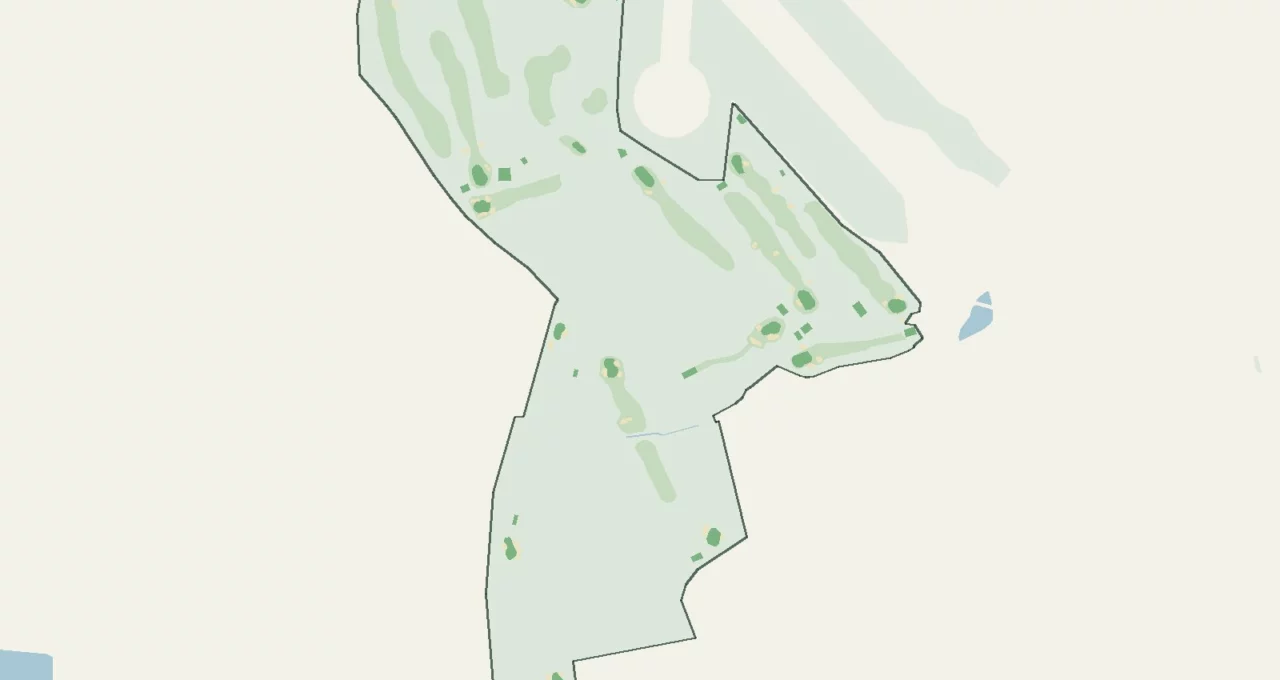
Layout of Horsforth Golf Club from OpenStreetMap survey data (ODbL licence).
Horsforth Golf Club
Holes
18
By
71 for men from the white and yellow tees, 72 for women from the red tees (club scorecard)
Length
6,329 yards from the white tees, 5,957 yellow, 5,490 red (club scorecard); directories give 6,258, 6,430 or 6,583 yards from the whites
Green fee
—
Best season
Open all year (GolfNow); the club sets separate visitor rates for April to October and November to March
Horsforth Golf Club is an 18-hole parkland course on the north-western edge of Leeds, West Yorkshire, laid out on the ground between the town of Horsforth and Leeds Bradford Airport. The club was founded in 1906 by a group of Horsforth residents, and its course carries three well-known names in its history: Dr Alister MacKenzie, who advised on it in 1913, James Braid, who modified it in 1925, and Frank Pennink, who helped redevelop it in 1964 after land was lost to the airport next door. From the white tees it measures 6,329 yards, par 71, according to the club’s own card. The clubhouse is on Layton Rise, Horsforth, LS18 5EX, and the club’s website is horsforthgolfclub.co.uk.
The club describes the course as a mixture of parkland and moorland, with tight, tree-lined fairways on which accuracy off the tee matters more than length. The site was once the catchment area of the Horsforth water undertaking, and two abandoned reservoirs form part of the boundary. The airport’s runway runs alongside part of the inward nine, so aircraft passing low overhead are part of a round here. It is a private members’ club of more than 600 men, women and juniors, and visitors are welcome every day of the week, with tee times bookable online.
Name and location
The club calls itself Horsforth Golf Club, the name it was given at its first general meeting in March 1907. OpenStreetMap names the ground Horsforth Golf Course, gives 1906 as its start date and links it to the Wikidata item Q56276009 and to the English Wikipedia article on the club. The course straddles Bayton Lane, a minor road that runs north towards the airport; the reverse geocoding of the OpenStreetMap position places the centre of the course in the Rawdon area of the City of Leeds, while the clubhouse and its postal address are on the Horsforth side, at Layton Rise, LS18 5EX. The Wikidata and Wikipedia coordinates sit about 600 metres south of the centre of the course as drawn in OpenStreetMap, close to the clubhouse; the map at the foot of this page uses the OpenStreetMap position.
Golfmagic, which ranks Horsforth fifth in its list of the best courses in Leeds, puts it about six miles from Leeds city centre and names Horsforth as the nearest railway station. A 2004 article in the turf trade publication Pitchcare puts it about four miles north of the city centre; the difference probably reflects road distance against a straight line. The Social Golfer places it just off the A6120, the Leeds outer ring road.
History
The English Wikipedia article on the club, which draws on the centenary brochure the club published in 2005, gives a detailed account of its early years. Horsforth Golf Club was formed on 8 November 1906 by residents called together by T. Clough and H. Whitfield at a house on Outwood Lane in Horsforth. On 8 February 1907 the new club agreed to lease a site on the Rawdon estate from Walter Egerton John Green-Emmott of Emmott Hall, at a rent of £140 a year. It was formally named at its first general meeting on 7 March 1907, when Sir William Duncan of Horsforth Hall was invited to become its first president and H. Whitfield was appointed first captain. The clubhouse was opened on 10 August 1907, an event reported in the Leeds Mercury two days later.
The club’s own account of the land goes further back. On its course page it says the course was created from rough farmland that had itself been reclaimed from moorland and forest during the ownership of the monks of Kirkstall Abbey, and that old field names such as Coal Pit Hill suggest coal mining and quarrying on the site at some point. Several hole names still recall the old fields: Whin Field, Sheep Hill, Spring Close, Long Close, Sand Pits.
The first layout was the work of the greens committee and of the club’s first professional and greenkeeper, T. Tate, according to Wikipedia. Alister MacKenzie, the Leeds doctor turned golf architect whose course at Alwoodley lies a few miles to the north-east, visited Horsforth in 1913 and made recommendations for improvements, including a scheme for bunkering the course. The club’s wording varies: its course page says the course was designed with MacKenzie’s assistance, its About page that it was designed by him, and its homepage that the original layout was his. The Wikipedia account suggests the more modest version, an advisory visit to a course already in play.
1913 was an eventful year in other ways. The original clubhouse was destroyed by fire on 26 January 1913, as the Leeds Mercury reported the next day. Less than a month later, on 20 February, the same paper reported damage on the links attributed to suffragettes: turf cut on the 18th green, a movable shed used by members as temporary accommodation set alight, and Votes for Women leaflets left behind. The new clubhouse, on its present site, reopened on 6 September 1913, at a cost of £1,450 according to Wikipedia.
In 1925 the club invited James Braid, five times Open champion and by then a prolific course designer, to inspect the course. He did so on 19 March 1925 and sent a report for a fee of £14 5s; Wikipedia says many of his suggestions were adopted, and the club credits him with modifying the layout that year. The third architect, Frank Pennink, came in 1964, when the club bought new land in compensation for ground taken over by the expanding airport and asked him to appraise the course and help redevelop it. The club’s website does not mention Pennink, and we found no detail of which holes he changed.
The airport has continued to shape the course. The 2004 Pitchcare article reports that the 14th green, which lay close to the airport, had to be moved because the airport authorities needed the land under the flight path and new safety rules treated aircraft passing over it as a hazard. The airport paid £80,000 for a new green and surrounding works, including new tees and bunkers; the article says the former dog-leg is now straight, and that the new green was built with an 80 per cent sand root zone, while the other greens were clay-based. The same article describes the site as a natural water catchment with three reservoirs in the valley bottom, and fossilised trees found during drainage work. The club celebrated its centenary in 2006, with a programme of tee renovation planned for the occasion.
The course has kept changing since. The club says tree planting over the last thirty years has turned much of the original heathland into parkland, and that it is in the middle of a refurbishment involving bunker redesign, new tees and tree thinning. The club also belongs to the 1906 Club, a group of British golf clubs founded in the same year that offer one another’s members reciprocal golf.
What it asks of you
The club publishes a card for three sets of tees and a page for every hole, and the hole-by-hole yardages add up exactly to its totals:
- White tees: 6,329 yards, par 71 (35 out, 36 in).
- Yellow tees: 5,957 yards, par 71.
- Red tees: 5,490 yards, par 72 for women, the 7th becoming a par 5.
Ratings depend on which page you read. The club’s course page still shows a course rating of 71.2 and a slope of 132 from the whites, 69.4 and 129 from the yellows and 72.9 and 131 for women from the reds. The England Golf course handicap tables that the club publishes on its WHS rating page, valid from 1 October 2025, give 71.4 and 129 for men from the whites, 69.8 and 127 for men from the yellows, and 73.3 and 129 for women from the reds. The newer tables are the ones in force. Either way, the slope from every set of tees sits well above the neutral 113, which matches the club’s own message that the course is harder than its modest length suggests.
The card is short on par 5s and long on short holes. There are four par 3s, at the 3rd, 9th, 11th and 15th, and three par 5s, at the 6th, 16th and 18th. The front nine is the shorter half from the whites, at 3,052 yards against 3,277 for the back nine, but it holds the hardest hole on the card: the 7th, at 440 yards the longest par 4 on the course and stroke index 1, which the club says only two well-struck shots will reach.
The 1st and 2nd holes are on the west side of Bayton Lane; the course then crosses the road for the 3rd and the holes that follow, and returns across it only for the 18th. The opening hole sets the tone the club describes: a slightly uphill par 4 of 330 yards with a ditch in view in front of the tee and a narrow, tree-lined fairway. Out of bounds runs down the left of the 2nd. Ditches recur, across or beside the 1st, 4th, 6th and 17th, and the club’s course safety page warns of several ponds and of public footpaths that run alongside and across several holes, where walkers have priority.
The par 3s are the holes the club singles out, and its descriptions of them are consistent: take more club than you think. Anything short at the 166-yard 3rd rolls off the front of the green; the 9th, at 184 yards, has bunkers left and right; the 11th, at 171 yards, is played over a valley, and the club warns that its stroke index of 18 flatters it. The 15th, called Reservoir and 202 yards from the whites, is usually played into the prevailing wind, with a heavily contoured green; the club advises a draw from the right.
Two par 4s on the back nine ask for nerve rather than length. The 10th, at 355 yards from the whites, is a sharp dog-leg from right to left, with out of bounds down the left; longer hitters can cut the corner over the out of bounds, provided the group in front is out of range, while others aim at a marker and play a short iron to a small green. The club’s course page describes it as a hole of little over 300 yards with a blind drive and a narrow ledge of a green, which fits the red tees, at 290 yards, better than the whites. The 12th, 384 yards, is a blind tee shot with a bell to ring once the fairway is clear and a bunker in the middle of the landing area, then an approach downhill to a green that runs away.
The finish is the strongest stretch on paper. The description on the GolfNow listing notes that the run of 16, 17 and 18, two par 5s around a par 4, has wrecked many a card. The 16th, 493 yards, demands an accurate drive from the back tee and may need a second played over the corner of the out of bounds. The 17th, 364 yards, has a ditch across the fairway at about 200 yards, forcing a choice between laying up and carrying it, and a two-tier green. The 18th, 561 yards from the whites, starts from the widest fairway on the course, then plays over the brow of a hill, on a line set by a marker, before the S-shaped fairway falls to a green beyond a pond, with the clubhouse behind; the club describes it on one page as close to 550 yards and on the hole page as 561.
The course’s characteristic hazard is the airport. On the 14th, a par 4 of 418 yards and stroke index 2, the runway runs parallel along the whole of the left side, and the club asks for an accurate tee shot before an approach that can be run on or flown in. The hole descriptions refer again and again to the prevailing wind.
What golfers say
Public reviews of Horsforth are fairly numerous on booking and review sites but thin in detail, and several of the main sources could not be read in full. What we used: the one review on Top 100 Golf Courses, written by a panellist after a visit at the club’s invitation and published on 3 October 2026; the short reviews on Hole19, which shows an average of 4.5; the summaries of reviews on GolfPass, which search results put at about a hundred reviews with an average of 4.6 and a high score for friendliness, but whose pages refused our requests; a review in Dutch on Leading Courses and brief comments on Golfshake and Wheree, also known to us only through search summaries; and descriptions in directories. The points below summarise what recurs. They are other people’s opinions, not ours; nobody from Panxis has played the course, and we name and quote no one.
What comes up in its favour
- The welcome: staff in the professional’s shop and the bar, and members, are repeatedly described as friendly, and the Top 100 panellist found a lively members’ club where the social side and the golf remain closely tied.
- Condition: well-kept greens, fairways and bunkers come up again and again in GolfPass and Hole19 reviews, alongside the description of a course that is tight and challenging.
- Variety: reviewers mention many different types of hole, and the panellist rated the routing as the main strength of the course, enjoying the way it changes direction and leaves the player unsure of the way back to the clubhouse.
- The par 3s: the panellist judged them the best group of holes on the course and the 15th the best hole of all, a view that matches the club’s own emphasis.
- The aircraft: for some players, watching planes come in to land is part of the charm.
What comes up against
- Noise: the same aircraft distract others, and the Dutch review and several GolfPass comments describe the airport as a drawback.
- Tightness: some reviewers find the course a little tight, with neighbouring holes sharing rough and trees.
- Architecture: the Top 100 panellist, judging against the best courses in Yorkshire, found some green complexes modest in size and slope and thought the fairway bunkering could do more to make players think, and scored strategy and green complexes 2 out of 5, variety and facilities 3.
- Greens: one older Hole19 review found them bumpy, against many that praise them.
- The clubhouse food and some signage drew criticism in an older GolfPass review.
Most of the detailed reviews are several years old, and the club has since rebuilt bunkers and practice facilities; none of these points carries much weight on its own.
Facilities and how to play it
The club’s visitor page says visitors are welcome every day, at weekends as well as during the week, with no handicap or skill requirement; the course can be busy when competitions are on, especially on Saturdays. Tee times can be booked through the online visitor booking system, run on BRS Golf, or by calling the professional’s shop. Normal golf attire is required on the course. There are no clubs for hire. Caddies are welcome, and buggies can be hired from the professional when conditions allow; the club asks for them to be booked in advance and has a buggy policy with designated routes.
The practice facilities have been redeveloped and include a range with grass and artificial bays, a chipping green with bunkers, a pitching area and a putting green beside the clubhouse, all open to visitors before a round. The club also has an indoor golf simulator, open to members and non-members, and two PGA professionals, Dean Stokes and Simon Booth, who have run the shop since 2000 and offer lessons, club fitting and repairs. The clubhouse has a bar, catering and locker rooms, and hosts Sunday lunches, weddings, parties and funeral teas.
Societies are welcome, including at weekends, with packages that combine golf and catering; the club also organises corporate golf days and runs open competitions through the season, including open days for seniors, women, juniors and mixed teams. The women’s section is a signatory to the Women in Golf Charter. Membership categories, from full seven-day membership to social, country and practice-ground membership, are listed on the club’s membership page, and prospective members can arrange to play the course before joining.
Getting there and when to go
The clubhouse is at Layton Rise, Horsforth, Leeds, LS18 5EX, with ample parking according to the club. The office is on 0113 258 6819, extension 2, from 9am to 4pm on weekdays, and the professional’s shop on extension 3; the club also has an enquiry form on its contact page. Horsforth railway station is the nearest station according to Golfmagic, and Leeds Bradford Airport is next door.
GolfNow lists the course as open all year, and the club sets separate visitor rates for April to October and for November to March, with a weekend twilight rate. The homepage carries a course status notice saying how many holes are in play and whether trolleys and buggies are allowed; on the day we checked, in October 2026, all 18 holes were open with trolleys and buggies permitted. The club’s hole descriptions make clear that the wind changes the clubs needed on several holes. The club has a lightning policy, signalled by three short blasts on an air horn, and a fog and darkness policy.
Green fees
Horsforth sets visitor rates for weekdays and weekends, for summer and winter, with and without a member, for juniors and for weekend twilight play: see the club’s website for current prices.
How this page was made
The factual frame comes from public sources: OpenStreetMap for the location, outline, name and start date of the course; Wikidata for the item linked to it, its coordinates and address; the English Wikipedia article on Horsforth Golf Club, which draws on the club’s 2005 centenary brochure and on reports in the Leeds Mercury, for the foundation, the lease, the first officers, the 1907 opening, the 1913 fire and suffragette damage, the visits of MacKenzie and Braid and Pennink’s work in 1964; the club’s website for its description of the course and the site, the card, the hole-by-hole descriptions, the England Golf course handicap tables from 1 October 2025, visitor arrangements, practice facilities, professionals, membership, societies, open days, course safety and contact details; Pitchcare (December 2004) for the relocation of the 14th green, the airport’s payment, the reservoirs and the greens; Golfmagic, GolfNow, The Social Golfer and Hole19 for third-party facts and cards; and Top 100 Golf Courses, Hole19, GolfPass, Golfshake, Wheree and Leading Courses for the opinions summarised above.
Where sources disagree, we say so. The course is 6,329 yards from the whites on the club’s card and in Wikipedia, 6,258 yards in Wikidata, in Golfmagic and in GolfNow’s quick facts, 6,583 yards in GolfNow’s own description and about 6,430 yards in The Social Golfer; Hole19 shows a red card of 5,048 yards and par 72 with different pars on several holes, which matches no club figure. Course ratings and slopes on the club’s course page and on GolfNow are older than the England Golf tables of October 2025 published on the club’s WHS page. The Social Golfer gives 1907 as the year the course opened, which fits the opening of the clubhouse; the club, Wikipedia and OpenStreetMap give 1906 for the foundation. The club credits MacKenzie with the design, with assisting in the design or with the original layout depending on the page, while Wikipedia, citing the centenary brochure, describes a 1913 visit to a course laid out by the greens committee and the first professional. The club’s course page describes the 10th as little over 300 yards and the 18th as close to 550, its hole pages as 355 and 561 yards from the whites; the stroke index of the 17th is 14 in the hole page’s heading and 4 in its table. Golfmagic puts the club six miles from Leeds city centre, Pitchcare four miles. The Wikidata coordinates are about 600 metres from the OpenStreetMap outline.
GolfPass, Golfshake, Wheree, Leading Courses, 1golf and Today’s Golfer refused our requests, so what they say is known to us only through search summaries, and we have relied on them for no figure; the GolfNow listing showed no review text. We found no account of which holes Pennink or Braid altered, no date for the current pond on the 18th and no length for the course in metres from the club, and we have not invented them. Green fee amounts are deliberately left out.
The opinion section summarises reviews and course descriptions read in October 2026. We report recurring themes rather than individual voices, and we reproduce no quotations from reviewers. Nobody from Panxis has played or visited this course, and this page is no substitute for a round.
The club has not paid for this page, has not seen it before publication and has no say over its content. This page contains no commercial link and earns us no commission. If you know the course and something here is wrong or out of date, write to us and we will correct it.
Other courses nearby
Closest to this one in our British directory:
- Moortown Golf Club — 5 mi
- Sand Moor Golf Club — 5 mi
- Alwoodley Golf Club — 6 mi
- Huddersfield Golf Club — 14 mi
The hole to know
Perfection, a par 4 of 418 yards from the white tees and stroke index 2, with the Leeds Bradford Airport runway running parallel down the whole left side; its green was moved, at the airport's expense, before 2004 (club website, Pitchcare).