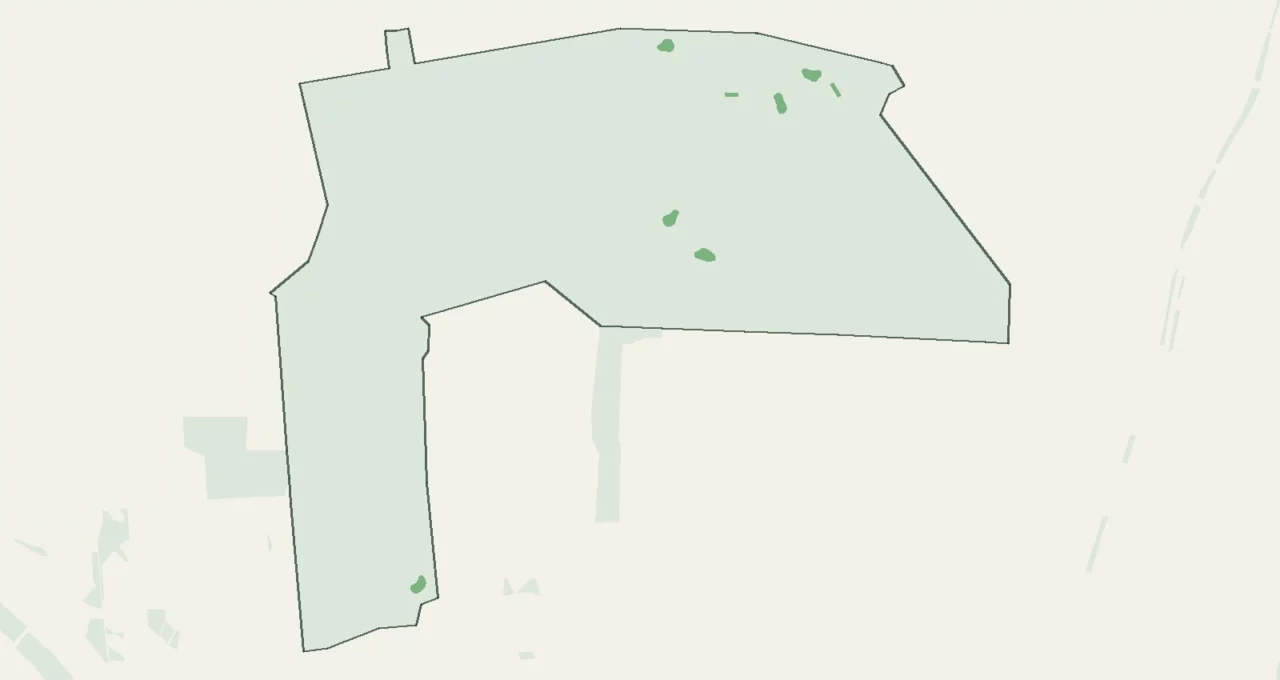
Layout of Moortown Golf Club from OpenStreetMap survey data (ODbL licence).
Moortown Golf Club
Holes
18 (club website)
By
71 for men from the blue, white and yellow tees, 75 for ladies from the red tees (club scorecard)
Length
7,001 yards from the blue tees, 6,741 white, 6,455 yellow, 5,913 red (club scorecard); Golfshake lists 6,980, 6,747, 6,452 and 5,939
Green fee
—
Best season
Open all year; the club says it is rarely closed thanks to the course's natural drainage (club website)
Moortown Golf Club is an 18-hole heathland course on Harrogate Road in Alwoodley, on the northern edge of Leeds, West Yorkshire. It was founded in 1909 on a stretch of boggy, heathery hillside called Black Moor, its course was laid out by Dr Alister MacKenzie, and in April 1929 it staged the second Ryder Cup, the first played in Great Britain, which the home side won by seven points to five. The club’s current scorecard gives 7,001 yards and par 71 from the blue tees, 6,741 yards from the white, 6,455 from the yellow and 5,913 yards and par 75 from the red. The club’s website is moortown-golf-club.co.uk.
The club describes the site as 175 acres of mainly level woodland and moorland, or, in newer wording, dramatic lowland heathland. Heather, silver birch and gorse line many holes, the turf is peaty and springy underfoot, and the bunkering and large, sloping greens carry MacKenzie’s signature. The par 3 10th, called Gibraltar, is the hole MacKenzie built first to persuade the founders, and it remains the club’s signature hole. Moortown is a private members’ club that takes visitors through the week and at limited times at weekends, with booking required in advance.
Which club is this?
The club calls itself Moortown Golf Club, and OpenStreetMap, Wikidata (item Q6908508) and Wikipedia use the same name. Despite the name, the course is not in the Leeds suburb of Moortown itself: the club’s postal address is Harrogate Road (A61), Alwoodley, Leeds LS17 7DB, and Wikipedia places it in Alwoodley. Its neighbour Alwoodley Golf Club, MacKenzie’s first design, lies a few hundred yards away according to GolfMagic, and Sand Moor Golf Club is close by too; the club’s long-serving professional has recalled that Sand Moor once ran alongside the 18th.
The map at the foot of this page uses the OpenStreetMap position of the course. When the founders found the site in 1908, the club says, Black Moor lay on the outer northern fringe of Leeds, five and a half miles from the centre of the city.
History: from Black Moor to the Ryder Cup
The club’s own history, published on its website, starts in 1903, when Frederick Lawson-Brown, on holiday in Bridlington, went to watch the Yorkshire Amateur Championship at Ganton and came away wanting a course in similar surroundings for Leeds. With three associates, and later two golfers from Woodhall Hills, he spent eight months looking for land. In October 1908 they settled on Black Moor, which the club describes as a heathery, boggy hillside full of stagnant pools. In November 1908 the land was taken from the Lane-Fox (Bramham) estate for a rent of 100 pounds for ten years, free of rates and tax, and circulars went out inviting a hundred members to join.
The founders invited Alister MacKenzie to look at the site in October 1908. The club’s course history page says that MacKenzie, who with Harry Colt was nearing completion of the course at Alwoodley, was asked first to design a single test hole to attract members. That hole was Gibraltar. The MacKenzie Society, quoting details supplied by the club, adds that it was built on a rock outcrop, opened in early 1909, was originally the 17th, and brought in sixty more members. MacKenzie was then invited to lay out all eighteen holes, with the aim of playing nine as soon as possible. The MacKenzie Society says twelve holes were described at the club’s first annual dinner in November 1909 and that all eighteen were open by Whitsuntide 1910.
MacKenzie stayed involved. The club records that he chaired many early meetings, was elected a vice-president in 1909 and was captain in 1913, and that he remained constructional adviser as the club leased more land and reshaped holes. Early comment focused on bunkers imitating natural seaside contours and large, undulating greens of seaside type. By 1928, with MacKenzie working mostly abroad, the club turned to his younger brother Charles as course consultant, a role he held until 1933, when the green committee decided the course had reached more or less its final form. The club says that by the mid-1920s the course had taken the layout that would last without major alteration for more than sixty years, and the present clubhouse dates from 1915.
The official opening was a challenge match between James Braid, the reigning Open champion, and Harry Vardon. It was set for 21 May 1910 and postponed after the death of King Edward VII, and finally played on 24 September 1910; Wikipedia supports both dates with reports in The Yorkshire Post and The Standard.
The event that made Moortown’s name came in 1929. The club credits a member, Kolin Robertson, a golf writer at the Yorkshire Evening News, with bringing the Ryder Cup to Leeds; his newspaper’s professional tournament had been coming to Moortown since 1925. Great Britain, captained by George Duncan and including a young Henry Cotton, faced a United States side led by Walter Hagen with Gene Sarazen and Leo Diegel. The club’s account says the Americans led 2½ to 1½ after the foursomes, and Great Britain took the singles by 5½ to 2½, Duncan beating Hagen by 10 and 8. Most writers of the day quoted a strict par of 69. The ladies of the club still play each year for their own Ryder Cup, a trophy Samuel Ryder gave them for their help during the match. A civic plaque at the club commemorates the event.
Championship golf has followed ever since. The club lists the Yorkshire Evening News tournament (1925 to 1962, won among others by Bobby Locke and Henry Cotton), the PGA Cup match of 1976, the Tournament Players Championship of 1980, won by Bernard Gallacher, and the Car Care tournaments of 1984 to 1986 on the European Tour, the first won by Nick Faldo. Amateur events include the English Amateur, the Brabazon Trophy and the Boys’ Amateur Championship, most recently in 2024; Danny Willett won the Yorkshire Amateur here in 2007, and the club has hosted regional qualifying for The Open, most recently in 2016.
Restoring MacKenzie
The course you play today is the product of fifteen years of work aimed at bringing MacKenzie back. The MacKenzie Society, again on information from the club, records tree removal between 2008 and 2011 to restore the original heathland character, and a ten-year restoration programme begun in 2020 with Clyde Johnson of Cunnin Golf Design, using aerial photographs from the 1940s. The 5th, a dogleg, was rebuilt in 2021 as a short, driveable par 4 with risk and reward; in 2022 a MacKenzie hump was restored on the right of the approach to the 3rd; the 15th was fully restored in 2023, with greenside bunkers back, the green extended and fairway bunkers removed; the 12th has had its pile of stones bunkers rebuilt; and in the winter of 2025 the 14th was partly rebuilt, with original bunkering reinstated and heather planted on the slope of the approach. New bunkers have also appeared on the 4th and 18th. More is planned ahead of 2029, the centenary of the Ryder Cup at Moortown.
GolfMagic, whose reviewer is a member and says so, describes fairway bunkers being taken out to put the emphasis back on angles of approach, and says only two entirely new holes have been added to MacKenzie’s routing, the 6th and 7th; the club itself refers to the new 6th. Golf Monthly notes work on the par 3 4th and several new tees.
What it asks of you
The club publishes its scorecard on its course overview page. Men play par 71 from every set of tees:
- Blue tees: 7,001 yards, out in 3,609 and back in 3,392.
- White tees: 6,741 yards, out in 3,472 and back in 3,269.
- Yellow tees: 6,455 yards, out in 3,272 and back in 3,183.
- Red tees (ladies): 5,913 yards, par 75, out in 3,016 (par 38) and back in 2,897 (par 37).
The card itself carries no course rating or slope. Golf Monthly gives slopes of 141 from the blue tees, 140 from the white, 133 from the yellow and 146 from the women’s red; Wikipedia gives a course rating of 74.8 without saying for which tees.
For men the front nine is par 36 and the back nine par 35. There are three par 5s, the 1st (486 yards from the white tees), the 7th (519) and the 12th (550), and four par 3s, the 4th (172), 8th (189), 10th (165) and 17th (153). That leaves eleven par 4s, seven of them over 400 yards from the white tees: the 2nd and 3rd at 436 yards each, the 6th at 446, the 9th at 447, the 13th at 427, the 16th at 419 and the 18th at 429. The hardest hole by stroke index is the 6th, which the club calls the new 6th, followed by the 13th and the 2nd. For ladies the card turns seven holes into par 5s, the 1st, 2nd, 7th, 9th, 12th, 13th and 18th, and the 12th, at 507 yards, is stroke index 1.
The opening hole is a par 5 played from an elevated tee, and GolfMagic calls it the likeliest birdie of the day. Then come two long par 4s, and visitors on Golfshake warn that the first few holes can wreck a card. The 5th, rebuilt in 2021, measures 380 yards from the blue tees but 341 from the white and 309 from the yellow, short enough to tempt a long hitter now that the view of the green has been opened up.
The heart of the round is the moor top. The 10th, Gibraltar, is 173 yards from the blue tees, 165 from the white, 157 from the yellow and 144 from the red, uphill to a plateau green built into a rocky slope. Golf Monthly describes contours that send any shot slightly off line into the deep bunkers to the left and right; GolfMagic says the wind has to be factored in and that some hole positions make an up-and-down from beyond the green very unlikely. Bernard Darwin, writing in 1925 according to the MacKenzie Society, found it of an alarming excellence. After it, Golf Monthly notes, the next four holes run up and down beside one another on a plateau: the 11th, a par 4 of 365 yards; the 12th, a par 5 of 550 yards that runs downhill and that Golf Monthly calls gettable; the 13th, a par 4 of 427 yards to a green GolfMagic rates highly; and the 14th, rebuilt in 2025.
The finish has its own reputation. The 18th, 436 yards from the blue tees and 429 from the white, doglegs right and climbs slightly towards the clubhouse, with bunkers down the right and thick moorland rough down the left, to a green between bunkers that sits under the clubhouse windows. The club calls it a classic finish needing two exceptional shots, and its professional is quoted by GolfMagic as rating it alongside the 10th as the best hole on the course. It is also the scene of Moortown’s two best stories. In 1974, during an amateur championship, Nigel Denham’s approach ran into the clubhouse and he played his next shot back through a window onto the green; in 1980 Severiano Ballesteros, in contention in the Tournament Players Championship, flew his approach over the green, the spectators and the trees onto the practice putting green, and Bernard Gallacher won. Sources tell both stories differently; see the box at the end of this page. Today the clubhouse would be out of bounds.
The common thread in every description is that the course looks more generous than it is. National Club Golfer and Golf Monthly’s panellists both describe fairways that appear wide but are squeezed by punishing rough and by bunkers that gather balls from some distance; accuracy, they say, counts for more than length. GolfMagic’s member reviewer, more indulgent, says you have to be very wayward to lose a ball. The peaty turf drains well, and the club says Moortown is rarely closed.
What golfers say
We read Golf Monthly’s review and the comments of its three Top 100 panellists (updated in April 2025), GolfMagic’s review of July 2025, National Club Golfer’s profile (2022, updated 2023), the 44 written reviews and overall rating of 4.9 out of 5 from 60 ratings on Golfshake, and the Wanderlog summary of 198 Google reviews (4.6 out of 5). Top 100 Golf Courses gives an overall rating of 4.0 out of 5, but its individual reviews would not load for us. The points below summarise what recurs. They are other people’s opinions, not ours; nobody from Panxis has played the course, and we name and quote no reviewer.
What comes up in its favour
- The design: reviewers single out the MacKenzie bunkering, the large greens and the variety of holes, and several say there is no weak hole. The 10th, the run of holes on the moor top and the 18th are the most often praised.
- Condition: tees, fairways and greens are usually described as very well kept, including after wet winters, and the springy, peaty turf comes up repeatedly.
- The challenge: a long, stern test with demanding par 4s, which most reviewers count as a reason to go rather than a complaint.
- History and clubhouse: the Ryder Cup memorabilia, the MacKenzie Bar, the old locker room and the snooker room give the visit a sense of occasion, and the welcome in the pro shop and the clubhouse is often called friendly.
- Quiet: several reviewers are surprised how peaceful the course feels for a site almost surrounded by houses and a short way off a main road.
What comes up against
- Price and value: value for money is the lowest of Golfshake’s sub-scores, and some visitors say the round is not cheap or that a nearby course is better value.
- Greens after maintenance: several reviews mention greens that had just been hollow-tined or were slow and bumpy in early spring, and one reviewer who played an open in 2020 found the greens slow and the fairways patchy. Opinion on the greens is therefore mixed, though most recent comments are positive.
- Difficulty: the rough and the length punish a wayward or short hitter, and the opening holes can be brutal; one reviewer found the course tough as soon as you miss a fairway.
- A bird deterrent: one Golf Monthly panellist found the speakers placed around the course to scare birds noisy and distracting.
- The setting: the A61 and the houses around the course are never far away, and some traffic noise carries, even if most find the course calm.
Reviews span several years, and the course has changed since some were written.
Playing as a visitor
The club says it welcomes local, national and international visitors, with tee times through the week and limited times at weekends. All bookings must be made in advance, through the club’s online visitor booking on the BRS system or by telephone on 0113 268 6521; Golf Monthly advises telephoning or emailing the club, at secretary@moortown-gc.co.uk, for availability. Packages are offered for groups of twelve or more.
Martin Heggie, a PGA Fellow Professional, has run the pro shop, open seven days a week, since 2002. Buggies, electric trolleys, push trolleys and hire clubs are available, and the club advises booking a buggy in advance. The club mentions complimentary warm-up areas, and lessons and custom fitting are offered.
The clubhouse, in use since 1915, centres on the MacKenzie Bar, hung with memorabilia, trophies and photographs, with the Samuel Ryder Lounge and a dining room that hosts golf days, a snooker room, and a glass-fronted terrace added in 2022 overlooking the 18th, where the benches behind the green are a Moortown tradition.
The dress code asks for recognised golf attire on the course, shirts tucked in and tailored shorts. Denim, cargo trousers and shorts with external pockets, sleeveless or football-style shirts, trainers, flip-flops and sliders are not allowed on the course or in the clubhouse. Smart casual dress is fine in the clubhouse, except at formal dinners. Clean soft-spiked golf shoes are allowed only in the foyer and the MacKenzie Bar. Phones stay on silent, and calls in the clubhouse are limited to the locker rooms and the car park.
Getting there and when to go
The entrance is on the A61 Leeds to Harrogate road, immediately after the Shell petrol station, about half a mile north of the A6120 ring road, between Primley Park View and Sandmoor Lane. The A61 is a dual carriageway here: coming south from Harrogate, the club tells drivers to make a U-turn just past the petrol station, about half a mile south of Leeds Grammar School. A security barrier closes the drive, and visitors are asked to call the office to have it opened on arrival and departure. Golf Monthly puts the club about five miles from central Leeds. The club keeps two defibrillators, one in the porch of the MacKenzie Bar and one at the halfway house beside the 10th, 13th and 15th tees.
The course is open all year, and the club stresses its natural drainage. Visitor tee times are easier to find on weekdays.
How this page was made
The factual frame comes from public sources: OpenStreetMap for the name and outline of the course; Wikidata and Wikipedia for the identifiers, the coordinates, the 1908 and 1910 press references, the tournament lists and the course rating; and the club’s own website for its history, course history, Ryder Cup and championship records, scorecard, visitor, booking, dress code, pro shop, clubhouse, directions and safety information. The club’s live site blocked automated reading, so we read its pages through Internet Archive copies made between 2024 and 2026. We also used the MacKenzie Society’s page on Moortown, which states that its dates come from the club, for Gibraltar’s origins and the restoration programme; Golf Monthly, GolfMagic, National Club Golfer and Top 100 Golf Courses for descriptions, slopes, rankings and the stories of the 18th; and Golfshake and Wanderlog for the opinions summarised above.
Where sources disagree, we say so. The club has the founders inviting a hundred members at two guineas each; the MacKenzie Society speaks of one guinea each. Golf Monthly dates the opening to 1908, the year of the design, where the club and Wikipedia give 1909 for the founding and 1910 for the full course. Wikipedia, citing the Daily Mirror, says about two thousand spectators saw the first day of the 1929 Ryder Cup; the club says more than fifteen thousand were present on the Saturday afternoon, which may describe a different day. Wikipedia dates the shared Brabazon Trophy of Michael Bonallack and Rodney Foster to 1969, the club to 1968. The club spells the 1980 winner Bernard Gallagher; Wikipedia and Golf Monthly give Gallacher. Directories differ from the club’s card: Golfshake lists 6,980, 6,747, 6,452 and 5,939 yards for the four sets of tees, against the club’s 7,001, 6,741, 6,455 and 5,913, and search results show older listings at par 72; we follow the club’s card. Gibraltar is 165 yards from the white tees on the card, 158 yards in Top 100 Golf Courses and around 160 for GolfMagic, and one directory calls it the 8th rather than the 10th. Wikipedia’s infobox gives a course record of 141, the same number as Golf Monthly’s blue-tee slope, so we have not reported a course record. The 1974 incident is placed in the English Amateur by National Club Golfer and in the Brabazon Trophy, the English amateur stroke play championship, by GolfMagic and Top 100 Golf Courses; the ball came to rest in the main lounge, the billiard room or the bar depending on the source; and National Club Golfer leaves it six feet from the hole while GolfMagic says the putt was missed. The club says Ballesteros’s ball in 1980 finished on the putting green; GolfMagic adds that it was out of bounds.
GolfPass refused our requests, the individual reviews on Top 100 Golf Courses did not load, and we did not read TripAdvisor reviews directly; we have not relied on them. We found no published course rating per set of tees from England Golf or the club, so the slopes above are Golf Monthly’s. Green fee amounts, lesson and hire prices are deliberately left out.
The opinion section summarises reviews and descriptions read in October 2026. We report recurring themes rather than individual voices, and we reproduce no quotations from reviewers. Nobody from Panxis has played or visited this course, and this page is no substitute for a round.
The club has not paid for this page, has not seen it before publication and has no say over its content. This page contains no commercial link and earns us no commission. If you know the course and something here is wrong or out of date, write to us and we will correct it.
Other courses nearby
Closest to this one in our British directory:
- Sand Moor Golf Club — 1 mi
- Alwoodley Golf Club — 1 mi
- Horsforth Golf Club — 5 mi
- Waterton Park Golf Club — 15 mi
The hole to know
Gibraltar, the club's signature hole and the first MacKenzie built, as a test hole to attract members: a par 3 of 165 yards from the white tees (173 blue, 157 yellow, 144 red), played uphill to a sloping plateau green set into a rocky outcrop, with deep bunkers left and right.