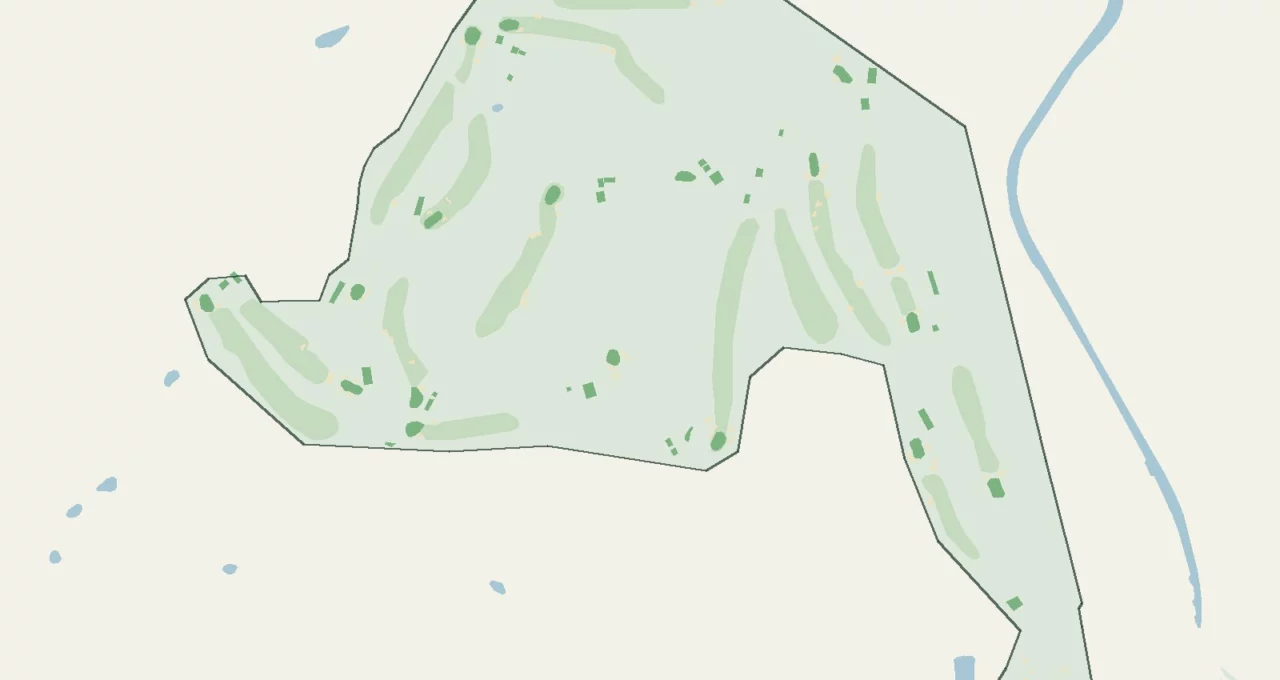
Layout of Manchester Golf Club from OpenStreetMap survey data (ODbL licence).
Manchester Golf Club
Holes
18 (club website; Colt layout open to members since 30 March 1912)
By
72 from the blue, white and yellow tees, 74 from the red tees (club hole pages, Golfshake)
Length
6,638 yards from the blue tees, 6,491 white, 6,246 yellow, 5,696 red, 4,349 gold (club hole pages); course rating and slope 72.6/133 white, 71.4/128 yellow, 74.3/134 red (Golfshake)
Green fee
—
Best season
Open all year; fairway mats compulsory from 1 November, no buggies for visitors from 1 October to 31 March, winter wheels on trolleys from 1 November to 31 March (club booking terms)
Manchester Golf Club is an 18-hole course at Hopwood, on the northern edge of Middleton in Greater Manchester, laid out by Harry Shapland Colt and open to members since 30 March 1912. The club itself is older: it was founded in October 1882 and played on two other sites in Manchester before it settled at Hopwood. The course covers about 247 acres of rolling ground that the club describes as predominantly moorland in character, with heathland and parkland features, and it plays to par 72 over 6,491 yards from the white tees, with a course rating of 72.6 and a slope of 133 according to Golfshake’s published card. It is a private members’ club that takes visitors and societies, and the club’s website is mangc.co.uk.
The club’s members and the golfers who write about it almost always call it simply Hopwood, after the estate it moved to, and the club itself uses the name freely. It has a long record as a championship venue: England Golf’s Reid Trophy and English Women’s Open Amateur Strokeplay Championship, the Northern Counties Championship and, according to the club, European Tour qualifying events. In July 2026 it staged the Women’s English Open on the Ladies European Tour Access Series, and in the same year it hosted the Lancashire Amateur Championship for the fourth time.
Name and location
The club’s website and its postal address use both Manchester Golf Club and The Manchester Golf Club; its booking terms are issued in the name of Manchester Golf Club Ltd, and Wikipedia and Wikidata (item Q30623266) use Manchester Golf Club. OpenStreetMap draws the course as a single area labelled Manchester Golf Course and links it to the same Wikidata item. The postal address is Hopwood Cottage, Rochdale Road, Middleton, M24 6QP.
We checked that the coordinates used on this page belong to the club described. The point at the foot of the page, 53.5768 N, 2.1888 W, is the centre of the area OpenStreetMap draws for the course, which stretches about three quarters of a mile from north to south and nearly a mile from east to west. The coordinates given by Wikidata and Wikipedia, 53.5728 N, 2.1791 W, lie inside the south-eastern corner of that area and match almost exactly the position of the club’s postcode, M24 6QP, which marks the clubhouse off Rochdale Road. The two points are a little under half a mile apart and describe the same ground: the course and the clubhouse at its entrance.
The address says Middleton, but the land falls within the Metropolitan Borough of Rochdale, in the Castleton ward, and OpenStreetMap’s address lookup places the middle of the course beside the M62 near Castleton. The motorway runs close to the northern part of the course; the club’s own wildlife guide notes that the 9th descends towards it, and that oystercatchers feeding on the 18th fairway fly off to nest on the roofs of the Stakehill industrial estate next door.
From Manley Park to Hopwood
The club’s history page and its English Women’s Open guide tell the story in some detail. In October 1882 eight founder members played their first round over a small nine-hole course at Manley Park, in the Whalley Range district of Manchester. They had no clubhouse and shared the land with a farmer’s cattle and sheep. Top 100 Golf Courses adds that the eight were Scots, and that golf had first been played in Manchester in 1818 on Kersal Moor.
The club was first called the Manchester St Andrews Golf Club. The club’s championship guide says the name reflected the founders’ strong connections with the home of golf; Wikipedia says it was chosen to distinguish the new club from a similarly named one. Both agree on what happened next: in 1883, when the older club was thought to have stopped playing, the words St Andrews were dropped. The history page says that the original club has since been known as the Old Manchester Golf Club.
Urban growth soon pushed the club out. In 1898 it moved to Trafford Park, on land leased from the Trafford Park Estates Company, which had bought the de Trafford family estate the year before. Trafford Hall became the clubhouse. Industrial development followed it there too, and with the lease due to end in 1912, the club announced in 1910 that it would move to Hopwood Park. The owner, Edward Robert Gregge Hopwood, agreed to lease the land for 35 years from Christmas Day 1912.
Harry Colt, whose other work the club lists as including Wentworth, Sunningdale, Muirfield, Royal Portrush and Royal Liverpool, laid out the new course on about 247 acres. It was ready for play by September 1911 but opened to members only on 30 March 1912. In 1925 the club bought the freehold for £10,000, which secured its home. The most radical change since, in the club’s words, was the extensive alteration of Hopwood Cottage, the clubhouse, in 1985. On the course, the club says that apart from relatively minor modifications the layout remains much as Colt designed it, lengthened from 6,145 yards to 6,491.
The most recent addition is off the course. In 2023, after what the club calls a three-year development project, it opened an academy with a driving range, indoor and grass bays fitted with Trackman, a short game area and a teaching studio, designed by what the club describes as a renowned Harry Colt specialist. Since April 2024 the course has also been playable as a virtual course on Trackman simulators.
Championships and players
The club lists Ryder Cup players Lee Westwood, Darren Clarke, Howard Clark and Mark James among those who have competed at Hopwood, and Casey Jarvis among the younger players: he won the Reid Trophy there in 2017. Among its own members, the club names county and international players, two of whom, Kelly Tidy and Rachel Connor, went on to play professionally.
In August 2023 Hopwood hosted England Golf’s English Women’s Open Amateur Strokeplay Championship, 72 holes for a field of 100 amateurs, decided after a four-hole play-off. The Lancashire Amateur, the men’s county championship played since 1910, returned in 2026. The club says it has staged the event on three previous occasions; Top 100 Golf Courses records that in 2011 only two players broke par in a round and nobody finished under par over four rounds.
The biggest event in the club’s recent history came from 8 to 10 July 2026, when it hosted the Women’s English Open, an England Golf event on the LET Access Series, the development tour of the Ladies European Tour, with a prize fund of €80,000. Thalia Martin of England equalled the course record with a nine-under-par 63 in the second round, and Tereza Zapletal Kozeluhova of Czechia won at 12 under par, one shot clear, for her first professional title. The LET Access Series did not say whose record Martin had equalled.
What it asks of you
The club publishes a hole-by-hole card with five sets of tees: blue, white, yellow, red and gold. The figures below are added up from the club’s own hole pages; the white, yellow and red totals match the card published by Golfshake, which also gives course ratings and slopes. We found no published rating for the blue or gold tees.
- Blue tees: 6,638 yards, par 72.
- White tees: 6,491 yards, par 72, course rating 72.6, slope 133.
- Yellow tees: 6,246 yards, par 72, course rating 71.4, slope 128.
- Red tees: 5,696 yards, par 74, course rating 74.3, slope 134.
- Gold tees: 4,349 yards, with their own pars and stroke indexes for men and for women.
From the whites the course goes out in 3,262 yards and par 37 and comes home in 3,229 yards and par 35. The club describes it as beautifully balanced, and the numbers bear that out: four par 5s, ten par 4s and four par 3s, with three of the four par 5s on the front nine. From the red tees the 12th and the 17th become par 5s, which gives the ladies’ par of 74.
The round starts from what the club calls an elevated first tee. The 1st is a short par 4 of 328 yards; the club’s course planner says club selection is vital off the tee because of a bunker on the left of the fairway, and that a drive carrying it leaves a short iron to an elevated green where distance control matters. The club’s wildlife guide adds that the hole rises gradually to the north and is bordered on the left by a fence protecting a peat bog of ecological importance. Then come two par 5s in a row: the 2nd at 495 yards from the whites and the 3rd at 516, both 538 from the blue tees. The 3rd is one of the very few blind holes on the course, according to the club, with a level opening stretch and a descent towards the green.
The 4th is the first of the par 3s, 195 yards from the whites and 210 from the blues, and the club counts it among the most striking holes on the course: Trub Brook crosses it, pines stand on the left and rhododendrons flower around it in early summer. The 5th is a short par 4 of 317 yards rising to an elevated green. The 6th, at 453 yards, is the hardest hole on the card by stroke index for both men and women; the club calls it the second blind hole and one of the longest par 4s on the course, with its tee beside Hopwood woods and an oak wood beyond the green. The short 7th climbs to an elevated green with gorse below it. The 8th, a par 3 of 157 yards, is played at the high point of the course, which the club says has views in every direction, and the 9th, a par 5 of 513 yards, descends with wide views towards the M62.
The back nine opens with a drive over a lily-covered pond on the left of the 10th tee. The 11th is a short par 4 with willows and bog on the left. The 12th, 427 yards and stroke index 4, runs between oak woods and ponds towards a bluebell wood beyond the green. The 13th is the shortest hole on the course, 152 yards and stroke index 18, played across the stream for a second time; it is also the hole reviewers single out most often. The 14th is a dog-leg par 5 of 476 yards from the whites and 511 from the blues, with the largest area of gorse on the course below the tee and a stream that, the club says, never freezes.
Reviewers on Top 100 Golf Courses, and the site’s own description, rate the closing stretch as the strongest part of the course, and the card explains why. The 15th is a par 4 of 430 yards and stroke index 2. The 16th is a long par 3 of 227 yards from both the white and the blue tees, with a sandy bank by the stream where sand martins nest. The 17th, at 444 yards, is the second-longest par 4 after the 6th, and the 18th is a par 4 of 385 yards from the whites, stretched to 417 from the blues.
Top 100 Golf Courses describes the layout as hilly and the wind as a constant factor, and stresses strategy and club selection. Reviewers on the same site point to the variety of holes, to fairway bunkers they consider well placed and to the scarcity of flat lies, which makes positioning important. Several mention the rough, and the club’s wildlife guide shows how much of the course is bordered by gorse, scrub, bog and woodland.
The setting is the course’s other selling point. Hopwood is home to roe deer, hares, foxes, kingfishers, barn owls and a long list of other species, documented hole by hole on the club’s website with photographs by a member who has catalogued the course’s wildlife for more than 40 years. The club asks golfers to watch from a distance and stresses that there is no public right of way across the course.
What golfers say
Manchester Golf Club has a solid body of public opinion. We read the Golfshake page, which gives an average of 4.5 out of 5 from 82 ratings, with 98 per cent of reviewers saying they would play again; the Top 100 Golf Courses page, with 17 ratings averaging 4.5 and written reviews from 2022 to 2026; search summaries of the Golf Monthly review, whose full text we could not load; summaries of a 2017 discussion on the Golf Club Atlas forum, which refused our requests; and the visitor comments the club publishes on its testimonials page. The points below summarise what recurs. They are other people’s opinions, not ours; nobody from Panxis has played the course, and we name and quote no one.
What comes up in its favour
- The land: reviewers like the scale of the site, the rolling ground, the mix of moorland, heathland and parkland and the views, including towards the city, from a course that feels rural despite being close to Manchester.
- The design: the layout is described as varied and well thought out, with each hole feeling different, and the par 3s are praised as a set, the 13th and the 16th most of all, along with the 2nd, 3rd, 4th and 12th.
- The finish: the last four holes are repeatedly called the strongest part of the round.
- Condition: the course is generally described as well presented, with good greens; several reviewers call them fast.
- The wildlife, especially the deer seen between the fairways.
- Practice facilities and welcome: the range and short game areas, the professional’s shop, the clubhouse food and friendly staff all come in for praise.
What comes up against
- The walk: several reviewers warn that it is long and hilly, and the club itself restricts buggies for visitors in winter.
- The rough: it is the most frequent complaint, described by some as penal and blamed for lost balls, especially beside tighter holes.
- Value for money is the lowest of Golfshake’s category scores, and pace of play the second lowest; one visitor comment published by the club calls the course not cheap but worth playing.
- The M62 can be heard from parts of the course, although reviewers who mention it say it fades once the round is under way.
- Not everyone is convinced: one Top 100 reviewer found the greens true but neither especially fast nor undulating and expected a stiffer test on a calm morning, and one contributor to the 2017 forum discussion said he had never warmed to the course despite its reputation.
The weight of opinion is clearly positive, but individual experiences vary with the season, the weather and the state of the rough on the day.
Facilities and how to play it
The club says it welcomes visitors and guests. Visitors book online through the club’s visitor booking page, run on the BRS system, with full payment at the time of booking; societies and company days are arranged through the office. The booking terms ask visitors to hold a handicap and to be ready to show proof of it. They also allow a booking to be passed to another player who meets the same conditions.
Practice is a strong point. The academy opened in 2023 has a driving range with covered and grass bays and Trackman Range technology, a short game area and a teaching studio, and the club also has two chipping greens with bunkers at its entrance, a practice ground called The Hill for members, and a putting green that runs the full width of the clubhouse beside the outdoor decking. The range is open to members and to golfers who have paid a green fee or are taking a lesson, not to the general public. The professional’s operation, the House of Golf, runs a shop, a fitting studio, a putting lab and a workshop beside the first tee.
The club has electric buggies, electric trolleys and pull trolleys for hire, to be booked well in advance through golf reception. Its booking terms state that buggies are not available to visitors from 1 October to 31 March, that trolleys must have winter wheels from 1 November to 31 March, and that the course manager decides each day whether buggies and trolleys may go out. Fairway mats are compulsory on all holes from 1 November.
The dress code is traditional. On the course: no denim, no shirts without collars or sleeves, no tracksuits and no training shoes; tailored shorts are allowed for men, and the booking terms add that shirts must be tucked in and socks of an appropriate length worn with shorts. In the clubhouse, smart casual dress is acceptable, waterproofs come off, hats are removed and golf shoes are not allowed in the carpeted lounges or the room the club calls the chapel, although soft spikes are accepted in the 19th. Vaping is banned throughout the clubhouse. Visitors sign the visitors’ book and display a temporary membership tag on their bag.
Getting there and when to go
The club is at Hopwood Cottage, Rochdale Road, Middleton, M24 6QP. Directories place it close to junction 20 of the M62: from the motorway, the A627(M) towards Oldham and then the A664 Rochdale Road towards Middleton lead to the club entrance, just past a railway bridge. The club gives its general office number as 0161 643 3202 and the professional’s shop as 0161 655 3668. Its course status page carries weather forecasts for the site.
The course is open all year, but the season changes how it plays. Winter brings fairway mats, no buggies for visitors and winter wheels on trolleys; spring brings the rhododendrons on the 4th and the bluebell wood behind the 12th green. On an exposed, rolling site, wind is part of the test at any time.
How this page was made
The factual frame comes from public sources: OpenStreetMap for the location, outline and name of the course; Wikidata and the postcode database for the coordinates we compared; the club’s website for its description, history, championship record, course planner, hole-by-hole pars, yardages and stroke indexes, wildlife guide, practice facilities, professional, buggy hire, dress code, booking terms and contact details; Golfshake for course ratings and slopes and for review scores; Wikipedia for the club’s early names; Top 100 Golf Courses for the club’s early history, the 2011 Lancashire Amateur and reviews; the LET Access Series for the 2026 Women’s English Open; and Golf Monthly, Golf Club Atlas and directory listings, read through search summaries, for opinions and directions.
Where sources disagree, we say so. The club gives the length of its first course at Manley Park as 1,856 yards on its history page and 1,826 yards on its championship guide. It explains the original St Andrews name by its founders’ links with the home of golf, where Wikipedia says the name distinguished the club from another of similar name. The club gives the site as 247 acres, Top 100 Golf Courses as 248. The blue tees add up to 6,638 yards on the club’s hole pages, where Top 100 Golf Courses gives 6,650 and other directories up to 6,670. On the 5th, the club’s hole page gives the yellow tee as 312 yards in its table and 317 in its summary; we use the table. The club describes its range as 350 yards on one page and as having a 300-yard-plus landing area on another. For the 2026 Women’s English Open the club spoke of more than 100 players, the LET Access Series of 132.
The Golf Monthly review and the Golf Club Atlas thread refused our requests or did not load, and 1golf refused our requests too, so what we say of them comes from search summaries and we have relied on none of them for a figure. We found no course rating or slope for the blue or gold tees, no detail of the changes made to Colt’s layout since 1912, and no record of who set the course record that was equalled in 2026. Green fee amounts and other prices are deliberately left out.
The opinion section summarises reviews and descriptions read in October 2026. We report recurring themes rather than individual voices, and we reproduce no quotations from reviewers. Nobody from Panxis has played or visited this course, and this page is no substitute for a round.
The club has not paid for this page, has not seen it before publication and has no say over its content. This page contains no commercial link and earns us no commission. If you know the course and something here is wrong or out of date, write to us and we will correct it.
Other courses nearby
Closest to this one in our British directory:
- Chorlton-cum-Hardy Golf Club — 11 mi
- Huddersfield Golf Club — 17 mi
- Longridge Golf Club — 24 mi
- Huyton & Prescot Golf Club — 28 mi
The hole to know
The shortest hole on the course, a par 3 of 152 yards from the white and blue tees and stroke index 18, played across the stream for the second time in the round; the hole reviewers single out most often.