Short putts from parkland to links: the routine that holds
The putt from five feet decides more medal rounds than any drive. A fixed five-step routine, a target smaller than the hole, and three drills that create pressure on purpose.
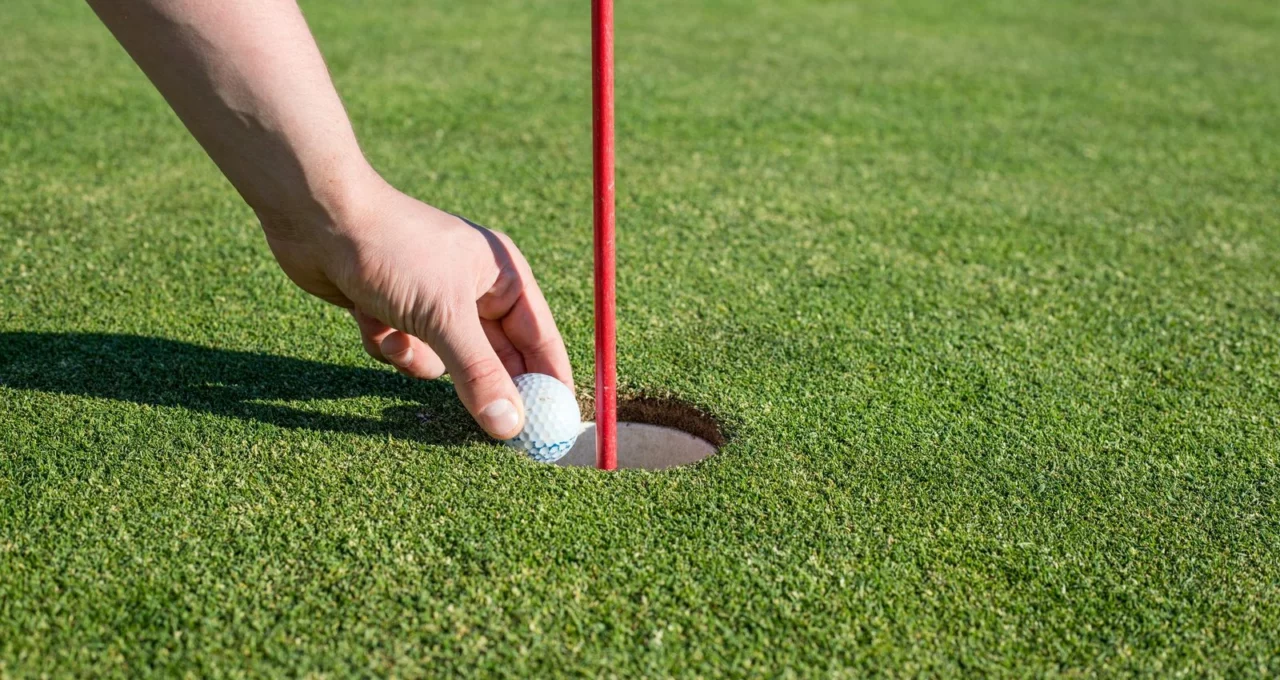
In brief
- Tour players hole about 77 per cent from five feet. Nobody holes everything.
- Inside six feet a scratch golfer holes 93 per cent, a twenty handicapper 70 per cent.
- Aim at a mark a foot ahead of the ball rather than at the hole.
- Short backswing, accelerating through: deceleration twists the face.
The putt from five feet is the most honest shot in golf. Nothing about it is physically hard: no distance to cover, no bunker to carry, no clubhead speed to find. And yet it is the shot that decides whether a good card survives the back nine, because it is the only one you hit while knowing exactly what a miss costs.
Most club golfers treat it as a formality and then wonder where three shots a round went. The players who hole them are not braver. They have a routine, they use the same one on the first green and the eighteenth, and they stop making decisions once it starts.
The distance where cards are actually lost
Begin with the numbers, because they are not what television suggests. Tour players hole around 77 per cent of putts from exactly five feet, which means the best putters in the world miss roughly one in four. From eight feet they hole about half. Nobody at any level is expected to hole everything.
The amateur picture comes from Shot Scope, which records real rounds rather than practice greens. Inside six feet, a scratch golfer holes about 93 per cent, a ten handicapper about 85 per cent and a twenty handicapper about 70 per cent. That gap of more than twenty points, on the shortest putts on the course, is where handicap levels separate. It is not driving distance and it is not iron play.
Why the short one is harder than it looks
The five-footer is difficult for reasons that have nothing to do with technique.
It carries visible consequence. A missed drive can be recovered. A missed five-footer is a shot, immediately, in front of three people who are watching because there is nothing else to look at.
And it is the shot you take least seriously on the practice green and most seriously on the course. That mismatch is the whole problem: you rehearse it relaxed and perform it tense, and a stroke that only works when relaxed is not a stroke you own. It usually arrives at the end of a hole that has already gone wrong, which is why irritation is the real opponent.
A routine is a fixed number of things, in a fixed order
A routine is not a superstition and it is not a mood. It is a checklist you perform identically whether the putt is meaningless or the one that saves your medal round. That identical quality is the point: it gives the tense version of you the same inputs the relaxed version had.
Build it from five steps and never change the order.
One, read it from behind the ball, crouched, looking at the low side of the hole. Give it eight seconds, not thirty. A five-footer has one borrow or none, and staring longer produces doubt rather than information.
Two, name your target. Left edge, right lip, middle. Say which one to yourself. A putt struck without a stated target is a putt struck in hope.
Three, take one practice stroke beside the ball, looking at the hole. One, not three. You are feeling the length of the stroke, not rehearsing a method.
Four, set the face first and the feet second. Almost every club golfer does this the other way round, builds a stance and then aims the face inside it, which is how a putt gets pushed before it starts.
Five, one look at the hole, eyes back to the ball, and go. No second look. The second look is where the stroke dies.
The whole thing takes about fifteen seconds. Time it once at home, then never think about the clock again.
Pick a target smaller than the hole
The hole is four and a quarter inches across, which is generous from five feet and generous enough to be a vague target. Vague targets produce vague strokes.
Aim at something specific instead: a single blade of grass on your line, a discoloured patch, an old pitch mark healed over. Pick it about a foot in front of the ball rather than at the hole. Rolling the ball over a mark twelve inches away is a task your eyes can verify, and it is far easier than aiming at a cup you cannot look at while you putt. For most golfers this is the single change that turns short putts round, and it needs no practice at all.
Short back, accelerating through
The mechanical fault is almost always the same one. The backswing gets too long, the golfer senses it is too long, and the hands decelerate to compensate. A decelerating putter face twists, and a twisted face from five feet misses.
Make the backswing deliberately shorter than feels adequate and let the forward stroke be longer than the backswing. A putt struck with an accelerating face holds its line through the last two feet, which is exactly where a slowing ball is most affected by every imperfection in the green.
Firmness buys something else too, and it matters more here than in most countries. On a windy afternoon on a links, a dying putt is at the mercy of the breeze; a ball rolling at pace also takes less borrow and is less bothered by footprints and afternoon growth. On a green that has had fifty pairs of shoes across it since dawn, the firm putt is the one that survives the last twelve inches.
Inside four feet, take the borrow out
From four feet on a normal green, borrow is a decision you can usually avoid. Strike it firmly enough to remove most of it and aim inside the edge rather than outside it.
The argument goes beyond simplicity. A putt aimed at the edge and struck slightly hard misses. A putt aimed at the middle and struck slightly hard usually still catches the cup. You are buying a margin for the error you are most likely to make.
The exception is a fast downhill five-footer, which you cannot bully, and on a seaside green in August that is a real shot. That one takes the borrow and wants the pace of a putt finishing a foot past. Recognise it as a different shot rather than applying the same recipe.
Practice that creates pressure on purpose
Ten minutes of aimless short putts teaches you nothing you will use, because the thing you are training is not the stroke. It is the stroke under consequence.
The gate. Two tees just wider than the ball, a foot ahead of it, on your start line. Putt through from four feet. Catching a tee means the face was open or closed at impact, which is invisible to you and enormous over five feet. This one diagnoses rather than trains, and it is worth two minutes before every session.
Ten in a row. Five feet, same hole, count restarts at zero on a miss. The tenth putt of a good run feels like a putt on the eighteenth green, which is precisely why it works. Do not leave until the set is finished, and notice what your hands do at seven.
The circle. Six balls in a ring at three feet, then a second ring at five. Hole all six before moving out. The circle forces a fresh read every time rather than grooving one repeated stroke, which is what actually happens on a golf course.
Twelve minutes of this, twice a week, changes a card faster than an hour on the range hitting from 150 yards.
The gimme is costing you
In a friendly fourball, most golfers pick up inside three feet. It speeds the round up and it is part of the social contract of a Sunday morning. It also means that in your first competition you will face a genuine three-footer having not holed one in months. Players who come apart in their first medal are rarely nervous about the swing. They are nervous about the two-footers nobody has made them hole since spring.
The remedy is free. Hole out everything for one round a month and submit the card as a general play score. Knowing it is a different game before it counts is worth several shots.
Two rules worth knowing here
You may repair damage on your line, including spike marks and shoe damage, which has been allowed since 2019. You may not repair aeration holes or natural wear. If your five-footer runs over a scuffed patch left by the group in front, fix it.
You may not stand on an extension of the line behind your ball while making the stroke, and nobody may stand behind you to line you up once you have begun taking your stance. The rest of the rules club golfers get wrong matter less than these two.
Where to work on this in Britain
The putting green at the club you are about to play is the whole answer, and it is included in your green fee at essentially every course in the country. Arriving ten minutes earlier is the entire cost, and it gives you today’s green speed, which is the only speed your hands need to know.
Members have the better deal here: most clubs allow use of the putting green without booking a tee time, which makes twelve minutes on the way home from work a realistic habit rather than an intention. Visitors and pay-and-play golfers should simply ask in the pro shop. Nobody has ever been refused rudely for asking.
Green speeds vary more here than golfers assume. A parkland green in February and the same green in July are different surfaces, and a links green in a dry August is a third one. That is an argument against trusting a read you formed in April.
At home, a putting mat is genuinely useful at exactly this distance, unlike for long putts, where a mat runs at one speed and a golf course does not. Five feet on a mat trains start line and stroke length, and both transfer. Mats are stocked by American Golf and by most club professionals.
If the gate drill says the face is not square, that is a face angle problem rather than a nerve problem, and it is the one short-putt fault worth a lesson. A PGA professional at your own club can identify it in twenty minutes, and indoor studios with putting analysis are now common at larger clubs and county centres. Panxis Golf has no commercial relationship with any retailer, coach or facility named here.
Five things to try in your next round
- Count the putts you missed from inside six feet. That number, not your total putts, tells you where the shots went.
- Use the same five-step routine on every putt inside ten feet, including the ones that do not matter.
- Pick a mark a foot ahead of the ball and roll it over that, rather than aiming at the hole.
- Make the backswing shorter than feels right and accelerate through.
- Hole out everything for one round this month, and see what the number really is.
None of this requires talent, equipment or a coach. It requires arriving ten minutes early and doing the same five things every time, which is the least glamorous improvement available in golf and comfortably the cheapest.
Figures come from tour ShotLink data as published in golf media, and from Shot Scope, which records amateur rounds rather than practice sessions. Rules references are to the Rules of Golf as they stand in 2026.