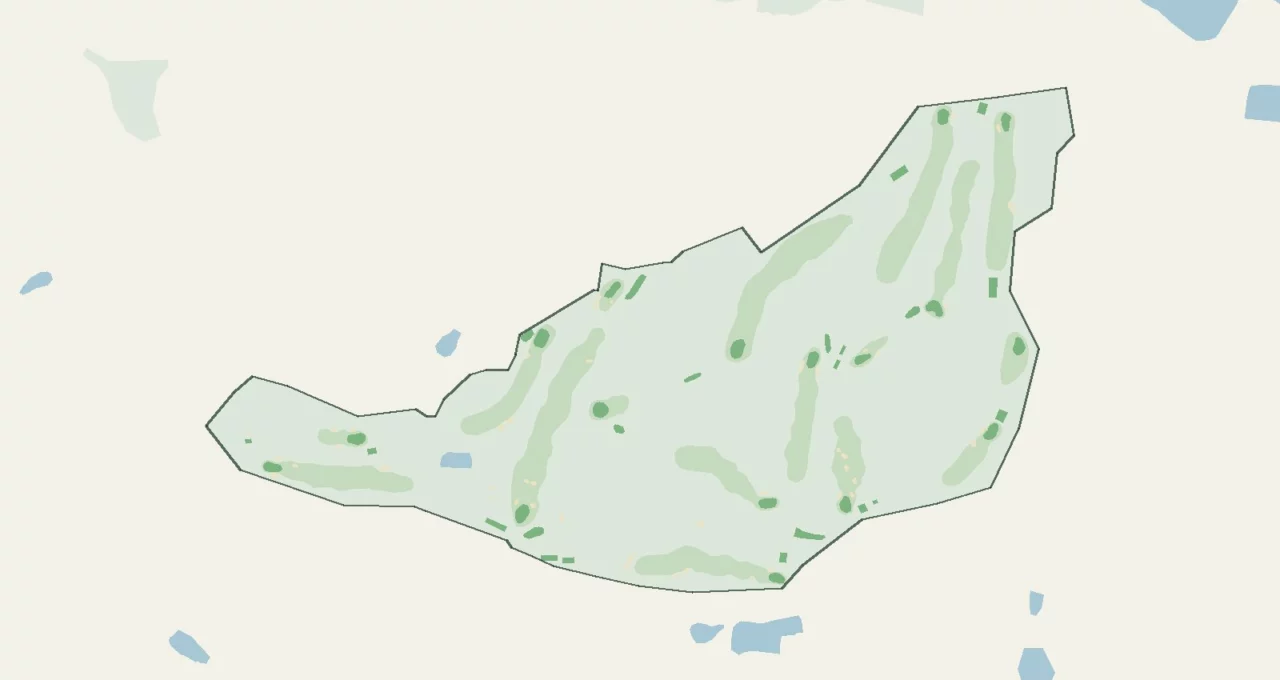
Layout of Newbury & Crookham Golf Club from OpenStreetMap survey data (ODbL licence).
Newbury & Crookham Golf Club
Holes
18
By
69 (men); 71 (women)
Length
5,902 yards from the black tees, 5,710 purple, 5,253 silver (club scorecard); club pages say just under 6,000 yards
Green fee
—
Best season
Year-round (club); preferred lies in operation from 1 October 2026 (club course status)
Newbury & Crookham Golf Club is a private members’ club on Bury’s Bank Road, on the southern edge of Newbury in West Berkshire, postcode RG19 8BZ. The club places itself on the south side of the town, between Greenham Common and Newbury Racecourse, and says it is just a mile from the centre of Newbury; Wikipedia, which locates it at Greenham on the fringes of the common, puts it about two miles from the centre. The course is an eighteen-hole layout of par 69 for men and par 71 for women. On the club’s current scorecard it measures 5,902 yards from the black tees, with a course rating of 69.3 and a slope of 130, and the club’s own pages describe it more loosely as just under 6,000 yards.
The club gives 1873 as its founding year and calls itself one of the oldest clubs in England. That date belongs to the Crookham club, which played on a different piece of ground; the course in use today dates from 1923. The club describes the land as undulating heath and parkland set among mature woodland, a patchwork of plateaus, ridges and gullies, with views north across Berkshire, south into Hampshire and down into the Kennet Valley, where the racecourse lies below. On the day we checked in October 2026, the club’s course status page read that preferred lies had been in operation since 1 October.
Two clubs, one course
The club’s history describes two distinct origins. The older is Crookham. According to the club, The Field reported in July 1873 that a golf links had been started at Crookham, near Thatcham railway station; Wikipedia, citing the club historian Brian Bowness, gives an earlier first mention, a call for members in the Berkshire Chronicle on 3 May 1873. Both accounts name the same two founders: Captain Robert Dashwood Fowler, a naval officer who had learned his golf at Westward Ho!, and the Rev John Scott Ramsay, who had studied and played at St Andrews. Wikipedia places the Crookham course on Crookham Common, on the north side of the road from Newbury through Crookham, with a local inn, the Traveller’s Friend, serving as clubhouse.
The club says a St Andrews professional, T Manzie, was hired within a year of the founding but proved too expensive and soon left for Blackheath. Its history also tells the story of two of the oldest trophies in English golf. The Open Cup, which drew the best players of the day, was won three times by Horace Hutchinson and so became his outright; he later gave it back. The Challenge Cup went to Westward Ho! when interest waned in the 1880s, and was returned in the same spirit. Wikipedia names them today as the Newbury & Crookham Medal and the Newbury & Crookham Bogey, and dates Hutchinson’s three wins to the spring, autumn and spring of 1878 and 1879. Wikipedia also preserves Hutchinson’s description of a Crookham hole called The Avenue, a short hole played over a line of tall lime trees, which it says are still visible on Greenham Common.
The younger club is the one whose course survives. The club says the Newbury and District club was founded in 1923 on a course designed by James Sherlock and John H Turner, laid out to use the hollows and rifts in the ground, and opened with an exhibition match between the two designers, James Braid and Ted Ray. Wikipedia agrees on the year and the two names, but adds, from Bowness, that Turner’s contribution was by far the greater. Top 100 Golf Courses credits the layout to J.H. Turner alone, whom it describes as the professional at Frilford Heath, and adds that later modifications have been credited to the Howard Swan design company. The club’s own pages do not mention Swan, and we found nothing that dates that work.
The two clubs then lived side by side. The club’s history says that the Crookham club, revived for a time by the Rev Herbert Skrine and then based at The Volunteer Inn, was slow to recover after the First World War. In 1940, it says, Greenham Common was requisitioned and the Crookham course was lost for good; its members were taken in by their neighbours, the arrangement became permanent and the club took the name Newbury and Crookham. Wikipedia dates the amalgamation of the two clubs to 1946. Top 100 Golf Courses adds that during the Second World War only seven holes stayed in play, with sheep grazing part of the course and aircraft taxiways built across what are now the 1st, 14th and 15th fairways. The club says the clubhouse occupies the former laundry and stables of Greenham Lodge, on land first leased from the Baxendale family and bought by the club in 1952.
Two names run through the club’s account of the twentieth century. Jack Hughes arrived as a fifteen-year-old assistant in 1923, became club professional in 1931 and held the post until he retired in 1977. Frank Barton was head greenkeeper from 1946 to 1986. The club also lists the players who have visited over the years, among them J.H. Taylor, James Braid, Ted Ray, Max Faulkner and Bobby Locke. Much of this history comes from a book by the late member Brian Bowness, The Golf Courses of Newbury and Crookham, which Wikipedia dates to 1996 in a limited edition.
What the course asks of you
A par of 69 under 6,000 yards tells you the shape of the card before you see the ground. On the club’s scorecard, the black tees give 2,789 yards out and 3,113 back; the purple tees 5,710 yards, rated 68.3 with a slope of 122; and the silver tees 5,253 yards, rated 66.1 with a slope of 113. For women, the same three sets of tees carry a par of 71, because the 7th and 8th become par 5s, with ratings of 75.1, 74.1 and 71.2 and slopes of 143, 139 and 127. There are five par 3s, three of them on the front nine, and only two par 5s, both on the back nine. The front nine is a par 33 for men; the back nine, with its two long holes, is a par 36.
The club’s case is the greens. It says the course has always been known for them, and that investment in an irrigation system, new bunkers and a new fleet of machinery keeps the surfaces in condition all year. The hole-by-hole notes below come from the club’s course guide unless we say otherwise; yardages are from the black tees on the current card.
The 1st, a par 4 of 400 yards, is what the club calls a kind start, with a wide fairway and a carry of 150 yards to clear three cross bunkers. The left side of the fairway leaves the better angle to a small, flat green with a bunker at the front left and trouble through the back. The 2nd, 290 yards, is the first of the short par 4s that the club’s history praises as risk and reward holes: a long hitter can try to reach the green, which slopes hard from front to back, while a mid iron and a pitch is the safe route. The club’s warning is that a birdie and a double bogey are both on the table.
The 3rd, 160 yards, is the club’s favourite short hole, played from a raised tee down to a large green, with a giant oak guarding the front right, a difficult chip up a bank if you are short and out of bounds if you are long. The club suggests one more club when in doubt, and mentions bluebells in spring. The 4th, 395 yards, has an elevated competition tee and a narrow corridor of trees to drive through, then a narrow two-tier green. The 5th, 352 yards, climbs gently all the way, with a ridge across the fairway that longer hitters must carry or lay up short of, and a green in three parts with raised sections at the back left and back right.
The 6th is the shortest hole on the course, 125 yards, but the club warns that the green is very narrow at the front, widens towards the back and is defended by large bunkers short. The 7th, 462 yards, is the longest par 4: a straight drive between a ditch on the right and a large oak on the left, then either a lay-up short of an open stream that crosses the fairway or a long approach with woods on one side and the stream on the other.
The club rates the 8th, 426 yards and stroke index 2 for men, as the best hole on the course and one of the best in England. Out of bounds runs down the right and trees and long grass down the left; the drive is aimed left, where a bank feeds the ball back to the middle, and the hole then doglegs left, over a ditch and up the hill to the green. Many players lay up and pitch; longer hitters stay short of the ditch and come in with a mid or long iron. The 9th, 179 yards, is played from a slightly raised tee over rough and a ditch to a green with a bank in front that stops the ball running on.
The back nine opens with the 10th, 336 yards, where a drive past the trees opens the hole out and leaves a short iron. The 11th, 356 yards, is the hogsback: a fairway on a ridge where a ball missing left can run into the trees, and one missing right faces a shot over bunkers. The 12th, 292 yards, is the third short par 4 and, in the club’s words, a very good driving hole, where the side to drive to depends on where the flag is. The 13th, 493 yards, is the first par 5, with one fairway bunker on the left from the tee, a gully to carry with the second, a large oak that can block a crooked approach and a long, narrow green.
The 14th, 406 yards, is stroke index 1 for both men and women: a dogleg left that favours a draw, usually played in a left-to-right crosswind that pushes drives towards trees and a bunker on the right. The 15th, 183 yards, is the longest par 3, with deep bunkers on both sides short of the green and a bank on the right; the club’s advice is to play for the front. The 16th, 376 yards, doglegs left again; bunkers wait at about 230 yards for a straight driver, so a fairway wood or iron to the corner is the safer play, and a holly bush to the right of the green has, says the club, swallowed many balls. The 17th, 165 yards, is played over a road and then bunkers to a green with no real bail-out, and the 18th, the second par 5 at 506 yards, needs a drive kept away from a road and trees, a lay-up short of cross bunkers and clear of heather on the left, and a wedge to a long green.
What golfers say
The themes below come from two places: the user reviews on Top 100 Golf Courses, published between 2011 and 2021, and the user reviews on Golfshake, the most recent of which date from 2026. We have also read the society testimonials that the club publishes on its own site, which are naturally favourable. These are other people’s opinions, not ours. Nobody from Panxis has played the course, and we name no reviewer.
What comes up in its favour
- The greens. This is the most consistent theme on both sites: reviewers describe them as fast and true, with sharp slopes that make downhill putts frightening, and some greens small enough to be a target in themselves.
- Condition. Several reviewers say the course was in fine shape when they played, including in autumn and in the off-season, and the society testimonials on the club’s site make the same point.
- Variety. Reviewers describe uphill and downhill holes, doglegs, carries over gullies and a mix of short and long par 4s, so that a short course does not feel repetitive.
- The short holes. The par 3s are widely praised, with the 3rd most often singled out; the 9th and 17th are also named.
- Particular holes. The 7th and 8th are described as long, demanding par 4s, the 8th as a hole where par feels like a birdie, and the 16th draws praise from one regular visitor.
- Course management. Reviewers note that many par 4s can be played without a driver, which makes the round a matter of placement rather than length.
- The welcome. Friendly staff and members, a pleasant clubhouse and the views come up regularly, and one reviewer adds sightings of red kites and deer.
What comes up against
- Its standing in the county. Several reviewers on Top 100 Golf Courses say that while it is good and worth playing, it does not belong in the same company as the best heathland courses in Berkshire, and two describe it as no better than average.
- The finish. One reviewer felt the course faded over the last few holes and that the greens on the back nine were not as good as those on the front; another did not find the 18th a classic closing hole, with a blind approach for most players.
- Wet ground. Reviewers on both sites mention drainage problems after heavy rain, particularly on the lower holes and in early spring, and note that the course plays longer when wet.
- Crowded tees. One reviewer found that some tees sit close together, so that players drive across one another.
- Practice facilities, which Golfshake reviewers rate lower than anything else about the club.
Getting there and when to go
The club is on Bury’s Bank Road on the south side of Newbury, between the town and Greenham Common. The nearest railway station is Newbury Racecourse, about a mile away in a straight line by our measurement on the map, and Newbury station is about a mile and a half away; both are further by road. The club says it has ample car parking.
Visitors are welcome. The club takes tee time bookings online through its visitor booking page and through a tee time booking service, and by telephone on 01635 40035. Its fee table separates weekday play from Monday to Thursday from play on Fridays, weekends and bank holidays, when visitor rounds are listed from 1 pm, and it offers twilight golf from 4 pm, subject to availability. County card holders can book a limited number of weekday tee times up to four days in advance. The club asks visitors to call ahead if they need a buggy, says it restricts the number of buggies on the course and allows privately owned buggies only with the General Manager’s permission in advance. Trolleys and buggies must be kept away from the greens, particularly between greenside bunkers and the green. The club publishes a dress code for the course and the clubhouse.
Societies and corporate days are taken from Monday to Thursday, excluding bank holidays, for groups from 12 to 105 golfers, with packages of 18, 27 or 36 holes and catering from breakfast to dinner. The professional’s shop is open seven days a week, and the club has an indoor swing studio with a launch monitor, used for lessons, club fitting and a simulator; we found no mention of a driving range on the club’s site. The clubhouse is open from 7 am all year, closing at 10.30 pm in summer and 6 pm in winter, though the club says those hours can vary.
The course is open all year, and the club stresses that it is kept in condition through the seasons. The reviews suggest that the lower holes are the ones to watch after heavy rain or in early spring, while the club’s own suggestion for colour is spring, when the bluebells are out beside the 3rd.
Green fees
Visitor rates vary by day and time and are published by the club on its visitor information page, which also carries the dress code and the link to book a tee time.
How this page was made
The factual frame comes from public sources: OpenStreetMap for the location, the address and the station positions; the club’s website, read in October 2026, for the founding date, the history of the two clubs, the designers and the opening match, the clubhouse and its hours, the course status, the hole-by-hole guide, the scorecard, the course and slope ratings in the handicap table dated 2025, the visitor, buggy and society arrangements, the professional’s shop and the swing studio; the English Wikipedia article on the club, which draws on Brian Bowness’s history, for the location at Greenham, the 1946 amalgamation, the Berkshire Chronicle notice, the Crookham course and its trophies; Top 100 Golf Courses for its course description, its county ranking and its user reviews; Golfshake for its user reviews; Wikidata for the identifiers. The distances from the stations are our own measurement.
Where sources disagree, we say so. The club dates the loss of the Crookham course and the change of name to 1940, while Wikipedia dates the amalgamation of the two clubs to 1946. The club credits the 1923 course to James Sherlock and John H Turner jointly; Wikipedia says Turner did most of the design, and Top 100 Golf Courses names Turner alone and mentions later work by Howard Swan, which the club does not. The club dates the first press report on Crookham to The Field in July 1873, Wikipedia to the Berkshire Chronicle of 3 May 1873. The club puts itself a mile from the centre of Newbury, Wikipedia about two miles. The club’s pages say just under 6,000 yards; the scorecard gives 5,902 from the black tees, and Golfshake lists 5,961 yards overall. In the club’s course guide, the 11th is 335 yards from the silver tees in the quick figures and 355 in the tee table, against 335 on the card; the 18th is women’s stroke index 15 in the quick figures and 11 in the tee table and on the card; Top 100 Golf Courses gives the 17th as 170 yards against 165 on the card. Top 100 Golf Courses ranks the course 11th in Berkshire.
The opinion section summarises user reviews on Top 100 Golf Courses and on Golfshake, read in October 2026, and takes account of the testimonials the club publishes. We report recurring themes rather than individual voices, and we reproduce no quotations from reviewers. Nobody from Panxis has played or visited this course, and this page is no substitute for a round.
The club has not paid for this page, has not seen it before publication and has no say over its content. This page contains no commercial link and earns us no commission. If you know the club and something here is wrong or out of date, write to us and we will correct it.
Other courses nearby
Closest to this one in our British directory:
- Sandford Springs Golf Club — 5 mi
- The West Berkshire Golf Club — 9 mi
- Goring and Streatley Golf Club — 11 mi
- Calcot Park Golf Club — 12 mi
The hole to know
Par 4 of 426 yards from the black tees, stroke index 2 for men: out of bounds right, trees left, a drive to the left side where a bank feeds the ball back, then a dogleg left over a ditch and up the hill. The club calls it its best hole.